Biomimetic Self-Assembly: From Fundamental Mechanisms to Advanced Applications in Drug Delivery and Biomedical Engineering
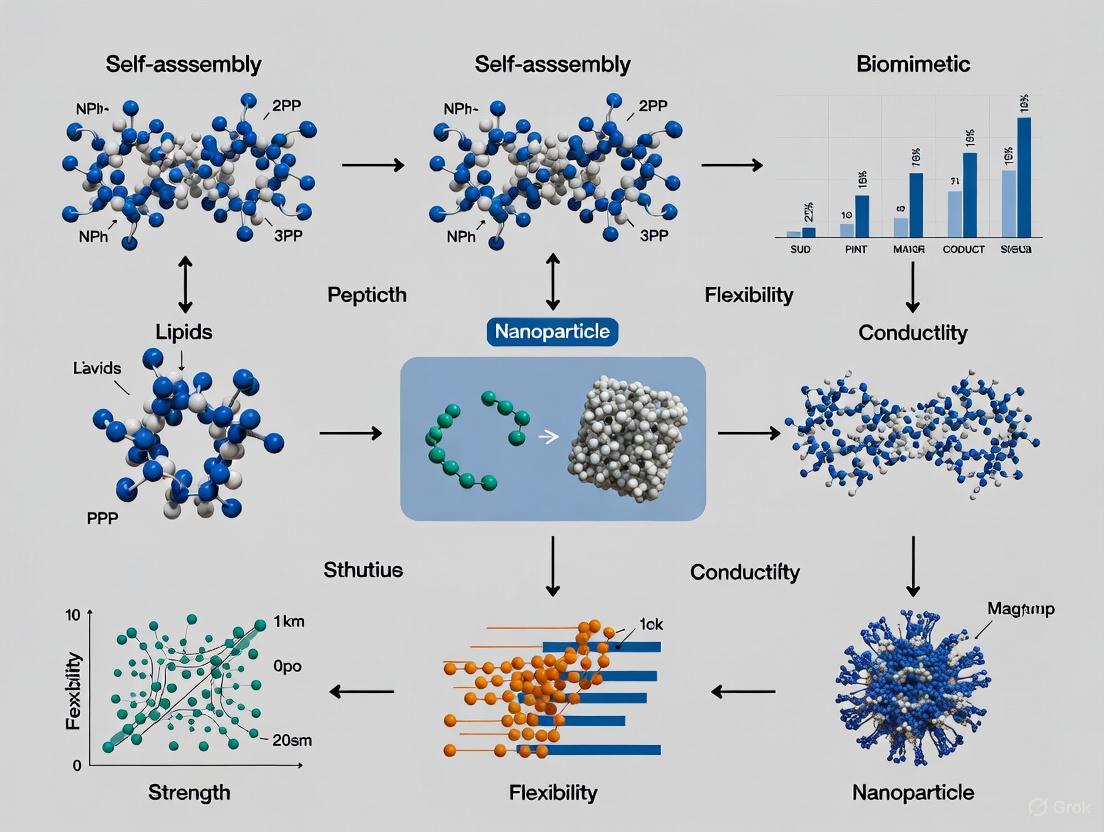
This article provides a comprehensive analysis of the self-assembly properties of biomimetic materials, exploring the fundamental mechanisms inspired by natural processes and their transformative applications in biomedicine.
Biomimetic Self-Assembly: From Fundamental Mechanisms to Advanced Applications in Drug Delivery and Biomedical Engineering
Abstract
This article provides a comprehensive analysis of the self-assembly properties of biomimetic materials, exploring the fundamental mechanisms inspired by natural processes and their transformative applications in biomedicine. Tailored for researchers, scientists, and drug development professionals, it systematically covers foundational principles, advanced methodological approaches for drug delivery systems, troubleshooting of common challenges, and rigorous validation techniques. By synthesizing the latest research, this review serves as a strategic guide for leveraging biomimetic self-assembly to develop next-generation therapeutic platforms, intelligent precision assembly modes, and multifunctional biomedical coatings with enhanced efficacy and biocompatibility.
Nature's Blueprint: Fundamental Principles and Mechanisms of Biomimetic Self-Assembly
Biomimetic self-assembly represents a paradigm shift in materials science, leveraging nature's evolutionary-optimized principles to create complex, functional structures from elementary building blocks. This technical guide delves into the core mechanisms, design principles, and experimental methodologies underpinning biomimetic self-assembling systems. By examining natural prototypes—from viral capsids to cellular matrices—we extract fundamental rules governing bottom-up organization and apply these principles to engineer advanced materials with tailored properties. Framed within broader research on self-assembly properties of biomimetic materials, this review provides researchers and drug development professionals with quantitative frameworks, standardized protocols, and visualization tools to advance this transformative interdisciplinary field.
Fundamental Principles and Biological Inspiration
Biomimetic self-assembly is defined as the autonomous organization of components into patterned structures or functional systems without external intervention, inspired by biological processes [1]. This approach stands in stark contrast to traditional top-down manufacturing, instead leveraging nature's bottom-up strategies where entropy and thermodynamic driving forces guide organization [1]. Biological systems demonstrate remarkable self-assembling capabilities, from the precise folding of proteins into three-dimensional functional structures to the complex formation of viral capsids from protein subunits [1]. These natural processes share common elements: structured particles, specific binding forces, controlled environmental conditions, and entropy-driven forces that collectively enable spontaneous organization into complex architectures.
The fundamental distinction between self-assembly and related processes lies in their pathways and constraints. Self-assembly typically occurs through parallel processes where multiple components spontaneously organize simultaneously, while self-folding represents a constrained form of self-assembly where bending and binding occur at specific points within building blocks, often through serial processes [1]. In practice, hybrid processes frequently emerge, such as template-assisted self-assembly where components are tethered to templates that restrict their interaction possibilities, combining aspects of both self-assembly and self-folding [1]. This is exemplified in RNA-tethered viral capsomeres, where the template introduces serial aspects into the parallel assembly process [1].
Natural systems provide exquisite models for biomimetic design. The self-assembly of viral capsids demonstrates how identical protein subunits can efficiently form highly symmetric, stable containers for genetic material [1]. Similarly, keratin structures in avian feathers achieve remarkable mechanical properties through disulfide cross-links that preserve secondary structure and facilitate specific assembly pathways [2]. These biological systems share common design principles: hierarchical organization across multiple length scales, specific molecular recognition capabilities, and energy-efficient assembly pathways that minimize external intervention requirements.
Table 1: Comparative Analysis of Self-Organization Processes
| Process Type | Assembly Pathway | External Guidance | Biological Analogues | Key Characteristics |
|---|---|---|---|---|
| Self-Assembly | Parallel | None | Viral capsid formation, ribosome formation | Spontaneous organization of autonomous components |
| Self-Folding | Serial | None | Protein folding, wing-unfolding in beetles | Bending and binding at specific points within components |
| Template-Assisted Self-Assembly | Hybrid (Serial/Parallel) | Template scaffolding | RNA-tethered viral capsomeres | Components constrained by tethering to templates |
| Human-Guided Serial Folding | Serial | Intelligent external force | None | Robotic or human-directed folding along specific pathways |
Quantitative Performance Metrics of Biomimetic Materials
The translation of biological design principles into engineered materials has yielded remarkable advances in material performance. Biomimetic approaches enable the creation of materials with enhanced mechanical properties, environmental responsiveness, and multifunctionality that often surpass conventional engineering materials. These performance enhancements are quantified through standardized metrics across mechanical, functional, and sustainability domains, providing researchers with benchmark values for material development and optimization.
Recent breakthroughs in biomass-derived polymers demonstrate the efficacy of biomimetic self-assembly strategies. A novel self-reinforcing polyester material (PAOM) derived from lignin and soybeans incorporates aromatic π-conjugated vinylidene structures that enable performance enhancement under service conditions through a [2+2]-cycloaddition mechanism [3]. This biomimetic approach results in exceptional property enhancements, with tensile strength increasing to 103 MPa, elongation at break reaching 560%, and anti-ultraviolet efficiency of 73% - representing improvements of 61%, 201%, and 9% respectively over conventional materials [3]. These metrics significantly exceed those of most petroleum-based engineered plastics while maintaining full recyclability.
Hierarchical porous structures inspired by natural materials like bone, pomelo peel, and honeycomb configurations exhibit exceptional energy absorption properties critical for lightweight engineering applications [4]. Bio-inspired honeycomb structures achieve specific energy absorption values of 25.8-41.3 kJ/kg, substantially outperforming conventional hexagonal honeycombs (16.1-29.5 kJ/kg) [4]. Similarly, multilayer tube structures modeled after bamboo and horsetail plants demonstrate progressive collapse mechanisms with crush force efficiency (CFE) values of 0.68-0.87, compared to 0.55-0.65 for single-cell tubes, indicating more stable and efficient energy dissipation [4]. These quantitative improvements highlight the performance advantages attainable through biomimetic design principles.
Table 2: Performance Metrics of Biomimetic Materials Versus Conventional Counterparts
| Material System | Key Performance Metrics | Biomimetic Materials | Conventional Materials | Improvement |
|---|---|---|---|---|
| Self-Reinforcing Polyester (PAOM) | Tensile Strength (MPa) | 103 | 64 | +61% |
| Elongation at Break (%) | 560 | 186 | +201% | |
| Anti-UV Efficiency (%) | 73 | 67 | +9% | |
| Bio-inspired Honeycombs | Specific Energy Absorption (kJ/kg) | 25.8-41.3 | 16.1-29.5 | +60% (max) |
| Multilayer Tubes | Crush Force Efficiency (CFE) | 0.68-0.87 | 0.55-0.65 | +58% (max) |
| Biomimetic Porous Adsorbents | Heavy Metal Removal Efficiency (%) | 90.27 (BSA) | 70-85 | +15% |
Experimental Methodologies and Protocols
Biological Template-Directed Synthesis
Biological tissue templating utilizes native biological structures as scaffolds for material synthesis, preserving their intricate architectural features. The protocol begins with template selection and preparation: plant-derived architectures (cotton fibers, lotus roots, cane leaves) or microbial templates (yeast, bacteria) are cleaned and subjected to surface functionalization [5]. For cotton fiber templates, the methodology involves hydrothermal in situ growth on Al2O3 fiber surfaces to engineer hierarchical microporous 3D architectures of LDH (layered double hydroxides)/Al2O3 composites [5]. The specific protocol entails immersing the biological template in precursor solutions (e.g., 0.1M Al(NO₃)₃ for 24 hours), followed by controlled calcination at 400-600°C in an inert atmosphere to remove the organic template while preserving the microstructural morphology [5]. This approach yields materials with high specific surface areas (documented up to 90.27% adsorption efficiency for bovine serum albumin) and tailored pore size distributions ranging from micropores (tens of micrometers) to macroporous frameworks (hundreds of micrometers) [5].
For microbial templating, urease-producing bacteria are employed in microbially induced carbonate precipitation. The protocol involves cultivating bacterial colonies in a nutrient-rich medium (e.g., 5g/L peptone, 3g/L beef extract) at 30°C for 24 hours, then suspending the cells in a solution containing urea (20g/L) and calcium chloride (25g/L) [5]. Heavy metal ions (Pb²⁺, Cd²⁺) are introduced to coordinate with carbonate ions, forming hybrid adsorbents through a 7-day incubation period. The resulting materials demonstrate exceptional adsorption capacity for heavy metals through combined electrostatic attraction and chemical complexation mechanisms, maintaining performance through multiple regeneration cycles [5].
Biomimetic Mineralization Techniques
Biomimetic mineralization employs biological macromolecules to control the assembly of inorganic materials into mineralized structures, mimicking natural processes like bone and tooth formation [5]. A standardized protocol involves preparing an aqueous solution of organic matrix macromolecules (e.g., collagen, chitin, or synthetic polypeptides) at 1-5 mg/mL concentration, followed by dropwise addition of inorganic precursors (e.g., CaCl₂ and Na₂HPO₄ for hydroxyapatite) under constant stirring at physiological pH (7.4) and temperature (37°C) [5]. The mineralization process proceeds for 24-72 hours, with morphological control achieved through modulation of ion concentration, temperature, and macromolecular templates. This bottom-up approach enables fabrication of porous nanomaterials with tunable morphology and dimensions, exhibiting enhanced mechanical properties including high elastic modulus and hardness [5].
Molecular Self-Assembly of Synthetic Polymers
The molecular self-assembly of keratin-based biomaterials exemplifies protein-derived approaches. The protocol begins with keratin extraction from poultry feathers using ionic liquid-based treatment or reduction processes that preserve the protein's secondary structure [2]. Critical to this process is maintaining disulfide crosslinks that enable the formation of homogeneous gels indicative of successful structure preservation [2]. The extracted keratin (at 5-10% w/v concentration) is dissolved in appropriate solvents (e.g., hexafluoroisopropanol or aqueous urea solutions), followed by solvent casting or electrospinning to create fibrous networks. Self-assembly occurs through controlled precipitation in anti-solvents or pH adjustment, resulting in materials that mimic the mechanical properties of native feathers—specifically designed to withstand flexure and lateral buckling at low thicknesses [2].
Visualization of Biomimetic Self-Assembly Pathways
The following diagrams, created using Graphviz DOT language, illustrate key pathways and relationships in biomimetic self-assembly processes. The color palette complies with the specified requirements, ensuring sufficient contrast for accessibility.
Diagram 1: Biomimetic Self-Assembly Workflow illustrates the conceptual pathway from natural systems observation to functional structures creation through self-assembly processes.
Diagram 2: Self-Assembly Pathway Classification delineates the three primary pathways through which building blocks organize into functional structures.
Research Reagent Solutions and Essential Materials
Successful implementation of biomimetic self-assembly protocols requires specific reagents and materials that enable replication of biological design principles in synthetic systems. The following toolkit details essential components, their functions, and application contexts to facilitate experimental design and reproduction of results.
Table 3: Essential Research Reagents for Biomimetic Self-Assembly
| Reagent/Material | Function | Application Examples | Key Characteristics |
|---|---|---|---|
| Ionic Liquids | Keratin extraction with structure preservation | Feather keratin extraction [2] | Preserves disulfide crosslinks, maintains secondary structure |
| Hydroxyethylated Soy Isoflavone Monomer (DDF–OH) | Provides aromatic π-conjugated vinylidene structures | Self-reinforcing polyester materials [3] | Enables [2+2]-cycloaddition, enhances mechanical properties |
| Biological Templates (Plant/Microbial) | Structural scaffolds for biomimetic synthesis | Hierarchical porous materials [5] | Provides optimized architectures, controlled porosity |
| Polyelectrolytes (PDDA/PAA) | Surface modification for biomimetic mineralization | Yeast cell templating [5] | Enables layer-by-layer assembly, controls mineralization |
| Urease-Producing Bacteria | Microbially-induced carbonate precipitation | Heavy metal adsorbents [5] | Enables eco-friendly material synthesis, wastewater treatment |
| Ru-TiO₂/PC Composite | Photocatalytic functionality | Biomimetic photocatalysts [5] | Enhances visible-light absorption, improves electron-hole separation |
The selection of appropriate reagents must align with the targeted biomimetic principle and desired material properties. For structural applications requiring high strength and damage tolerance, reagents enabling π-π stacking interactions (such as DDF–OH) are critical for creating physically cross-linked networks that enhance chain segment friction and molecular dynamic volume [3]. For environmental applications including filtration or adsorption, biological templates with hierarchical porosity combined with surface modification agents enable creation of materials with superior selectivity and capacity [5]. In all cases, biomass-derived precursors align with sustainability objectives while maintaining performance requirements comparable to petroleum-based alternatives.
Biomimetic self-assembly represents a transformative approach to materials design, translating evolutionary-optimized biological principles into engineering solutions. This technical guide has established fundamental frameworks, quantitative metrics, standardized protocols, and visualization tools to advance research in this interdisciplinary domain. The integration of biomimetic principles with materials science enables creation of systems with enhanced performance, sustainability, and functionality across biomedical, environmental, and energy applications. As research progresses, the convergence of biological design rules with synthetic systems promises to unlock new generations of adaptive, self-repairing, and intelligent materials that address pressing global challenges while operating in harmony with natural systems.
In biomimetic materials research, the rational design of functional systems relies on mastering fundamental non-covalent interactions that drive molecular self-assembly. Hydrogen bonding, π-π stacking, and hydrophobic effects represent three cornerstone mechanisms governing the spontaneous organization of molecular building blocks into sophisticated architectures mirroring biological complexity. These directional, reversible, and synergistic interactions enable the bottom-up construction of materials with precise structural control and responsive functionalities, making them indispensable in applications ranging from targeted drug delivery to adaptive tissue engineering. This technical guide provides an in-depth examination of these key interaction mechanisms, focusing on their physical origins, quantitative characterization, and exploitation in biomimetic material design, particularly for pharmaceutical and therapeutic applications.
Hydrogen Bonding
Fundamental Principles and Energetics
Hydrogen bonding (H-bonding) is an attractive interaction between a hydrogen atom (H) covalently bonded to an electronegative donor atom (Dn), and another electronegative atom bearing a lone pair of electrons – the hydrogen bond acceptor (Ac). The general notation is Dn−H···Ac, where the solid line represents a polar covalent bond, and the dotted line indicates the hydrogen bond [6]. This interaction arises from a combination of electrostatics, charge transfer through orbital overlap, and dispersion forces, displaying partial covalent character that distinguishes it from purely electrostatic interactions [6].
The strength of hydrogen bonds varies considerably based on the donor-acceptor pair, geometry, and chemical environment, typically ranging from 1 to 40 kcal/mol – stronger than van der Waals interactions but generally weaker than covalent or ionic bonds [6]. Table 1 summarizes characteristic hydrogen bond strengths for biologically relevant pairs.
Table 1: Characteristic Hydrogen Bond Strengths in Various Systems
| Donor-Acceptor Pair | Example System | Bond Energy (kJ/mol) | Bond Energy (kcal/mol) | Strength Classification |
|---|---|---|---|---|
| F−H···:F− | HF⁻₂ ion | 161.5 | 38.6 | Very strong |
| O−H···:O | Water-water, Alcohol-alcohol | 21 | 5.0 | Strong |
| O−H···:N | Water-ammonia | 29 | 6.9 | Strong |
| N−H···:N | Ammonia-ammonia | 13 | 3.1 | Moderate |
| N−H···:O | Water-amide | 8 | 1.9 | Moderate |
| C−H···:O | Various molecular systems | <17 | <4.0 | Weak |
| C−H···:S | Organosulfur compounds | 4-13 (approx.) | 1-3 (approx.) | Weak [7] |
Structural Characteristics and Directionality
Hydrogen bonds exhibit distinct geometric preferences that contribute to their directionality in molecular self-assembly. The X−H distance is typically approximately 110 pm, whereas the H···Y distance ranges from 160 to 200 pm [6]. In water, the typical hydrogen bond length is 197 pm [6]. The ideal bond angle depends on the nature of the hydrogen bond donor, with linear (180°) D-H···A arrangements generally forming the strongest interactions, though significant deviation can occur with weaker donors or in constrained systems [6] [7].
The recent identification of C−H···S hydrogen bonding highlights the expanding understanding of non-traditional hydrogen bonds in biomimetic systems. These interactions, with strengths of 1-3 kcal/mol, meet the definition of proper hydrogen bonds and play important roles in molecular recognition, particularly with sulfur-containing biological molecules and reactive sulfur species [7].
Experimental Characterization Methodologies
X-ray Crystallography
Principle: Measures electron density distributions to determine atomic positions and identify D···A distances shorter than the sum of van der Waals radii as evidence of hydrogen bonding [6] [7].
Procedure:
- Grow high-quality single crystals of the target compound
- Collect X-ray diffraction data at appropriate temperature (typically 100-150 K for biomimetic compounds)
- Solve and refine the crystal structure
- Identify short D···A contacts (L2) and H···A distances (L1)
- Measure D-H···A (θ₁) and R-A···H (θ₂) angles
- Apply statistical analysis using databases (Cambridge Structural Database for small molecules, Protein Data Bank for biomacromolecules) to establish significance [7]
Key Parameters: L1 < sum of van der Waals radii; θ₁ typically 130-180°; θ₂ preferably approaching 180° for stronger bonds [7]
Nuclear Magnetic Resonance (NMR) Spectroscopy
Principle: Detects hydrogen bonding through downfield chemical shift changes of the involved proton in ¹H NMR spectra [6] [7].
Procedure:
- Prepare sample in appropriate deuterated solvent
- Acquire ¹H NMR spectrum at controlled temperature
- Compare chemical shifts (δH) with non-hydrogen-bonded references
- For C−H···S systems, chemical shift changes of up to 0.65 ppm have been observed for protons involved in hydrogen bonding [7]
- Perform titration experiments to measure association constants and binding energies
Application: Particularly valuable for detecting strong hydrogen bonds, such as the acidic proton in the enol tautomer of acetylacetone (δH = 15.5 ppm) [6]
Infrared Spectroscopy
Principle: Monitors X−H stretching frequency red shifts and band broadening due to hydrogen bond formation [6] [8].
Procedure:
- Acquire IR spectrum of compound in appropriate state (solution, solid, or gas phase)
- Identify X-H stretching region (e.g., O-H: 3600-3200 cm⁻¹, N-H: 3500-3300 cm⁻¹)
- Compare frequencies with non-bonded references
- Measure shift magnitude correlates with bond strength
- For advanced analysis, use variable-temperature IR to study hydrogen bond dynamics [6]
Application: The amide I mode of backbone carbonyls in α-helices shifts to lower frequencies when forming H-bonds with side-chain hydroxyl groups [6]
π-π Stacking Interactions
Fundamental Principles and Energetics
π-π stacking refers to reversible, noncovalent interactions between aromatic rings containing π-orbitals [9]. These interactions arise from the quadrupolar moment introduced by delocalized π-electrons, resulting in electrostatic interactions that compete with dispersion forces [9]. The benzene dimer represents the simplest prototype of π-π stacking, with binding energies of only 2-3 kcal/mol, explaining the challenge in studying these weak interactions [9].
Contrary to simplistic "sandwich" structures, parallel-displaced (staggered) configurations dominate π-π stacking, where aromatic rings are horizontally offset to maximize electrostatic attraction between positively charged hydrogen atoms and negatively charged π-clouds [9]. This configuration balances attractive van der Waals interactions with Pauli repulsion [9].
Structural Patterns and Biological Relevance
The strength of π-π stacking increases with the size of the conjugated system. Table 2 summarizes binding energies for representative polycyclic aromatic hydrocarbons, demonstrating this size-dependent enhancement.
Table 2: Binding Energies of π-π Stacking in Polycyclic Aromatic Hydrocarbons
| Aromatic System | Number of π-electrons | Binding Energy (kcal/mol) | Preferred Configuration | Experimental Method |
|---|---|---|---|---|
| Benzene dimer | 6 each | 2-3 | Parallel-displaced | DFT/MD [9] |
| Anthracene dimer | 14 each | 7.83 (SMD) / 8.30 (DFT) | Parallel-displaced | SMD/DFT [9] |
| Phenanthrene dimer | 14 each | 8.59 (SMD) / 9.08 (DFT) | Parallel-displaced | SMD/DFT [9] |
| Rhodamine 6G dimer | 12 each | 8.07 (SMD) / 8.55 (DFT) | Parallel-displaced | SMD/DFT [9] |
In biological systems, π-π stacking contributes to nucleic acid base pairing, protein structure stabilization, and molecular recognition events. These interactions are particularly important in drug design, where aromatic moieties in pharmaceutical compounds often engage in stacking interactions with biological targets.
Experimental and Computational Methodologies
Steered Molecular Dynamics (SMD) with Force Field Parameters
Principle: Utilizes molecular dynamics simulations with specially parameterized force fields to estimate binding energies of stacked aromatic dimers [9].
Procedure:
- Parameterize force field with specific atom types (e.g., CA for sp² carbons in aromatic rings) with unique ε and radius values [9]
- Perform MD simulations of free diffusion for aromatic molecules in explicit solvent (e.g., 100 ns time scale at 300 K)
- Monitor center of mass (COM) distance between molecules to identify spontaneous dimerization events
- For stable dimers, apply SMD to gradually separate molecules while measuring force
- Integrate force-distance curve to obtain binding energy
- Validate with quantum chemical calculations (e.g., DFT at ωB97X-D3/cc-pVQZ level) [9]
Advantages: Computationally efficient compared to full quantum mechanical calculations; good agreement with DFT results [9]
Density Functional Theory (DFT) Calculations
Principle: Quantum chemical approach that explicitly models electron distribution to calculate interaction energies.
Procedure:
- Select appropriate functional (e.g., ωB97X-D3) and basis set (e.g., cc-pVQZ) [9]
- Generate initial geometries of monomer and dimer structures
- Perform geometry optimization to locate energy minima
- Calculate binding energy as: Ebinding = Edimer - 2E_monomer
- Include correction for basis set superposition error (BSSE)
- Analyze interaction components using energy decomposition analysis
Application: Provides reference data for validating force-field methods; reveals detailed electronic structure contributions to stacking interactions [9]
Hydrophobic Effects
Fundamental Principles and Thermodynamics
The hydrophobic effect describes the tendency of nonpolar molecules or molecular surfaces to aggregate in aqueous environments, minimizing their contact with water [8] [10]. This phenomenon is involved in numerous chemical and biological processes, including molecular recognition, protein folding, membrane formation, and surfactant aggregation [8].
Contrary to early "hydrophobic bond" misconceptions, hydrocarbon-water attractions are actually stronger than hydrocarbon-hydrocarbon attractions, but weaker than water-water interactions [10]. The hydrophobic effect thus primarily stems from the strong self-attraction of water molecules through hydrogen bonding, which makes them thermodynamically prefer to interact with each other rather than with nonpolar solutes [10].
The thermodynamics of hydrophobic interactions depends on the size scale of the solute. For small solutes (<1 nm), the process is entropy-driven at room temperature, with minimal enthalpy changes. For larger hydrophobic surfaces, hydration involves significant enthalpic penalties due to broken water hydrogen bonds [8] [10].
Molecular Mechanism and Length-Scale Dependence
The molecular origin of hydrophobic effects lies in the structural competition between hydrogen bonding of interfacial versus bulk water [8]. When a hydrophobic solute is introduced to water, the interface mainly affects the structure of interfacial water (the topmost water layer). The hydration free energy depends on solute size, leading to different behaviors:
- Small hydrophobic solutes: Water molecules can reorganize around the solute while largely preserving their hydrogen-bond network, resulting in an entropy-driven process with minimal enthalpy changes.
- Large hydrophobic surfaces: Hydrogen bonds of water are broken at the solute surface, causing an enthalpic penalty that dominates the thermodynamics.
This size dependence leads to a crossover in hydration behavior at the nanometer length scale, with hydration free energy growing linearly with solute volume for small solutes but with surface area for large solutes [8].
Experimental Characterization Methodologies
Hydration Free Energy Measurements
Principle: Determines the free energy change when transferring a solute from a nonpolar environment to water.
Procedure:
- Select a series of hydrophobic solutes with varying sizes and surface areas
- Measure partition coefficients (log P) between water and a nonpolar solvent (e.g., octanol)
- Calculate hydration free energy using: ΔG_hyd = -RT ln P
- Analyze dependence on solute volume (small solutes) or surface area (large solutes)
- Alternatively, use computational approaches to derive hydration free energy from structural studies of water and air-water interfaces [8]
Application: Reveals the crossover from entropy-driven to enthalpy-driven hydrophobic effects with increasing solute size [8]
Neutron Scattering with Contrast Variation
Principle: Probes water structure around hydrophobic groups in aqueous solutions.
Procedure:
- Prepare aqueous solutions containing hydrophobic solutes (e.g., tetramethylammonium chloride, methane)
- Use neutron scattering with isotopic substitution (H/D) to highlight different components
- Measure scattering patterns at multiple concentrations
- Analyze water structure through radial distribution functions
- Compare with bulk water structure to identify ordering or disordering effects
Application: Studies do not generally support increased tetrahedral order around small hydrophobic groups, contrary to the "iceberg" model [8]
Synergistic Integration in Biomimetic Self-Assembly
Cooperative Interaction Networks
In biological and biomimetic systems, hydrogen bonding, π-π stacking, and hydrophobic effects rarely operate in isolation. Instead, they form cooperative networks that enable sophisticated self-assembly with precise structural control and dynamic responsiveness. For instance, DNA base pairing combines hydrogen bonding with π-π stacking of nucleobases, while protein folding integrates hydrophobic clustering with specific hydrogen bonding patterns.
The hierarchical self-assembly observed in natural systems emerges from the interplay of these interactions operating across multiple length scales. By strategically designing molecular building blocks that leverage all three interactions, researchers can create biomimetic materials with programmable assembly pathways and functionalities.
Applications in Drug Delivery Systems
Self-assembled nanostructures for drug delivery represent a prime example where these interactions are harnessed in biomimetic materials. As illustrated in Figure 2, these systems utilize multiple non-covalent forces to create functional architectures for therapeutic applications.
Drug-based self-assembled nanostructures represent a promising platform where therapeutic agents spontaneously organize into well-defined structures stabilized through these non-covalent interactions [11]. These systems eliminate the need for additional nondrug excipients, making them efficient for targeted delivery [11]. Key advantages include improved drug bioavailability, enhanced solubility, greater stability, and targeted delivery to specific cell types and tissues, thereby minimizing off-target toxicity [11].
The Scientist's Toolkit: Essential Research Reagents
Table 3: Essential Reagents for Studying Non-Covalent Interactions
| Reagent/Category | Specific Examples | Function/Application | Key Considerations |
|---|---|---|---|
| Hydrogen Bonding | Deuterated solvents (D₂O, CDCl₃, DMSO-d₆) | NMR spectroscopy for H-bond detection | Purity, water content, hydrogen-deuterium exchange |
| Cambridge Structural Database | Statistical analysis of geometric parameters | Subscription access, search expertise | |
| π-π Stacking | Polycyclic aromatic hydrocarbons (anthracene, phenanthrene) | Model systems for stacking studies | Purity, photostability, handling precautions |
| CHARMM 36 force field | Molecular dynamics parameterization | Proper atom typing (CA for aromatic carbons) | |
| Hydrophobic Effects | Tetramethylammonium chloride, methane derivatives | Model hydrophobic solutes for hydration studies | Purity, concentration range for neutron scattering |
| Partition coefficient standards (octanol-water) | Hydration free energy measurements | Standardized measurement protocols | |
| General Materials | Squalene conjugates, amphiphilic drugs | Self-assembly building blocks | Synthetic accessibility, characterization |
| Targeting ligands (folic acid, hyaluronic acid, oligopeptides) | Active targeting functionalization | Binding affinity, stability in circulation |
Hydrogen bonding, π-π stacking, and hydrophobic effects represent fundamental interaction mechanisms that collectively enable the sophisticated self-assembly processes observed in both biological systems and engineered biomimetic materials. The quantitative understanding of their strength, directionality, and context-dependence provides the foundation for rational design of functional nanomaterials with precise structural control. As characterization methodologies continue to advance, particularly in computational prediction and real-time monitoring of assembly processes, researchers are increasingly able to harness these interactions synergistically for applications in targeted drug delivery, biosensing, and adaptive materials. The continued refinement of our understanding of these key interaction mechanisms will undoubtedly yield next-generation biomimetic materials with enhanced complexity and functionality.
Biological templates represent a cornerstone of biomimetic materials research, leveraging evolutionary-optimized architectures from nature to synthesize advanced functional materials. This approach utilizes microbial and plant-derived structures as scaffolds or patterns to create porous materials with hierarchical structures that are often impossible to achieve through conventional synthesis methods. Framed within the broader context of biomimetic self-assembly, biological templating enables precise control over material architecture across multiple length scales, from nanometers to micrometers, facilitating the development of materials with enhanced properties for specialized applications in biomedicine, environmental remediation, and energy technologies [5].
The fundamental premise of biological temploring revolves around replicating and optimizing biological structures through techniques including biological templating, microbial templating, biomimetic mineralization, and self-assembly. These methods allow researchers to overcome the limitations of traditional materials synthesis, which often involves energy-intensive processes with significant waste generation and limited control over material properties [12]. In contrast, biological templating offers enhanced operational flexibility, improved mechanical properties of porous matrices, precise control over pore size distribution, optimal interporous connectivity, and reduced defect formation probability [5].
Fundamental Mechanisms of Biological Templating
Structural Principles from Nature
Biological templates exploit the unique structural organizations found in nature, where complex architectures have evolved to optimize specific functions. Plant-derived templates often feature hierarchical porous networks, such as the intricate vascular systems in leaves and stems, while microbial templates offer nanoscale surface features and metabolic activities that can direct material synthesis. These biological structures serve as scaffolds that can be replicated through various synthesis techniques, preserving their optimized architectures in inorganic or synthetic materials [5].
The self-assembly properties of biomimetic materials research are intrinsically linked to biological templating, as natural structures already employ sophisticated self-assembly principles. For instance, in plant cell walls, cellulose chains synthesized by enzymes crystallize in situ into nanofibers, which coassemble with cellulose-binding polysaccharides to form structures with remarkable mechanical properties [13]. Similarly, microbial surfaces provide precisely organized templates that can direct the assembly of molecules through electrostatic interactions, hydrogen bonding, and other non-covalent forces [5] [12].
Key Interactions in Bio-Templated Synthesis
The successful implementation of biological templates relies on fundamental interactions between the biological scaffold and the target material precursors:
- Electrostatic Interactions: Charged groups on biological surfaces (e.g., carboxyl groups in plant fibers, amine groups in microbial cell walls) facilitate the adsorption of precursor ions or nanoparticles [5] [14].
- Hydrogen Bonding: Hydroxyl, carboxyl, and amine groups on biological templates form hydrogen bonds with precursor molecules, directing their assembly and crystallization [15] [13].
- Biomineralization: Microorganisms can actively mediate mineral formation through metabolic processes that alter local pH or redox conditions, leading to template-directed precipitation [5] [12].
- Spatial Confinement: The physical dimensions of biological structures (pores, channels, surface features) confine material growth to specific geometries, replicating the template architecture [5] [13].
Plant-Derived Biological Templates
Plant-derived architectures offer a diverse array of structurally optimized templates for material synthesis. The preparation typically involves harvesting biological structures, processing them to preserve or modify their architecture, and then using them to direct material synthesis.
Table 1: Common Plant-Derived Templates and Their Applications
| Template Source | Processing Method | Resulting Material | Key Applications | Reference |
|---|---|---|---|---|
| Cotton fibers | Hydrothermal in situ growth | Hierarchical LDH/Al₂O₃ composites | Adsorption (90.27% BSA efficiency) | [5] |
| Lotus root | Freeze polymerization crosslinking | Multiscale porous polymers | CO₂ and aniline adsorption | [5] |
| Pomelo peel | Two-step leach calcination | Ru-TiO₂/PC composite photocatalyst | Visible-light photocatalysis | [5] |
| Canna leaves | Calcination in nitrogen | TiO₂-coated multilayer carbon | Enhanced photocatalytic performance | [5] |
| Epipremnum aureum leaves | Biomorphic synthesis | Porous Al₂O₃ with hierarchical microstructure | High-surface-area scaffold | [5] |
| Cellulose nanocrystals (CNCs) | Evaporation-driven self-assembly | Cholesteric liquid crystalline films | Structural colors, sensors | [16] |
Experimental Protocols for Plant-Derived Templating
Hierarchical LDH/Al₂O₃ Composite Synthesis Using Cotton Templates
Objective: Fabricate fibrous crystalline alumina with hierarchical microporous 3D architecture for enhanced adsorption capabilities.
Materials:
- Cotton fibers (biological template)
- Aluminum oxide (Al₂O₃) precursors
- LDH (Layered Double Hydroxides) precursors
- Hydrothermal reactor
- Deionized water
Procedure:
- Clean cotton fibers thoroughly with deionized water and ethanol to remove impurities
- Prepare Al₂O₃ precursor solution (e.g., aluminum isopropoxide in ethanol)
- Immerse cotton fibers in Al₂O₃ precursor solution under vacuum to ensure complete infiltration
- Transfer to hydrothermal reactor and heat at 180°C for 12 hours
- Recover the Al₂O₃-coated fibers and calcine at 500°C for 2 hours to remove organic template
- Prepare LDH precursor solution (typically containing Mg²⁺ and Al³⁺ ions in specific ratio)
- Subject the Al₂O₃ fibers to secondary hydrothermal treatment with LDH precursors at 120°C for 6 hours
- Wash and dry the resulting LDH/Al₂O₃ composite
Key Parameters: Precursor concentration, hydrothermal temperature and duration, calcination conditions [5]
Biomimetic TiO₂-Coated Multilayer Carbon from Canna Leaves
Objective: Replicate multilayer leaf structure to create visible-light-active photocatalytic materials.
Materials:
- Fresh Canna leaves
- Titanium isopropoxide (TiO₂ precursor)
- Nitrogen gas supply
- Muffle furnace
Procedure:
- Wash Canna leaves thoroughly to remove surface contaminants
- Immerse leaves in titanium isopropoxide solution for controlled duration
- Slowly withdraw leaves to ensure uniform coating
- Air-dry coated leaves overnight
- Transfer to muffle furnace and calcine at 400-500°C under pure nitrogen atmosphere for 2 hours
- Gradually cool to room temperature under continued nitrogen flow
Key Parameters: Titanium precursor concentration, immersion time, withdrawal speed, calcination temperature [5]
Performance Metrics of Plant-Templated Materials
Table 2: Quantitative Performance of Plant-Templated Materials
| Material System | Specific Surface Area (m²/g) | Key Performance Metric | Value | Application Efficiency |
|---|---|---|---|---|
| LDH/Al₂O₃ composites | Not specified | BSA adsorption efficiency | 90.27% | High protein adsorption |
| Lotus root-templated polymers | High surface area | CO₂ and aniline adsorption | Significant enhancement | Rapid mass transport |
| Ru-TiO₂/PC photocatalyst | Large specific surface area | Visible-light absorption | Substantial capacity | Outstanding photocatalytic performance |
| TiO₂-coated carbon materials | High specific surface area | Photogenerated electron-hole separation | Improved separation | Enhanced organic degradation and H₂ generation |
| Al₂O₃ leaf-templated structure | High surface area | Structural replication | Faithful hierarchical reproduction | Platform for photocatalytic composites |
Microbial Biological Templates
Microbial Systems and Their Applications
Microorganisms provide versatile templates for material synthesis through their cellular structures and metabolic activities. Different classes of microorganisms offer distinct advantages based on their surface properties, size, and biological functions.
Table 3: Microbial Template Systems and Applications
| Microbial Template | Synthesis Approach | Resulting Material | Key Applications | Reference |
|---|---|---|---|---|
| Urease-producing bacteria | Microbially induced carbonate precipitation | Heavy metal carbonates | Wastewater treatment (Pb²⁺, Cd²⁺ removal) | [5] |
| Yeast cells (S. cerevisiae) | Biomimetic mineralization with polyelectrolytes | Wavy-surfaced hollow spheres | Microcapsules with tunable permeability | [5] |
| Caustic alkali-pretreated yeast | Surfactant-free emulsion stabilization | Interconnected superporous adsorbents | Radioactive ion adsorption (Rb⁺, Cs⁺, Sr²⁺) | [5] |
| Magnetotactic bacteria | Biomineralization in magnetosomes | Magnetic nanoparticles (Fe₃O₄ or Fe₃S₄) | Magnetic materials, biomedical applications | [12] |
| Phosphate-solubilizing bacteria | Enzyme-induced phosphate precipitation | Heavy metal phosphates | Bioremediation of metal contaminants | [12] |
Experimental Protocols for Microbial Templating
Heavy Metal Removal via Microbially Induced Carbonate Precipitation
Objective: Synthesize innovative adsorbents for heavy metal removal from wastewater using urease-producing bacteria.
Materials:
- Urease-producing bacteria (e.g., Sporosarcina pasteurii)
- Urea broth medium
- Heavy metal solutions (Pb²⁺, Cd²⁺ at specified concentrations)
- Calcium chloride (CaCl₂)
- Centrifuge and incubation equipment
Procedure:
- Culture urease-producing bacteria in urea broth at 30°C with shaking (150 rpm) for 24-48 hours
- Harvest bacterial cells by centrifugation at 5000 × g for 10 minutes
- Resuspend bacterial pellet in reaction solution containing urea (3g/L), CaCl₂ (2.5g/L), and heavy metal ions (concentration based on contamination level)
- Incubate reaction mixture at 30°C with mild shaking (50 rpm) for 24-72 hours
- Monitor pH increase due to urea hydrolysis (from ~7.0 to ~8.5)
- Collect precipitates by centrifugation and characterize for metal carbonate formation
Key Parameters: Bacterial cell density, urea concentration, metal ion concentration, incubation time [5] [12]
Yeast-Templated Porous Microcapsules via Biomimetic Mineralization
Objective: Fabricate porous microcapsules with distinctive wavy-surfaced hollow spheres using yeast cells as core templates.
Materials:
- Saccharomyces cerevisiae (baker's yeast)
- Poly (diallyl dimethylammonium chloride) (PDDA)
- Polyacrylic acid (PAA)
- Precursor solutions for target material
- Muffle furnace for calcination
Procedure:
- Culture yeast cells in standard growth medium to mid-log phase
- Harvest cells by centrifugation and wash with deionized water
- Resuspend yeast cells in PDDA solution (1 mg/mL in 0.5 M NaCl) for 20 minutes with gentle agitation
- Centrifuge and wash to remove excess PDDA
- Resuspend in PAA solution (1 mg/mL in 0.5 M NaCl) for another 20 minutes
- Repeat polyelectrolyte layering as needed to achieve desired coating thickness
- Add material precursors for mineralization reaction
- Incubate for specified time to allow mineralization on template surface
- Recover composite material and calcine at 500°C to remove biological template
Key Parameters: Yeast cell concentration, polyelectrolyte concentration and molecular weight, mineralization time, calcination temperature [5]
Performance Metrics of Microbial-Templated Materials
Table 4: Quantitative Performance of Microbial-Templated Materials
| Material System | Template Organism | Key Performance Metric | Value | Application Efficiency |
|---|---|---|---|---|
| Heavy metal carbonates | Urease-producing bacteria | Heavy metal adsorption | High efficiency | Effective Pb²⁺, Cd²⁺ removal |
| Porous microcapsules | Yeast cells | Elastic modulus and hardness | Enhanced values | Superior impermeability |
| Radioactive ion adsorbents | Pretreated yeast | Adsorption capacity retention | ~99% after 5 cycles | Efficient Rb⁺, Cs⁺, Sr²⁺ removal |
| Magnetic nanoparticles | Magnetotactic bacteria | Magnetic properties | Controlled size and morphology | Biomedical applications |
| Phosphate precipitates | Phosphate-solubilizing bacteria | Heavy metal stabilization | Thermodynamic stability | Lower pH tolerance |
Advanced Characterization and Experimental Design
The Scientist's Toolkit: Essential Research Reagents and Materials
Successful implementation of biological templating strategies requires specific reagents and materials optimized for interacting with biological systems while enabling precise material synthesis.
Table 5: Essential Research Reagents for Biological Templating
| Reagent/Material | Function | Application Examples | Key Considerations |
|---|---|---|---|
| Poly(diallyl dimethylammonium chloride) - PDDA | Cationic polyelectrolyte for surface modification | Yeast cell templating, layer-by-layer assembly | Molecular weight affects film thickness and uniformity |
| Polyacrylic acid - PAA | Anionic polyelectrolyte for multilayer assembly | Microbial surface functionalization | Concentration and pH critical for adsorption |
| Uridine 5'-diphosphate glucose - UDP-glucose | Enzyme substrate for cellulose synthesis | In vitro enzymatic synthesis of low-molecular-weight cellulose | Purity essential for controlled polymerization |
| Cellodextrin phosphorylase - CDP | Enzyme for cellulose oligomerization | Biomimetic hydrogel formation with polysaccharides | Activity assays required for consistency |
| Ionic liquids (e.g., CnECholBr) | Green solvents with antimicrobial properties | Surface-active agents, biofilm control | Biodegradability varies with alkyl chain length |
| Carboxymethyl cellulose - CMC | Cellulose-binding polysaccharide | Stiff hydrogel formation with LMW cellulose | Degree of substitution affects interaction with cellulose |
| S811 chiral dopant | Induces helical structures in liquid crystals | Biomimetic Bouligand structures in thin films | Concentration determines pitch length |
Diagram: Workflow for Biological Template-Mediated Material Synthesis
The following diagram illustrates the generalized experimental workflow for developing materials through biological temploring approaches, integrating both plant-derived and microbial strategies:
Diagram Title: Biological Template-Mediated Material Synthesis Workflow
Diagram: Self-Assembly Mechanisms in Biomimetic Materials
Understanding the self-assembly principles underlying biological temploring is essential for advancing biomimetic materials design. The following diagram illustrates key mechanisms and their relationships:
Diagram Title: Self-Assembly Mechanisms in Biomimetic Materials
Biological templates derived from microbial and plant sources represent a powerful paradigm for materials synthesis that aligns with the broader principles of biomimetic self-assembly. These approaches leverage evolutionary-optimized architectures to create functional materials with hierarchical structures, enhanced properties, and improved sustainability profiles compared to conventional synthesis methods.
The future of biological temploring will likely focus on several key areas: (1) developing hybrid approaches that combine multiple biological templates to create materials with synergistic properties, (2) advancing synthetic biology tools to engineer microbial templates with enhanced functionality and specificity, (3) scaling up production methods while maintaining structural fidelity, and (4) expanding the range of applications to include advanced drug delivery systems, tissue engineering scaffolds, and next-generation energy storage devices.
As the field progresses, integration of computational design with experimental implementation will enable more precise control over template-directed material synthesis. Machine learning approaches can help predict optimal template-material combinations and processing parameters, accelerating the development of novel biomimetic materials with tailored properties for specific applications. The continued exploration of biological templates promises to yield increasingly sophisticated materials that bridge the gap between biological complexity and engineering functionality.
Biomimetic mineralization represents a frontier in materials science, employing nature's principles to direct the synthesis and assembly of inorganic nanostructures. This whitepaper delineates the core mechanisms, methodologies, and applications of biologically inspired mineralization, framing it within the broader context of self-assembling biomimetic materials. Unlike traditional high-temperature synthetic routes, these processes occur under benign conditions, leveraging molecular recognition, non-covalent interactions, and organic templates to exert precise control over the morphology, hierarchy, and functionality of inorganic materials such as calcium phosphate, silica, and metal oxides. This technical guide provides a comprehensive resource for researchers and drug development professionals, detailing fundamental principles, experimental protocols, and advanced characterization techniques essential for harnessing biomimetic mineralization in applications ranging from regenerative medicine to environmental technologies.
Biomimetic mineralization is an efficient bottom-up approach where biological macromolecules precisely control the assembly of inorganic materials into mineralized structures [5]. This paradigm shift from conventional fabrication draws inspiration from natural biomineralization processes, such as the formation of bone, teeth, and seashells, which exhibit remarkable mechanical properties and hierarchical organization [17]. The process is characterized by its environmentally benign nature, cost-effectiveness, and precise controllability, enabling the fabrication of porous nanomaterials with tunable morphology and dimensions [5].
The fundamental distinction between engineered and biological materials lies in their formation. Biological structures are grown through biologically controlled self-assembly according to a genetic recipe, allowing for functional adaptation and hierarchical structuring. In contrast, engineered materials are fabricated according to a fixed design from a wide palette of elements, often requiring extreme conditions [17]. Biomimetic mineralization bridges this gap by replicating the natural strategy of using organic matrices to direct inorganic crystallization at ambient temperatures, leading to structures with enhanced structural fidelity and functional performance.
Fundamental Mechanisms and Templates
The controlled assembly of inorganic nanostructures is governed by specific mechanisms and templates that guide nucleation and growth.
The Role of Organic Matrices and Interfaces
In natural systems, the organic matrix provides a critical biointerface that templates and directs the mineralization process. For instance, in tooth enamel remineralization, a complex of polyfunctional organic and polar amino acids is required to form an organic matrix similar to that of natural enamel. This matrix provides crystallization processes and determines the orientation and binding of inorganic subunits [18]. The formation of a mineralized layer with properties surpassing natural enamel is contingent upon the homogeneous crystallization and binding of individual nanocrystals into a single complex by this organic booster [18].
Template-Directed Synthesis
Biological Tissue Templates: Plant and animal-derived architectures offer a diverse array of structurally optimized templates. For example, using cotton fibers as biological templates allows for the fabrication of fibrous crystalline alumina with a hierarchical microporous 3D architecture. Similarly, Canna leaves have been used as both a substrate and carbon precursor to create biomimetic titanium dioxide-coated multilayer carbon materials, which possess a multilayer structure and a nanoporous-rich surface that enhances photocatalytic performance [5].
Microbial Template Technique: This approach utilizes bacterial and biological cell structures as scaffolds for constructing novel porous architectures through mineralization processes. Urease-producing bacteria can be used in microbially induced carbonate precipitation, synthesizing innovative adsorbents through the coordination of free heavy metal ions with carbonate ions. Yeast cells are also effective templates; their robust redox enzyme systems facilitate the secretion of acidic macromolecules that promote spontaneous mineralization, leading to porous microcapsules or superporous adsorbents [5].
Table 1: Common Templates in Biomimetic Mineralization and Their Applications
| Template Type | Specific Example | Resulting Material/Structure | Key Application |
|---|---|---|---|
| Amino Acid Booster | Polar amino acid complex | Nanocrystalline hydroxyapatite layer | Enamel remineralization [18] |
| Plant Tissue | Canna leaves | TiO₂-coated multilayer carbon | Photocatalysis [5] |
| Plant Tissue | Lotus root | Multiscale porous polymers | CO₂ and aniline adsorption [5] |
| Microbial | Urease-producing bacteria | Carbonate precipitates | Heavy metal adsorbent [5] |
| Microbial | Yeast cells | Wavy-surfaced hollow spheres | Microcapsules [5] |
Experimental Protocols: Methodologies for Controlled Assembly
This section provides detailed methodologies for key biomimetic mineralization experiments.
Protocol: Biomimetic Mineralization of Tooth Enamel
This protocol is adapted from studies demonstrating the formation of a biomimetic mineralizing layer on dental enamel using nanocrystalline carbonate-substituted calcium hydroxyapatite (ncHAp) and an amino acid booster [18].
1. Sample Preparation:
- Source: Use human teeth with sound enamel (ICDAS code 0), extracted for orthodontic reasons. Clean teeth of plaque and store in distilled water at +4 °C.
- Sectioning: Using a low-speed (120 rpm) water-cooled diamond blade, segment teeth into ~2 mm thick segments.
- Cleaning: Clean enamel segments in an ultrasonic bath (transmitter power ~25 W) in distilled water for 60 s to remove residual contamination.
2. Sample Pretreatment (Group-Specific): Divide segments into groups for different pretreatment conditions:
- Group N1: Healthy enamel standards (no treatment).
- Group N2: Control (no pretreatment, stored in distilled water).
- Group N3: Acid-etching. Etch enamel surface with 38% orthophosphoric acid (H₃PO₄) for 30 seconds. Wash with distilled water.
- Group N4: Alkaline pretreatment. Place each sample in an alkaline solution of Ca(OH)₂ (pH=12) for 30 s. Wash with distilled water.
- Group N5: Two-step pretreatment. First, place sample in Ca(OH)₂ solution for 30 s. Wash, then place in an amino acid booster for 30 s.
3. Mineralization Procedure:
- Prepare a solution of nanocrystalline carbonate-substituted hydroxyapatite (ncHAp), pH 8.5.
- Immerse pretreated samples (N2-N5) in the ncHAp solution.
- Perform mineralization for 24 hours at room temperature.
- Wash the enamel segments in distilled water and store at 4 °C until analysis.
4. Analysis and Validation:
- Use Field-Emission Scanning Electron Microscopy (FESEM) and Atomic Force Microscopy (AFM) to characterize the morphology and homogeneity of the mineralized layer.
- Employ X-ray Diffraction (XRD) and Raman spectromicroscopy to analyze the crystallographic and molecular structure of the deposited ncHAp.
- Perform nanoindentation to measure the nanohardness of the mineralized layer. A successful mineralization, particularly from the N5 protocol, can show a ~15% increase in nanohardness in the enamel rods area compared to healthy natural enamel [18].
The following workflow diagram illustrates the experimental sequence for the enamel mineralization protocol, highlighting the critical branching points for different pretreatment methods:
Protocol: Chiral Self-Assembly of Inorganic Nanostructures
Chiral inorganic structures exhibit properties useful for medical applications like molecular probes and tumor therapy. One common synthesis strategy is chiral ligand-induced assembly [19].
1. Synthesis of Chiral Gold Nanorods (Au NRs):
- Method: Seed-mediated growth.
- Procedure: Perform the synthesis in the presence of L- or D-cysteine as chiral ligands. The cysteine enantiomers direct the asymmetric growth of the gold nanorods.
- Outcome: This yields discrete Au NRs with strong chiroptical responses (circular dichroism) in the visible and near-infrared region [19].
2. DNA Origami-Templated Chiral Assembly:
- Template Design: Create a two-dimensional DNA origami template with an 'X' pattern of DNA capturing strands (15 nt) on both sides.
- Functionalization: Functionalize Gold Nanorods (AuNRs) with DNA sequences complementary to those on the origami template.
- Assembly: Mix the components. The AuNRs position themselves on the origami via DNA hybridization, self-assembling into helical structures with the origami intercalated between neighboring rods [19].
Characterization and Performance Data
Rigorous characterization is vital to confirm the structure and properties of biomimetic minerals.
Table 2: Key Analytical Techniques for Biomimetic Mineralized Materials
| Analytical Technique | Information Obtained | Application Example |
|---|---|---|
| Field-Emission Scanning Electron Microscopy (FESEM) | High-resolution surface morphology, homogeneity of mineralized layer. | Visualizing the nanocrystalline hydroxyapatite layer on enamel [18]. |
| Atomic Force Microscopy (AFM) | Surface topography, roughness, and mechanical properties at the nanoscale. | Mapping the surface of remineralized enamel and measuring local hardness [18]. |
| X-ray Diffraction (XRD) | Crystallographic phase, crystal size, and preferred orientation. | Confirming the formation of nanocrystalline carbonate-substituted hydroxyapatite [18]. |
| Raman Spectromicroscopy | Molecular bonding, chemical composition, and phase identification. | Studying the molecular structure of biointerfaces with high spatial resolution [18]. |
| Nanoindentation | Nanomechanical properties (hardness, elastic modulus). | Quantifying the ~15% increase in nanohardness of the mineralized enamel layer [18]. |
Table 3: Performance Metrics of Selected Biomimetic Porous Materials
| Material | Synthetic Method | Key Performance Metric | Application |
|---|---|---|---|
| Alumina/LDH Composite [5] | Biological templating (cotton fibers) | 90.27% adsorption efficiency for bovine serum albumin. | Environmental remediation |
| Multiscale Porous Polymer [5] | Biological templating (lotus root) | High CO₂ and aniline adsorption capacity. | Gas capture & environmental |
| All-ceramic Silica Nanofiber Aerogel [5] | Bionic blind bristle structure | Ultralow thermal conductivity (0.0232–0.0643 W·m⁻¹·K⁻¹, -50 to 800 °C). | Energy-efficient insulation |
| Ru-TiO₂/PC Composite [5] | Biological templating (pomelo peel) | Enhanced visible-light absorption and outstanding photocatalytic performance. | Photocatalysis & H₂ generation |
The Scientist's Toolkit: Essential Research Reagents
This table details key reagents and materials essential for conducting biomimetic mineralization experiments.
Table 4: Essential Reagents for Biomimetic Mineralization Research
| Reagent/Material | Function in Biomimetic Mineralization | Technical Notes |
|---|---|---|
| Amino Acid Boosters (e.g., Asp, Pro, Cysteine) [18] [19] | Form an organic matrix; control crystallization, orientation, and binding of inorganic nanocrystals; induce chirality. | Specific polar amino acids are chosen to mimic the natural enamel matrix or to act as chiral ligands for metal assembly. |
| Nanocrystalline Carbonate-Substituted Hydroxyapatite (ncHAp) [18] | Primary inorganic building block for biomimetic bone and enamel repair. | Its physical and chemical properties are closest to natural apatite. Carbonate substitution is crucial for bioactivity. |
| Calcium Hydroxide (Ca(OH)₂) [18] | Alkaline pretreatment agent; prepares the biotemplate surface for enhanced mineralization. | Can be synthesized from bird eggshells via annealing to create CaO, followed by hydration. |
| Chiral Ligands (e.g., L-/D-Cysteine, Aspartic Acid) [19] | Induce asymmetric geometry and chiroptical properties in inorganic nanoparticles and their assemblies. | The enantiomer used (L or D) dictates the handedness of the final chiral structure. |
| DNA Origami Templates [19] | Provide a programmable, high-precision scaffold for the site-specific assembly of inorganic nanoparticles into complex shapes (e.g., helices). | Allows for exquisite control over the 3D arrangement of metallic nanoparticles like gold. |
| Biological Templates (e.g., plant tissues, microbial cells) [5] | Provide a pre-structured, often hierarchical, scaffold that is replicated during synthesis to create porous materials. | Templates like cotton, lotus root, and yeast cells impart their unique microstructures to the final material. |
Biomimetic mineralization has matured from a field of serendipitous discovery to a discipline grounded in systematic engineering principles [17]. The controlled assembly of inorganic nanostructures using organic templates and bioinspired processes enables the creation of materials with unparalleled hierarchical organization and functionality. As detailed in this guide, the successful application of these principles—from enamel repair to the synthesis of chiral nanomaterials for medicine—hinges on a deep understanding of the structure-function relationships in natural materials and their meticulous translation into experimental protocols.
The future of biomimetic mineralization lies in enhancing the precision and scalability of these techniques. Emerging directions include the integration of 3D printing and self-assembly to create hierarchically ordered porous transition metal compounds [20], the development of autonomous, self-regulating systems for environmental remediation [20], and a deeper exploration of chiral inorganic materials for advanced medical therapies, including precise tumor treatment and the induction of tissue regeneration [19]. Overcoming the challenges of mass production, long-term stability, and cost-effectiveness will be key to the widespread commercial deployment of these sophisticated bio-inspired materials.
The controlled organization of nanoscale building blocks into functional architectures is a cornerstone of modern nanotechnology and biomimetic materials research. Two fundamental paradigms—molecular self-assembly and directed assembly—enable the construction of nanostructures with spatial order, structural hierarchy, and replicable function. Self-assembly exploits spontaneous molecular interactions to create ordered patterns, while directed assembly employs external guidance to engineer order with enhanced precision. This comprehensive analysis compares these strategies across mechanistic principles, material systems, experimental methodologies, and performance metrics, with specific emphasis on their applications in biomimetic material design for therapeutic development and tissue engineering. The insights presented herein aim to equip researchers and drug development professionals with the foundational knowledge and practical protocols necessary to advance next-generation biomimetic systems.
In biological systems, molecular self-assembly is the dominant form of chemical organization, responsible for nearly every critical cellular process from genome replication to cytoskeletal formation [21]. Natural systems have evolved to capitalize on self-assembly, converting chemically simple building blocks into sophisticated materials and machinery fundamental to cellular function [22]. Biomimetic research seeks to emulate these natural processes by designing synthetic systems that replicate the structural and functional attributes of biological assemblies.
The fundamental distinction between self-assembly and directed assembly lies in the degree of external control imposed on the organization process. Self-assembly relies on spontaneous organization through non-covalent interactions—hydrogen bonding, electrostatic, hydrophobic, and van der Waals forces—without external intervention [23] [24]. This approach mimics how natural systems like the cytoskeleton form through reversible protein interactions [22]. In contrast, directed assembly introduces external guidance through fields, templates, or patterned surfaces to dictate the organization pathway and final architecture [23] [25]. This paradigm combines the advantages of bottom-up self-assembly with top-down spatial control, enabling more complex and functionally specific architectures.
This technical review provides a comparative analysis of these assembly strategies, with particular emphasis on their implementation in biomimetic materials for biomedical applications. We present structured experimental protocols, performance metrics across key criteria, and visualization of assembly mechanisms to facilitate research in this rapidly advancing field.
Fundamental Principles and Comparative Mechanisms
Molecular Self-Assembly: Biomimetic Foundations
Molecular self-assembly operates through the spontaneous organization of components into stable, well-defined structures driven by equilibrium thermodynamics. The process is governed by the principle of free energy minimization, where components arrange to achieve the most thermodynamically favorable state [24]. Biological systems exemplify this approach through the folding of polypeptides into complex three-dimensional proteins, the formation of phospholipid bilayers, and the hierarchical assembly of amyloid fibrils [22] [24].
In engineered biomimetic systems, self-assembly typically employs peptides, proteins, nucleic acids, lipids, and synthetic polymers designed with complementary interaction sites. A prominent example is the self-assembly of short peptide sequences like diphenylalanine (FF), which forms amyloid-like nanofibrils through a nucleation-dependent mechanism involving β-sheet formation [22]. These assemblies emerge from carefully designed molecular recognition events where building blocks interact through:
- Complementary shape and geometry
- Balanced attractive and repulsive forces
- Reversible interaction mechanisms
- Molecular mobility to explore configurations
The dynamic, reversible nature of non-covalent bonds in self-assembled systems confers self-healing properties and environmental responsiveness, making them particularly valuable for biomedical applications such as drug delivery and tissue engineering [24].
Directed Assembly: Engineering Spatial Control
Directed assembly introduces external guidance to steer the organization process toward desired configurations that may not correspond to thermodynamic minima. This approach combines the advantages of bottom-up self-assembly with elements of top-down control, enabling precise spatial patterning and alignment of nanoscale features [23] [25].
The two primary methodologies for directed assembly are:
Graphoepitaxy: Utilizes physical topographical templates (trenches, posts) fabricated via lithography to confine and guide assembly. The sidewalls of these templates impose structural constraints that direct the orientation of assembling blocks [25].
Chemoepitaxy: Employs chemically patterned surfaces with precisely controlled interfacial energies to direct nanoscale organization. Chemical patterns create alternating surface affinities that preferentially attract specific components of the assembling system [25].
Directed assembly is particularly valuable for semiconductor manufacturing and electronic device fabrication, where precise feature registration is essential. In biomedical contexts, it enables the creation of patterned biomimetic surfaces that control cell adhesion, alignment, and differentiation [26] [25].
Table 1: Fundamental Principles of Assembly Paradigms
| Characteristic | Molecular Self-Assembly | Directed Assembly |
|---|---|---|
| Driving Force | Thermodynamic equilibrium (free energy minimization) | Combined thermodynamic and external guidance |
| Control Mechanism | Intrinsic molecular properties and interaction specificity | External fields, templates, or patterned surfaces |
| Process Reversibility | High (dynamic non-covalent interactions) | Variable (dependent on guidance mechanism) |
| Spatial Precision | Limited to molecular recognition capabilities | High (can achieve atomic-scale critical dimension uniformity) |
| Primary Interactions | Non-covalent (hydrogen bonding, hydrophobic, electrostatic) | Combination of non-covalent and directed alignment forces |
| Inherent Error Correction | Yes (through reversible interactions) | Limited (dependent on guidance system flexibility) |
Visualization of Assembly Pathways and Mechanisms
The following diagrams illustrate the fundamental pathways and mechanisms for both self-assembly and directed assembly approaches, highlighting key decision points and methodological distinctions.
Experimental Protocols and Methodologies
Protocol: Biomimetic Peptide Self-Assembly for Nanofiber Formation
This protocol describes the formation of amyloid-like nanofibrils from short peptide sequences, a foundational methodology in biomimetic material assembly with applications in tissue engineering and drug delivery [22].
Materials Required:
- Diphenylalanine (FF) peptide or other self-assembling sequences (e.g., FFKLVFF)
- Organic solvent (methanol, hexafluoroisopropanol)
- Aqueous buffer solution (pH ~7.4)
- Ultrasonic bath
- Temperature-controlled incubator or water bath
- Atomic force microscopy (AFM) or transmission electron microscopy (TEM) for characterization
Procedure:
- Peptide Solution Preparation: Dissolve the peptide in organic solvent (e.g., methanol) at a concentration of 1-100 mg/mL to create a stock solution. Sonication for 10-30 minutes may be required for complete dissolution.
Initiation of Assembly: Dilute the peptide stock solution into aqueous buffer under vigorous stirring. Critical parameters include:
- Final peptide concentration: 0.1-5 mg/mL
- Buffer ionic strength: 10-100 mM
- pH: Specific to peptide sequence (typically 5-8)
Incubation and Assembly: Incubate the solution at controlled temperature (20-37°C) for 2-48 hours. Assembly progression can be monitored through turbidity measurements, thioflavin T fluorescence, or circular dichroism spectroscopy.
Structural Characterization:
- AFM Sample Preparation: Deposit 10-50 μL of assembly solution onto freshly cleaved mica, incubate for 1-5 minutes, rinse gently with deionized water, and air dry.
- TEM Sample Preparation: Apply 5-10 μL of assembly solution to carbon-coated grid, blot after 1 minute, negatively stain with 1% uranyl acetate if needed, and air dry.
Mechanical Property Assessment: For hydrogel formation, rheological measurements can determine storage (G') and loss (G") moduli using oscillatory rheometry at 0.1-10% strain and 0.1-10 rad/s frequency.
Technical Notes: Environmental conditions significantly influence assembly outcomes. Humidity [22] and oxygen levels [22] must be controlled for reproducibility. For Fmoc-protected peptides, gelation may occur immediately upon pH adjustment.
Protocol: Directed Assembly of Block Copolymers via Graphoepitaxy
This protocol details the graphoepitaxial directed assembly of polystyrene-block-poly(methyl methacrylate) (PS-b-PMMA) for nanoscale patterning, a widely adopted methodology in semiconductor manufacturing and functional surface engineering [25].
Materials Required:
- Block copolymer (e.g., PS-b-PMMA with appropriate molecular weight for target feature size)
- Neutral brush layer material (e.g., random copolymer of PS and PMMA)
- Appropriate solvent (toluene, propylene glycol monomethyl ether acetate)
- Pre-patterned substrate with topographic features
- Thermal annealing oven or solvent vapor annealing chamber
- Reactive ion etching system
Procedure:
- Substrate Preparation:
- Clean substrate (silicon wafer) with oxygen plasma or piranha solution
- Apply neutral brush layer by spin-coating (1-2% solution in toluene) at 2000-4000 rpm for 60 seconds
- Anneal at 150-250°C for 5-30 minutes to form brush layer
- Rinse with toluene to remove ungraf ted polymer
Guiding Pattern Fabrication:
- Use lithography (optical, EUV, or electron beam) to create topographic patterns (lines, trenches, holes)
- Pattern dimensions should be integer multiples of the natural periodicity (L0) of the BCP
Block Copolymer Deposition:
- Prepare 0.5-2.0% BCP solution in appropriate solvent
- Spin-coat onto patterned substrate at 1500-3000 rpm for 60 seconds to achieve desired film thickness
- Soft bake at 70-100°C for 1 minute to remove residual solvent
Annealing and Microphase Separation:
- Thermal Annealing: Process at 180-250°C for 5-60 minutes under nitrogen atmosphere
- Solvent Vapor Annealing: Expose to controlled solvent vapor (e.g., toluene) for 1-60 minutes in saturated environment
Selective Block Removal and Pattern Transfer:
- Expose to UV radiation (254 nm) for 5-20 minutes to degrade PMMA block
- Develop in acetic acid or reactive ion etch (RIE) with oxygen plasma to remove degraded PMMA
- Use resulting pattern as etch mask for underlying substrate transfer
Technical Notes: The Flory-Huggins parameter (χ) and degree of polymerization (N) determine the inherent domain spacing (L0). Successful directed assembly requires precise matching of guide pattern dimensions to integer multiples of L0. Defect densities can be minimized through optimized annealing conditions and surface chemistry.
The Scientist's Toolkit: Essential Research Reagents and Materials
Table 2: Key Research Reagents and Materials for Assembly Studies
| Category | Specific Examples | Function and Application | Biomimetic Relevance |
|---|---|---|---|
| Peptide Building Blocks | Diphenylalanine (FF), Fmoc-FF, FFKLVFF, Elastin-like peptides (ELPs) | Self-assemble into nanofibers, hydrogels, and tubular structures | Mimic extracellular matrix components; tissue engineering scaffolds [22] [26] |
| Block Copolymers | PS-b-PMMA, PLA-b-PEG, PEO-b-PPO-b-PEO (Pluronics) | Form nanostructured domains through microphase separation | Create patterned surfaces for cell guidance; drug delivery vehicles [25] |
| Surface Modification Agents | Silane coupling agents, thiols for gold surfaces, neutral brush layers | Modulate surface energy and chemical patterning for directed assembly | Control cell-biomaterial interactions; create bioadhesive patterns [26] [25] |
| Crosslinking Agents | Genipin, glutaraldehyde, EDAC/NHS, photoinitiators (Irgacure 2959) | Stabilize assembled structures and enhance mechanical properties | Mimic natural crosslinking in tissues; improve scaffold stability [26] |
| Characterization Standards | Thioflavin T, Congo red, fluorescently-labeled biomolecules | Detect and characterize assembly structures and morphology | Identify amyloid-like structures; track assembly kinetics [22] |
Performance Metrics and Comparative Analysis
The selection between self-assembly and directed assembly strategies involves critical trade-offs across multiple performance dimensions. The following comparative analysis outlines these trade-offs to inform research and development decisions.
Table 3: Comparative Performance Metrics of Assembly Strategies
| Performance Criterion | Molecular Self-Assembly | Directed Assembly | Biomimetic Implications |
|---|---|---|---|
| Feature Resolution | 5-50 nm (dependent on molecular dimensions) | <10 nm to 50 nm (extendable to sub-5 nm with high-χ BCPs) | Nanoscale features approach biological dimensions (e.g., protein complexes, ECM fibers) [23] [25] |
| Scalability | High for solution-based processes; limited in structural uniformity over large areas | Moderate to high with advanced guidance systems; compatible with wafer-scale processing | Clinical translation requires scalable manufacturing of biomimetic constructs [23] |
| Process Complexity | Low to moderate (minimal equipment requirements) | High (requires lithography, precise surface patterning) | Complexity impacts reproducibility and cost-effectiveness for biomedical applications [23] |
| Material Flexibility | High (compatible with diverse biomolecular building blocks) | Moderate (constrained by compatibility with guidance systems) | Enables incorporation of bioactive peptides, proteins, and signaling motifs [23] [24] |
| Cost/Time Requirements | Low to moderate (rapid processing, minimal infrastructure) | High (equipment-intensive, longer processing times) | Impacts practical feasibility for tissue engineering and drug delivery applications [23] |
| Structural Adaptability | High (dynamic, responsive to environmental cues) | Low to moderate (constrained by guidance templates) | Crucial for creating responsive biomimetic systems that adapt to biological microenvironments [22] [24] |
| Defect Density | Variable (dependent on purification and optimization) | Low (0.5 nm CDU demonstrated on 300 mm wafers) | Structural perfection influences functional performance in electronic and optical applications [25] |
Applications in Biomimetic Materials and Biomedical Research
Biomimetic Self-Assembly Applications
Tissue Engineering Scaffolds: Self-assembling peptide hydrogels recreate critical aspects of the native extracellular matrix (ECM), providing structural support and biochemical signaling cues for tissue regeneration. These biomimetic hydrogels exhibit programmable reactivity to specific stimuli (pH, temperature, ionic strength), enabling customized material properties that match target tissue requirements [26]. Their nanofibrous architecture mimics natural collagen fibrils, promoting cell adhesion, proliferation, and differentiation.
Drug Delivery Systems: Self-assembled nanostructures offer sophisticated platforms for therapeutic delivery. Peptide-based vesicles, micelles, and nanotubes can encapsulate drugs and release them in response to biological triggers [27]. For instance, dipeptides containing α,β-dehydrophenylalanine (ΔF) residue assemble into hydrogels consisting of amyloid-like fibrils that trap and release various drug-like molecules [22]. The dynamic nature of self-assembled systems allows for sustained release profiles that enhance therapeutic efficacy while minimizing side effects.
Antimicrobial Agents: Certain self-assembling peptides form nanostructures that mimic antimicrobial peptides in innate immunity. These assemblies can disrupt bacterial membrane integrity while exhibiting low toxicity toward host cells, presenting a promising approach to combat antibiotic-resistant pathogens [22].
Directed Assembly Applications in Biomedical Research
Patterned Biomimetic Surfaces: Directed assembly creates surfaces with precisely controlled chemical and topographical patterns that guide cell behavior. Using chemoepitaxial and graphoepitaxial methods, researchers can fabricate surfaces with alternating adhesive and non-adhesive regions that control cell positioning, migration, and organization [26] [25]. This capability is particularly valuable for neural interfaces, vascular grafts, and structured tissue constructs.
Biosensing Platforms: The highly ordered nanostructures produced through directed assembly provide enhanced sensitivity and specificity in biosensing applications. Regularly arrayed metallic nanoparticles, quantum dots, or polymeric structures fabricated via directed assembly can significantly improve signal-to-noise ratios in diagnostic platforms [25].
Advanced Drug Delivery Systems: Directed assembly enables the creation of structured particles with compartmentalized functionality. Through techniques like layer-by-layer assembly and microfluidic patterning, researchers can design carriers with precise control over size, shape, and surface chemistry, optimizing their pharmacokinetic profiles and target specificity [27] [24].
Future Perspectives and Research Directions
The convergence of self-assembly and directed assembly methodologies represents a promising frontier in biomimetic materials research. Hybrid approaches that combine the molecular precision of self-assembly with the spatial control of directed assembly are emerging as powerful strategies for creating increasingly sophisticated functional materials [23] [25].
Several key areas warrant focused research attention:
Predictive Computational Modeling: The extreme complexity of self-assembly pathways presents substantial challenges for accurate quantitative modeling. The number of possible reaction trajectories grows exponentially with complex size, creating combinatorial explosion in pathway space [21]. Advanced computational methods integrating molecular dynamics, machine learning, and multi-scale modeling are needed to predict assembly outcomes and optimize building block design.
Dynamic and Adaptive Systems: Future biomimetic materials will increasingly incorporate dynamic elements that enable adaptation and response to changing biological environments.4D printing technologies that combine 3D fabrication with temporal responsiveness represent a promising direction for creating living biomimetic constructs [26].
Multifunctional Integration: The integration of multiple functionalities within single assembled structures will expand application possibilities. Examples include combined diagnostic and therapeutic capabilities (theranostics), spatially controlled growth factor release in tissue engineering, and materials with coupled electrical and mechanical properties for neural interface applications [24].
Clinical Translation: As the field matures, increasing emphasis must be placed on addressing the practical requirements for clinical translation, including scalability, reproducibility, sterilization, and long-term stability. Collaboration between materials scientists, biologists, and clinicians will be essential to bridge the gap between laboratory demonstrations and clinical implementation [26] [27].
In conclusion, both molecular self-assembly and directed assembly offer distinct advantages and capabilities for biomimetic materials design. The strategic selection and integration of these approaches, informed by their comparative principles and performance characteristics, will drive continued innovation in therapeutic development and regenerative medicine.
Hierarchical organization represents a fundamental design principle in biological systems, where ordered structures emerge across multiple scales through the programmed self-assembly of nanoscale building blocks into functional macroscopic materials. This paradigm has inspired a transformative frontier in biomimetic materials research, enabling the creation of sophisticated systems that replicate the structural complexity and functional efficiency of natural organisms [28]. In biological systems, hierarchical assembly proceeds through precisely coordinated stages—from amino acids folding into proteins, which further organize into complex cellular machinery—demonstrating how simple molecular components can achieve remarkable structural and functional complexity through multi-scale organization [29].
The core thesis of this whitepaper posits that by understanding and mimicking nature's hierarchical assembly principles, researchers can engineer biomimetic materials with unprecedented control over their physical, chemical, and biological properties. These materials are characterized by their transition from passive structural elements to active, adaptive systems that participate in therapeutic processes, making them particularly valuable for precision medicine applications [28]. The hierarchical approach enables bottom-up fabrication of complex structures that would be impossible to create through top-down manufacturing methods alone, offering new pathways for tissue regeneration, drug delivery, and biosensing technologies.
Fundamental to this process are the non-covalent interactions that drive molecular self-assembly, including hydrogen bonding, van der Waals forces, electrostatic interactions, π-π aromatic stacking, and metal coordination. These weak interactions collectively enable the formation of responsive and programmable biomaterial platforms that can assemble under equilibrium conditions without external direction [28] [29]. The emerging understanding of hierarchical assembly mechanisms provides a powerful framework for designing functional materials that bridge the nanoscale to macroscopic dimensions, offering revolutionary potential for biomedical applications.
Fundamental Principles and Interactions Governing Hierarchical Assembly
Molecular Interactions in Self-Assembly
The hierarchical organization of biomimetic materials is governed by a delicate balance of non-covalent interactions that direct the stepwise assembly of molecular components into complex architectures. Hydrogen bonding provides directional specificity that guides molecular recognition events, particularly in peptide and DNA-based systems where complementary pairs form stable interactions. Electrostatic forces enable long-range organization of charged molecules, facilitating the formation of ordered structures through attractive and repulsive interactions between ionic groups. Van der Waals interactions contribute stabilization energy through transient dipoles, while π-π stacking between aromatic rings enables the ordered assembly of planar molecules. Additionally, metal coordination creates strong yet reversible bonds that can be tuned by selecting different metal ions and ligand structures [28].
These interactions operate in concert to create energy landscapes that favor the formation of specific hierarchical structures. The strength and specificity of these interactions must be carefully balanced—too strong, and the system becomes trapped in kinetic intermediates; too weak, and no ordered structures form. Successful hierarchical assembly requires that interaction strengths be scaled with the size of the assembling units, such that the binding energy between intermediate structures remains approximately constant across different scales of organization [29]. This principle ensures that assembly proceeds progressively through multiple generations without requiring changes in external conditions.
Mechanical Properties in Hierarchical Design
A key aspect of hierarchical materials is their ability to replicate the mechanical properties of natural tissues, which is essential for biomedical applications. The elastic modulus (Young's modulus) varies significantly across biological tissues, and biomimetic materials must match these mechanical characteristics to function effectively in physiological environments. The table below summarizes the mechanical properties of various biological tissues and biomimetic materials:
Table 1: Mechanical Properties of Biological Tissues and Biomimetic Materials
| Tissue/Material | Young's Elastic Modulus | Reference |
|---|---|---|
| Human epithelial cells (normal) | 1.60 kPa | [26] |
| Human epithelial cells (cancer) | 1.40 kPa | [26] |
| Cartilage | 100–500 kPa | [26] |
| Skin (different species) | 20–40 MPa | [26] |
| Tendon | 43–1660 MPa | [26] |
| Human proximal tibia | 11–14 GPa | [26] |
| Self-assembling peptides (SAPs) | 0.1 kPa < E < 10 kPa | [26] |
| Cross-linked SAPs | 200 kPa < E < 850 kPa | [26] |
| Fmoc-Phe-Phe-OH | 200 kPa | [26] |
| Gelatin methacryloyl (GelMA) | 3 kPa < E < 184 kPa | [26] |
| H-Phe-Phe-OH nanotubes | 20 GPa | [26] |
The data illustrates how biomimetic materials can be engineered to span the wide range of stiffness values found in biological systems, from soft neural tissues to stiff mineralized bone. This tunability is achieved through hierarchical design principles that control molecular organization at multiple length scales. For instance, elastin-like peptides (ELPs) can be designed to replicate the exceptional extendibility and resilience of natural elastin, which can be extended and relaxed billions of times without losing function [26]. Similarly, collagen-mimetic peptides can be programmed to form triple helices that further assemble into higher-order fibrillar structures resembling natural collagen [26].
Experimental Methodologies for Hierarchical Biomimetic Materials
Fabrication Techniques for Hierarchical Structures
Multiple advanced fabrication techniques have been developed to create biomimetic materials with hierarchical architectures. Biological templating utilizes natural structures (e.g., plant tissues, microbial cells) as scaffolds for material synthesis, preserving their intricate porous architectures after processing. For example, cotton fibers have been used as templates to fabricate fibrous crystalline alumina with hierarchical microporous 3D architectures [5]. Biomimetic mineralization employs biological macromolecules to control the assembly of inorganic materials into mineralized structures with tunable morphology and dimensions, replicating processes found in bone and tooth formation [5]. Molecular self-assembly leverages designed molecules (e.g., peptides, DNA strands) that spontaneously organize into ordered structures through programmed interactions [28]. Electrospinning creates fibrous mats that mimic the extracellular matrix, while 3D bioprinting enables precise deposition of biomaterials in complex, predefined architectures [26] [5].
Each technique offers distinct advantages for hierarchical material fabrication. Biological templating provides access to complex, evolutionarily optimized structures that are difficult to recreate synthetically. Biomimetic mineralization enables the formation of organic-inorganic composites with enhanced mechanical properties. Molecular self-assembly offers the highest degree of programmability through sequence-specific interactions. 3D bioprinting allows for patient-specific customization and integration of multiple material types. Increasingly, these methods are being combined in multi-step fabrication processes that leverage the strengths of each approach to achieve increasingly sophisticated hierarchical materials [5].
Protocol: Hierarchical Self-Assembly of Sticky Squares Model
The "sticky squares" model provides a computational framework for studying hierarchical self-assembly principles, offering insights into the design rules for efficient multi-scale organization [29].
Table 2: Experimental Parameters for Sticky Squares Assembly
| Parameter | Specification | Purpose |
|---|---|---|
| Platform | Virtual Move Monte Carlo algorithm | Simulate molecular dynamics with cluster movements |
| Lattice | 2D square with periodic boundary conditions | Provide structured assembly environment |
| Particles | Sticky squares (monomers) with directional interactions | Model molecular building blocks |
| Interactions | Programmed binding energies δk for native contacts | Control specificity and strength of interactions |
| Target Structure | n-square (n=2k×2k=4k) | Define desired hierarchical assembly product |
| Concentration | Volume fraction ϕ≈0.05 | Mimic experimental conditions |
| Diffusion Coefficient | Dk≈1/√n=1/2k | Model size-dependent mobility |
Procedure:
- System Initialization: Distribute nNc monomers randomly on a 2D square lattice with side length L, ensuring no overlaps. The volume fraction should be maintained at ϕ=nNc/L2≈0.05.
- Interaction Specification: Set the interaction energies δijl→ such that native interactions (between monomers that are neighbors in the target structure) have positive values, while all non-native interactions are set to zero.
- Hierarchical Parameterization: Scale interaction energies such that δk decreases with hierarchical level k, maintaining consistent binding energy between assembling units regardless of scale: δk ∝ 1/2k.
- Equilibrium Simulation: Run Virtual Move Monte Carlo simulations with cluster moves enabled, allowing clusters to diffuse, rotate, merge, and dissociate according to the Boltzmann distribution.
- Yield Quantification: Measure the yield yk of perfectly formed target structures as yk=Nf/Nc, where Nf is the number of complete target structures and Nc is the maximum possible number.
Key Considerations:
- The simulation must maintain detailed balance to ensure proper sampling of the equilibrium distribution.
- Cluster diffusion coefficients should scale inversely with cluster size to mimic hydrodynamic drag.
- Interaction strengths must be carefully tuned to avoid kinetic traps while ensuring thermodynamic stability of the target structure.
- The hierarchical strategy achieves high yields (up to five generations) without temperature annealing when interactions are properly scaled [29].
Protocol: Fabrication of Biomimetic Peptide Hydrogels
Self-assembling peptides (SAPs) form hydrogels that replicate key aspects of the extracellular matrix, making them valuable for tissue engineering and drug delivery applications [28] [26].
Table 3: Reagents for Biomimetic Peptide Hydrogel Fabrication
| Reagent | Function | Specifications |
|---|---|---|
| Self-assembling peptides | Structural building blocks | Typically 8-16 amino acids with alternating charged/hydrophobic residues |
| Buffer solution | Control assembly conditions | Phosphate-buffered saline (PBS) or specific ionic strength buffers |
| pH adjusters | Trigger self-assembly | HCl/NaOH solutions or biological buffers |
| Crosslinkers | Enhance mechanical properties | Genipin, glutaraldehyde, or enzymatic crosslinkers |
| Therapeutic cargo | Active payload for delivery | Drugs, growth factors, or nucleic acids |
Procedure:
- Peptide Synthesis and Purification: Synthesize self-assembling peptides using standard Fmoc solid-phase peptide synthesis. Purify by reverse-phase HPLC and verify by mass spectrometry.
- Solution Preparation: Dissolve purified peptides in appropriate buffer (typically PBS, pH 7.4) at concentrations ranging from 0.1-2.0% w/v. Sonicate if necessary to ensure complete dissolution.
- Assembly Triggering: Induce self-assembly by adjusting pH to the peptide's isoelectric point, adding divalent cations, or changing temperature according to the specific peptide sequence.
- Gelation Monitoring: Monitor the sol-gel transition using rheometry, measuring storage (G') and loss (G") moduli until a stable hydrogel forms.
- Functionalization: Incorporate bioactive motifs (e.g., RGD cell-adhesion sequences) during synthesis or conjugate them to the assembled hydrogel.
- Characterization: Assess hierarchical structure using scanning electron microscopy, atomic force microscopy, and confocal microscopy. Measure mechanical properties via rheology or compression testing.
Key Considerations:
- Peptide concentration significantly affects nanofiber morphology and mechanical properties.
- Assembly kinetics can be controlled by the trigger method—rapid triggering often creates more heterogeneous structures.
- Sterile conditions are essential for biomedical applications.
- The mechanical properties of SAP hydrogels can be tuned from 0.1 kPa to 850 kPa through crosslinking and peptide design [26].
Visualization of Hierarchical Assembly Pathways
The hierarchical self-assembly process can be visualized as a multi-stage pathway where simple building blocks progressively organize into increasingly complex structures. The following diagram illustrates this conceptual framework:
Hierarchical Self-Assembly Pathway
This pathway illustrates the progressive organization from molecular building blocks to functional macroscopic materials, with each stage enabling the next level of complexity. The dashed lines represent cross-scale interactions that contribute to the emergent properties of the final material.
Applications in Biomedicine and Drug Development
Therapeutic Delivery Systems
Hierarchically organized biomimetic materials offer sophisticated platforms for controlled therapeutic delivery. Peptide-based hydrogels demonstrate exceptional versatility in drug delivery applications, providing controlled, prolonged, and targeted release through stimuli-responsive mechanisms activated by pH, temperature, light, redox conditions, and enzyme activity [28]. These materials can be engineered to respond to specific disease microenvironments, such as the acidic pH of tumor tissues or elevated enzyme concentrations at inflammation sites. For anticancer therapy, peptide hydrogels provide specific tumor microenvironment targeting, addressing complex temperature heterogeneity and acidic conditions while supporting combination chemotherapy and immunotherapy approaches [28].
DNA hydrogels offer exceptional programmability and molecular recognition capabilities, enabling advanced biosensing applications and multi-modal therapeutic administration [28]. These systems can be designed to release payloads in response to specific molecular triggers, such as disease-associated nucleic acids or proteins. The hierarchical organization of these materials allows for the incorporation of multiple therapeutic agents with distinct release kinetics, enabling complex treatment regimens from a single administration. Challenges such as nuclease degradation under physiological conditions are addressed by innovative stabilizing solutions including chemical modifications, protective coatings, and hybrid system integration [28].
Tissue Engineering and Regenerative Medicine
Hierarchical biomimetic materials play a transformative role in tissue engineering by replicating the complex architecture of native extracellular matrix (ECM). Self-assembled peptide hydrogels accelerate chronic wound repair by mimicking the ECM, enabling sustained growth factor delivery, and exhibiting antimicrobial characteristics that prevent infection while encouraging re-epithelialization [28]. In regenerative medicine applications, these materials demonstrate remarkable potential for bone regeneration, where peptide hydrogels stimulate osteogenic differentiation and hydroxyapatite binding, and for neural regeneration, where they support axonal growth and functional recovery in spinal cord and peripheral nerve injuries [28].
These hydrogels serve as advanced 3D cell culture platforms and stem cell niches, permitting regulated differentiation and transplantation success while maintaining cell viability and proliferation [28]. The hierarchical organization of these materials is crucial for their function, as it enables the presentation of bioactive signals at multiple length scales—from nanoscale molecular recognition motifs to microscale topological features that guide cell behavior. This multi-scale bioactivity more effectively replicates the natural cellular microenvironment than conventional biomaterials, leading to improved therapeutic outcomes.
The Scientist's Toolkit: Essential Research Reagents and Materials
The following table catalogues key reagents and materials essential for research on hierarchically organized biomimetic materials:
Table 4: Essential Research Reagents for Hierarchical Biomimetic Materials
| Reagent/Material | Function | Specifications |
|---|---|---|
| Self-assembling peptides | Primary structural elements | Typically 8-16 amino acids with complementary charged/hydrophobic residues (e.g., RADA16, KLD12) |
| Functionalized peptides | Incorporate bioactivity | Peptides conjugated with cell-adhesion motifs (e.g., RGD, IKVAV) or enzyme-cleavable sequences |
| DNA nanostructures | Programmable assembly units | Single-stranded DNA tiles, origami structures with specific sticky-end associations |
| Elastin-like peptides (ELPs) | Provide elastic properties | Repeating VPGXG sequences that undergo thermally-responsive phase transition |
| Collagen-mimetic peptides | Replicate collagen structure | Triple-helix forming peptides (e.g., (POG)n) that assemble into higher-order structures |
| Biomimetic polymers | Synthetic alternatives | PEG-based hydrogels, PLA/PLGA scaffolds with controlled degradation profiles |
| Crosslinking agents | Enhance mechanical properties | Genipin, glutaraldehyde, NHS-ester chemistry, or enzymatic crosslinkers (e.g., transglutaminase) |
| Mineralization precursors | Replicate inorganic phases | Calcium phosphate, silicate, or other ion solutions for biomimetic mineralization |
| Template structures | Guide hierarchical assembly | Biological templates (cellulose scaffolds, decellularized tissues), synthetic porogens |
| Characterization standards | Validate assembly quality | AFM calibration standards, molecular weight markers, reference materials for mechanical testing |
This toolkit enables researchers to design, fabricate, and characterize hierarchically organized biomimetic materials across multiple length scales. The selection of appropriate building blocks and assembly conditions allows precise control over material properties and functionality for specific biomedical applications.
Hierarchical organization from nanoscale building blocks to macroscopic function represents a paradigm shift in biomimetic materials design, moving from passive structural elements to active, adaptive systems that participate in therapeutic processes. The field has demonstrated remarkable progress in understanding fundamental assembly principles, developing fabrication methodologies, and creating functional materials for biomedical applications. These advances position hierarchical biomimetic materials as foundational technologies for next-generation precision medicine, tissue engineering, and regenerative therapeutics [28].
Future developments in this field will likely focus on increasing structural complexity while maintaining precise control over hierarchical organization. The integration of artificial intelligence and machine learning approaches will accelerate the design of molecular building blocks with programmed assembly characteristics [26]. Additionally, four-dimensional printing—creating materials that evolve over time in response to environmental cues—will add temporal control to the spatial hierarchy already achievable. As these technologies mature, we anticipate increased clinical translation of hierarchically organized biomimetic materials, particularly in regenerative medicine applications where current solutions remain inadequate. The growing biomimetic materials market, projected to reach USD 72.7 billion by 2032, reflects the increasing recognition of these materials' potential to transform therapeutic approaches [30].
The continued exploration of nature's design principles, coupled with advances in fabrication technologies and computational design, will undoubtedly yield increasingly sophisticated biomimetic materials with enhanced functionality. By embracing the hierarchical organization strategies that nature has refined over billions of years, researchers can develop materials that more effectively interface with biological systems, ultimately leading to improved outcomes in drug delivery, tissue regeneration, and diagnostic applications.
Engineering Life-Inspired Materials: Methodologies and Biomedical Applications
The pursuit of advanced biomimetic materials requires fabrication techniques that can replicate the hierarchical complexity and functional sophistication of natural systems. Among the most promising approaches are molecular self-assembly, 3D printing, and electrospinning, each offering unique capabilities for structuring matter across multiple length scales. Molecular self-assembly exploits spontaneous interactions to create ordered nanostructures from designed building blocks [23]. Three-dimensional printing provides unprecedented digital control over macroscopic geometry [31] [32], while electrospinning produces fibrous scaffolds that closely mimic the native extracellular matrix [33] [34]. When integrated within a biomimetic framework, these techniques enable the creation of materials with tailored properties and biological relevance, offering powerful platforms for applications ranging from tissue engineering to drug delivery and nanoelectronics.
Molecular Self-Assembly
Fundamental Principles and Pathways
Molecular self-assembly is a bottom-up fabrication strategy where pre-designed molecular components spontaneously organize into ordered, functional structures through non-covalent interactions. This process is governed by thermodynamic principles and molecular recognition, making it fundamental to both biological systems and artificial materials design [23]. Two primary pathways—self-assembly and directed assembly—serve as leading strategies for creating nanostructures. Self-assembly relies on spontaneous molecular interactions such as hydrogen bonding, hydrophobic effects, and electrostatic forces to create ordered patterns. In contrast, directed assembly employs external guidance through signals or constructed templates to engineer order [23].
Biomimetic peptide systems exemplify how synthetic chemistry can explore chemical space beyond natural building blocks. These systems often utilize short peptide sequences as minimal recognition modules to mediate molecular recognition and self-assembly processes [22]. Natural systems capitalize on elementary motifs like α-helices and β-sheets to hierarchically assemble complex structures, an approach replicated artificially using synthetic biomimetic peptides [22].
Key Methods and Experimental Protocols
Table 1: Comparative Analysis of Molecular Self-Assembly Techniques
| Method | Mechanism | Typical Materials | Structural Products | Accuracy | Scalability | Material Flexibility |
|---|---|---|---|---|---|---|
| Self-Assembled Monolayers (SAMs) | Spontaneous organization on substrates | Alkanethiols on gold, silanes on silica | Ordered molecular films | High | Medium | Medium |
| Block Copolymer Assembly | Microphase separation of immiscible blocks | Polystyrene-b-polyethylene oxide | Spheres, cylinders, gyroids | Medium | High | High |
| DNA-Directed Assembly | Programmable base-pairing | DNA origami, DNA-functionalized nanoparticles | 3D nanostructures, patterned devices | Very High | Low | Medium |
| Peptide Self-Assembly | β-sheet formation, hydrophobic/π-π interactions | Diphenylalanine (FF), peptide amphiphiles | Nanotubes, fibrils, hydrogels | High | Medium | High |
DNA-Directed Assembly Protocol [35]:
- Materials: DNA origami frames (custom sequences), gold-patterned silicon substrates, buffer solutions (TAE/Mg²⁺), silica and tin oxide precursors for templating.
- Procedure:
- Design and synthesize DNA origami frames to serve as structural templates.
- Functionalize gold-patterned silicon substrates with chemical cues for selective binding.
- Incubate substrates with DNA origami solutions to allow specific adsorption onto predefined locations.
- Grow nanolattices selectively on the DNA templates through molecular programming.
- Functionalize structures using atomic layer deposition (ALD) to deposit silica and infiltrate with tin oxide (SnOx) for semiconducting properties.
- Characterize using electron microscopy and measure photocurrent response to verify device functionality.
Biomimetic Peptide Nanofibril Assembly [22]:
- Materials: Diphenylalanine (FF) or modified peptides (e.g., Fmoc-FF, Boc-FF), organic solvents (methanol, water), dehydrophenylalanine (ΔF) residues for hydrogel formation.
- Procedure:
- Dissolve peptide monomers in appropriate solvent (water for cationic forms, methanol for alternative structures).
- Initiate assembly by adjusting concentration, pH, or temperature to trigger nucleation.
- Monitor formation of β-sheet-rich amyloid-like fibrils through thioflavin T fluorescence or electron microscopy.
- For hydrogel formation, incorporate modifying groups (e.g., Fmoc, PEG) to enhance stability and mechanical properties.
- Characterize mechanical properties through rheology and structural features through scanning electron microscopy.
Biomimetic Applications and Frontiers
Molecular self-assembly finds diverse applications in biomimetic materials research. Peptide-based systems self-assemble into nanostructures for drug delivery, either through drug-conjugated sequences that form β-sheets or through hydrogel matrices that encapsulate therapeutic molecules for sustained release [22]. DNA-directed assembly enables massive 3D nanofabrication for neuromorphic computing and photonic materials by combining molecular programming with conventional lithography [35]. DNA-based self-assembly integrated with top-down approaches creates 3D nanostructured devices with semiconducting properties for potential applications in advanced computing and photonics [35]. Peptide amphiphiles and lipopeptides assemble into nanostructures that interact with specific biological ligands, making them ideal for tissue engineering scaffolds and antimicrobial agents [22].
3D Printing
Technological Foundations
Three-dimensional printing, or additive manufacturing (AM), creates physical objects from digital models by successively adding material layer by layer [32]. This approach transforms manufacturing by enabling complex geometries that would be impossible or costly with traditional methods. Recent advances have made 3D printing accessible across various industries, including engineering, manufacturing, dentistry, healthcare, and education [32].
The three most established 3D printing technologies for plastics are stereolithography (SLA), selective laser sintering (SLS), and fused deposition modeling (FDM) [32]. SLA uses a laser to cure liquid resin into hardened plastic through photopolymerization, producing high-accuracy, watertight parts with smooth surface finish. SLS employs a high-power laser to sinter polymer powder particles, creating parts with excellent mechanical properties without need for support structures. FDM extrudes thermoplastic filaments through a heated nozzle, building parts layer by layer, and is most common for consumer-level printing [32].
Advanced Methodologies and Protocols
Table 2: 3D Printing Technologies Comparison
| Technology | Mechanism | Materials | Resolution | Strength | Ideal Applications | Key Limitations |
|---|---|---|---|---|---|---|
| Stereolithography (SLA) | Laser photopolymerization | Photoreactive resins | High | Medium | High-accuracy prototypes, dental, jewelry | Limited material properties, post-processing required |
| Selective Laser Sintering (SLS) | Laser sintering of powder | Nylon, thermoplastics | Medium | High | Functional prototypes, end-use parts | Rough surface finish, porous parts |
| Fused Deposition Modeling (FDM) | Thermal extrusion | ABS, PLA filaments | Low | Medium | Basic proof-of-concept, simple prototypes | Layer adhesion issues, low resolution |
Topology Optimization with Printer Limitations [31]:
- Materials: CAD software with topology optimization algorithms, 3D printing equipment (various technologies), engineering thermoplastics or photopolymers.
- Procedure:
- Develop computational model using topology optimization algorithms to generate material structures with optimized stiffness, strength, or other performance thresholds.
- Incorporate printer-specific limitations into design algorithms: print nozzle size, layer bonding characteristics, and print head path direction.
- Add variables to account for the center of the extrusion bead and exact location of weak bonding regions between layers.
- Automatically generate optimal print head path during production.
- Fabricate designed structures and compare mechanical performance with traditionally optimized designs.
- Validate fidelity through mechanical testing and dimensional analysis.
Multi-Material Bioprinting Protocol [36]:
- Materials: Bioinks (hydrogels with tunable mechanical properties), living cells, growth factors, multi-material 3D bioprinter.
- Procedure:
- Formulate bioinks to mimic extracellular matrix (ECM) properties, incorporating natural or synthetic polymers with controlled mechanical properties.
- Integrate patient-derived living cells into bioinks at appropriate concentrations and viability.
- Design complex tissue architectures using CAD models, incorporating vascular network patterns.
- Print using multi-material capable bioprinters, depositing different cell types and materials according to anatomical design.
- For vascularization, incorporate sacrificial materials or angiogenic factors to promote blood vessel formation.
- Culture printed constructs in bioreactors with appropriate physiological stimulation.
- Characterize tissue functionality through histological analysis, gene expression profiling, and functional assays.
Biomimetic Integration and Applications
The integration of self-assembly with 3D printing, termed SAMAM, represents an emerging frontier that combines molecular and nanostructural features with macroscale design freedom [37]. This approach enables material-driven nanostructuring of additively manufactured parts and widens the range of 3D printable materials [37]. In biomedical applications, 3D printing creates patient-specific implants and prostheses tuned to individual anatomy, significantly improving fit, function, and treatment outcomes [36]. Bioprinting technology facilitates the fabrication of functional tissues and organs using patient-derived cells for drug screening, disease modeling, and regenerative medicine [36]. The technology also enables point-of-care manufacturing of medical devices, reducing reliance on centralized manufacturing facilities and complex supply chains [36].
Electrospinning
Technical Principles and Structural Designs
Electrospinning is a versatile fabrication technique that uses electrical forces to draw charged threads from polymer solutions or melts, producing fibrous scaffolds with diameters ranging from micrometers down to nanometers [33] [34]. This method is particularly valuable in tissue engineering for its ability to create structures that closely mimic the natural extracellular matrix (ECM) [34]. The process involves applying a high voltage to a polymer solution, which forms a Taylor cone at the spinneret and ejects a jet that undergoes whipping and stretching before collecting on a grounded substrate [33].
Electrospun scaffolds can be engineered with specific macroscopic structures to match different tissue requirements. Laminar structures provide large surface areas for cell adhesion, while three-dimensional structures better replicate the natural tissue microenvironment [33]. Bundle structures offer mechanical reinforcement through aligned fibers, and tubular structures are essential for vascular and neural tissue engineering [33].
Functionalization and Hybrid Fabrication Protocols
Table 3: Electrospun Scaffold Structures and Applications
| Scaffold Structure | Fabrication Approach | Key Characteristics | Target Tissues | Notable Materials |
|---|---|---|---|---|
| Laminar | Basic electrospinning, multi-layer deposition | Large surface area, isotropic/anisotropic fiber alignment | Skin, cartilage | PLA, PCL, collagen, gelatin |
| 3D Structures | Advanced collectors, post-processing | Enhanced porosity, cell infiltration microenvironment | Bone, adipose tissue | PLGA, silk fibroin, chitosan |
| Bundle Structures | Dynamic collection, mechanical stretching | Aligned fibers, anisotropic mechanical properties | Muscle, nerve, tendon | PU, PVA, keratin |
| Tubular Structures | Rotating mandrel collectors | Cylindrical geometry, luminal surface | Blood vessels, nerves | PCL, gelatin, elastin |
Multi-Functional Electrospun Scaffold Fabrication [33] [34]:
- Materials: Synthetic polymers (PLA, PCL, PU), natural polymers (gelatin, silk fibroin, keratin), crosslinkers (genipin, glutaraldehyde), conductive materials (carbon nanotubes, polypyrrole).
- Procedure:
- Prepare polymer solutions with optimized concentration and viscosity for electrospinning.
- Incorporate bioactive molecules such as growth factors or cell adhesion peptides into the polymer solution.
- Electrospin using customized collector geometries (aligned drums, patterned electrodes) to control fiber organization.
- Apply post-treatment methods: hot pressing to improve mechanical strength, crosslinking to enhance stability, or surface functionalization to add bioactivity.
- Combine with other fabrication techniques: 3D printing for structural reinforcement, freeze-drying to create porous networks, or in situ electrospinning for direct deposition on tissues.
- Characterize scaffold properties through mechanical testing, microscopy, and biological assays.
Biomimetic Keratin Extraction and Electrospinning [2]:
- Materials: Poultry feathers (keratin source), ionic liquids or reducing agents for extraction, electrospinning equipment.
- Procedure:
- Extract keratin from poultry feathers using ionic liquid-based or reduction-based methods that preserve secondary structure.
- Assess preservation of disulfide crosslinks and protein structure through spectroscopic methods.
- Form homogeneous gels suggesting successful structure preservation.
- Electrospin keratin solutions to create fibrous scaffolds that mimic native feather structures.
- Characterize mechanical properties, particularly flexibility and resistance to buckling.
- Evaluate for biomedical applications requiring specific mechanical and biological properties.
Biomimetic Applications in Tissue Engineering
Electrospun scaffolds demonstrate balanced advantages in biocompatibility, practicality, cost-effectiveness, and adaptability for soft tissue engineering applications [33]. They are particularly effective for skin repair and nerve regeneration, where they can closely replicate native tissue microstructure and provide suitable scaffolds for cell growth and differentiation [33]. Muscle tissue engineering benefits from electrospun scaffolds that replicate anisotropic fiber arrangement and provide mechanical adaptation under physiological loads [33]. Neural tissue engineering utilizes conductive biomaterials and aligned fibers to guide axon regeneration and restore electrophysiological signaling pathways [33]. Vascular tissue engineering employs tubular scaffolds with mechanical properties matching native vessels and luminal surfaces that support endothelialization [33].
Integrated Workflows and Comparative Analysis
Hybrid Fabrication Strategies
The convergence of self-assembly, 3D printing, and electrospinning enables the creation of hierarchical structures with enhanced functionality across multiple length scales. Hybrid combinations of electrospinning with other biofabrication techniques allow fine simulation of bionic 3D microenvironments and complex tissue structures [34]. The SAMAM (self-assembly meets additive manufacturing) approach represents a crossover area where these techniques integrate, enabling simultaneous harnessing of molecular and nanostructural features with macroscale design freedom [37].
Table 4: Hybrid Fabrication Techniques and Applications
| Hybrid Combination | Integration Method | Structural Advantages | Target Applications |
|---|---|---|---|
| Electrospinning + 3D Printing | 3D printed framework with electrospun meshes | Structural reinforcement with biomimetic fiber networks | Complex tissue interfaces, osteochondral defects |
| Electrospinning + Textile Technologies | Woven/non-woven fabrics with nanofiber coatings | Enhanced mechanical properties and surface functionality | Smart bandages, wearable sensors |
| Electrospinning + Hydrogels | Hydrogel matrices embedding electrospun fibers | Improved mechanical strength while maintaining hydration | Soft tissue regeneration, drug delivery |
| Self-Assembly + 3D Printing | 3D printed templates guiding molecular self-assembly | Multiscale ordering from molecular to macroscopic levels | Functional metamaterials, responsive devices |
The Scientist's Toolkit: Essential Research Reagents
Table 5: Key Research Reagent Solutions for Biomimetic Fabrication
| Reagent/Material | Function | Example Applications | Technical Considerations |
|---|---|---|---|
| DNA Origami Frames | Programmable structural templates | 3D nanostructured devices, photonic materials | Requires precise base-pairing design, stability in biological environments |
| Diphenylalanine (FF) Peptides | Self-assembling building blocks | Nanotubes, drug delivery vehicles, hydrogels | pH-sensitive assembly, can be modified with protective groups (Fmoc, Boc) |
| Photoreactive Resins | SLA 3D printing materials | High-accuracy prototypes, dental applications | Post-curing required for optimal properties, material properties can be limited |
| Nylon Powder | SLS 3D printing material | Functional prototypes, end-use parts | Excellent mechanical properties, no support structures needed |
| Keratin Solutions | Biomimetic polymer from feather waste | Flexible scaffolds, tissue engineering | Extraction method critical for preserving secondary structure |
| Bioinks | Cell-laden hydrogels for bioprinting | Tissue constructs, organoids, drug screening | Must balance printability with cell viability and function |
| Conductive Polymers | Enable electrophysiological functionality | Neural interfaces, cardiac patches, biosensors | Can be blended with natural polymers to enhance biocompatibility |
Comparative Performance Metrics
When selecting fabrication techniques for biomimetic materials research, researchers must consider multiple performance criteria. Molecular self-assembly techniques typically offer high accuracy at the nanoscale but face challenges in scalability [23]. Three-dimensional printing provides excellent design freedom and customization but may struggle with resolution limitations and material properties [31] [32]. Electrospinning excels at creating biomimetic fibrous structures with high surface area but can encounter difficulties in producing thick 3D constructs [33] [34].
The integration of these techniques through hybrid approaches such as SAMAM helps overcome individual limitations, enabling the creation of structures with hierarchical organization across length scales from molecular to macroscopic [37]. This integration is particularly valuable for complex tissue engineering applications where native tissues exhibit multiscale structural organization.
Molecular self-assembly, 3D printing, and electrospinning each offer unique capabilities for fabricating biomimetic materials, with complementary strengths that make them suitable for different applications and length scales. The ongoing convergence of these techniques through hybrid approaches enables unprecedented control over material structure and functionality across multiple length scales. As these fabrication methods continue to evolve and integrate, they promise to advance the frontiers of biomimetic materials research, enabling increasingly sophisticated applications in tissue engineering, drug delivery, soft robotics, and beyond. The future of biomimetic fabrication lies not in selecting a single technique, but in strategically combining these approaches to create hierarchical structures that more faithfully replicate the complexity and functionality of natural systems.
Visualizations
Biomimetic Fabrication Techniques & Applications
Integrated Biomimetic Fabrication Workflow
The self-assembly of polyphenols into sophisticated drug delivery systems (DDS) represents a groundbreaking frontier in biomimetic materials research. These natural compounds, ubiquitous in plants, leverage their unique chemical architecture to form complex, functional nanostructures through covalent and non-covalent interactions. This whitepaper comprehensively examines the mechanisms driving polyphenol self-assembly, analyzes the resultant functional advantages for drug delivery, and provides detailed experimental protocols for fabricating and characterizing these systems. With applications spanning from targeted cancer therapy to managing inflammatory and ocular diseases, polyphenol-based DDS demonstrate remarkable capabilities in enhancing drug loading, improving targeting precision, and overcoming biological barriers. Furthermore, this review highlights the growing integration of intelligent manufacturing strategies to achieve precise control over self-assembled structures, paving the way for next-generation therapeutic platforms in precision medicine.
Polyphenols have emerged as versatile building blocks in the bottom-up design of advanced drug delivery systems, aligning perfectly with the core principles of biomimetic materials research that seek to emulate nature's efficiency and functionality. As a large class of secondary metabolites widely found in plants, polyphenols typically consist of one or more phenolic groups, with each benzene ring bearing one or more active hydroxyl groups that enable diverse molecular interactions [38]. The field of self-assembled drug delivery has progressively shifted toward these natural compounds due to their inherent biocompatibility, multifunctional properties, and structural complexity that mirrors biological systems.
The significance of polyphenol-based self-assembled systems lies in their unique ability to serve dual roles as both structural components and active therapeutic agents. These compounds exhibit a remarkable spectrum of biological activities, including potent free radical scavenging, antimicrobial, antitumor, and anti-inflammatory properties, making them ideal candidates for integrative therapeutic platforms [38]. Furthermore, their chemical architecture, featuring multiple phenolic hydroxyl groups and aromatic ring systems, confers a high capacity for both non-covalent (e.g., hydrogen bonding, π-π stacking, metal ion coordination) and covalent interactions (e.g., Michael addition, Schiff base formation) [38]. This versatile interaction capability underpins the rational design and engineering of advanced composite materials with tailored functionalities for specific biomedical applications.
Within the context of biomimetic materials research, polyphenol-based self-assembly represents a paradigm shift toward more sustainable and biologically integrated approaches to drug delivery. These systems mimic natural processes by leveraging molecular recognition and spontaneous organization to create complex structures from simple building blocks, much like the self-assembly observed in biological systems such as protein folding or lipid bilayer formation. The following sections will provide a comprehensive technical examination of the mechanisms, functions, preparation methodologies, and applications of these innovative drug delivery platforms.
Assembly Mechanisms and Molecular Interactions
The formation of polyphenol-based self-assembled drug delivery systems is governed by a complex interplay of covalent and non-covalent interactions that enable precise molecular organization and functionalization. Understanding these fundamental mechanisms is crucial for the rational design of systems with tailored properties for specific therapeutic applications.
Covalent Interactions
Covalent bonding provides stable and durable linkages in polyphenol-based assemblies. The most significant covalent mechanisms include:
Michael Addition and Schiff Base Formation: Quinone structures, formed through oxidation of catechol groups, readily undergo Michael addition or Schiff base reactions with nucleophilic groups (e.g., thiols, amines) present on proteins, peptides, or other polymers [38]. This reaction pathway is particularly exploited in polydopamine-based systems, where spontaneous oxidation and polymerization create complex networks with covalently linked phenolic units attached to various substrates [39].
Oxidative Polymerization: Under alkaline conditions, polyphenols such as dopamine undergo auto-oxidation leading to the formation of quinones, which subsequently polymerize into complex networks (e.g., polydopamine) [39]. This process enables the creation of robust nanocoatings on cell surfaces and materials, providing a stable platform for further functionalization.
Non-Covalent Interactions
Non-covalent interactions offer reversible and adaptable assembly mechanisms that are often less invasive and more responsive to environmental stimuli:
Metal-Phenolic Coordination: Polyphenols readily form coordination complexes with metal ions (e.g., Fe³⁺, Zn²⁺) through their deprotonated phenolic groups [38] [40]. For instance, tea polyphenol-zinc ion (TPZn) nanocomposites demonstrate how metal coordination creates stable frameworks with exceptional antibacterial and antioxidant properties for fruit preservation, principles directly applicable to drug delivery [40].
Hydrogen Bonding: The abundant phenolic hydroxyl groups in polyphenols form extensive hydrogen-bonding networks with various biological and synthetic polymers, facilitating molecular recognition and self-assembly [38] [39].
π-π Stacking and Hydrophobic Interactions: The aromatic rings in polyphenol structures enable π-π stacking interactions, while their hydrophobic nature drives assembly in aqueous environments [38]. These forces are particularly significant in the formation of carrier-free nanoparticles, such as EGCG-metformin (EM) NPs, where molecular recognition and spontaneous assembly occur without traditional nanocarriers [41].
Table 1: Primary Interaction Mechanisms in Polyphenol-Based Self-Assembly
| Interaction Type | Molecular Basis | Representative Systems | Stability Characteristics |
|---|---|---|---|
| Metal Coordination | Electron donation from deprotonated phenolic groups to metal ion centers | Tea polyphenol-Zn²⁺ nanocomposites [40], Tannic acid-Fe³⁺ networks [39] | High stability, pH-responsive dissociation |
| Hydrogen Bonding | Between phenolic OH groups and electronegative atoms (O, N) on partner molecules | Polyphenol-amino acid conjugates [42], Polyphenol-polymeric nanostructures | Moderate stability, temperature sensitivity |
| π-π Stacking | Overlap of π-electron clouds between aromatic rings | EGCG-metformin nanoparticles [41], Carrier-free polyphenol assemblies | Dependent on aromatic surface area |
| Hydrophobic Interactions | Aggregation of non-polar aromatic rings in aqueous environments | Polyphenol-protein complexes [38], Polymeric micelle incorporation | Affected by solvent polarity and temperature |
| Covalent Bonding | Michael addition, Schiff base formation with amines/thiols | Polydopamine coatings [39], Cross-linked polyphenol networks | High stability, often irreversible |
These interaction mechanisms frequently operate in concert, creating complex hierarchical structures that mimic the sophistication of biological systems. The combination of multiple weak non-covalent interactions can result in surprisingly stable supramolecular architectures with dynamic responsiveness to environmental stimuli, while covalent interactions provide structural integrity and permanence when required.
Functional Advantages and Applications
Polyphenol-based self-assembled systems demonstrate exceptional multifunctionality that translates into significant therapeutic advantages across diverse medical applications. These systems excel not only as drug carriers but also as active therapeutic agents themselves, creating synergistic treatment platforms.
Enhanced Bioavailability and Stability
A primary challenge in utilizing natural polyphenols therapeutically is their inherently poor bioavailability, characterized by chemical instability, rapid degradation in biological environments, and limited absorption [43] [42]. Self-assembly strategies effectively address these limitations:
Protection from Degradation: Nanoencapsulation shields polyphenols from premature degradation in the gastrointestinal tract and systemic circulation. For instance, liposomal encapsulation in lipid bilayers significantly improves polyphenol stability and absorption [43].
Improved Cellular Uptake: Nanoscale formulations enhance permeability across biological membranes. Research demonstrates that polyphenol-amino acid conjugate nanoparticles exhibit significantly improved cellular uptake compared to free polyphenols [42].
Prolonged Circulation: Self-assembled structures can be engineered to extend systemic circulation half-life, thereby enhancing therapeutic exposure to target tissues.
Targeted Delivery and Bioresponsiveness
Polyphenol-based systems demonstrate remarkable capabilities for targeted drug delivery and responsive release kinetics:
pH-Responsive Release: The metal-phenolic coordination bonds in systems like EM NPs (EGCG-metformin) display pH-dependent dissociation, enabling preferential drug release in acidic microenvironments such as tumor tissues or inflammatory sites [41].
Enzyme-Responsive Behavior: Certain polyphenol structures are susceptible to specific enzymes overexpressed in disease states, allowing for triggered drug release at the target site.
Biomimetic Targeting: Functionalization with cell membranes, such as neutrophil membranes in metal-polyphenol nanozymes, enables active targeting to inflammatory sites through retention of original cell receptor functions [44].
Therapeutic Applications Across Disease Models
The versatility of polyphenol-based DDS is evidenced by their successful application in diverse pathological conditions:
Ocular Diseases: Self-assembled EM NPs (EGCG-metformin) have demonstrated exceptional efficacy in treating experimental autoimmune uveitis (EAU) by simultaneously scavenging ROS, inhibiting microglial M1 polarization, and protecting blood-retinal barrier function through suppression of NF-κB signaling pathway activation [41].
Radiation Protection: Dietary polyphenols delivered through advanced systems show significant potential in mitigating radiation-induced inflammation (enteritis, pneumonia, dermatitis, osteitis) commonly associated with cancer radiotherapy [45].
Neurological Disorders: Neutrophil membrane-based biomimetic metal-polyphenol self-assembled nanozymes effectively target early brain injury following subarachnoid hemorrhage by exhibiting catalase (CAT) and superoxide dismutase (SOD)-like activities, reducing ROS levels and inhibiting ferroptosis [44].
Wound Healing: Polyphenol-amino acid nanoparticles (e.g., tea polyphenol@L-arginine) demonstrate enhanced ROS scavenging efficiency and promote cell proliferation under oxidative stress conditions, accelerating wound healing processes [42].
Table 2: Quantitative Performance Metrics of Representative Polyphenol-Based DDS
| System Composition | Therapeutic Application | Key Performance Metrics | Reference |
|---|---|---|---|
| EGCG-Metformin (EM) NPs | Experimental autoimmune uveitis | • Significant improvement in retinal and choroidal perfusion• Suppression of pro-inflammatory cytokines (TNF-α, IL-1β, IL-6)• Effective microglial polarization from M1 to M2 phenotype | [41] |
| Tea Polyphenol@L-Arginine NPs | Wound healing under oxidative stress | • Enhanced ROS scavenging efficiency• Promotion of cell proliferation in vitro• Protection of connective tissue cells under oxidative stress | [42] |
| Neutrophil Membrane-based Metal-Polyphenol Nanozymes | Early brain injury after subarachnoid hemorrhage | • Exhibited CAT and SOD-like activities• Reduced ROS levels• Activation of SLC7A11 and suppression of SPHK1/p-mTOR pathway• Inhibition of ferroptosis | [44] |
| Polyphenol-functionalized Nanoarchitectures | Cell surface engineering | • Enhanced cellular capabilities beyond intrinsic biological limits• Protection from environmental stresses• Maintenance of cell viability and functionality | [39] |
Preparation and Characterization Methods
The fabrication and analysis of polyphenol-based self-assembled systems require specialized methodologies that leverage both established nanotechnological approaches and techniques tailored to the unique properties of phenolic compounds.
Synthesis Protocols
Polyphenol-Amino Acid Nanoparticle Synthesis (Representative Protocol)
The following protocol details the synthesis of tea polyphenol@L-arginine (PTR) nanoparticles as described by Ye et al. [42]:
Materials Preparation:
- Dissolve 100 mg tea polyphenols in 50 mL deionized water at room temperature
- Prepare 1% (w/v) polyvinyl alcohol (PVA) solution in deionized water
- Have formaldehyde solution (∼37%) and L-arginine available
Synthetic Procedure:
- Add 200 μL formaldehyde to the tea polyphenol solution under constant stirring
- Incorporate varying concentrations of L-arginine (concentration optimization required for specific applications)
- Introduce 50 mL of 1% PVA solution to the mixture
- Subject the solution to ultrasonication for 2 minutes to ensure homogeneous mixing
- Stir the resulting solution at 250 rpm for 24 hours at room temperature to allow nanoparticle formation
- Collect PTR nanoparticles by centrifugation at 8000 rpm for 8 minutes
- Wash the nanoparticles three times with deionized water to remove residual impurities
Critical Parameters:
- pH adjustment may be necessary depending on the specific polyphenol-amino acid combination
- Reaction temperature should be maintained at 25±2°C for consistent results
- PVA acts as a stabilizer to prevent nanoparticle aggregation
EGCG-Metformin (EM) Nanoparticle Synthesis
For ocular applications, the EM NP synthesis follows a one-pot reaction approach [41]:
- Completely dissolve 75 mg EGCG in 25 ml deionized water
- Add 54.4 mg metformin to the EGCG solution with gentle stirring
- After 10 minutes of mixing, add 250 μL NaOH solution (1 mol/L)
- Stir overnight at room temperature
- Harvest EM NPs via centrifugation (14,000 rpm, 10 minutes)
- Perform three washing cycles with deionized water
Characterization Techniques
Comprehensive characterization is essential to validate the successful formation, stability, and functional properties of polyphenol-based self-assembled systems:
Morphological Analysis:
Size and Surface Charge:
Structural and Chemical Characterization:
- Fourier Transform Infrared (FTIR) Spectroscopy: Identifies functional groups and confirms chemical composition [42] [41]
- X-ray Photoelectron Spectroscopy (XPS): Detects characteristic chemical bonds and elemental composition [41]
- Ultraviolet-Visible (UV-Vis) Spectroscopy: Confirms polyphenol incorporation and evaluates stability [41]
Computational Modeling:
- Molecular Dynamics Simulations: Models molecular interactions and predicts stability using software such as Materials Studio with COMPASS II force field [41]
- Density Functional Theory (DFT) Calculations: Analyzes weak interactions (hydrogen bonding, van der Waals forces) between polyphenols and partner molecules [41]
Functional Assessment
Antioxidant Activity Evaluation:
- ABTS Radical Scavenging Assay: Measures free radical scavenging capacity [42]
- Hydrogen Peroxide Scavenging Assessment: Quantifies H₂O₂ neutralization using TiSO4-based colorimetric method [42]
- Hydroxyl Radical Scavenging: Evaluates ·OH radical scavenging via TMB chromogenic assay based on Fenton reaction [42]
Biological Performance:
- Cell Viability Assays: CCK-8 or MTT assays to determine cytotoxicity and protective effects under oxidative stress [42] [41]
- Cellular Uptake Studies: Fluorescence microscopy or flow cytometry to evaluate internalization efficiency
- Inflammatory Response Assessment: ELISA or Western blot analysis of pro-inflammatory cytokine expression (TNF-α, IL-1β, IL-6) [41]
The Scientist's Toolkit: Essential Research Reagents and Materials
Successful development of polyphenol-based self-assembled drug delivery systems requires access to specialized reagents, materials, and analytical capabilities. The following table compiles essential components referenced across multiple experimental protocols.
Table 3: Essential Research Reagents and Materials for Polyphenol-Based DDS Development
| Category | Specific Reagents/Materials | Function/Application | Representative Use Cases |
|---|---|---|---|
| Polyphenol Compounds | Epigallocatechin gallate (EGCG), Tea polyphenols, Tannic acid, Gallic acid | Core building blocks for self-assembly; provide structural framework and bioactivity | EGCG for EM NPs [41], Tea polyphenols for PTR NPs [42] |
| Pharmaceutical Agents | Metformin, Various chemotherapeutic drugs, Therapeutic peptides/proteins | Active pharmaceutical ingredients for encapsulation or co-assembly | Metformin in EM NPs [41] |
| Amino Acids & Polymers | L-arginine, Polyvinyl alcohol (PVA), Other natural/synthetic polymers | Enhance biocompatibility, facilitate self-assembly, stabilize nanostructures | L-arginine in PTR NPs [42], PVA as stabilizer [42] |
| Metal Ions | Fe³⁺, Zn²⁺, Other transition metals | Metal-phenolic coordination for network formation, additional functionality | Zn²⁺ in TPZn nanocomposites [40], Fe³⁺ in tannic acid networks [39] |
| Crosslinkers & Modifiers | Formaldehyde, Glutaraldehyde, NaOH | Facilitate covalent bonding, adjust pH for optimal assembly conditions | Formaldehyde in PTR NP synthesis [42], NaOH in EM NP formation [41] |
| Characterization Reagents | ABTS, TMB, TiSO4, Hydrogen peroxide, Cell viability assay kits | Evaluate antioxidant capacity, ROS scavenging, cytotoxicity, and functional performance | ABTS and TMB for antioxidant assays [42], CCK-8 for cell viability [42] |
| Cell Culture Components | DMEM medium, Fetal bovine serum, Penicillin-Streptomycin, Cell lines (L929, ARPE-19, BV2) | Biological systems for in vitro assessment of biocompatibility and efficacy | L929 fibroblasts [42], ARPE-19 and BV2 cells [41] |
Polyphenol-based self-assembled drug delivery systems represent a rapidly advancing frontier in biomimetic materials research, offering unprecedented opportunities for creating sophisticated therapeutic platforms. The unique multifunctionality of polyphenols—serving simultaneously as structural elements, active therapeutics, and targeting moieties—distinguishes them from conventional drug delivery materials. The reversible nature of many polyphenol interactions enables responsive systems that adapt to biological microenvironments, while their inherent bioactivity provides synergistic therapeutic benefits that extend beyond simple drug carriage.
Future developments in this field will likely focus on several key areas. Intelligent manufacturing strategies will evolve to achieve more precise control over self-assembled structures, potentially incorporating machine learning and computational modeling to predict assembly outcomes and optimize system performance [46]. The integration of polyphenol systems with biologics, including cells and enzymes, will open new avenues for cell-based therapies and tissue engineering, as evidenced by emerging research on polyphenol-functionalized nanoarchitectures for live cell surface engineering [39]. Additionally, the scaling of production methodologies will be crucial for translating these promising systems from laboratory research to clinical applications, requiring innovations in manufacturing processes that maintain the delicate structure-function relationships of these assemblies.
As research advances, polyphenol-based self-assembled systems are poised to make significant contributions to precision medicine, enabling therapies with enhanced targeting specificity, reduced off-target effects, and improved therapeutic outcomes across a spectrum of diseases. The continued exploration of these natural compounds exemplifies how biomimetic approaches can yield sophisticated solutions to complex challenges in drug delivery and therapeutic intervention.
Biomimetic Surfactants for Tunable Interfacial Properties in Nanocarriers
Biomimetic surfactants represent a powerful class of interfacial agents engineered to mimic the structure and function of natural amphiphiles, enabling unprecedented control over nanocarrier properties for biomedical applications [47] [48]. These sophisticated molecules are designed to overcome the limitations of conventional surfactants through precise molecular engineering that replicates key aspects of biological systems. Within the broader context of biomimetic materials research, these surfactants exemplify the fundamental principles of molecular self-assembly, hierarchically organizing into complex, functional structures driven by non-covalent interactions [22] [49]. This technical guide comprehensively examines the design principles, characterization methodologies, and therapeutic applications of biomimetic surfactants, with particular emphasis on their role in creating advanced nanocarrier systems with tunable interfacial properties.
The emerging field of biomimetic supramolecular chemistry has demonstrated that natural systems leverage a limited set of molecular motifs to construct remarkably diverse functional materials through self-assembly [22]. This review explores how biomimetic surfactants harness these principles to create nanocarriers with enhanced targeting capabilities, improved biocompatibility, and responsive drug release profiles. By integrating structural elements from biological amphiphiles—such as phospholipids, peptide domains, and glycolipids—these surfactants achieve interfacial properties that can be precisely modulated for specific therapeutic applications [48].
Fundamental Principles and Molecular Design
Structural Motifs and Biomimetic Inspiration
Biomimetic surfactants incorporate distinctive structural domains that mirror natural amphiphiles while introducing enhanced functionality through synthetic modification:
Peptide-based headgroups: Short peptide sequences (typically 2-7 residues) designed to mimic protein-binding domains or facilitate specific molecular recognition [22]. The diphenylalanine (FF) motif, derived from Alzheimer's β-amyloid polypeptides, serves as an elementary self-assembling unit that forms stable nanotubes, nanospheres, and hydrogels [22].
Lipid-inspired tails: Aliphatic chains or steroid derivatives that replicate the hydrophobic components of cellular membranes, often incorporating responsive elements such as unsaturated bonds or cleavable linkers [48].
Zwitterionic moieties: Phosphorylcholine, sulfobetaine, or other charge-balanced groups that mimic the outer surface of cell membranes, providing superior antifouling properties and reducing non-specific protein adsorption [48].
Polymer conjugates: Polyethylene glycol (PEG) or other biocompatible polymers that extend circulation time and enhance solubility, creating steric stabilization barriers similar to protective carbohydrate layers on cell surfaces [22].
Self-Assembly Mechanisms
The spontaneous organization of biomimetic surfactants into functional nanostructures follows energy-minimization principles driven by balanced molecular interactions:
Critical micelle concentration (CMC): The thermodynamic threshold for self-assembly is influenced by surfactant structure, particularly hydrophobic domain size and character. Quantitative Structure-Property Relationship (QSPR) studies demonstrate that molecular connectivity indices and quantum chemical descriptors accurately predict CMC values for surfactant design [50].
Molecular packing parameter: Defined as P = v/(a₀lₛ), where v is the tail volume, a₀ is the optimal headgroup area, and lₛ is the tail length, this geometric relationship determines nanocarrier morphology (spherical micelles when P ≤ 1/3, wormlike micelles when 1/3 < P ≤ 1/2, and vesicles when 1/2 < P ≤ 1) [48].
Pathway complexity: Biomimetic peptides often assembly through structural intermediates, with aliphatic peptides forming α-helical structures that subsequently convert to β-sheet-rich amyloid fibrils, while aromatic peptides like diphenylalanine directly form β-sheet aggregates without intermediate states [22].
Table 1: Comparison of Biomimetic Surfactant Classes and Their Properties
| Surfactant Class | Structural Features | Self-Assembly Structures | CMC Range | Key Advantages |
|---|---|---|---|---|
| Peptide amphiphiles | Peptide headgroup + lipid tail | Nanofibers, nanotubes, β-sheet tapes | 10-100 µM | Precise molecular recognition, high biocompatibility |
| Lipopeptides | Lipidated peptide sequences | Micelles, vesicles, fibrillar networks | 1-50 µM | Membrane permeability, antimicrobial activity |
| Polymer-surfactant conjugates | Synthetic polymer + biomimetic head | Core-shell nanoparticles, micelles | 0.1-10 µM | Extended circulation, stimuli-responsiveness |
| Zwitterionic surfactants | Charge-balanced headgroups | Vesicles, bilayers, monolayers | 0.01-1 mM | Anti-fouling, reduced protein adsorption |
| Glycolipid mimics | Carbohydrate head + lipid tail | Micelles, liposomes, cubic phases | 0.1-100 µM | Targeting, immune modulation |
Figure 1: Biomimetic Surfactant Design and Assembly Pathway. This diagram illustrates the hierarchical organization from molecular components to functional nanostructures through controlled self-assembly processes.
Experimental Characterization and Methodologies
Critical Micelle Concentration Determination
Accurate determination of CMC is essential for understanding surfactant self-assembly behavior and optimizing nanocarrier formulations:
Tensiometry: The classic technique for measuring surface tension versus concentration, identifying CMC as the point where surface tension plateaus. Requires precise temperature control and account for equilibrium times [50].
Fluorescence spectroscopy: Employing hydrophobic dyes (e.g., pyrene) that exhibit solvatochromic shifts in emission spectra when partitioned into hydrophobic micelle cores. The intensity ratio (I₃/I₁) of vibronic bands shows inflection at CMC [50].
Oiled paper assay: A simple, innovative method exploiting surface tension reduction for biosurfactant quantification. Aqueous surfactant solutions (50 µL) are placed on oiled paper, with droplet spreading area correlating with concentration (linear range: 10-500 µM for most biosurfactants) [51]. This technique is particularly valuable for rapid screening of natural surfactant producers.
Isothermal titration calorimetry (ITC): Directly measures enthalpy changes during micellization, providing both CMC and thermodynamic parameters (ΔG, ΔH, ΔS) for a comprehensive understanding of the self-assembly process [50].
Structural and Interfacial Characterization
Advanced analytical techniques provide insights into nanoscale organization and interfacial properties:
Dynamic Light Scattering (DLS) and Zeta Potential: Essential for determining hydrodynamic diameter, size distribution, and surface charge of surfactant-based nanocarriers. Zeta potential values > |30| mV typically indicate excellent colloidal stability [47].
Transmission Electron Microscopy (TEM) and Cryo-TEM: High-resolution imaging of nanocarrier morphology, internal structure, and self-assembly patterns. Negative staining with phosphotungstic acid or uranyl acetate enhances contrast [47] [22].
Atomic Force Microscopy (AFM): Topographical mapping of surfactant films and nanocarriers under near-physiological conditions, with capability for mechanical property assessment through force spectroscopy [47].
Fourier-Transform Infrared Spectroscopy (FTIR): Molecular-level analysis of surfactant conformation, hydrogen bonding, and intermolecular interactions, particularly useful for characterizing β-sheet formation in peptide-based systems [47].
Small-Angle X-ray Scattering (SAXS): Structural analysis of periodic arrangements in liquid crystalline phases of surfactant systems, providing information on domain spacing and long-range order [48].
Table 2: Experimental Techniques for Biomimetic Surfactant Characterization
| Technique | Information Obtained | Sample Requirements | Key Applications |
|---|---|---|---|
| Surface Tensiometry | Air-water interfacial tension, CMC | Aqueous solutions, temperature control | Determination of surface activity, CMC measurement |
| DLS/Zeta Potential | Hydrodynamic size, PDI, surface charge | Dilute suspensions, appropriate viscosity | Colloidal stability assessment, size distribution |
| TEM/Cryo-TEM | Nanostructure morphology, internal architecture | Grid preparation, staining for contrast | Visualization of micelles, vesicles, fibrillar structures |
| SAXS/SANS | Nanoscale organization, periodic structures | Concentration series, specialized cells | Liquid crystalline phase identification, structural parameters |
| Fluorescence Spectroscopy | CMC, micropolarity, membrane interactions | Fluorophore incorporation, controlled pH | Partition coefficients, critical aggregation concentration |
| ITC | Thermodynamics of self-assembly | Precise concentration matching | Enthalpy, entropy of micellization, binding constants |
Computational Modeling Approaches
Molecular dynamics (MD) simulations have emerged as powerful tools for predicting surfactant behavior and guiding molecular design:
Atomistic simulations: Model explicit interactions between surfactant molecules, water, and ions at atomic resolution, providing insights into molecular conformation, headgroup orientation, and hydration [47] [48].
Coarse-grained models: Enable simulation of larger systems and longer timescales by grouping multiple atoms into interaction sites, ideal for studying mesoscale phenomena like micelle formation and membrane interactions [48].
Quantitative Structure-Property Relationship (QSPR) modeling: Establishes correlations between molecular descriptors (topological, electronic, thermodynamic) and surfactant properties like CMC. Key descriptors include Kier-Hall connectivity indices, molecular orbital energies, and dipole moments [50].
The integration of computational and experimental approaches accelerates the rational design of biomimetic surfactants with tailored properties for specific nanocarrier applications.
Therapeutic Applications of Biomimetic Surfactant Nanocarriers
Drug Delivery Systems
Biomimetic surfactants enable advanced drug delivery platforms with enhanced targeting, permeability, and therapeutic efficacy:
Cancer therapy: Surfactant-based nanocarriers have demonstrated particular promise in breast cancer treatment, where they address challenges of molecular heterogeneity and multidrug resistance (MDR) [52]. Pluronic block copolymers and D-α-tocopheryl polyethylene glycol succinate (TPGS) inhibit P-glycoprotein (P-gp) efflux pumps, reversing MDR and increasing intracellular drug accumulation [52].
Pulmonary delivery: Biomimetic surfactant modification of nanoparticles significantly influences their fate in the lungs. Phospholipid-coated PLGA nanoparticles (DPPC, DPPE, DPPG, DPPS) demonstrate modulated mucoadhesion, alveolar macrophage uptake, and lung retention properties [53]. Neutral phospholipids (DPPC, DPPE) increase mucoadhesion but reduce macrophage uptake, while negatively charged DPPS enhances mucus penetration and systemic absorption [53].
Stimuli-responsive systems: Smart surfactants designed to undergo conformational or assembly changes in response to physiological triggers (pH, temperature, enzymes) enable site-specific drug release. pH-sensitive surfactants containing ionizable groups protonate in acidic tumor microenvironments or endosomal compartments, triggering nanocarrier disassembly and drug release [47] [48].
Antimicrobial Applications
Biomimetic surfactants incorporating antimicrobial peptides (AMPs) or membrane-disrupting motifs demonstrate potent activity against drug-resistant pathogens:
Membrane-targeting mechanisms: Antimicrobial lipopeptides mimic host defense peptides, disrupting bacterial membranes through carpet, barrel-stave, or toroidal pore mechanisms while maintaining selectivity over mammalian cells [48].
Anti-biofilm activity: Certain biosurfactants effectively penetrate biofilm matrices and inhibit quorum sensing signaling, reducing virulence and increasing antibiotic susceptibility [48] [51].
Synergistic combinations: Co-delivery of conventional antibiotics with antimicrobial surfactants in nanocarrier formulations demonstrates synergistic effects, lowering required antibiotic doses and overcoming resistance mechanisms [48].
Tissue Engineering and Regenerative Medicine
Biomimetic surfactant assemblies provide structural and signaling cues that direct cellular behavior and tissue formation:
Hydrogel scaffolds: Peptide amphiphiles self-assemble into three-dimensional nanofibrillar networks that mimic the native extracellular matrix, supporting cell adhesion, proliferation, and differentiation [22]. Fmoc-FF-konjac glucomannan hydrogels demonstrate enhanced stability and mechanical strength for tissue engineering applications [22].
Bioactive coatings: Surfactant-modified implant surfaces with antifouling zwitterionic moieties or bioactive peptides reduce foreign body response while promoting specific cell integration [47] [48].
Morphogenetic matrices: Spatially patterned surfactant systems can recreate developmental signaling gradients that guide tissue patterning and organogenesis in regenerative medicine approaches [22].
Figure 2: Biomimetic Surfactant Nanocarrier Applications. This diagram illustrates the relationship between different nanocarrier systems, their therapeutic applications, and key research findings that demonstrate their efficacy.
The Scientist's Toolkit: Essential Research Reagents and Materials
Table 3: Essential Research Reagents for Biomimetic Surfactant Studies
| Reagent/Material | Supplier Examples | Key Applications | Technical Considerations |
|---|---|---|---|
| Pluronic Block Copolymers | BASF, Sigma-Aldrich | Micelle formation, drug solubilization, P-gp inhibition | CMC varies with HLB balance; temperature-dependent aggregation |
| TPGS (D-α-tocopheryl PEG succinate) | Sigma-Aldrich, Isofarma | P-gp inhibition, bioavailability enhancement, nanocarrier stabilizer | 1-3 µM IC₅₀ for P-gp; optimal at 0.01-0.2% w/v in formulations |
| Diphenylalanine (FF) Peptide | Bachem, GenScript | Self-assembling nanostructures, hydrogel formation | Forms nanotubes in water (1-100 mg/mL); pH-dependent morphology |
| DPPC (Dipalmitoylphosphatidylcholine) | Avanti Polar Lipids, Sigma-Aldrich | Lung surfactant mimics, liposomal formulations, bilayer formation | Phase transition at 41°C; often mixed with other lipids (10-30%) |
| Rhamnolipids | AGAE Technologies, Sigma-Aldrich | Biosurfactant studies, antimicrobial formulations, emulsion stabilization | Natural mixture composition varies; CMC ~10-200 mg/L |
| Zwitterionic Sulfobetaines | Sigma-Aldrich, TCI America | Anti-fouling coatings, stealth nanocarriers | Excellent hydration; resistant to non-specific protein adsorption |
| Fluorescent Probes (Pyrene, NBD) | Thermo Fisher, Sigma-Aldrich | CMC determination, membrane interaction studies | Excitation/emission: pyrene (335/373,384 nm); environmental sensitivity |
Future Perspectives and Challenges
Despite significant advances, several challenges must be addressed to fully realize the potential of biomimetic surfactants in clinical applications:
Scalability and manufacturing: Transitioning from laboratory synthesis to industrial-scale production of complex biomimetic surfactants requires development of cost-effective, reproducible processes that maintain molecular fidelity [47] [48].
Regulatory pathways: The complex, multifunctional nature of biomimetic surfactants presents challenges for regulatory approval, necessitating comprehensive toxicological profiling and standardization of characterization methods [47] [52].
Long-term stability: Maintaining structural integrity and functionality during storage and administration requires optimization of formulation conditions and potentially lyophilization protocols with appropriate cryoprotectants [48].
Personalized medicine approaches: Future developments will likely focus on patient-specific surfactant designs tailored to individual disease characteristics, potentially incorporating biomarkers for enhanced targeting precision [52].
Emerging research directions include the development of multi-stimuli responsive systems that integrate several triggering mechanisms for precise spatial and temporal control, autonomous therapeutic materials capable of sense-and-response behavior, and integrated diagnostic-therapeutic platforms that combine imaging capabilities with targeted drug delivery [47] [54]. As computational prediction methods advance and our understanding of biological recognition deepens, biomimetic surfactants are poised to enable increasingly sophisticated nanocarrier systems that transcend current limitations in therapeutic delivery.
Redox-Responsive Polyurethane Nanocarriers with Sulfur Bonds for Controlled Release
The field of biomimetic materials research leverages nature's design principles to create advanced therapeutic systems capable of intelligent behavior. Within this paradigm, redox-responsive polyurethane nanocarriers represent a sophisticated class of biomimetic materials that exploit the distinctive biochemical landscape of pathological sites for targeted drug delivery. These engineered systems respond to the reducing tumor microenvironment (TME), characterized by elevated glutathione (GSH) levels that are 100 to 1000 times higher than in extracellular fluids and normal tissues [55]. This fundamental physiological disparity creates an ideal activation trigger for nanocarriers incorporating dynamic sulfur-based chemistries, enabling precise spatiotemporal control over therapeutic release [56] [57].
Polyurethane-based systems offer exceptional structural tunability, biocompatibility, and versatile processing characteristics, making them ideal platforms for incorporating redox-sensitive motifs [58]. By integrating sulfur bonds of varying oxidation states into the polymer backbone, researchers can precisely modulate nanocarrier assembly, stability, and disassembly kinetics in response to specific redox potentials [58] [59]. This technical guide comprehensively examines the design, synthesis, characterization, and application of sulfur-bonded polyurethane nanocarriers, providing researchers with advanced methodologies for developing next-generation controlled release systems within the broader context of biomimetic materials research.
Molecular Design Principles and Sulfur Bond Characteristics
Rational Design of Redox-Responsive Polyurethanes
The molecular architecture of redox-responsive polyurethanes typically employs an amphiphilic triblock design featuring hydrophilic polyethylene glycol (PEG) segments conjugated to hydrophobic polyurethane blocks incorporating sulfur linkages [58]. This arrangement enables spontaneous self-assembly into core-shell nanostructures in aqueous environments, with the sulfur bonds positioned strategically within the hydrophobic core to confer redox-sensitive disassembly capabilities. The nearly 90° bond angle characteristic of sulfur bonds introduces beneficial structural flexibility that prevents excessive molecular aggregation and facilitates optimal self-assembly behavior [59] [60].
Advanced design strategies have evolved from simple mono- and disulfide systems to more sophisticated architectures including trisulfide bonds and hybrid chalcogen bonds (e.g., sulfur-tellurium-sulfur, -STeS-; sulfur-selenium-sulfur, -SSeS-) that offer enhanced dual-responsivity to both oxidative and reductive stimuli [60]. These innovations directly address the challenge of heterogeneous redox conditions within tumors, where fluctuating levels of both GSH and reactive oxygen species (ROS) can limit the efficacy of single-stimulus responsive systems [60].
Comparative Properties of Sulfur Bonds
Table 1: Characteristics of sulfur bonds used in redox-responsive nanocarriers
| Bond Type | Chemical Structure | Redox Responsivity | Key Properties | Self-Assembly Stability |
|---|---|---|---|---|
| Monosulfide (-S-) | R–S–R | Oxidative (ROS-sensitive) | Thioether bond; oxidation-ultrasensitive | Moderate |
| Disulfide (-SS-) | R–SS–R | Reductive (GSH-sensitive) | Redox dual-responsivity; well-studied | Good |
| Trisulfide (-SSS-) | R–SSS–R | Primarily reductive | Enhanced GSH-sensitivity; improved assembly stability | Excellent |
| Hybrid Chalcogen (-STeS-) | R–S–Te–S–R | Dual oxidative/reductive | Ultrahigh dual-sensitivity; promotes self-assembly | Superior |
The selection of sulfur bond type directly influences multiple performance parameters including redox sensitivity, self-assembly stability, drug release kinetics, and ultimately, therapeutic efficacy [58] [59] [60]. Trisulfide bonds demonstrate particular advantages by combining strong reduction sensitivity with enhanced self-assembly capability due to their extended sulfur chain and favorable molecular geometry [59].
Experimental Methodologies and Protocols
Synthesis of Sulfur-Containing Polyurethane Nanocarriers
Materials Required:
- Methoxy polyethylene glycol (mPEG, Mn = 5000 g/mol)
- L-lysine diisocyanate (LDI) or other diisocyanate monomers
- Sulfur-containing diols: 2,2'-thiodiethanol (monosulfide), 2,2'-dithiodiethanol (disulfide), 3,3'-trithiodipropionic acid (trisulfide)
- Catalyst: dibutyltin dilaurate (DBTDL) or tin(II) octoate (Sn(Oct)₂)
- Anhydrous dimethylformamide (DMF) or dimethyl sulfoxide (DMSO)
- Anticancer drugs (e.g., doxorubicin hydrochloride, docetaxel, paclitaxel)
- Dialysis membranes (MWCO 3.5-14 kDa)
Synthetic Procedure for PEG-PSSSU-PEG Triblock Copolymer:
- Pre-polymer Synthesis: Conduct a polycondensation reaction under anhydrous, oxygen-free conditions using a molar ratio of LDI to diol sulfide (30:29) with DBTDL catalyst (0.1% w/w) at 75°C for 6 hours with continuous stirring [58].
- Chain Extension: Add methoxy-PEG (mPEG, Mn = 5000 g/mol) to the terminal isocyanate-functionalized pre-polymer at a 1:2 molar ratio (pre-polymer:PEG) and react for an additional 12 hours at 65°C.
- Purification: Precipitate the resulting triblock copolymer in cold diethyl ether, collect via filtration, and dry under vacuum.
- Characterization: Verify chemical structure using ¹H NMR spectroscopy and determine molecular weight distribution by gel permeation chromatography.
Alternative Prodrug Nanoassembly Approach: For homodimeric prodrug systems, conjugate two drug molecules using sulfur-containing linkers:
- Synthesize 3,3'-trithiodipropionic acid linker for trisulfide bridges [59].
- Conduct esterification between linker and drug molecules (e.g., paclitaxel) using N,N'-dicyclohexylcarbodiimide (DCC) and 4-dimethylaminopyridine (DMAP) catalyst system.
- Purify prodrugs via column chromatography and confirm structure by HRMS [59].
Nanocarrier Preparation and Drug Loading
Self-Assembly and Drug Encapsulation Protocol:
- Nanoprecipitation Method: Dissolve the synthesized polyurethane or homodimeric prodrug (10-20 mg) in water-miscible organic solvent (e.g., acetone, DMSO).
- Rapid Injection: Quickly inject the organic solution into deionized water (1:10 v/v organic:aqueous) under vigorous stirring.
- Solvent Removal: Continuously stir for 4 hours at room temperature followed by dialysis against deionized water for 12 hours to remove organic solvent.
- Size Optimization: Extrude the resulting nanosuspension through polycarbonate membranes (100-200 nm pore size) for size homogenization [58] [59].
Drug Loading Techniques:
- Physical Encapsulation: Co-dissolve hydrophobic drug with polymer prior to nanoprecipitation, then remove unencapsulated drug via centrifugation or filtration [58].
- Prodrug Approach: For homodimeric prodrugs, the drug is chemically conjugated, typically achieving drug loading >70% without additional excipients [59].
Table 2: Key research reagents for developing redox-responsive polyurethane nanocarriers
| Reagent Category | Specific Examples | Function/Purpose |
|---|---|---|
| Polymer Building Blocks | mPEG (Mn=5000), L-lysine diisocyanate (LDI) | Forms amphiphilic polymer backbone structure |
| Sulfur-Containing Linkers | 2,2'-thiodiethanol, 3,3'-dithiodipropionic acid, 3,3'-trithiodipropionic acid | Introduces redox-responsive cleavage sites |
| Catalysts | Dibutyltin dilaurate (DBTDL), Tin(II) octoate (Sn(Oct)₂) | Facilitates urethane bond formation |
| Therapeutic Payloads | Doxorubicin, Paclitaxel, Docetaxel | Model chemotherapeutic agents for evaluation |
| Redox Agents | Glutathione (GSH), Hydrogen peroxide (H₂O₂) | For evaluating redox-responsive behavior in vitro |
| Characterization Reagents | Nile red, DTNB, Ellman's reagent | Fluorescent tracking and thiol quantification |
Experimental Workflow
Characterization and Performance Evaluation
Physicochemical Characterization Techniques
Comprehensive characterization of redox-responsive polyurethane nanocarriers involves multiple analytical approaches:
Structural Analysis: ¹H NMR spectroscopy confirms successful incorporation of sulfur bonds and polymer structure. High-resolution mass spectrometry (HRMS) verifies prodrug structures [59].
Nanoparticle Properties: Dynamic light scattering (DLS) measures hydrodynamic diameter and polydispersity index (PDI). Zeta potential analysis determines surface charge. Transmission electron microscopy (TEM) visualizes morphology and confirms spherical structure [58] [59].
Critical Assembly Parameters: Fluorescence spectroscopy using pyrene as a probe determines critical micelle concentration (CMC). X-ray photoelectron spectroscopy (XPS) analyzes surface elemental composition and sulfur oxidation states [58].
Drug Loading Quantification: High-performance liquid chromatography (HPLC) measures drug loading capacity and encapsulation efficiency after dissolving nanocarriers in organic solvent [59].
Redox-Responsive Behavior Assessment
In Vitro Drug Release Protocol:
- Release Medium Preparation: Prepare phosphate buffered saline (PBS, pH 7.4) with and without 10 mM GSH to simulate normal physiological and tumor redox conditions, respectively [58] [59].
- Sample Incubation: Place drug-loaded nanocarriers in dialysis bags (MWCO 3.5-14 kDa) and immerse in release medium at 37°C with continuous shaking.
- Sampling and Analysis: Withdraw aliquots at predetermined time points and analyze drug content by HPLC. Maintain sink conditions throughout the study.
- Kinetic Modeling: Fit release data to various mathematical models (zero-order, first-order, Korsmeyer-Peppas) to elucidate release mechanisms [61].
Key Performance Findings:
- Trisulfide Advantage: Polyurethane nanocarriers with trisulfide bonds demonstrate significantly faster drug release (approximately 80% over 24 hours) under reductive conditions compared to disulfide (60%) and monosulfide (30%) variants [58].
- Stability Profile: Trisulfide-based systems maintain colloidal stability for over 35 days at 4°C and show superior serum stability compared to disulfide and monosulfide analogues [59].
- GSH Consumption: Trisulfide bonds consume 2 equivalents of GSH during cleavage compared to 1 equivalent for disulfide bonds, potentially enhancing antitumor efficacy through GSH depletion in cancer cells [59] [55].
Biological Evaluation Methods
Cellular Uptake and Cytotoxicity:
- Cell Culture: Maintain appropriate cancer cell lines (e.g., MCF-7, A549, 4T1) in recommended media with 10% fetal bovine serum at 37°C in 5% CO₂.
- Cellular Uptake: Incubate cells with fluorescently labeled nanocarriers (e.g., Nile red-loaded or coumarin-tagged) for 1-4 hours. Analyze internalization by flow cytometry and confocal microscopy [58].
- Cytotoxicity Assessment: Treat cells with varying concentrations of drug-loaded nanocarriers for 48-72 hours. Measure cell viability using MTT or CCK-8 assays. Calculate IC₅₀ values and compare with free drug [58] [59].
In Vivo Efficacy Studies:
- Animal Models: Establish tumor xenograft models by subcutaneously injecting cancer cells into immunodeficient mice.
- Dosing Regimen: Administer formulations intravenously at equivalent drug doses when tumor volumes reach 100-150 mm³.
- Efficacy Endpoints: Monitor tumor volume and body weight regularly. At study termination, collect tumors for histological analysis and measure final tumor weights [58] [59].
Table 3: Comparative performance of sulfur-bonded nanocarriers in preclinical studies
| Parameter | Monosulfide Systems | Disulfide Systems | Trisulfide Systems |
|---|---|---|---|
| GSH-Triggered Drug Release | Minimal (~30% in 24h) | Moderate (~60% in 24h) | Extensive (~80% in 24h) |
| Colloidal Stability | Moderate | Good | Excellent |
| Blood Circulation Half-life | Short | Moderate | Prolonged |
| Tumor Accumulation | Limited | Moderate | Enhanced |
| In Vivo Antitumor Efficacy | Weak inhibition | Moderate inhibition | Strong inhibition |
| GSH Consumption Capacity | Low | Moderate (1 equivalent) | High (2 equivalents) |
Mechanism of Action and Biomimetic Design Principles
Redox-Responsive Signaling Pathway
Biomimetic Design Integration
Redox-responsive polyurethane nanocarriers exemplify biomimetic engineering through their emulation of natural biological response mechanisms. These systems mirror nature's approach to stimulus-responsive behavior by incorporating molecular switches that activate specifically in pathological environments [62] [57]. The strategic placement of sulfur bonds within the polymer architecture creates enzyme-mimetic cleavage sites that respond to the distinct redox gradient between normal and tumor tissues [55].
Advanced systems further enhance this biomimetic principle through hybrid chalcogen bonds (e.g., -STeS-, -SSeS-) that respond to both reductive and oxidative stimuli, effectively addressing the heterogeneous redox landscape of solid tumors [60]. This dual-responsivity more closely approximates the sophisticated regulatory mechanisms found in biological systems, where multiple signaling pathways often integrate to control complex processes.
The self-assembly behavior of these nanocarriers represents another biomimetic feature, mirroring the spontaneous organization of phospholipids into bilayers and proteins into functional quaternary structures [62]. This inherent self-organization capability, combined with precise redox-triggered disassembly, creates a dynamic system that maintains stability during circulation while rapidly releasing payload upon reaching the target site—a fundamental principle in natural delivery mechanisms.
Redox-responsive polyurethane nanocarriers incorporating sulfur bonds represent a sophisticated advancement in biomimetic drug delivery, offering precise control over therapeutic release through exploitation of pathophysiological redox gradients. The evidence consistently demonstrates that trisulfide bonds provide superior performance compared to traditional disulfide and monosulfide linkages, with enhanced redox sensitivity, improved self-assembly stability, and more efficient tumor-specific drug release [58] [59].
Future research directions should focus on several key areas:
- Advanced Chalcogen Chemistry: Exploration of hybrid chalcogen bonds (-STeS-, -SSeS-) that offer dual redox responsivity to address tumor microenvironment heterogeneity [60].
- Multi-stimuli Responsive Systems: Integration of redox sensitivity with other tumor-specific triggers such as acidic pH, enzymatic activity, or external stimuli (light, ultrasound) for enhanced targeting precision [56] [57].
- Combination Therapy Platforms: Leveraging GSH-depletion capability of trisulfide systems to enhance efficacy of oxidative stress-based therapies including ferroptosis and cuproptosis induction [55].
- Translation-Oriented Design: Addressing scalable manufacturing, long-term stability, and regulatory considerations to facilitate clinical translation of these promising systems.
The continued refinement of sulfur-bonded polyurethane nanocarriers exemplifies the power of biomimetic design in creating increasingly sophisticated therapeutic platforms that dynamically interact with biological systems, promising enhanced treatment efficacy while minimizing off-target effects in cancer therapy.
Biomimetic Self-Reinforcing Recyclable Biomass-Derived Polymers
The development of sustainable materials is a critical component of global efforts to mitigate environmental pollution and reduce dependence on petroleum plastics. Within this context, biomimetic self-reinforcing recyclable biomass-derived polymers represent a frontier in material science, drawing inspiration from biological systems to create next-generation sustainable materials. These polymers are derived entirely from renewable biomass resources such as lignin and soybeans and are designed to mimic the sophisticated self-reinforcement mechanisms found in nature [3].
In biological systems, self-repair and self-reinforcement are fundamental characteristics that counteract aging and maintain functionality. For instance, the human body employs advanced self-regulation mechanisms to repair and renew tissues, where regular use triggers metabolic processes that rebuild and strengthen structures [3]. By emulating these biological principles, researchers have developed polymeric materials that can enhance their performance under environmental stressors such as ultraviolet (UV) radiation, hygrothermal conditions, and external electric fields, rather than undergoing degradation [3].
This technical guide delves into the core principles, fabrication methodologies, functional properties, and experimental protocols underpinning these innovative materials. Framed within the broader context of biomimetic materials research, this review aims to provide researchers, scientists, and drug development professionals with a comprehensive resource on the self-assembly and self-reinforcing properties of biomass-derived polymers, highlighting their potential to revolutionize sustainable material design.
Biomimetic Principles and Material Design
Inspiration from Biological Systems
Biological systems exhibit remarkable self-reinforcing anabolic mechanisms that enable them to resist aging and maintain functionality through cycles of tissue damage and reconstruction. These processes are governed by non-covalent interactions and dynamic, reversible assembly, which confer responsivity and adaptability to environmental stimuli [22] [63]. For example, the cytoskeleton's ability to reversibly self-assemble enables cellular motility and force generation, while protein folding and aggregation principles underlie the formation of functional materials like amyloid fibrils [22].
The core biomimetic concept involves replicating two key biological strategies:
- Metabolic Repair Mechanisms: Mimicking the body's ability to repair and renew tissues through processes that rebuild and strengthen molecular structures in response to use [3].
- Hierarchical Self-Assembly: Utilizing molecular building blocks that spontaneously organize into ordered, functional supramolecular structures driven by specific intermolecular interactions [22] [64].
Molecular Design of Self-Reinforcing Polymers
The biomimetic polymer system, designated as PAOM, is synthesized from abundant biomass feedstocks, including a hydroxyethylated soy isoflavone monomer (DDF–OH), dimethyl furan-2,5-dicarboxylate (DMFD), and 1,4-butanediol (BDO) [3]. The key innovation lies in incorporating aromatic π-conjugated vinylidene structures from DDF–OH, which enable a [2+2]-cycloaddition reaction when triggered by service conditions such as UV light, hygrothermal environments, or external electric fields [3].
This cycloaddition reaction, coupled with π-π stacking interactions, creates a dynamic physical and chemical cross-linking network that mimics the tissue damage-and-reconstruction process in biological systems. The π-π stacking interactions between rigid DDF–OH units facilitate tighter molecular packing, reduce free volume, and form a physically cross-linked network that increases chain segment friction and enhances molecular dynamic volume [3]. This biomimetic design results in a material that autonomously reinforces its structure during use, countering the degradation mechanisms typical of conventional polymers.
Figure 1: Biomimetic Design Workflow illustrating the translation of biological principles into functional material properties through molecular mechanisms.
Material Fabrication and Characterization
Synthesis Protocol
The fabrication of PAOM polymers follows a straightforward melt polymerization process [3]. The synthesis involves progressive increases in DDF–OH content, with materials designated as PAOM-1 to PAOM-4 corresponding to increasing DDF–OH concentrations [3].
Detailed Experimental Protocol:
Monomer Preparation:
- Source hydroxyethylated soy isoflavone monomer (DDF–OH) from soybean processing byproducts
- Obtain dimethyl furan-2,5-dicarboxylate (DMFD) and 1,4-butanediol (BDO) from biomass derivatives
Melt Polymerization:
- Combine monomers in stoichiometric ratios under inert atmosphere
- Heat mixture to melting temperature (exact temperature not specified in sources)
- Maintain reaction with continuous stirring for prescribed duration
- Control DDF–OH content from PAOM-1 (lowest) to PAOM-4 (highest)
Post-processing:
- Form resulting polymer into desired shapes or films
- Condition material under controlled humidity and temperature
Structural Characterization Techniques
Comprehensive characterization confirms the structural features enabling self-reinforcement:
X-ray Diffractometer (XRD) Analysis:
- Protocol: Scan samples from 5° to 60° (2θ) at specified rate
- Key Findings: Diffraction peaks at 29.6° and 33.2° correspond to d-values of 0.32 nm and 0.28 nm, confirming π-π stacking distances characteristic of aromatic interactions [3]
Low-field Nuclear Magnetic Resonance (NMR):
- Protocol: Measure relaxation times of polymer samples
- Key Findings: Decrease in relaxation time to 0.08 ms with introduction of DDF–OH, indicating restricted molecular mobility [3]
Positron Annihilation Lifetime Spectroscopy (PALS):
- Protocol: Expose samples to positron source, measure annihilation lifetimes
- Key Findings: Fractional free volume (FFV) decreases from 10.49% to 9.65% with increasing DDF–OH content [3]
- Calculations: Apply free volume theory equations (detailed in supplementary information of original research) [3]
Molecular Dynamics Simulation (MD):
- Protocol: Simulate polymer structures and interactions computationally
- Key Findings: Distance between benzene rings in DDF is 3.53 Å, consistent with π-π stacking interactions; free volume decreases from 38.45% to 36.64% [3]
Dynamic Mechanical Analysis (DMA):
- Protocol: Apply oscillatory stress to samples across temperature range
- Key Findings: Storage modulus increases with DDF–OH content, indicating enhanced chain segment friction [3]
Table 1: Structural Characterization Techniques and Key Findings
| Technique | Experimental Parameters | Key Measurements | Structural Insights |
|---|---|---|---|
| XRD | 5-60° (2θ) range | Peaks at 29.6°, 33.2° | π-π stacking with d=0.32nm, 0.28nm |
| Low-field NMR | Relaxation time measurement | T₂ = 0.08 ms with DDF–OH | Restricted molecular mobility |
| PALS | Positron annihilation lifetime | FFV: 10.49% → 9.65% | Reduced free volume |
| MD Simulation | Computational modeling | Inter-ring distance: 3.53Å | Confirmed π-π interactions |
| DMA | Temperature sweep, oscillatory stress | Increased storage modulus | Enhanced chain friction |
Functional Properties and Performance
Mechanical Properties
The PAOM materials exhibit exceptional and tunable mechanical properties that surpass many conventional engineering plastics. The physical cross-linking network created by π-π stacking interactions significantly enhances chain entanglement and molecular rigidity [3].
Table 2: Mechanical Properties of PAOM Biomimetic Polymers
| Material | Young's Modulus (MPa) | Tensile Strength (MPa) | Elongation at Break (%) | Notes |
|---|---|---|---|---|
| PAOM-1 | 975.5 | 50.0 | 386.3 | Base composition |
| PAOM-2 | Not specified | Not specified | >360.0 | Comparable to commercial PI |
| PAOM-3 | Not specified | Not specified | Not specified | Intermediate properties |
| PAOM-4 | 1091.0 | 64.0 | 186.3 | Highest DDF–OH content |
| After Self-Reinforcement | Not specified | 103.0 | 560.0 | Under UV/electric field |
| Commercial Plastics | Variable | Typically <60 | Typically <300 | Reference point |
The self-reinforcement mechanism enables remarkable property enhancement under specific environmental conditions. When subjected to UV radiation, external electric fields, or hygrothermal environments, the tensile strength can increase to 103 MPa, elongation at break to 560%, representing improvements of 61% and 201% respectively over the base material [3].
Multifunctional Performance
Beyond mechanical properties, PAOM polymers exhibit exceptional multifunctional characteristics:
Thermal Stability:
- Decomposition temperature at 5% weight loss (T₅d): 348°C to 355°C
- Maximum decomposition temperature (Tmax): 385°C to 389°C
- Residual mass at 700°C (R₇₀₀): 5.5% to 10.9% [3]
Optical Properties:
- Optical transparency: 88.3% to 82.9% (decreasing with DDF–OH content)
- Haze values: 9.4% to 22.4% (increasing with DDF–OH content) [3]
Barrier Properties and Flame Retardancy:
- Excellent barrier performance against gases and moisture
- Inherent flame retardancy without additional additives [3]
Anti-UV Efficiency:
- Enhanced to 73% after self-reinforcement, representing a 9% improvement [3]
Solvent Resistance:
- Superior resistance to various organic solvents compared to petrochemical-based materials [3]
Recyclability and Sustainability
A crucial advantage of the PAOM system is its chemical recyclability. The unique ester bond structure enables low-temperature depolymerization, allowing for recovery of polymerized monomers that can be repolymerized into new materials [3]. This closed-loop lifecycle aligns with circular economy principles and represents a significant advancement over conventional plastics.
Additionally, these materials can be repurposed into high-performance adhesives with maximum adhesion strength of 1.7 MPa, comparable to traditional strong adhesives [3].
Experimental Toolkit for Biomimetic Polymer Research
Table 3: Essential Research Reagents and Materials for Biomimetic Polymer Synthesis
| Reagent/Material | Function | Source/Biomass Origin | Experimental Role |
|---|---|---|---|
| DDF–OH | Self-reinforcing monomer | Soybeans | Provides aromatic π-conjugated vinylidene for [2+2] cycloaddition |
| Dimethyl Furan-2,5-dicarboxylate (DMFD) | Polyester precursor | Lignocellulosic biomass | Forms polymer backbone with ester linkages |
| 1,4-Butanediol (BDO) | Chain extender | Renewable carbohydrates | Controls polymer molecular weight and flexibility |
| Ionic Liquids | Extraction medium (for keratin-based systems) | Synthetic | Preserves protein secondary structure during biomass processing [65] |
| Reducing Agents | Disulfide bond manipulation | Chemical synthesis | Maintains crosslinking in protein-based systems [65] |
Advanced Experimental Protocols
Self-Assembly and Disassembly Mechanisms
For drug delivery applications, biomimetic peptides can be designed with pH-responsive self-assembly and disassembly characteristics:
Molecular Dynamics Simulation Protocol [66]:
- System Setup:
- Construct three peptide types with varying sequences: BPFFVLKHis6 (P1), BPFFVLKPEG(-His6) (P2), BPHis6FFVLKPEG (P3)
- Incorporate pH-sensitive histidine residues and PEG chains
Simulation Parameters:
- Apply coarse-grained molecular dynamics (CGMD) under different pH conditions
- Simulate neutral (pH 7.4) and acidic (pH 6.5) environments
- Analyze hydrophobic and hydrophilic interactions
Experimental Validation:
- Use Transmission Electron Microscopy (TEM) for morphological analysis
- Employ Fourier Transform Infrared (FTIR) spectroscopy for structural characterization
- Apply Atomic Force Microscopy (AFM) to measure interaction strengths
Key Findings: Peptide disassembly is primarily driven by hydrophobic and hydrophilic interactions controlled by pH-sensitive components, with significant implications for targeted drug delivery [66].
Biomimetic Peptide Self-Assembly for Functional Materials
Short peptide building blocks serve as minimal recognition modules for mediating molecular recognition and self-assembly [22] [67]:
Diphenylalanine (FF) Self-Assembly Protocol [22]:
- Preparation:
- Dissolve FF peptides in aqueous or organic (MeOH) solvents
- Explore variants including Boc-protected derivatives and Fmoc-FF conjugates
Assembly Conditions:
- Control environmental factors: humidity, oxygen levels, temperature
- Monitor structural transitions via microscopy and spectroscopy
Application Development:
- Form hydrogels for drug encapsulation and sustained release
- Create nanostructured materials for tissue engineering scaffolds
- Develop antimicrobial agents and active materials
Figure 2: Biomimetic Peptide Self-Assembly Pathway showing the transition from molecular building blocks to functional materials through environmentally-responsive intermediate states.
Biomimetic self-reinforcing recyclable biomass-derived polymers represent a paradigm shift in sustainable material design. By emulating nature's efficient self-repair and hierarchical assembly mechanisms, these materials achieve exceptional mechanical properties, multifunctionality, and environmental sustainability that surpass conventional petroleum-based plastics.
The unique self-reinforcement capability of PAOM polymers, mediated through [2+2]-cycloaddition reactions and π-π stacking interactions, enables performance enhancement during use rather than degradation. This counterintuitive property, combined with complete biomass origin and chemical recyclability, positions these materials as leading candidates for next-generation sustainable applications across packaging, biomedical devices, automotive components, and green energy technologies.
Future research directions should focus on expanding the library of biomass-derived monomers with self-reinforcing capabilities, optimizing activation triggers for controlled performance enhancement, and scaling production processes for commercial viability. As fundamental understanding of biomimetic assembly principles evolves, these material systems will continue to increase in sophistication, ultimately fulfilling their potential as environmentally responsible alternatives that match or exceed the performance of incumbent engineering plastics.
Self-Assembled Monolayers (SAMs) for Interface Engineering in Biomedical Devices
The integration of biomedical devices with biological systems presents a fundamental challenge in modern healthcare: how to create a seamless, functional, and biocompatible interface between synthetic materials and living tissue. Within the broader context of biomimetic materials research, Self-Assembled Monolayers (SAMs) have emerged as a powerful nanotechnology platform for precisely engineering biointerfaces at the molecular level. These highly organized, single-layer structures form spontaneously when functional molecules adsorb onto substrates, creating tailored surfaces that can mimic biological environments [68]. SAMs represent a cornerstone of bottom-up fabrication in biomimetics, enabling unprecedented control over surface chemistry, topography, and functionality. This technical guide explores the fundamental principles, current applications, and experimental methodologies of SAMs for advancing biomedical device performance, with particular emphasis on neural interfaces, implantable sensors, and regenerative medicine.
Fundamental Principles and Biomimetic Design Strategies
SAMs are typically composed of three key structural components: a headgroup that strongly binds to the substrate, a spacer chain that dictates organizational packing through intermolecular interactions, and a terminal functional group that determines surface properties and bioactivity [69]. The most well-characterized SAM systems involve alkanethiolates on gold due to their robust Au-S chemisorption and highly ordered hexagonal packing, though silane-based SAMs on silicon oxides and other material systems are also extensively utilized [68].
The biomimetic potential of SAMs stems from their ability to replicate key aspects of biological surfaces. By mimicking the zwitterionic nature of cell membranes or the precise spatial organization of extracellular matrix components, SAMs can be designed to interact with biological systems in specific, predetermined ways. This biomimicry operates at multiple levels:
- Functional group mimicry: Surfaces can be modified with phosphorylcholine groups to imitate the outer surface of cell membranes, imparting exceptional resistance to protein adsorption and cellular adhesion [70].
- Structural mimicry: Loosely packed SAMs can be engineered to better accommodate integrated lipid bilayers, creating more biologically relevant hybrid membrane systems than those formed on densely packed monolayers [71].
- Dynamic response: Advanced SAM systems can incorporate molecular switches or responsive elements that alter their properties in reaction to biological signals or environmental changes.
A critical conceptual framework in SAM-based biointerface design is "Whitesides' Rules," which establish that surfaces exhibiting hydrophilicity, hydrogen bond acceptance without donation, and electrical neutrality demonstrate maximal resistance to protein adsorption and cell adhesion [68]. These principles have guided the development of anti-fouling surfaces for medical devices and implants, significantly improving their biocompatibility and functional longevity.
Table 1: Core Components of Self-Assembled Monolayers and Their Biomimetic Functions
| SAM Component | Chemical Examples | Biomimetic Function |
|---|---|---|
| Headgroup | Thiols (-SH), Disulfides (-S-S-), Phosphonic acids, Silanes (-SiX~3~) | Provides substrate anchoring; Mimics stable anchoring proteins in biological membranes |
| Spacer Chain | Alkyl chains, Aromatic groups, Ethylene glycol oligomers | Mediates molecular packing; Mimics hydrocarbon core of lipid bilayers; Controls lateral mobility |
| Terminal Functionality | Methyl (-CH~3~), Carboxyl (-COOH), Hydroxyl (-OH), Ethylene glycol (-OEG-), Phosphorylcholine | Determines biointerfacial properties; Mimics cell surface receptors; Creates non-fouling surfaces |
SAM Applications in Biomedical Devices
Neural Interfaces
Neural interfaces represent one of the most challenging applications for biointerface engineering, requiring stable, long-term communication between electronic devices and nervous tissue. SAMs have demonstrated remarkable potential for improving the performance and biocompatibility of neural electrodes. Research on gold electrodes functionalized with mixed short-chain thiols—specifically 2-thiophenethiol (TT) and 2-mercaptoethanol (ME)—has revealed that SAM composition significantly influences both electrochemical properties and biological responses [72].
Electrochemical characterization of these mixed SAM systems shows that different TT:ME ratios yield distinct charge storage capacities and impedance profiles. The 1:1 TT:ME formulation particularly stands out, demonstrating a charge storage capacity of 4.02±0.21 mC/cm², significantly higher than bare gold electrodes (1.89±0.15 mC/cm²) [72]. This enhanced charge transfer capability is crucial for effective neural signal recording and stimulation.
From a biological perspective, mixed TT:ME SAMs substantially influence neural cell behavior. In vitro studies using PC12 neuronal cells revealed that SAM composition affects cell adhesion, proliferation, and morphology, with certain formulations promoting more extensive neurite outgrowth—a key indicator of healthy neuronal integration [72]. These findings underscore how precise chemical control at the molecular level can direct desired biological responses at cellular and tissue levels.
Biosensors and Diagnostic Devices
SAMs play a critical role in the development of highly sensitive and specific biosensing platforms. By providing a molecularly controlled interface for biomolecule immobilization, SAMs enable the creation of robust sensing surfaces with optimized orientation and activity of recognition elements. For electrochemical biosensors, SAMs can be engineered to minimize non-specific adsorption while promoting specific binding events, dramatically improving signal-to-noise ratios.
A notable example includes cysteamine SAMs on fluorine-doped tin oxide electrodes for detecting α-synuclein, a biomarker for Parkinson's disease. This configuration achieved a detection limit of 1.13 ng/mL, demonstrating the clinical sensitivity required for early disease diagnosis [69]. Similarly, SAMs have been utilized in microfluidic devices for circulating tumor cell detection, where thiol-terminated DNA aptamers form specific recognition interfaces on gold nanoparticles [69].
The biomimetic approach extends to creating molecularly imprinted surfaces using SAMs that template specific biological binding sites. These "epitope bridges" can mimic natural antibody-antigen interactions while offering superior stability and manufacturability compared to biological recognition elements [69].
Biomimetic Coatings for Implants and Tissue Engineering
SAM-based surface modifications have revolutionized the biocompatibility of implantable materials, particularly metallic implants such as titanium. By creating biomimetic monolayers that resemble natural cell membranes, researchers can significantly improve implant integration while reducing adverse immune responses and infection risks.
Phosphorylcholine-containing SAMs have demonstrated exceptional anti-fouling properties, effectively resisting protein adsorption and platelet adhesion—critical factors for blood-contacting implants and cardiovascular devices [70]. These biomimetic surfaces replicate the zwitterionic properties of natural cell membranes, creating a "bio-invisible" interface that the body doesn't recognize as foreign.
For orthopedic and dental implants, SAMs functionalized with specific bioactive molecules can promote direct osseointegration. Strontium- and zinc-phytic acid SAMs on titanium surfaces have shown promising bone-forming and antimicrobial properties, creating multifunctional interfaces that support bone cell adhesion and proliferation while resisting microbial colonization [69].
Table 2: Performance Metrics of SAM-Modified Biomedical Interfaces
| Application | SAM System | Key Performance Metrics | Biological Outcomes |
|---|---|---|---|
| Neural Interfaces | Mixed TT:ME (1:1) on gold | Charge storage capacity: 4.02±0.21 mC/cm² [72] | Enhanced neurite outgrowth; Reduced glial scarring |
| Cardiovascular Implants | Phosphorylcholine disulfides on gold | Fibrinogen adsorption: >70% reduction vs. bare gold [70] | Significant reduction in platelet adhesion; Improved thromboresistance |
| Bone Implants | SrPhy/ZnPhy on titanium | Enhanced osteoblast adhesion and proliferation [69] | Promoted bone growth; Antimicrobial activity |
| Biosensors | Cysteamine on FTO electrodes | Detection limit: 1.13 ng/mL for α-synuclein [69] | Early diagnosis capability for Parkinson's disease |
Experimental Protocols and Methodologies
Substrate Preparation and SAM Formation
The formation of high-quality SAMs requires meticulous substrate preparation and controlled assembly conditions. For gold substrates, which are widely used in biomedical applications:
Substrate Cleaning: Gold substrates (typically on silicon or glass wafers with titanium adhesion layers) should be thoroughly cleaned prior to SAM formation. This typically involves immersion in piranha solution (3:1 concentrated H~2~SO~4~:30% H~2~O~2~) for 15-30 minutes, followed by extensive rinsing with high-purity water and ethanol. (Caution: Piranha solution is extremely corrosive and reactive.)
UV-Ozone Treatment: Alternatively, gold substrates can be treated with UV-ozone for 20-30 minutes to remove organic contaminants, followed by ethanol rinsing and nitrogen drying.
SAM Solution Preparation: Prepare fresh solutions of thiol compounds in high-purity ethanol (typically 0.1-1.0 mM concentration). For mixed SAM systems, prepare solutions with precise molar ratios of the different thiol components.
SAM Formation: Immerse the clean substrates in the thiol solutions under inert atmosphere (nitrogen or argon) to prevent oxidation. Assembly times typically range from 12-24 hours at room temperature to ensure complete monolayer formation and organizational packing.
Post-Assembly Processing: After formation, rinse the SAM-functionalized substrates thoroughly with pure ethanol to remove physisorbed molecules, followed by gentle drying under a stream of nitrogen or argon.
Characterization Techniques
Comprehensive characterization is essential to verify SAM quality, organization, and functionality:
Electrochemical Characterization:
- Cyclic Voltammetry (CV): Perform CV in a standard three-electrode cell using potassium ferricyanide or other redox probes to assess SAM integrity and electron transfer properties. The significant reduction in Faradaic current for well-formed SAMs indicates effective surface coverage [72].
- Electrochemical Impedance Spectroscopy (EIS): Measure impedance spectra typically from 100 kHz to 0.1 Hz at open circuit potential to evaluate charge transfer resistance and interfacial properties.
Surface Analysis:
- Fourier-Transform Infrared Spectroscopy (FTIR): Use reflection-absorption mode to characterize molecular orientation and packing density through analysis of CH stretching modes (2800-3000 cm⁻¹) [72].
- X-ray Photoelectron Spectroscopy (XPS): Quantify elemental composition and verify successful attachment of SAM molecules through detection of characteristic signals (e.g., S 2p for thiolates, P 2p for phosphorylcholine groups) [70].
- Contact Angle Goniometry: Measure static water contact angles to assess surface wettability, which correlates with terminal group functionality and packing quality.
Morphological Characterization:
- Atomic Force Microscopy (AFM): Image surface topography at nanoscale resolution to evaluate SAM homogeneity and detect defects.
- Scanning Electron Microscopy (SEM): Characterize surface morphology and, when combined with biological studies, assess cell adhesion and distribution on SAM-modified surfaces [72].
Biological Evaluation
The biological performance of SAM-modified interfaces must be rigorously evaluated using relevant cellular models:
Cell Culture Studies:
- Utilize appropriate cell lines (e.g., PC12 cells for neural interfaces, osteoblasts for bone implants, endothelial cells for cardiovascular applications).
- Culture cells according to standard protocols and seed onto SAM-functionalized substrates at appropriate densities (typically 10,000-50,000 cells/cm²).
- Maintain cultures for predetermined periods (1-7 days) with regular medium changes.
Cell Viability and Proliferation Assays:
- Assess metabolic activity using MTT or Alamar Blue assays according to manufacturer protocols.
- Quantify DNA content or use live/dead staining to evaluate cell proliferation and viability.
Cell Morphology and Differentiation:
- Fix cells with paraformaldehyde (typically 4% for 15 minutes) and permeabilize with Triton X-100 (0.1% for 5 minutes).
- Stain actin cytoskeleton with phalloidin conjugates and nuclei with DAPI for fluorescence microscopy.
- For neuronal cells, quantify neurite outgrowth using image analysis software, measuring parameters such as neurite length and branching complexity [72].
Protein Adsorption Studies:
- Incubate SAM substrates with fluorescently labeled proteins (e.g., fibrinogen, fibronectin) for 1-2 hours.
- Quantify adsorbed protein using fluorescence microscopy or spectroscopic methods.
- Alternatively, use surface plasmon resonance or quartz crystal microbalance for real-time, label-free protein adsorption kinetics.
Advanced Biomimetic Strategies and Future Directions
Co-Self-Assembled Monolayers (Co-SAMs)
Recent advances in SAM technology have demonstrated the superior performance of mixed monolayer systems, known as co-SAMs. These systems combine multiple molecular components to achieve optimized interfacial properties that cannot be attained with single-component SAMs. In organic photovoltaics, carbazole-based co-SAMs blending 2PACz with 4PDACB have achieved outstanding power conversion efficiencies of 17.55%, significantly exceeding single-component systems [73] [74]. This co-SAM approach effectively balances electrode work function tuning, interfacial quality improvement, and active layer morphology optimization—principles that are directly transferable to biomedical interface engineering.
For neural interfaces, mixed SAMs of 2-thiophenethiol and 2-mercaptoethanol create surfaces with tailored electrochemical and biological properties. The 1:1 TT:ME formulation demonstrates optimal charge storage capacity while supporting neuronal adhesion and growth [72]. This binary approach enables fine-tuning of surface characteristics to address competing requirements—such as maximizing charge transfer while minimizing inflammatory responses—that are common in biomedical device design.
Biomimetic Mineralization
SAMs provide exceptional platforms for controlling biomineralization processes, with significant implications for orthopedic and dental applications. Sulfonic acid-terminated SAMs have been shown to direct the growth of enamel-like hydroxyapatite crystals in simulated body fluids containing fluoride ions [75]. The resulting needle-shaped crystals grow in bundles up to 10 μm in length, closely mimicking the microstructure and composition of natural tooth enamel.
Recent breakthroughs in supramolecular protein matrices have further advanced biomimetic mineralization approaches. Elastin-like recombinamers (ELRs) assembled into β-rich fibrillar structures can trigger epitaxial growth of apatite nanocrystals that recreate the complex microarchitecture of different anatomical regions of enamel [76]. These systems demonstrate how SAM-inspired molecular assembly principles can be extended to create truly biomimetic interfaces that restore both structure and function to mineralized tissues.
The Scientist's Toolkit: Essential Research Reagents
Table 3: Essential Research Reagents for SAM-Based Biointerface Studies
| Reagent/Chemical | Function/Application | Key Characteristics |
|---|---|---|
| 11-Mercapto-1-undecanol | Hydrophilic SAM component for non-fouling surfaces | Terminal hydroxyl group; follows "Whitesides' Rules" for protein resistance [68] |
| 16-Mercaptohexadecanoic acid | Carboxyl-terminated SAM for biomolecule conjugation | Enables covalent immobilization of proteins/peptides via EDC/NHS chemistry |
| 2-Thiophenethiol (TT) | Aromatic thiol for neural interfaces | Forms compact SAMs; enhances charge transfer properties [72] |
| 2-Mercaptoethanol (ME) | Short-chain hydrophilic thiol for mixed SAMs | Hydrophilic terminal group; modulates surface energy [72] |
| Phosphorylcholine-terminated thiols | Biomimetic membrane-mimicking SAMs | Zwitterionic interface; exceptional hemocompatibility [70] |
| Cysteamine | Amine-terminated SAM for biosensor applications | Facilitates antibody immobilization; used in Parkinson's biomarker detection [69] |
| Octadecyltrichlorosilane (OTS) | Hydrophobic SAM on silicon/silica substrates | Creates low surface energy coatings; improves organic semiconductor crystallinity [69] |
| Elastin-like Recombinamers (ELRs) | Protein-based biomimetic matrices | Engineered to emulate enamel-developing matrix; enables hierarchical mineralization [76] |
Self-assembled monolayers represent a versatile and powerful platform for engineering biomedical device interfaces within the broader context of biomimetic materials research. Through precise molecular-level control of surface properties, SAMs enable the creation of interfaces that can direct specific biological responses—from minimizing protein adsorption and inflammatory responses to promoting targeted cell adhesion and tissue integration. The continuing evolution of SAM technology, particularly through advanced strategies such as co-SAMs, biomimetic mineralization, and dynamic responsive systems, promises to further enhance the performance and biocompatibility of next-generation medical devices. As research in this field advances, the integration of computational design, high-throughput screening, and machine learning approaches will likely accelerate the development of optimized biointerfaces for specific clinical applications, ultimately improving patient outcomes across a wide spectrum of medical conditions.
Advanced Characterization Techniques for Self-Assembled Structures
The field of biomimetic materials research is increasingly focused on the self-assembly of molecular components into highly organized and functional nanostructures through non-covalent interactions [28]. This bottom-up approach mirrors nature's evolutionary-optimized architectures, enabling the creation of sophisticated materials for biomedical applications, including drug delivery, wound healing, and regenerative medicine [28] [5]. The precise characterization of these self-assembled structures is paramount, as their functional properties are directly dictated by their hierarchical organization across multiple length scales—from the molecular arrangement to the macroscopic morphology [77] [16]. Advanced characterization provides the critical link between the synthesis conditions, the resulting nano/micro-structure, and the ultimate performance of the material, thereby guiding the rational design of next-generation biomimetic systems [5].
The structural biology of amyloid-like and other self-assembling systems has experienced significant advances, driven by impressive technological and methodological developments in both experimental and computational techniques [77]. These advancements offer unprecedented atomic-level details into the molecular architecture of these aggregates, enabling researchers to decode the fundamental self-assembly mechanisms and subsequently exploit this knowledge to engineer novel functional materials [77] [28]. This review aims to serve as a technical guide, detailing the core characterization methodologies that are indispensable for researchers, scientists, and drug development professionals working at the frontier of self-assembled biomimetic materials.
Structural and Morphological Characterization
Understanding the innate structure and morphology of self-assembled materials is the foundational step in their analysis. A combination of techniques is typically required to probe different structural levels, from the primary molecular arrangement to the overall supramolecular architecture.
Molecular and Nanoscale Analysis
At the molecular and nanoscale, the goal is to resolve the secondary structure of the building blocks and the fundamental geometry of the assembled aggregates.
- Molecular Dynamics (MD) Simulations: MD simulations serve as a powerful computational tool to preliminarily evaluate the stability and assembly pathways of putative self-assembling fragments before experimental verification. Simulations provide atomic-level insights into the dynamic behavior of peptides, predicting potential interactions such as co-aggregation that stabilize the final architecture [77]. The protocol involves: (1) constructing initial coordinates of the peptide fragment based on the parent protein structure (e.g., transthyretin); (2) solvating the system in an explicit water model within a periodic boundary box; (3) running simulations using a high-performance computing cluster with a force field (e.g., CHARMM36 or AMBER) for hundreds of nanoseconds to microseconds; and (4) analyzing trajectories for stability, intermolecular contacts (hydrogen bonds, π-π stacking), and free energy of association.
- X-ray Diffraction (XRD): XRD is used to confirm the presence of a characteristic cross-β sheet architecture in self-assembled peptides, a hallmark of amyloid-like structures [77]. The experimental workflow entails: (1) aligning the self-assembled sample (e.g., a hydrogel fiber) on a sample holder; (2) exposing it to a collimated X-ray beam in a transmission mode setup; (3) collecting the diffraction pattern using a 2D detector; and (4) analyzing the pattern for reflections indicative of inter-strand (∼4.7 Å) and inter-sheet (∼10 Å) spacing, which confirm the β-sheet arrangement.
Table 1: Techniques for Molecular and Nanoscale Structural Analysis
| Technique | Key Outputs | Spatial Resolution | Sample Environment |
|---|---|---|---|
| Molecular Dynamics (MD) | Stability, assembly pathways, intermolecular forces | Atomic-scale (Å) | In silico (solution conditions) |
| X-ray Diffraction (XRD) | Crystalline structure, cross-β signature | Atomic-scale (Å) | Solid state (fibers, films) |
| Synchrotron SAXS | Nanoscale shape, diameter, mass-length ratio | ~1-100 nm | Solution or solid state |
The following diagram illustrates a typical integrated workflow for the structural characterization of self-assembling peptides, from computational screening to experimental validation:
Microscopic and Macroscopic Analysis
Imaging techniques bridge the gap between nanoscale organization and the macroscopic material form, revealing the hierarchical structure.
- Scanning Electron Microscopy (SEM): SEM visualizes the surface topography and overall morphology of self-assembled structures like hydrogels. The protocol involves: (1) critical point drying the hydrogel sample to preserve its delicate nanostructure; (2) mounting the dried sample on a stub using conductive tape; (3) sputter-coating with a thin layer of gold or platinum to prevent charging; and (4) imaging under high vacuum at an accelerating voltage of 1-5 kV to resolve fibrillar networks, fiber diameters, and porosity.
- Polarized Light Microscopy: This technique identifies birefringent domains in self-assembled materials, which are indicative of long-range molecular order and anisotropy, commonly found in liquid crystalline phases like the cholesteric mesophases of cellulose nanocrystals (CNCs) [16]. The methodology is: (1) placing a sample between two crossed polarizers on a microscope stage; (2) rotating the stage to observe changes in light intensity; and (3) analyzing the appearance of bright birefringent regions against a dark background, confirming the presence of an ordered anisotropic structure.
Table 2: Techniques for Microscopic and Macroscopic Analysis
| Technique | Key Outputs | Spatial Resolution | Information Depth |
|---|---|---|---|
| Scanning Electron Microscopy (SEM) | Surface morphology, fiber network, porosity | ~1-10 nm | Surface and near-surface |
| Polarized Light Microscopy | Birefringence, liquid crystalline phases, anisotropy | ~200 nm (diffraction-limited) | Bulk of the sample |
Mechanical and Functional Characterization
Beyond structure, the physical and functional properties of self-assembled materials are critical for their application, particularly in biomedicine.
Mechanical Properties
The mechanical robustness of materials like hydrogels determines their suitability for applications such as tissue engineering and implantable devices.
- Rheology: Rheology quantifies the viscoelastic properties of self-assembled hydrogels, measuring how they simultaneously exhibit solid-like and liquid-like characteristics. The standard protocol involves: (1) loading the hydrogel sample between parallel plate geometries; (2) performing an amplitude sweep oscillatory test to determine the linear viscoelastic region (LVR); and (3) conducting a frequency sweep oscillatory test within the LVR to measure the storage modulus (G', elastic response) and loss modulus (G", viscous response). A G' > G" confirms the formation of a stable, solid-like gel.
Optical and Stimuli-Responsive Properties
For materials intended for photonic or sensing applications, characterizing their interaction with light and external stimuli is essential.
- Spectroscopy: UV-Vis-NIR spectroscopy is employed to analyze the photonic properties and structural color of materials like cellulose-based cholesteric liquid crystals [16]. The method consists of: (1) placing the film or suspension in a spectrophotometer; (2) measuring transmission or reflection spectra across the visible wavelength range; and (3) identifying reflection peaks that correspond to the photonic bandgap, the position of which determines the observed structural color. This can be further correlated to the helical pitch of the cholesteric structure.
- Stimuli-Responsive Testing: Evaluating the response to environmental cues is key for "intelligent" drug delivery systems. For pH-responsive peptide hydrogels, the protocol involves: (1) incubating the hydrogel in buffers of different pH; (2) using rheology to measure changes in G' and G" as a function of pH; (3) monitoring any associated swelling/deswelling or change in release kinetics of an encapsulated drug molecule via UV-Vis spectroscopy or HPLC.
Table 3: Summary of Functional Characterization Techniques
| Property | Characterization Technique | Key Metrics | Application Relevance |
|---|---|---|---|
| Mechanical Integrity | Oscillatory Rheology | Storage (G') and Loss (G") Moduli | Tissue engineering scaffolds, injectable depots |
| Photonic Properties | UV-Vis-NIR Spectroscopy | Reflection peak, bandgap position | Structural colorants, optical sensors [16] |
| Stimuli-Response | Rheology, Spectrophotometry | Change in modulus/release rate | Targeted drug delivery, smart sensors [28] |
| Drug Release Profile | HPLC, UV-Vis Spectroscopy | Release rate, encapsulation efficiency | Controlled release therapeutics [28] |
The Scientist's Toolkit: Essential Research Reagents and Materials
The following table details key reagents and materials commonly used in the fabrication and characterization of self-assembled biomimetic materials, as featured in the cited research.
Table 4: Key Research Reagent Solutions for Self-Assembly Studies
| Reagent/Material | Function/Description | Example Application |
|---|---|---|
| Transthyretin-derived Peptides | Self-assembling fragments that form stable cross-β assemblies and soft hydrogels. | Model system for developing novel peptide-based biomaterials [77]. |
| Cellulose Nanocrystals (CNCs) | Colloidal particles forming left-handed cholesteric liquid crystalline phases. | Creating biodegradable, structurally coloured films and photonic materials [16]. |
| Hydroxypropyl Cellulose (HPC) | Water-soluble cellulose derivative forming right-handed cholesteric phases. | Mechanochromic, printable, and edible photonic materials and sensors [16]. |
| Ionic Liquids | Green solvents used for the extraction of keratin from biomass. | Biomimetic extraction of keratin from poultry feathers while preserving secondary structure [2]. |
| Poly(diallyl dimethylammonium chloride) (PDDA) | A polycation used in layer-by-layer self-assembly. | Surface modification of yeast cell templates for biomimetic mineralization [5]. |
| Bio-templates (e.g., Pomelo Peel, Canna Leaves) | Natural biological structures used as sacrificial templates. | Synthesizing hierarchical porous materials like Ru-TiO₂/PC photocatalysts [5]. |
The comprehensive characterization of self-assembled structures, as detailed in this guide, is not a mere supplementary activity but the core engine driving innovation in biomimetic materials research. The synergy between computational predictions, advanced structural probes, and functional assays provides a holistic understanding of the self-assembly process, from initial molecular folding to the emergence of macroscopic function. As the field progresses toward increasingly complex and adaptive systems, such as intelligent drug delivery platforms and responsive photonic materials [16] [28], the role of characterization will only grow in importance. The future of biomimetic materials hinges on our ability to not only create but also to meticulously decode these sophisticated self-assembled architectures, thereby enabling the rational design of the next generation of precision biomedical technologies.
Overcoming Implementation Challenges: Stability, Scalability, and Optimization Strategies
Addressing Stability Issues in Physiological Environments
The integration of biomimetic materials into biomedical devices and drug delivery systems represents a frontier in modern medicine. However, the successful deployment of these advanced materials is critically dependent on their stability within the complex and demanding conditions of physiological environments. This whitepaper provides a comprehensive technical analysis of the stability challenges facing biomimetic materials, with a particular focus on how their inherent self-assembly properties can be harnessed to enhance performance. It details the underlying failure mechanisms in biological systems and presents advanced testing methodologies and material design strategies—including the use of biomimetic mineralization, self-assembling polymers, and engineered hydrogels—to predict and improve in vivo longevity. Furthermore, this guide offers standardized experimental protocols for assessing stability, ensuring that researchers can generate reliable, reproducible data to accelerate the development of durable and effective biomedical solutions.
Biomimetic materials are engineered to imitate natural biological systems, leveraging designs perfected by evolution for applications in tissue engineering, drug delivery, and implantable medical devices [26]. A core property of many of these materials is their ability to self-assemble, where molecules spontaneously organize into ordered, functional structures through non-covalent interactions such as hydrogen bonding, electrostatic forces, and hydrophobic effects [78]. While this biomimicry offers unparalleled biocompatibility and functionality, a significant translational challenge remains: ensuring long-term stability in physiological environments.
The human body presents a uniquely hostile environment for foreign materials. Factors such as constant exposure to body fluids with specific pH and ionic strength, dynamic mechanical loading (e.g., in joints and blood vessels), enzymatic activity, and a potent immune response can lead to the rapid degradation, structural failure, or functional loss of biomaterials [79]. For instance, polymers may undergo hydrolysis, metals may corrode, and composites may suffer from fatigue under cyclic loads [79]. Therefore, understanding and addressing these stability issues is not merely an engineering hurdle but a prerequisite for the clinical success of any biomimetic technology. This guide frames the quest for stability within the broader context of biomimetic materials research, arguing that the very self-assembly principles used for design can also be the key to achieving resilience.
Material Classes and Stability Mechanisms
Different classes of biomimetic materials exhibit distinct stability profiles and failure mechanisms in physiological conditions. The table below summarizes the key stability considerations for primary material categories.
Table 1: Stability Profiles of Biomimetic Material Classes
| Material Class | Key Self-Assembly Mechanisms | Primary Stability Challenges in Physiological Environments | Inherent Stabilizing Features |
|---|---|---|---|
| Polymeric Hydrogels | Cross-linking, hydrophobic interactions, hydrogen bonding [26] [78] | Swelling/dehydration, enzymatic degradation, hydrolysis, viscoplastic deformation under load [26] [79] | High water content mimicking native tissue; tunable mechanical properties [26] |
| Self-Assembling Peptides | Electrostatic interactions, β-sheet formation, π-π stacking [78] | Susceptibility to proteolytic enzymes, low mechanical strength, dissociation under shear stress [26] | Inherent biocompatibility; ability to display bioactive motifs for cellular integration [26] |
| Biomimetic Composites | Template-directed mineralization, molecular self-assembly at interfaces [5] | Modulus mismatch leading to creep/fracture, delamination, corrosive ion release from inorganic phases [80] [79] | Hierarchical, multi-scale architecture for efficient stress dissipation (e.g., Bouligand structure) [5] [80] |
| Metallic Implants | (Not typically self-assembled) | Electrochemical corrosion, fatigue cracking, wear debris-induced inflammation [79] | Native passivation oxide layers; high fatigue resistance in bulk form [79] |
The mechanical properties of a material are paramount to its functional stability. The following table provides quantitative data on the stiffness of various biological tissues and biomimetic materials, which is a critical design parameter for ensuring mechanical compatibility and longevity.
Table 2: Young's Elastic Modulus of Biological Tissues and Biomimetic Materials [26]
| Biological Tissues | Young's Elastic Modulus | Synthetic Biomimetic Materials | Young's Elastic Modulus |
|---|---|---|---|
| Human epithelial cells (normal) | 1.60 kPa | Hyaluronic acid (HA) hydrogel | 1 kPa |
| Cartilage | 100–500 kPa | Alginate hydrogel | 117 kPa |
| Skin (different species) | 20–40 MPa | Cross-linked Self-Assembling Peptides (SAPs) | 200 kPa < E < 850 kPa |
| Tendon | 43–1660 MPa | Chitosan | ~ 7 MPa |
| Human proximal tibia | 11–14 GPa | Collagen (mammalian tendon) | 1.2 GPa |
Experimental Protocols for Stability Assessment
Robust and physiologically relevant testing is essential for accurately predicting in vivo performance. Below are detailed protocols for key stability assessments.
Protocol for Hydrolytic and Chemical Degradation
This protocol assesses a material's stability in aqueous physiological solutions.
- Sample Preparation: Prepare material specimens (e.g., discs of 10mm diameter) with consistent dimensions and surface finish. Record initial dry mass (M_i) and dimensions precisely.
- Immersion Medium: Prepare simulated body fluid (SBF) or phosphate-buffered saline (PBS) at pH 7.4. For accelerated aging, a solution at pH 5.5 may also be used to simulate inflammatory conditions [79]. All solutions must be sterile.
- Incubation: Immerse each specimen in a controlled incubation environment (37°C, with agitation if simulating dynamic flow). Use a minimum solution volume to sample surface area ratio of 10:1 to avoid saturation effects.
- Time-Point Analysis: Remove samples at predetermined intervals (e.g., 1, 7, 30 days).
- Mass Loss: Rinse retrieved samples, dry thoroughly, and measure final mass (Mf). Calculate percentage mass loss: [(Mi - Mf) / Mi] * 100.
- Mechanical Integrity: Perform tensile or compressive tests on retrieved samples to track changes in elastic modulus and ultimate strength.
- Surface Morphology: Analyze surface degradation and crack formation using Scanning Electron Microscopy (SEM).
- Chemical Analysis: Use techniques like Fourier-Transform Infrared Spectroscopy (FTIR) to identify chemical bond breakage or changes in crystallinity.
Protocol for Biomimetic Mechanical Fatigue Testing
This protocol evaluates a material's resistance to failure under cyclic mechanical loading, replicating conditions in the cardiovascular system or joints.
- Fixture Design: Fabricate custom fixtures that securely hold the test material in a configuration relevant to its application (e.g., tensile clamps, compression plates).
- Environmental Control: Submerge the fixture and specimen in a bath of SBF maintained at 37°C for the duration of the test.
- Loading Regime: Program a servo-hydraulic or electrodynamic testing system to apply a cyclic load. The load magnitude should be a percentage of the material's ultimate tensile strength (UTS), typically between 20-50%, at a physiologically relevant frequency (e.g., 1-2 Hz for cardiac applications).
- Endpoint Monitoring: Run the test until specimen failure (defined by fracture or a significant drop in stiffness) or for a pre-set number of cycles (e.g., 10 million cycles). The data is used to create an S-N curve (stress vs. cycles to failure), which is critical for predicting implant lifespan [79].
Workflow for Stability Assessment
The following diagram illustrates the logical workflow for a comprehensive stability assessment, integrating the protocols above.
Figure 1: Biomimetic Material Stability Assessment Workflow
Advanced Stabilization Strategies in Biomimetic Design
Biomimetic Mineralization for Enhanced Integrity
Biomimetic mineralization is a powerful bottom-up approach where biological macromolecules precisely control the assembly of inorganic materials, creating robust composite structures [5]. This process can be used to form a protective inorganic layer on or within a soft material, dramatically improving its mechanical properties and resistance to enzymatic degradation. A prominent example is the creation of hollow microcapsules with a secondary inorganic wall through biomimetic mineralization, which grants them superior impermeability, a high elastic modulus, and hardness [5]. This strategy directly mimics the strengthening mechanisms found in natural structures like bone and nacre.
Harnessing Hierarchical and Bouligand Structures
Natural materials derive exceptional toughness not from their base components alone, but from their hierarchical architecture. The Bouligand structure, a helicoidal arrangement of fibrous layers found in mantis shrimp clubs and insect exoskeletons, is a prime example [80]. This structure efficiently deflects crack propagation and dissipates energy, resulting in high damage tolerance. Recent research has successfully replicated this architecture in synthetic systems using directed self-assembly of chiral liquid crystals (CLCs) on chemically patterned surfaces [80]. This approach creates a thin-film material with a hierarchical helical structure that provides enhanced mechanical response and optical properties, demonstrating a pathway to overcome the intrinsic weakness of soft materials without relying on rigid inorganic components.
Engineered Self-Assembly for Dynamic Stability
The self-assembly of polymers and peptides can be engineered to create stable structures that are dynamically responsive to their environment. For instance, self-assembling peptides (SAPs) can form stable hydrogel scaffolds that mimic the extracellular matrix (ECM) [26] [78]. Their stability can be tailored through molecular design, such as by creating cross-linked SAPs that achieve elastic moduli comparable to many soft tissues (200 kPa < E < 850 kPa) [26]. Furthermore, the use of elastin-like peptides (ELPs) incorporates the irreplaceable elastic and resilient properties of native elastin into biomaterials, allowing them to withstand billions of extension-relaxation cycles without functional failure—a critical property for materials in dynamic physiological environments like blood vessels and heart valves [26].
The Scientist's Toolkit: Essential Reagents and Materials
Table 3: Key Research Reagents for Biomimetic Stability Research
| Reagent/Material | Function in Stability Research | Example Application |
|---|---|---|
| Simulated Body Fluid (SBF) | Provides an inorganic ion concentration nearly equal to human blood plasma for in vitro bioactivity and corrosion testing [79]. | Testing bioresorbable ceramics and bioactive coatings on metallic implants. |
| Enzymatic Solutions (e.g., Collagenase, Trypsin) | Mimics the proteolytic (enzyme-driven) degradation environment of the body to assess material longevity [79]. | Evaluating the degradation rate of protein-based hydrogels and peptide scaffolds. |
| Poly(Diallyl Dimethyl Ammonium Chloride) - PDDA | A polyelectrolyte used in the Layer-by-Layer (LbL) self-assembly to create composite thin films and as a modifier for microbial templates [5]. | Used in biomimetic mineralization to create stable, wavy-surfaced hollow microcapsules after calcination. |
| Chitosan | A natural polymer derived from chitin, known for its biocompatibility and forming stable, mechanically robust hydrogels (E ~ 7 MPa) [26]. | Used as a scaffold material for bone and cartilage tissue engineering due to its strength and degradation profile. |
| Cellulose Nanocrystals (CNCs) | Biodegradable and mechanically strong nanoparticles that can self-assemble into chiral liquid crystalline structures, including Bouligand-like architectures [80]. | Served as a primary model system for creating bulk biomimetic composites with enhanced toughness. |
| Ionic Liquids | Used as green solvents for the extraction of biopolymers (e.g., keratin from feathers) while preserving their native secondary structure [2]. | Enables the creation of biomimetic materials that retain the functional properties of their natural source. |
Achieving stability in physiological environments is a multifaceted challenge that requires a deep understanding of material science, biology, and the dynamic nature of the human body. The path forward lies in embracing the complexity of biological systems rather than resisting it. By leveraging advanced biomimetic strategies—such as template-directed mineralization, the design of hierarchical Bouligand structures, and the engineering of dynamically self-assembling systems—researchers can create a new generation of biomaterials that are not only highly functional but also inherently stable and long-lasting. The standardized experimental protocols and foundational knowledge outlined in this whitepaper provide a critical roadmap for guiding these innovations from the laboratory bench to successful clinical application, ultimately ensuring that biomimetic materials fulfill their transformative potential in medicine.
Optimizing Scalability from Laboratory to Industrial Production
Translating the self-assembly properties of biomimetic materials from controlled laboratory experiments to robust, cost-effective industrial production presents a multifaceted engineering challenge. The inherent complexity of biological systems—with their hierarchical structures, multi-scale organization, and precise molecular interactions—creates significant hurdles in maintaining functional fidelity at larger scales. This technical guide examines current methodologies, quantitative performance metrics, and practical protocols to bridge this critical gap, enabling the transition of biomimetic self-assembling systems from research curiosities to commercially viable products within pharmaceutical, materials, and manufacturing sectors.
The scalability challenge is particularly pronounced in biomimetic systems where functionality is intimately tied to structural precision. As identified in recent manufacturing research, biomimetics represents a promising solution to overcoming resilience and sustainability challenges in production, but current methods "are often limited by lacking interdisciplinary translation and considerations for solution implementation" [81]. This guide addresses these limitations by providing a structured framework for scaling that integrates materials science, process engineering, and biological design principles.
Scalable Fabrication Techniques for Biomimetic Materials
Comparison of Manufacturing Approaches
Multiple fabrication techniques have emerged as particularly suitable for scaling biomimetic self-assembly processes, each with distinct advantages, limitations, and optimal application domains. The table below provides a structured comparison of these key methods:
Table 1: Scalable Fabrication Techniques for Biomimetic Materials
| Technique | Key Principles | Scalability Advantages | Current Limitations | Representative Applications |
|---|---|---|---|---|
| Ice-Templating with Controlled Freezing [82] | Dual temperature gradients guide ice crystal growth, creating directional porous structures | Ambient temperature/pressure processing; Rapid structural formation; Compatible with continuous processing | Limited to water-soluble systems; Structural consistency across large batches | Nacre-like composites; Bone-mimetic scaffolds; Filtration membranes |
| Biological Templating [5] | Uses natural structures (plants, tissues) as sacrificial templates | Utilizes abundant, renewable materials; Inherits optimized natural architectures; Simple thermal processing | Template variability; Limited structural customization; Post-processing required | Hierarchical porous carbons; Photocatalytic materials; Filtration systems |
| Biomimetic Mineralization [5] | Biological macromolecules control assembly of inorganic materials | Bottom-up assembly reduces energy input; Tunable morphology/dimensions; Ambient conditions | Reaction kinetics control at scale; Precise reagent stoichiometry; Cost of biological templates | Bone repair materials; Protective coatings; Drug delivery carriers |
| 3D Printing/Additive Manufacturing [83] | Layer-by-layer construction of complex geometries | Digital design flexibility; Minimal material waste; Customization without retooling | Limited resolution vs. natural structures; Production speed; Material compatibility | Patient-specific implants; Lightweight structural components; Customized drug delivery systems |
| Self-Assembly [5] | Autonomous organization of components into patterns | Energy efficient; Parallel processing capability; Molecular-level precision | Defect propagation; Limited structural robustness; Slow assembly kinetics | Functional coatings; Molecular devices; Smart materials |
Performance Metrics of Scalable Biomimetic Materials
Quantifying the performance of scaled biomimetic materials provides critical insights for manufacturing optimization. The following table summarizes key mechanical and functional properties achieved through scalable production methods:
Table 2: Performance Metrics of Scalable Biomimetic Materials
| Material System | Fabrication Method | Key Mechanical Properties | Functional Performance | Production Scale Demonstrated |
|---|---|---|---|---|
| Nacre-like CMM [82] | Ice-templating + carbon mineralization | Flexural strength: 45 MPa (8× cement composite); Fracture toughness: 2.03 MJ/m³ (20× improvement); Density: 1.2 g/cm³ | CO₂ sequestration during production; Complete biodegradation | Lab-scale batches (tens of grams); Pilot reactor demonstrated |
| LEAFF Packaging Film [84] | Dip-coating + crosslinking | Tensile strength: >65 MPa (surpasses polypropylene); Water contact angle: 71.9° (hydrophobic) | Ambient soil biodegradation (5 weeks); High transparency; High gas barrier | Lab-scale continuous coating (meters of film) |
| Biomorphic TiO₂/Carbon [5] | Biological templating + calcination | Specific surface area: >200 m²/g; Pore volume: 0.3-0.5 cm³/g | Visible-light photocatalytic activity; Enhanced hydrogen generation | Batch processing (hundreds of grams) |
| 3D-Printed Lattice Steel [83] | Additive manufacturing | Weight reduction: 30-80% vs. solid; Strength-to-weight ratio optimization | Integrated cooling channels; Customized load distribution | Industrial components (aerospace, medical) |
Experimental Protocols for Scalable Biomimetic Fabrication
Ice-Templating with Dual Temperature Gradients
This protocol describes the fabrication of nacre-like carbon mineralized materials (CMM) through controlled freezing and carbonation, representing a highly scalable approach for producing robust biomimetic composites [82].
Materials and Reagents:
- γ-dicalcium silicate (γ-C2S) as inorganic precursor
- Polyvinyl alcohol (PVA) as binding agent (1-3 wt% solution)
- Water-reducing/wetting agents (e.g., polycarboxylate ethers, 0.1-0.5 wt%)
- Deionized water
- CO₂ source (pure gas or industrial flue gas)
- Polydimethylsiloxane (PDMS) wedge mold
- Copper cooling plate
Procedure:
- Slurry Preparation: Prepare aqueous suspension with γ-C2S particles (25-40 vol%), PVA binder (1-3 wt%), and wetting agents (0.1-0.5 wt%). Mix thoroughly using high-shear mixer for 15-30 minutes to achieve homogeneous dispersion with optimal flowability.
Directional Freezing: Pour slurry into PDMS wedge mold positioned on copper cooling plate. Implement dual temperature gradients:
- Vertical gradient: -5°C (bottom) to 20°C (top)
- Horizontal gradient: across wedge thickness (thin to thick sections) Maintain gradients for 2-4 hours to complete directional ice crystal growth.
Freeze-Drying: Transfer frozen sample to freeze-dryer. Maintain shelf temperature at -40°C under vacuum (<100 Pa) for 24-48 hours to sublime ice crystals, preserving hierarchical lamellar structure.
In Situ Carbon Mineralization: Expose freeze-dried scaffold to CO₂ atmosphere (≥99% purity or flue gas) at ambient temperature and pressure for 4-24 hours. Monitor reaction progress by weight gain (theoretical maximum: ~47%).
Organic Phase Infiltration (Optional): For enhanced toughness, infiltrate mineralized scaffold with gelatin or other biopolymer solutions (5-15 wt%), followed by secondary crosslinking if required.
Critical Scaling Parameters:
- Ice crystal growth rate: 1-10 μm/s (controls pore size)
- Solid loading in slurry: 25-40 vol% (balances structure integrity and porosity)
- Carbonation time: scales with part thickness² (diffusion-limited process)
Biological Templating for Hierarchical Porous Materials
This protocol utilizes plant-derived templates to create biomimetic porous materials with multiscale architectures, suitable for large-scale environmental and energy applications [5].
Materials and Reagents:
- Biological templates (cotton fibers, pomelo peel, lotus root, etc.)
- Metal precursors (e.g., titanium isopropoxide, aluminum chloride)
- Solvents (ethanol, deionized water)
- Carbonization furnace (inert atmosphere)
Procedure:
- Template Preparation: Clean biological templates thoroughly to remove surface contaminants. For plant materials, use sequential washing with DI water, ethanol, and acetone. Cut to desired dimensions.
Precursor Infiltration: Immerse templates in metal precursor solution (0.1-1.0 M concentration) for 12-48 hours with occasional agitation to ensure complete infiltration of hierarchical structure.
Controlled Calcination:
- Step 1: Pyrolyze template-precursor composite at 400-600°C in inert atmosphere (N₂ or Ar) for 2-4 hours to carbonize biological structure.
- Step 2: Oxidize at 450-650°C in air for 1-3 hours to remove carbon template (if pure metal oxide desired).
- Alternative: Maintain carbon phase for composite materials by limiting oxidation.
Post-Processing (Optional):
- Doping: Introduce heteroatoms via vapor deposition or solution soaking.
- Activation: Steam or chemical activation to enhance surface area.
Scaling Considerations:
- Template availability and seasonal consistency
- Energy consumption during calcination steps
- Waste stream management from template removal
Figure 1: Biological Templating Workflow. This diagram illustrates the sequential process for creating hierarchical porous materials using biological templates.
Process Optimization and Quality Control
Scaling biomimetic self-assembly requires meticulous process control to maintain structural fidelity across production volumes. Based on industrial case studies, several critical factors emerge as essential for successful translation:
Structural Control Parameters
For ice-templared nacre-like materials, the dual temperature gradient system must be precisely maintained across larger processing volumes. Research demonstrates that "dual temperature gradients, vertical (bottom to top) and horizontal (thin to thick), were achieved by a polydimethylsiloxane (PDMS) wedge attached to the copper plate, facilitating the directional growth of ice crystals in the slurry" [82]. In scaled systems, this requires multi-zone temperature control with accuracy of ±0.5°C to ensure consistent pore alignment throughout the material.
The carbon mineralization step presents additional scaling challenges, as the reaction rate is diffusion-limited. Engineering solutions include fluidized bed reactors for enhanced gas-solid contact or conveyor systems with controlled atmosphere chambers. The in situ carbon mineralization occurs over hours under mild conditions, simultaneously strengthening the structure and sequestering CO₂ [82].
Functional Performance Validation
Quality control metrics must evolve beyond traditional material characterization to include biomimetic functionality assessment:
- Hierarchical Structure Verification: Multi-scale imaging (SEM, micro-CT) at minimum 3 locations per production batch to confirm structural consistency from nano- to macro-scale.
- Mechanical Property Mapping: Region-specific mechanical testing to identify processing-induced gradients in biomimetic composites.
- Functional Testing: Application-specific testing such as permeability measurements for barrier materials or photocatalytic activity for environmental remediation materials.
The Scientist's Toolkit: Essential Research Reagents
Successful development of scalable biomimetic materials requires carefully selected reagents and materials that enable both self-assembly functionality and manufacturing feasibility:
Table 3: Essential Research Reagents for Biomimetic Self-Assembly
| Reagent/Material | Function in Biomimetic Self-Assembly | Scalability Considerations | Representative Examples |
|---|---|---|---|
| Ionic Liquids [2] | Solvent media preserving protein secondary structure during processing | Cost; Recovery/recycling; Potential toxicity | Keratin extraction preserving feather structure |
| Polyvinyl Alcohol (PVA) [82] | Binding agent for inorganic particles; Freeze-structuring modifier | Aqueous processing; Biocompatibility; Cost-effectiveness | Ice-templated nacre-like composites |
| γ-dicalcium silicate (γ-C2S) [82] | Reactive inorganic precursor for carbon mineralization | Abundant raw materials; Mild reaction conditions | Carbon mineralized materials (CMM) |
| Polylactic Acid (PLA) [84] | Biodegradable polymer coating for barrier properties | Industrial availability; Processing compatibility | LEAFF sustainable packaging |
| Cellulose Nanofibers (CNF) [84] | Renewable structural reinforcement from biomass | Sustainable sourcing; Surface modification requirements | Multilayer biomimetic films |
| Hexamethylene Diisocyanate (HMDI) [84] | Crosslinker for interfacial compatibilization | Handling safety; Residual monomer concerns | CNF-PLA composite crosslinking |
| Biological Templates [5] | Sacrificial scaffolds for hierarchical structure replication | Seasonal availability; Batch-to-batch variation | Plant-derived porous materials |
Figure 2: Biomimetic Material Development Pathway. This workflow outlines the key stages in translating biomimetic self-assembly from laboratory discovery to industrial production.
The scalable production of biomimetic materials with controlled self-assembly properties represents both a significant challenge and tremendous opportunity for advanced manufacturing. By leveraging nature's design principles while implementing robust engineering approaches, researchers and manufacturers can overcome the traditional trade-offs between performance, sustainability, and production scalability. The protocols, data, and frameworks presented in this guide provide a pathway for translating nature's ingenuity from laboratory demonstrations to industrial-scale production, enabling a new generation of high-performance, sustainable materials across pharmaceutical, environmental, and industrial applications.
Enhancing Drug-Loading Capacity and Targeting Precision
The pursuit of enhanced drug-loading capacity and targeting precision represents a cornerstone of modern therapeutic development. Within the broader thesis on the self-assembly properties of biomimetic materials research, these objectives are being addressed through the ingenious mimicry of biological structures and processes. Biomimetic materials are synthetic or semi-synthetic systems designed to imitate the sophisticated functionalities found in nature, such as the structure of cell membranes, the hierarchical porosity of plant tissues, or the self-organizing principles of biological molecules [5] [85]. The driving hypothesis is that by emulating these evolved, efficient natural systems, we can create drug delivery platforms with superior performance.
The property of self-assembly is fundamental to this approach. It describes the spontaneous, reversible organization of molecular components into ordered, functional structures through non-covalent interactions such as hydrogen bonding, hydrophobic forces, and electrostatic interactions [11]. This bottom-up fabrication strategy is not only energy-efficient but also allows for the creation of complex, adaptive nanostructures that can respond to specific physiological stimuli. This review details how the convergence of biomimicry and self-assembly principles is forging a new path toward drug delivery systems that achieve unprecedented loading capacity and targeting precision.
Foundational Principles of Biomimetic Self-Assembly
Key Interactions and Driving Forces
The self-assembly of biomimetic drug delivery systems is governed by a repertoire of non-covalent interactions that mirror those found in biological systems. Understanding these forces is crucial for rational design.
- Hydrophobic Interactions: Drive the sequestration of hydrophobic drug molecules away from an aqueous environment, facilitating the formation of micellar cores or bilayer membranes [11].
- Hydrogen Bonding: Enables the specific and directional association between molecules, such as the interaction between polyphenol groups and drug molecules or polymer chains, enhancing structural stability [46].
- Electrostatic Interactions: Facilitate the attraction between oppositely charged species, useful for layer-by-layer assembly and for concentrating drugs within a matrix [5].
- π–π Stacking: Contributes to the stability of assemblies involving aromatic rings, common in many drug molecules and biomimetic components [11].
Classification of Biomimetic Self-Assembled Systems
These systems can be categorized based on their structural inspiration and composition:
- Vesicular Systems: Includes liposomes and hybrid extracellular vesicles, which mimic the lipid bilayer of cell membranes for encapsulating both hydrophilic and hydrophobic cargo [86] [11].
- Supramolecular Microgels/Nanogels: Formed by the self-assembly of low-molecular-weight gelators or polymers into three-dimensional networks that can swell with water and trap large drug payloads [87].
- Polymer-Based Nanostructures: Including micelles and polymersomes, which self-assemble from block copolymers and mimic the compartmentalization found in cellular structures [11].
- Biomimetic Metal-Organic Frameworks: Porous materials synthesized using biological templates, such as plant structures, to create high-surface-area scaffolds for drug adsorption [5].
Strategies for Enhancing Drug-Loading Capacity
Enhancing the amount of drug that can be carried by a single delivery vehicle is critical for reducing excipient burden and improving therapeutic efficacy. Biomimetic self-assembly offers several innovative pathways to achieve high drug loading.
In-Droplet Self-Assembly of Supramolecular Microgels
Conventional methods struggle with the fabrication of microgels from fragile, non-covalent networks. An advanced in-droplet self-assembly strategy overcomes this by controlling the solidification of emulsion droplets. In this process, gelator molecules like ascorbyl palmitate spontaneously form nanosheets within shrinking droplets via hydrophobic interactions and hydrogen bonding. These nanosheets then concentrate, interpenetrate, and form a stable microgel structure. This method is particularly powerful for incorporating palmitate-based prodrugs directly into the interdigitated bilayer structure of the nanosheets, achieving an exceptionally high drug-loading degree of 36.4–47.2 wt% [87]. This approach leverages self-assembly to position the drug as an integral structural component rather than a passive guest.
High-Surface-Area Bio-Templated Scaffolds
Biological structures, optimized by evolution, often possess intricate porous architectures. The biological tissue template technique replicates these natural blueprints. For instance, using lotus root or plant leaves as templates, combined with processes like freeze polymerization, researchers can create multiscale porous polymers. These materials feature a hierarchical pore structure, from macropores down to micropores, which provides a vast surface area for drug adsorption and facilitates rapid mass transport [5]. Similarly, porous all-ceramic silica nanofiber aerogels with biomimetic structures offer a highly porous scaffold capable of accommodating substantial drug payloads [5].
Drug Self-Assembly as a Carrier-Free Strategy
A paradigm-shifting approach is the design of drug-based self-assembled nanostructures. Here, the therapeutic molecules themselves are engineered to self-assemble into well-defined nanostructures, such as nanofibers, micelles, or vesicles. In these systems, the drug serves a dual role as both the active pharmaceutical ingredient and the primary carrier material. This "carrier-free" strategy eliminates the need for inert excipients, dramatically increasing the drug-loading capacity to near-theoretical maximums and simplifying the production process by reducing quality control challenges associated with traditional nanomaterial carriers [11].
Table 1: Strategies for Enhancing Drug-Loading Capacity in Biomimetic Self-Assembled Systems
| Strategy | Mechanism | Exemplary System | Reported Drug Loading |
|---|---|---|---|
| In-Droplet Self-Assembly | Controlled droplet solidification allowing drug integration into a supramolecular bilayer structure. | Ascorbyl palmitate (AP) microgels [87] | 36.4 – 47.2 wt% |
| Bio-Templated Porous Scaffolds | Replication of natural hierarchical pore structures for high surface area and adsorption. | Lotus root-templated polymers [5] | High CO₂/aniline adsorption (specific value not stated) |
| Carrier-Free Drug Self-Assembly | Therapeutic molecules self-assemble into nanostructures, acting as both carrier and payload. | Drug-drug conjugates & amphiphilic drugs [11] | Approaches 100% (drug is the carrier) |
Strategies for Improving Targeting Precision
Precision targeting ensures that therapeutic agents are delivered specifically to the site of disease, minimizing off-target effects and systemic toxicity. Biomimetic materials achieve this through passive, active, and stimulus-responsive mechanisms.
Biomimetic Membrane Camouflage for Active Homotypic Targeting
A leading biomimetic strategy involves cloaking synthetic nanoparticles with natural cell membranes, such as those derived from cancer cells, red blood cells, or immune cells. This biomimetic camouflage endows the nanoparticle with a "self" signature, significantly extending its circulation time by evading immune clearance (e.g., via CD47 "don't eat me" signals) [86] [88]. Furthermore, nanoparticles coated with cancer cell membranes (CCM) retain the surface adhesion molecules (e.g., E-cadherin, EpCAM) of their source cells. These molecules facilitate homotypic targeting—the innate tendency of like cells to recognize and bind to each other. This allows the biomimetic nanoplatform to specifically target and accumulate in the tumor tissue from which the membrane was derived, achieving a 2.0-fold higher tumor retention compared to non-camouflaged counterparts [88].
Stimuli-Responsive Drug Release
To further refine precision, biomimetic systems can be designed to release their payload only upon encountering specific pathological stimuli. This stimuli-responsive release ensures that drugs are activated at the disease site.
- Thermo-Responsive Release: Systems incorporating polymers like poly-(N-isopropylacrylamide-co-carboxymethyl chitosan) undergo a phase transition upon localized heating (e.g., from near-infrared light), triggering drug release [89].
- Reduction-Responsive Release: The presence of high glutathione concentrations in the cytoplasm of cancer cells can break disulfide bonds (e.g., in cross-linkers like bis(acryloyl)cystamine), leading to intracellular drug release [89].
- Inflammation-Responsive Release: Supramolecular microgels can be designed to disassemble in response to the elevated enzymatic activity or redox potential of inflammatory microenvironments, providing flare-dependent, on-demand drug release, as demonstrated in inflammatory arthritis models [87].
Physical Energy-Mediated Penetration and Activation
Overcoming biological barriers to reach specific cellular targets is a major challenge. Combining biomimetic nanoparticles with physical energy sources like ultrasound (US) creates a powerful synergistic effect. For example, a mesoporous silica-loaded iron oxyhydroxide core camouflaged with a cancer cell membrane (MSF@CCM) leverages the US cavitation effect. The nanoparticle's porous structure amplifies this effect, transiently disrupting tumor vasculature and the dense extracellular matrix. This promotes deep tumor penetration and can simultaneously activate sonocatalytic therapies, such as Fenton reaction-induced ferroptosis, achieving a remarkable 96.5% tumor growth inhibition in vivo [88].
Table 2: Strategies for Improving Targeting Precision in Biomimetic Self-Assembled Systems
| Strategy | Targeting Mechanism | Key Features | Application Example |
|---|---|---|---|
| Biomimetic Membrane Camouflage | Homotypic cell recognition and immune evasion via "self" markers. | Coating with cancer cell membrane (CCM) or immune cell membrane [86] [88] | 2.0-fold higher tumor retention; Enhanced circulation time. |
| Stimuli-Responsive Release | Drug release triggered by pathological stimuli (pH, enzymes, redox). | Triple-responsive (thermo-, reduction-, PTT-triggered) nanospheres [89]; Inflammation-responsive microgels [87] | Targeted tumor cell delivery; Disease-severity-adaptive release for inflammatory arthritis. |
| Physical Energy-Mediated Targeting | Ultrasound disrupts physical barriers and activates catalytic therapies. | MSF@CCM nanoplatform combined with ultrasound [88] | Enhanced deep tumor penetration; 96.5% tumor growth inhibition. |
Detailed Experimental Protocols
To facilitate practical application, this section outlines detailed methodologies for two key experiments cited in this guide.
Protocol 1: Fabrication of High Drug-Loaded Supramolecular Microgels via In-Droplet Self-Assembly
This protocol describes the formation of inflammation-responsive microgels with high drug-loading capacity, as detailed in [87].
- Droplet Generation: Utilize a microfluidic device to generate monodisperse aqueous droplets containing the low-molecular-weight gelator (e.g., ascorbyl palmitate, AP) and the palmitate-based prodrug within a continuous oil phase.
- Controlled Solidification: Precisely manage the thermodynamic conditions (e.g., temperature) to initiate mild solidification within the droplet. This promotes the self-assembly of AP molecules into nanosheets through hydrophobic interactions and hydrogen bonding.
- Droplet Shrinking and Gelation: Allow the droplets to shrink controllably. This concentration process forces the nanosheets to interpenetrate and form a stable, spherical supramolecular microgel, with the prodrug incorporated into the interdigitated bilayer structure.
- Purification and Collection: Isolate the formed microgels from the oil phase, wash to remove any unincorporated components, and suspend them in a suitable buffer for storage and characterization.
- Characterization: Confirm drug loading degree (target 36-47 wt%) using HPLC or similar techniques. Assess microgel size and morphology via dynamic light scattering (DLS) and scanning electron microscopy (SEM). Validate inflammation-responsive disassembly in vitro using relevant enzyme solutions or redox stimuli.
Protocol 2: Synthesis of Core-Shell Multifunctional Composite Nanospheres (CPAu)
This protocol outlines the preparation of multi-responsive nanocarriers based on [89].
- Synthesis of Gold Nanocages (AuNCs) Core:
- In a 100 mL flask, place 60 mL of ethylene glycol (EG) and preheat with stirring (260-350 rpm) at 150°C for over 1 hour.
- Sequentially add 180 µL of ~3 mM Na₂S solution and 4 mL of 3 mM HCl solution to the preheated EG.
- Rapidly inject 3 mL of 20 mM AgNO₃ solution into the mixture and continue heating for 60 minutes.
- Add 5 mL of 1 mg/mL PVP K30 solution, then slowly inject 2.5 mL of 0.1 M HAuCl₄·3H₂O solution. The solution color will change from yellow to brown, then to greenish-blue, and finally to dark blue.
- Continue the reaction for 10 minutes, then cool to room temperature. Isolate the AuNCs via centrifugation, wash with acetone and water, and re-disperse in water.
- Formation of Copolymer Shell:
- Activate the AuNCs surface using a cross-linker such as bis(acryloyl)cystamine (BAC).
- In a reaction vessel, combine the activated AuNCs with N-isopropylacrylamide (NIPAM) and carboxymethyl chitosan (CTS) monomers.
- Initiate a free-radical copolymerization reaction to form a cross-linked poly-(N-isopropylacrylamide-co-carboxymethyl chitosan) (CP) shell around the AuNCs core, resulting in CPAu nanospheres.
- Drug Loading and Characterization:
- Load the chemotherapeutic drug (e.g., Doxorubicin, DOX) into the CPAu nanospheres via incubation and diffusion.
- Characterize the final nanospheres: measure size (~146 nm) via DLS, confirm core-shell morphology via TEM, and validate multi-responsive (thermo-, reduction-, NIR-triggered) drug release profiles in vitro.
The Scientist's Toolkit: Essential Research Reagents and Materials
Table 3: Key Research Reagent Solutions for Biomimetic Drug Delivery Systems
| Reagent/Material | Function/Description | Exemplary Application |
|---|---|---|
| Carboxymethyl Chitosan (CTS) | A water-soluble, biocompatible, and biodegradable polysaccharide derivative used to form responsive hydrogel shells. | Shell component in CPAu nanospheres for thermo- and reduction-sensitive drug release [89]. |
| Ascorbyl Palmitate (AP) | A low-molecular-weight gelator that self-assembles into nanosheets via hydrophobic interactions and hydrogen bonding. | Structural backbone for high drug-loaded supramolecular microgels [87]. |
| Bis(acryloyl)cystamine (BAC) | A disulfide bond-containing cross-linker that confers reduction-responsiveness to polymer networks. | Cross-linker in CPAu nanospheres for glutathione-triggered drug release in tumor cells [89]. |
| Cancer Cell Membrane (CCM) | A natural vesicle derived from tumor cells, bearing homotypic targeting and immune evasion proteins. | Camouflage for nanoparticles (e.g., MSF@CCM) to enhance tumor accumulation and evade clearance [88]. |
| N-Isopropylacrylamide (NIPAM) | A monomer used to synthesize thermosensitive polymers that undergo phase transition above a lower critical solution temperature. | Component of the copolymer shell for heat-triggered drug release [89]. |
| Mesoporous Silica Nanoparticles (MSN) | Inorganic nanoparticles with high surface area and tunable pore size, serving as a versatile core template. | Core template in MSF@CCM for loading agents and amplifying ultrasound effects [88]. |
Visualizing Workflows and Signaling Pathways
Biomimetic Nanoparticle Synthesis and Targeting Workflow
The following diagram illustrates the key stages in creating and applying a biomimetic, cell-membrane-camouflaged nanomedicine, integrating processes from multiple research studies [86] [88].
Supramolecular Microgel Self-Assembly Process
This diagram details the in-droplet self-assembly mechanism for creating high drug-loaded microgels, as described in [87].
Signaling Pathway for Ultrasound-Activated Ferroptosis
This diagram outlines the key molecular signaling events leading to ferroptosis cell death in cancer therapy, as induced by a biomimetic sonocatalytic platform [88].
Controlling Self-Assembly Kinetics and Structural Fidelity
The precise control of self-assembly kinetics is a cornerstone for achieving structurally faithful biomimetic materials in tissue engineering and drug delivery. This whitepaper synthesizes current research to provide a technical guide on governing the transition from disordered components to ordered, functional structures. We detail quantitative frameworks linking processing parameters to kinetic pathways and structural outcomes, focusing on biomimetic hydrogels, block copolymers, and peptide-based systems. The methodologies and data presented herein are designed to equip researchers and drug development professionals with strategies to overcome kinetic traps and enhance the reproducibility of self-assembled architectures for advanced biomedical applications.
In biomimetic materials research, self-assembly is the engineered process where disordered components spontaneously form organized, functional structures by following specific interaction rules. The kinetics of this process—the rate and pathway of assembly—directly determines the structural fidelity, or how accurately the final architecture replicates the intended biological blueprint. Controlling kinetics is critical because competing pathways can lead to metastable, kinetically trapped states that lack the desired functionality or mechanical properties, rather than the thermodynamically stable target structure. Within the broader thesis of biomimetic materials, this control is essential for fabricating reproducible and clinically viable extracellular matrix (ECM) mimics, drug delivery vesicles, and tissue scaffolds that faithfully emulate the complexity of living systems [26].
The challenge lies in the multitude of interdependent factors governing self-assembly. The quest is to navigate this complexity to reliably produce biomimetic materials such as self-assembling peptides (SAPs) and polymersomes with predefined and consistent properties [26] [90]. This guide outlines the key experimental and theoretical approaches to exert this control.
Quantitative Framework: Key Parameters and Properties
The relationship between processing conditions, kinetic parameters, and final material properties is summarized in the table below. These quantitative ranges provide targets for designing experiments aimed at specific structural and kinetic outcomes.
Table 1: Key Properties of Biomimetic Materials and Self-Assembly Targets
| Material / Tissue | Young’s Elastic Modulus | Reference |
|---|---|---|
| Human Epithelial Cells (normal) | 1.60 kPa | [26] |
| Cartilage | 100–500 kPa | [26] |
| Skin (different species) | 20–40 MPa | [26] |
| Tendon | 43–1660 MPa | [26] |
| Biomimetic Material | Young’s Elastic Modulus | Reference |
| Hyaluronic Acid (HA) Hydrogel | 1 kPa | [26] |
| SAPs | 0.1 kPa < E < 10 kPa | [26] |
| Fmoc-Phe-Phe-OH | 200 kPa | [26] |
| Cross-SAPs | 200 kPa < E < 850 kPa | [26] |
| Gelatin Methacryloyl (GelMA) | 3 kPa < E < 184 kPa | [26] |
Table 2: Experimental Parameters Governing Self-Assembly Kinetics and Fidelity
| Control Parameter | Experimental Tuning Knob | Impact on Kinetics & Fidelity |
|---|---|---|
| Solvent Quality | Water content, solvent type (e.g., THF, DMSO) | Dictates chain mobility; poor solvent quality drives assembly but can cause kinetic traps [90]. |
| Temperature | Controlled thermal incubation | Higher temperatures accelerate chain diffusion and bond exchange, reducing incubation time [91]. |
| Dynamic Covalent Chemistry | Concentration of excess amines or salt catalysts | Regulates bond exchange rate; nonmonotonic impact on incubation time and growth rate of ordered structures [91]. |
| Polymer Chemistry | Glycolide incorporation, block length, functional groups | Controls chain mobility, degradation profile (hydrolytic), and final membrane thickness [90]. |
Experimental Protocols for Kinetic Control
Protocol: Formulating Monodisperse Polymersomes via Kinetic Control
This protocol is adapted from methods for preparing biodegradable polymersomes from PEG-b-PDLLA and PEG-b-PLGA block copolymers [90].
- Polymer Dissolution: Dissolve the block copolymer (e.g., PEG-b-PLGA) in a suitable organic solvent (e.g., Tetrahydrofuran, THF) at a concentration of 5-10 mg/mL. Ensure complete dissolution to form a homogeneous starting state.
- Controlled Hydration: Initiate self-assembly by slowly adding ultrapure water to the polymer solution using a syringe pump. Maintain constant stirring (e.g., 500 rpm). The rate of water addition (e.g., 0.1 mL/min) and final water content (e.g., 20-50%) are critical parameters that control the pathway (sphere-to-worm-to-vesicle) and prevent kinetic trapping into micellar states.
- Temperature-Mediated Annealing: Transfer the resulting suspension to a temperature-controlled environment. The temperature should be systematically varied (e.g., 25°C to 70°C) to enhance chain mobility and allow the structure to anneal from a kinetically trapped state to the thermodynamically stable polymersome.
- Purification and Characterization: Purify the formed polymersomes by dialysis or tangential flow filtration to remove organic solvents. Characterize the final population using Dynamic Light Scattering (DLS) for size and polydispersity, and Cryo-Electron Microscopy (Cryo-EM) for structural fidelity and membrane morphology.
Protocol: Modulating Self-Assembly Kinetics with Dynamic Covalent Bonds
This protocol details the use of Vinylogous Urethane (VU) bonds at block copolymer junctions to control ordering kinetics, based on studies with PDMS-PEO copolymers [91].
- Synthesis of VU-Junctional Block Copolymer: Synthesize the diblock copolymer with vinylogous urethane dynamic covalent bonds at the junction point. Confirm the polymer structure using NMR and GPC.
- Introduction of Kinetic Modulators: Prepare a series of polymer solutions with varying concentrations of:
- Excess Nucleophile: Add a low molecular weight amine (e.g., butylamine) at 0-20 mol% relative to the VU bonds.
- Catalyst/Salt: Add a catalyst salt (e.g., zinc acetate) at 0-5 mol% to facilitate bond exchange independently.
- Time-Dependent X-ray Scattering: Load the prepared solutions into a sample holder for Small-Angle X-Ray Scattering (SAXS). Acquire scattering patterns at regular time intervals (e.g., every 30 seconds) immediately after sample preparation. The incubation time (time before signature peaks of order appear) and the growth rate of peak intensity are the primary kinetic metrics.
- Data Analysis and Model Fitting: Analyze the SAXS data to determine the characteristic spacing and degree of long-range order. Fit the kinetic data (peak intensity vs. time) to models (e.g., Avrami model) to quantify the rates of nucleation and growth. Compare results with dynamic self-consistent field theory simulations for deeper mechanistic insight [91].
The Scientist's Toolkit: Essential Research Reagents
The following table catalogues key reagents and their functions in controlling self-assembly for biomimetic materials.
Table 3: Research Reagent Solutions for Self-Assembly Experiments
| Reagent / Material | Function in Self-Assembly |
|---|---|
| PEG-b-PLGA / PEG-b-PDLLA | Biodegradable block copolymer for polymersome formation; provides amphiphilicity and controls membrane properties [90]. |
| Elastin-Like Peptides (ELPs) | Engineered polypeptides that provide biomimetic elasticity and thermo-responsive behavior for tissue engineering [26]. |
| Self-Assembling Peptides (SAPs) | Short peptide sequences that form stable β-sheet-rich nanofibrous hydrogels, mimicking the native ECM [26]. |
| Vinylogous Urethane (VU) Chemistry | Dynamic covalent bonds placed at polymer junctions; enables topological reconfiguration and accelerates ordering kinetics [91]. |
| Low Molecular Weight Amines (e.g., Butylamine) | Act as excess nucleophiles to drive dynamic bond exchange, directly influencing incubation times and growth rates [91]. |
| Catalyst Salts (e.g., Zn(OAc)₂) | Accelerate the rate of dynamic covalent bond exchange, reducing energy barriers for structural rearrangement [91]. |
Visualization of Workflows and Pathways
Polymer Self-Assembly Kinetic Pathways
Dynamic Bond Exchange Workflow
Mitigating Cytotoxicity and Ensuring Biocompatibility
The pursuit of advanced biomimetic materials represents a cornerstone of modern regenerative medicine and therapeutic device development. These materials are engineered to imitate one or more attributes of a living organism to restore natural function or sustain a biological environment [26]. The fundamental goal driving this field is the creation of materials that can seamlessly integrate with biological systems without provoking adverse reactions. Within the broader context of a thesis on the self-assembly properties of biomimetic materials, the principles of biocompatibility and cytotoxicity mitigation are not merely secondary considerations but are foundational to functional design [92]. Self-assembling systems, which autonomously organize into structured patterns without external intervention, hold immense promise for creating complex, life-like structures [92]. However, their clinical translation is entirely contingent upon their safe interaction with host tissues, making the evaluation and assurance of biocompatibility a critical research imperative.
The paradigm has shifted from using inert materials to employing actively interactive, degradable biomaterials that participate in biological processes [26]. This evolution demands a more sophisticated understanding of the material-cell interface. As research progresses towards increasingly complex systems, such as three-dimensional (3D) bioprinted structures and smart, stimulus-responsive hydrogels, the strategies for evaluating and ensuring safety must similarly advance [26]. This guide details the core principles, standardized methodologies, and material design strategies essential for mitigating cytotoxicity and ensuring the biocompatibility of self-assembling biomimetic materials, providing a technical framework for researchers and drug development professionals.
Core Principles: Cytotoxicity and Biocompatibility
Defining the Key Concepts
- Biocompatibility refers to the ability of a material to perform with an appropriate host response in a specific application [93]. It is not a passive property of mere inertness but an active characteristic denoting a harmonious interaction between the material and the biological environment. A biocompatible material should not induce significant inflammation, immunogenicity, thrombosis, or other deleterious effects.
- Cytotoxicity describes the quality of being toxic to cells. It is a critical parameter to assess, as cytotoxic materials can cause cell death through apoptosis or necrosis, leading to tissue damage and implant failure. Cytotoxicity is often the first screening test performed on new biomaterials.
The Biomaterial-Tissue Interaction Interface
The interaction between a biomaterial and the host tissue occurs at the interface, which is governed by several key properties of the material [26]:
- Topography: Surface roughness and porosity at the nano- and micro-scale.
- Physical Properties: Mechanical properties (e.g., stiffness, elasticity) and wettability.
- Chemical Properties: Surface energy, charge, and the presence of bioactive molecules.
These properties collectively influence crucial cell behaviors, including adhesion, proliferation, and differentiation, ultimately determining the success of the biomaterial [26].
Standardized Evaluation Methodologies
Rigorous, standardized testing is indispensable for validating the safety of any biomimetic material. The following protocols and models form the backbone of this evaluation.
In Vivo Evaluation Protocol for Biomaterials
An experimental surgical model in rats, compliant with the ISO 10993-6 standard, provides a robust method for assessing the long-term local tissue response to implanted materials [93].
Experimental Protocol Overview:
- Objective: To evaluate the local tissue response, including inflammation, repair, and fibrous capsule formation, to a biomaterial used in conjunction with a silicone implant.
- Animal Model: Male Wistar rats (250-350 g).
- Groups:
- Experimental Group (EG): Implant with the biomaterial under test (e.g., Acellular Bovine Pericardium (ABP)) superimposed on a miniature mammary prosthesis (MP).
- Control Group (CG): MP implanted without the test biomaterial.
- Surgical Procedure:
- Intraperitoneal anesthesia with ketamine (75 mg/kg) and xylazine (5 mg/kg).
- Trichotomy and antisepsis of the dorsum with 2% alcoholic chlorhexidine.
- A 1-cm horizontal skin incision on both sides of the back.
- Incision and divulsion of subcutaneous tissue and the panniculus carnosus muscle.
- Implantation of a textured silicone MP (2 mL) in the submuscular plane.
- Coaptation of the muscle layer to partially cover the MP.
- For EG only: The MP-muscle set is overlapped with the ABP biomaterial, fixed with four interrupted nylon sutures.
- Repositioning and suturing of skin flaps.
- Biological Time Points: 1, 2, 4, 12, and 26 weeks post-implantation (n=8 animals per time point).
- Endpoint Analysis:
- Euthanasia via lethal injection.
- Retrieval of tissue specimens with a 1 cm margin around the MP.
- Fixation in buffered 4% formaldehyde for 48 hours.
- Removal of the MP, followed by histological processing (paraffin embedding, sectioning into 5-μm slices).
- Staining with Hematoxylin and Eosin (H&E).
- Histopathological analysis by light microscopy to observe the inflammatory response, tissue repair, and fibrous capsule formation [93].
This model is particularly suitable for evaluating polymeric materials and allows for the distinction between the reaction due to the surgical procedure and the response elicited by the biomaterial itself over both short-term (1-4 weeks) and long-term (12-26 weeks) periods [93].
Key Quantitative Metrics for Biocompatibility
The table below summarizes critical quantitative data from in vivo and material studies that researchers should use for comparison and benchmarking.
Table 1: Key Quantitative Metrics in Biocompatibility and Biomimetics
| Metric / Property | Target / Acceptable Range | Relevance / Standard | Reference |
|---|---|---|---|
| In Vivo Study Duration (Long-term) | ≥ 12 weeks | ISO 10993-6 recommendation for non-degradable materials to distinguish surgical from biomaterial response. | [93] |
| Elastic Modulus (Tendon Tissue) | 43 – 1660 MPa | Target for biomaterials intended to replace flexible musculoskeletal tissues. | [26] |
| Elastic Modulus (Cartilage Tissue) | 100 – 500 kPa | Target for biomaterials intended to replace soft biological tissues. | [26] |
| Porosity (Bone Tissue Scaffolds) | > 80%, Pores 100-500 μm | Facilitates cell migration, vascularization, and nutrient waste transport. | [94] |
| WCAG 2.0 AA Contrast Ratio (Text) | ≥ 4.5:1 | Applicable for visual readability in diagnostic software and device interfaces. | [95] |
Material Design Strategies for Enhanced Biocompatibility
The intrinsic properties of a biomaterial can be engineered to minimize cytotoxicity and promote integration.
Leveraging Self-Assembly and Biomimicry
Self-assembling peptides (SAPs) and other biomimetic materials are designed to replicate the natural extracellular matrix (ECM) [26]. This biomimicry provides a familiar microenvironment for cells, promoting natural behaviors and reducing the likelihood of an adverse immune reaction. These materials are typically composed of amino acids, offering advantages of low immunogenicity and biodegradation into non-toxic metabolites [26].
Optimizing Mechanical Properties
Matching the mechanical properties of the target tissue is crucial. A mechanical mismatch can lead to improper force transmission, tissue irritation, inflammation, and ultimately implant failure [26]. For instance, engineering a tendon graft requires a material with a high elastic modulus (up to 1.66 GPa), whereas a cartilage replacement material should be much softer (0.1-0.5 kPa) [26].
Scaffold vs. Scaffold-Free Approaches
The "classical" tissue engineering approach relies on scaffolds that provide a 3D template for cell growth but can pose challenges related to immunogenicity, inflammatory response to degradation products, and mechanical mismatch [92]. As an alternative, scaffold-free, self-assembly approaches utilize multicellular units (e.g., spheroids) as building blocks that can fuse and self-organize into larger tissue structures, leveraging the body's innate regenerative capabilities and minimizing the use of foreign materials [92].
The following diagram illustrates the logical decision process and key strategies for selecting and designing biocompatible materials.
The Scientist's Toolkit: Essential Reagents and Materials
Successful research and development in this field rely on a suite of key materials and reagents, each serving a specific function in creating and testing biomimetic materials.
Table 2: Research Reagent Solutions for Biomimetic Material Development
| Category / Item | Specific Examples | Function / Rationale | Reference |
|---|---|---|---|
| Natural Polymers | Collagen, Gelatin, Hyaluronic Acid (HA) | Mimic the native ECM, provide biological cues for cell adhesion and proliferation. Highly biocompatible. | [94] [26] |
| Synthetic Polymers | Poly(lactic-co-glycolic acid) (PLGA) | Offer controllable degradation rates and mechanical properties. Used as biodegradable scaffolds. | [94] |
| Self-Assembling Peptides (SAPs) | Fmoc-Phe-Phe-OH, Custom SAPs | Form nanofibrous hydrogels that closely resemble the native ECM; low immunogenicity. | [26] |
| Elastin-Like Peptides (ELPs) | Recombinant ELPs | Confer critical elastomeric properties (extendibility, resilience) to emulate soft living tissues. | [26] |
| In Vivo Model System | Wistar Rat Model (with MP) | Standardized platform for evaluating long-term tissue response and biocompatibility per ISO 10993-6. | [93] |
| Conductive Materials | Polypyrrole, Polyaniline | Used in skeletal muscle tissue engineering to create electroactive scaffolds that enhance myogenic differentiation. | [94] |
| Bioactive Inorganics | Bioactive Glass (BG), Glass-Ceramics (GC) | Provide osteoconductive properties and improve mechanical strength in bone tissue engineering. | [94] |
Ensuring the biocompatibility and mitigating the cytotoxicity of self-assembling biomimetic materials is a multifaceted challenge that requires an integrated approach. It begins with intelligent material design—leveraging biomimicry, self-assembly, and mechanical property matching—and must be rigorously validated through standardized in vivo protocols like those outlined in ISO 10993-6. As the field advances with technologies such as 3D bioprinting and sophisticated synthetic biology circuits, the foundational principles detailed in this guide will remain paramount. The future of biomimetic materials lies not only in their functional complexity but also in their ability to coexist safely and synergistically with the biological systems they are designed to repair and regenerate.
Computational Approaches for Predicting and Optimizing Self-Assembly
The field of biomimetic materials research is increasingly leveraging computational strategies to master a fundamental process in nature: self-assembly. This process, where disordered components spontaneously form organized structures via non-covalent interactions, is central to the creation of complex biological machinery. Emulating this in artificial settings allows researchers to fabricate sophisticated supramolecular materials with tailored properties for applications in drug delivery, tissue engineering, and nanotechnology [96] [67]. The self-assembly of peptides, serving as fragments of proteins, is a particularly vibrant area of study. These peptides resemble the structural and functional characteristics of biomolecules and act as versatile building blocks for supramolecular structures such as hydrogels, which have great potential in biomedical applications due to their biological activity and mechanical properties similar to native tissues [97].
However, the rational design of these systems presents a significant challenge. Self-assembly is a multi-scale process, spanning from atomic-level monomers to mesoscopic-level nanostructures, governed by reversible non-covalent bonds [97]. Understanding and predicting the formation mechanism is not only a scientific challenge but is also critical for developing novel functional materials. In recent years, computational methods have become indispensable for acquiring microscopic-scale details that are often inaccessible to experimental observation, providing insights into molecular conformational propensity, intermolecular interaction modes, and the architectures of self-assembled nanostructures [97] [22]. This guide details the core computational approaches, their integration with experiment, and the resulting advances in the predictive design of self-assembling biomimetic materials.
Computational Methodologies Across Scales
Different computational methods, each with a unique level of accuracy and application scope, are required to probe the different scales of the self-assembly process.
Molecular Dynamics (MD) Simulations
MD simulations are a cornerstone technique for modeling the temporal evolution of molecular systems. They provide atomic-level resolution into the structural properties and conformational dynamics of self-assembling peptides, effectively acting as a "computational microscope" [97].
- Principle and Workflow: MD simulations calculate the forces between atoms and integrate Newton's equations of motion to track their trajectories over time. A typical workflow, as employed in recent studies of self-assembling peptides, involves several key steps [98]:
- System Preparation: Building an initial configuration of the peptide building blocks, often in an explicit water solvent box with ions to neutralize the system.
- Energy Minimization: Relaxing the system to remove steric clashes and unfavorable interactions.
- Equilibration: Running short simulations under controlled temperature (NVT ensemble) and pressure (NPT ensemble) to stabilize the system's density and temperature.
- Production MD: Performing a long-timescale simulation (now commonly reaching microseconds) to sample the system's behavior. For statistical reliability, multiple independent simulations (replicas) are often conducted.
- Application Example: In the design of peptide FDFK12 (FDFKFDFKFDFK), MD simulations were crucial for comparing its aggregation propensity against other peptides like LDLK12 and RADA16. Simulations of 30 monomers in explicit water for 500 ns revealed how the strategic substitution of leucine with phenylalanine enhanced π-π stacking, a key driver for supramolecular organization [98]. Furthermore, MD simulations can model the interaction between peptides and cross-linkers like genipin, predicting how varying concentrations (e.g., 1% w/v vs. 5% w/v) influence cross-linking efficiency and the final network architecture [98].
Coarse-Grained (CG) Modeling
While all-atom MD provides high detail, its computational cost limits the accessible time and length scales. Coarse-grained modeling addresses this by grouping multiple atoms into single "beads," effectively reducing the number of interacting particles and enabling the simulation of larger systems over longer times.
- Principle: CG models sacrifice atomic detail to capture mesoscale phenomena, such as the formation and entanglement of entire nanofibers, which are the structural element of supramolecular hydrogels [97]. This is essential for understanding the step beyond initial aggregation: the formation of a network that can entrap water and form a hydrogel [97].
- Application: CG simulations are used to access the details of nanofiber network growth, the interactions between nanofibers, and the interaction between nanofibers and solvents [97]. This provides a bridge between molecular-scale simulations and the macroscopic properties of the material.
Chemoinformatics and Machine Learning (ML)
When designing a new self-assembling material, researchers often face a vast family of candidate molecules. Chemoinformatics technologies, including machine learning, have emerged as powerful tools for predicting self-assembly behavior from sequence or structure [97].
- Principle: ML models are trained on existing datasets of peptide sequences and their known self-assembly outcomes (e.g., fiber-former or non-fiber-former). The trained model can then predict the behavior of new, uncharacterized sequences, dramatically accelerating the screening process.
- Application: One study demonstrated the use of molecular dynamics-based descriptors as input for machine learning models to predict supramolecular gelation [97]. This hybrid approach combines the physical insights from simulation with the predictive power of ML. In a different context, algorithms like K-Nearest Neighbor (K-NN), Random Forest (RF), and Support Vector Machine (SVM) have been successfully used to analyze data from bionic electronic noses, highlighting the broader application of ML in biomimetic sensor development [99].
Table 1: Key Computational Methods for Studying Self-Assembly
| Method | Spatial Scale | Temporal Scale | Key Outputs | Primary Applications |
|---|---|---|---|---|
| Molecular Dynamics (MD) | Atomic (Å to nm) | Nanoseconds to Microseconds | Molecular conformations, interaction modes (H-bonding, π-π), free energy | Peptide folding, initial aggregation, ligand-binding studies [97] [98] |
| Coarse-Grained (CG) Modeling | Mesoscopic (nm to µm) | Microseconds to Milliseconds | Nanofiber formation, network topology, porosity | Network formation, gelation mechanics, solvent interaction [97] |
| Machine Learning (ML) | N/A (Sequence-based) | N/A (Instant prediction) | Classification (e.g., gelator/non-gelator), property prediction | High-throughput screening, rational design, QSAR for peptides [97] |
Experimental Validation of Computational Predictions
Computational predictions are hypotheses that require rigorous experimental validation. This synergy is the bedrock of modern rational design in biomimetic materials.
Protocol for Validating a Computationally Designed Peptide
The following methodology, inspired by the design and assessment of peptide FDFK12, outlines a standard protocol for experimental validation [98].
1. Peptide Synthesis and Preparation
- Method: Peptides are synthesized using standard solid-phase peptide synthesis (SPPS) techniques. The C- and N-termini are often acetylated and amidated, respectively, to neutralize charge effects and promote specific interactions [98].
- Sample Preparation: The purified peptide is dissolved in an aqueous solvent (e.g., deionized water or phosphate-buffered saline) and often subjected to a controlled gelation trigger, such as sonication or a pH shift.
2. Rheological Analysis
- Objective: To quantify the mechanical properties and stability of the formed hydrogel.
- Procedure: Oscillatory rheology is performed to measure the viscoelastic moduli—the storage modulus (G') and loss modulus (G''). A G' greater than G'' confirms the formation of a solid-like gel. Amplitude and frequency sweeps determine the gel's linear viscoelastic region and mechanical robustness [98].
3. Microscopic Structural Characterization
- Objective: To visualize the morphology of the self-assembled nanostructures.
- Procedure: Scanning Electron Microscopy (SEM) or Transmission Electron Microscopy (TEM) is used. A sample of the hydrogel is typically critical-point dried or freeze-dried to preserve its nanostructure, then coated and imaged. This reveals the network architecture, such as the presence of nanofibers, ribbons, or sheets [98].
4. Spectroscopic Analysis
- Objective: To characterize the secondary structure of the peptides within the assembled material.
- Procedure: Fourier-Transform Infrared (FTIR) Spectroscopy is employed. The position of the amide I band (around 1600-1700 cm⁻¹) is sensitive to secondary structure, with signals at ~1620-1640 cm⁻¹ indicating β-sheet formation, a common motif in self-assembled peptides [98]. Circular Dichroism (CD) is another complementary technique for this purpose.
Representative Workflow and Results
The integration of computation and experiment follows a logical, iterative workflow, which can be visualized as follows:
Diagram 1: Integrated Comp-Exp Workflow
In the case of peptide FDFK12, this workflow proved successful. MD simulations predicted enhanced aggregation due to aromatic stacking, which was experimentally confirmed by rheology showing improved mechanical stability and SEM imaging revealing a dense nanofibrous network. FTIR spectroscopy further validated the computational prediction by confirming a dominant β-sheet secondary structure [98].
Table 2: Key Experimental Techniques for Validation
| Technique | Property Measured | Typical Outcome for a Successful SAP Hydrogel |
|---|---|---|
| Oscillatory Rheology | Mechanical strength, viscoelasticity | G' > G'', indicating a solid-like material; high yield stress [98] |
| Scanning Electron Microscopy (SEM) | Nanoscale morphology | Porous, 3D network of entangled fibrils or ribbons [98] |
| FTIR Spectroscopy | Secondary structure | Strong Amide I band at ~1620-1640 cm⁻¹, signifying β-sheet content [98] |
| Circular Dichroism (CD) | Secondary structure | Spectrum characteristic of β-sheet (minimum at ~218 nm) or other elements |
The Scientist's Toolkit: Essential Research Reagents and Materials
The following table details key reagents and materials essential for the computational and experimental research in self-assembling biomimetic peptides.
Table 3: Essential Research Reagents and Materials
| Item | Function / Role | Specific Example & Notes |
|---|---|---|
| Self-Assembling Peptides | Core building blocks that form supramolecular structures. | FDFK12, LDLK12, RADA16. Sequence defines assembly propensity and final structure [98]. |
| Cross-linking Agents | Stabilize the supramolecular network, enhancing mechanical properties. | Genipin: A natural, low-toxicity cross-linker that reacts with lysine residues [98]. |
| Molecular Dynamics Software | Platform for running all-atom or coarse-grained simulations. | GROMACS, AMBER, NAMD. Use force fields like AMBER99SB-ILDN for proteins [98]. |
| Explicit Solvent Models | Simulate the aqueous environment critical for biological self-assembly. | TIP3P water model. Counterions (Na+/Cl⁻) are added to neutralize the system [98]. |
| Machine Learning Libraries | Develop predictive models for peptide self-assembly. | scikit-learn (for K-NN, RF, SVM). Used for classification and regression tasks [97] [99]. |
Computational approaches have fundamentally transformed the design and optimization of self-assembling biomimetic materials. The synergy between multi-scale molecular simulations, machine learning-based prediction, and rigorous experimental validation has created a powerful paradigm for rational materials design. This is eloquently summarized in the hierarchical relationship between the different modeling techniques and the material's final function, a conceptual model critical to the field.
Diagram 2: Multi-scale Modeling to Function
As summarized in recent literature, molecular simulation techniques provide microscopic insights into self-assembled nanostructures at different stages and scales, becoming powerful supplements to experimental research [97]. The future of this field lies in the further refinement of these integrated approaches. This includes the development of more accurate and efficient force fields for simulations, the creation of larger, more standardized datasets to train robust ML models, and the increased use of multi-scale modeling that seamlessly connects quantum, atomic, and mesoscopic scales. As these computational tools continue to evolve, they will undoubtedly unlock new frontiers in the design of intelligent, adaptive, and highly functional biomimetic materials for advanced applications in nanomedicine, tissue engineering, and beyond.
Strategies for Improving Material Recyclability and Sustainability
The development of sustainable materials represents one of the most critical challenges in materials science, driven by the urgent need to reduce environmental pollution and dependence on petroleum-based plastics. Within this context, biomimetic materials research has emerged as a transformative approach, drawing inspiration from biological systems to create materials with enhanced functionality, sustainability, and recyclability. Biological organisms have evolved sophisticated mechanisms for self-assembly, self-repair, and resource efficiency over billions of years, offering valuable blueprints for technological innovation [3]. This technical guide explores cutting-edge strategies for improving material recyclability and sustainability, framed specifically within the context of self-assembly properties in biomimetic materials research for an audience of researchers, scientists, and drug development professionals.
The paradigm shift toward biomimetic design represents a fundamental change in materials development. Where traditional materials often degrade chemically or physically when exposed to environmental stressors, biological systems employ advanced self-regulation mechanisms to repair and renew tissues, often becoming stronger with use [3]. By mimicking these strategies, researchers can design materials that not only resist aging but also enable efficient recycling and reuse. This guide provides a comprehensive overview of current biomimetic approaches, experimental methodologies, and computational tools that are accelerating the discovery and implementation of next-generation sustainable materials, with particular emphasis on their relevance to pharmaceutical applications and drug development platforms where material purity, biocompatibility, and environmental impact are of paramount concern.
Biomimetic Design Principles for Enhanced Recyclability
Self-Reinforcing Mechanisms in Biomass-Derived Polymers
Recent breakthroughs in biomass-derived polymers demonstrate how biological self-reinforcement principles can be translated into synthetic materials. Researchers have developed a self-reinforcing, recyclable polyester material (PAOM) derived entirely from biomass lignin and soybeans that mimics the self-reinforcement mechanism of biological systems [3]. This material leverages a [2+2]-cycloaddition reaction mediated by aromatic π-conjugated vinylidene structures, enhancing performance under ultraviolet light, hygrothermal conditions, and external electric fields.
The key innovation lies in the material's ability to improve its properties during use rather than degrading, much like biological tissues that strengthen through metabolic rebuilding processes. Specifically, the tensile strength, elongation at break, and anti-ultraviolet efficiency can be enhanced to 103 MPa, 560%, and 73%, respectively, far surpassing most conventional biomass-derived materials and engineered plastics [3]. This performance enhancement occurs through a physical and chemical cross-linking network facilitated by cycloaddition reactions triggered under service conditions, driven by the aromatic π-conjugated vinylidene structure of a hydroxyethylated soy isoflavone monomer (DDF–OH).
Table 1: Performance Comparison of Biomimetic PAOM Material Versus Conventional Polymers
| Material Property | PAOM Biomimetic Polymer | Conventional Biomass Polymers | Engineered Plastics (e.g., PET) |
|---|---|---|---|
| Tensile Strength (MPa) | 103 | 25-45 | 55-75 |
| Elongation at Break (%) | 560 | 150-250 | 100-300 |
| Anti-UV Efficiency (%) | 73 | 45-60 | 50-65 |
| Decomposition Temperature (°C) | 348-355 | 300-330 | 350-380 |
| Recyclability | Chemical recycling at low temperature | Limited recycling cycles | Mechanical recycling only |
Self-Assembly and Structural Coloration Principles
Beyond mechanical properties, biomimetic approaches can also enhance functionality while maintaining sustainability. Structural colors found in bird feathers, created by arrays of melanin granules that act as both structural colors and scattering absorbers, have inspired the development of high-visibility structural colors without toxic dyes [100]. Researchers have created biomimetic core-shell particles with melanin-like polydopamine (PDA) shell layers, controlling four key variables: size, blackness, refractive index, and arrangement of the nano-elements.
This approach enables the production of both iridescent and non-iridescent structural colors from a single component, mimicking how biological systems achieve complex visual effects through self-assembled nanostructures rather than pigment chemistry [100]. The method involves synthesizing monodisperse polystyrene (PSt) particles as core material with PDA layers as the shell layer, designated PSt(X)@PDA(Y) core-shell particles (X: diameter of PSt core particles, Y: thickness of PDA shell layer). The structural colors produced demonstrate how self-assembly principles can create multifunctional materials with reduced environmental impact compared to conventional coloration methods that often involve hazardous chemicals and complex manufacturing processes.
Experimental Protocols for Biomimetic Material Development
Fabrication of Self-Reinforcing Biomass-Derived Polyesters
The development of self-reinforcing biomimetic materials requires specialized experimental protocols. For the PAOM material system discussed earlier, the fabrication process involves several critical steps [3]:
Materials and Reagents:
- Hydroxyethylated soy isoflavone monomer (DDF–OH) derived from soybean processing
- Dimethyl furan-2,5-dicarboxylate (DMFD) from biomass sources
- 1,4-butanediol (BDO) as a chain extender
- Catalytic system for polymerization (typically metal-based catalysts such as titanium or tin compounds)
Synthesis Protocol:
- Monomer Preparation: Purify DDF–OH through recrystallization from ethanol solution. Characterize purity using HPLC and NMR spectroscopy.
- Melt Polymerization: Conduct polymerization in a stainless steel reactor under inert nitrogen atmosphere. Heat the mixture of DDF–OH, DMFD, and BDO in molar ratios ranging from 1:1:1 to 1:1:2, with progressive increase in DDF–OH content designated as PAOM-1 to PAOM-4.
- Temperature Profile: Gradually increase temperature from 150°C to 220°C over 3 hours, then maintain at 220°C for 2 hours under mechanical stirring at 50-100 rpm.
- Pressure Reduction: Gradually reduce pressure to 0.1 mbar over 30 minutes to remove condensation byproducts and complete chain extension.
- Material Processing: Extrude the polymer melt and pelletize for further processing, or compression mold into films or test specimens.
Characterization Methods:
- X-ray diffractometer (XRD) to confirm π-π stacking interactions with diffraction peaks at 2θ angles of 29.6° and 33.2°
- Low-field nuclear magnetic resonance (NMR) to measure relaxation times
- Melt rheology characterization to determine complex viscosity (η), storage (G′), loss (G′′), and zero shear viscosity (η0)
- Dynamic thermomechanical analysis (DMA) to assess tensile storage modulus
- Positron annihilation lifetime spectrum (PALS) to characterize free volume
- Molecular dynamics simulation (MD) to calculate π-π stacking interaction and free volume
Biomimetic Structural Color Fabrication
The production of biomimetic structural colors involves precise control over nanoparticle self-assembly [100]:
Materials and Reagents:
- Monodisperse polystyrene (PSt) particles with different diameters (prepared by emulsifier-free emulsion polymerization)
- Dopamine hydrochloride for polydopamine shell formation
- Tris(hydroxymethyl)aminomethane (Tris buffer), pH 8.5
- Ethanol and deionized water for purification
Synthesis Protocol:
- Core Particle Preparation: Synthesize monodisperse PSt particles via emulsifier-free emulsion polymerization using hydrophilic comonomers. Characterize size distribution by dynamic light scattering.
- PDA Coating: Suspend PSt particles in Tris buffer (10 mM, pH 8.5) at concentration of 0.5 wt%. Add dopamine hydrochloride at varying concentrations (0.3 to 2.0 mg/mL) to control shell thickness.
- Oxidative Polymerization: Stir reaction mixture for 24 hours at room temperature to allow spontaneous oxidation and polymerization of dopamine onto PSt cores.
- Purification: Centrifuge core-shell particles at 12,000 rpm for 15 minutes, discard supernatant, and resuspend in deionized water. Repeat three times.
- Structural Color Formation: Sediment core-shell particles by centrifugation at 3,000 rpm for 10 minutes to form pellets with photonic crystal structures.
Characterization Methods:
- FT-IR spectroscopy to confirm PDA shell formation
- ζ potential measurements to assess surface charge
- SEM analysis to determine PDA shell thickness
- UV-vis spectroscopy to evaluate optical properties and blackness
- Reflection spectroscopy to measure structural colors
Diagram 1: Biomimetic Structural Color Fabrication Workflow
Computational and Data-Driven Approaches
High-Throughput Computing and Machine Learning
The integration of computational methods has revolutionized biomimetic materials design, enabling rapid screening and discovery of sustainable materials. Digitized material design methodologies combine high-throughput computing (HTC) with machine learning to accelerate the discovery of materials with desirable recyclability and sustainability profiles [101]. These approaches address the limitations of traditional experimental methods, which are often resource-intensive and time-consuming.
Advanced frameworks now combine physics-informed machine learning with generative optimization for material design and performance prediction. These systems typically consist of three major components [101]:
- A graph-embedded material property prediction model that integrates multi-modal data for structure-property mapping
- A generative model for structure exploration using reinforcement learning
- A physics-guided constraint mechanism that ensures realistic and reliable material designs
Table 2: Computational Tools for Biomimetic Materials Discovery
| Computational Method | Application in Biomimetic Materials | Key Advantages | Representative Tools/Platforms |
|---|---|---|---|
| High-Throughput Computing (HTC) | Rapid screening of biomass-derived polymer configurations | Accelerates discovery timeline; Identifies promising candidates | Materials Project; mkite platform |
| Graph Neural Networks (GNNs) | Predicting structure-property relationships in self-assembling systems | Handles complex molecular structures; Extracts hierarchical features | MatterGen; G-SchNet |
| Generative Models (VAEs, GANs) | Designing novel recyclable polymer architectures | Proposes unprecedented material candidates; Enables inverse design | ChemicalVAE; MolGAN |
| Molecular Dynamics (MD) Simulation | Modeling self-assembly and degradation behavior | Provides atomic-level insights; Predicts long-term performance | LAMMPS; GROMACS |
| Foundation Models | Transfer learning for material property prediction | Reduces need for labeled data; Generalizes across material classes | ChemBERTa; MatSciBERT |
Foundation Models for Materials Discovery
Foundation models represent a paradigm shift in computational materials science, leveraging self-supervised training on large datasets to create generalized representations that can be adapted to various downstream tasks [102]. These models, pretrained on extensive material databases, can significantly accelerate the discovery of sustainable materials by predicting properties, suggesting synthesis pathways, and generating novel molecular structures.
For biomimetic materials focused on recyclability, foundation models can predict key properties such as degradation behavior, chemical recyclability, and compatibility with recycling processes. Encoder-only models based on architectures like BERT (Bidirectional Encoder Representations from Transformers) are particularly valuable for property prediction from molecular representations such as SMILES or SELFIES [102]. The decoupling of representation learning from specific tasks means these models can be fine-tuned for biomimetic material applications with relatively small, targeted datasets, making them especially valuable for novel material classes where extensive experimental data may not yet exist.
Biomimetic Materials in Pharmaceutical Applications
Sustainable Biomaterials for Drug Delivery
The principles of biomimetic material design align closely with needs in pharmaceutical development, where biocompatibility, precise control over degradation, and minimal environmental impact are essential. Self-assembling biomimetic polymers offer particular promise for controlled drug delivery systems, where their ability to respond to physiological stimuli mirrors biological feedback mechanisms.
Biomass-derived polyesters like the PAOM system demonstrate exceptional barrier properties, solvent resistance, and controlled degradation profiles that make them suitable for pharmaceutical packaging and implantable drug delivery devices [3]. The self-reinforcing properties of these materials under environmental stressors could translate to maintained structural integrity in physiological conditions, ensuring consistent drug release profiles throughout the therapeutic period.
Biomimetic Surface Engineering
Biomimetic surface engineering, inspired by natural structures like cell membranes or plant surfaces, enables the development of advanced drug delivery systems with improved targeting and reduced side effects. The same double-tagging approach used to rigidly anchor fluorescent proteins for enhanced microscopy contrast [103] can be adapted to create precisely oriented targeting ligands on drug delivery nanoparticles.
This biomimetic anchoring strategy significantly improves the consistency of ligand presentation, potentially enhancing binding specificity to target cells while reducing off-target effects. The principle of rigid anchoring through multiple attachment points can be applied to various pharmaceutical contexts, from functionalized liposomes to polymer-drug conjugates, ensuring optimal orientation of targeting moieties for maximum therapeutic efficacy.
Diagram 2: Biomimetic Design Logic for Sustainable Materials
Research Reagent Solutions for Biomimetic Materials
Table 3: Essential Research Reagents for Biomimetic Materials Development
| Reagent/Material | Function in Research | Biomimetic Principle | Application Examples |
|---|---|---|---|
| Hydroxyethylated soy isoflavone monomer (DDF–OH) | Provides aromatic π-conjugated vinylidene structures for cross-linking | Self-reinforcement through metabolic-like rebuilding | Self-strengthening polymers [3] |
| Polydopamine (PDA) | Creates melanin-like shell layers in core-shell particles | Structural coloration through controlled light interference | Non-iridescent pigments [100] |
| Dimethyl furan-2,5-dicarboxylate (DMFD) | Rigid bio-based monomer for polyester synthesis | Biomass utilization with tailored molecular geometry | High-performance bioplastics [3] |
| Farnesylation/palmitoylation sequences | Enables rigid membrane anchoring of proteins | Mimics natural protein localization mechanisms | Cellular imaging probes [103] |
| Monodisperse polystyrene particles | Template for core-shell structural color particles | Controlled self-assembly of photonic structures | Angle-independent colors [100] |
| Reversibly photoswitchable fluorescent proteins | Enables excitation polarization angle narrowing | Biomimetic photoresponsive behavior | Super-resolution microscopy [103] |
The field of biomimetic materials for enhanced recyclability and sustainability is rapidly advancing, driven by synergistic developments in synthetic chemistry, computational design, and manufacturing technologies. The strategies outlined in this technical guide demonstrate how biological principles—particularly self-assembly and self-reinforcement mechanisms—can be translated into material systems with exceptional performance and environmental profiles.
Looking forward, several emerging trends are poised to further accelerate progress in this field. The integration of foundation models with high-throughput experimentation will enable more predictive design of recyclable biomimetic materials [102]. Additionally, advances in directed self-assembly will allow more precise control over hierarchical structures, potentially leading to materials that not only mimic biological functions but also biological manufacturing efficiency. For pharmaceutical applications, the convergence of biomimetic materials with stimuli-responsive drug delivery will create increasingly sophisticated therapeutic systems that minimize environmental impact throughout their lifecycle.
As research in this field progresses, the fundamental connection between biomimetic design strategies and sustainable material development will continue to strengthen, offering promising pathways to address some of the most pressing environmental challenges while advancing pharmaceutical innovation. The continued collaboration between materials scientists, biologists, computational researchers, and pharmaceutical developers will be essential to fully realize the potential of these approaches.
Performance Validation and Comparative Analysis of Biomimetic Self-Assembled Systems
In Vitro and In Vivo Efficacy Assessment of Self-Assembled Nanocarriers
The development of self-assembled nanocarriers represents a transformative frontier in biomimetic materials research, offering unprecedented control over drug delivery processes. These systems leverage molecular self-assembly—a fundamental principle in nature—to create complex, functional structures from simple building blocks. Drawing inspiration from biological systems, self-assembled nanocarriers demonstrate remarkable capabilities in improving drug solubility, extending circulation time, enabling targeted delivery, and reducing systemic toxicity [104] [105]. However, the transition from promising in vitro results to successful in vivo performance remains a significant challenge in the field, creating a critical "translational gap" that must be addressed through robust assessment methodologies [105].
The biomimetic approach to nanocarrier design focuses on replicating and optimizing biological structures and functions. This paradigm has led to the creation of sophisticated drug delivery systems with enhanced biocompatibility and biodegradability [5]. Within this framework, establishing robust correlations between in vitro characterization and in vivo performance (IVIVC) becomes paramount for accelerating clinical translation. Conventional IVIVC approaches, often relying on simplistic in vitro dissolution models, frequently fail to recapitulate dynamic physiological processes, leading to discrepancies between predicted and actual in vivo performance [104]. This technical guide provides comprehensive methodologies for assessing both in vitro and in vivo efficacy of self-assembled nanocarriers, with particular emphasis on bridging this correlation gap within the context of biomimetic materials research.
Fundamental Principles of Self-Assembled Nanocarriers
Biomimetic Design Strategies
Self-assembled nanocarriers in drug delivery typically utilize a combination of hydrophobic interactions, electrostatic forces, hydrogen bonding, and van der Waals interactions to form stable nanostructures. The biomimetic approach draws inspiration from natural self-assembly processes observed in cellular membranes, protein folding, and viral capsid formation [5]. These principles have been applied to create various nanocarrier platforms with distinct structural and functional properties tailored to specific therapeutic applications.
Table 1: Classification of Self-Assembled Nanocarriers in Biomimetic Research
| Nanocarrier Type | Key Components | Self-Assembly Mechanism | Biomimetic Inspiration | Typical Size Range |
|---|---|---|---|---|
| Lipid-Based Nanocarriers | Phospholipids, cholesterol, ionizable lipids | Hydrophobic interaction, molecular geometry | Cellular membranes | 50-200 nm (conventional); <15 nm (ultrasmall) [106] |
| Polymeric Micelles | Amphiphilic block copolymers (e.g., PEG-b-PLA, PEG-b-PCL) | Hydrophobic segregation | Micelle formation in aqueous environments | 10-100 nm [106] |
| Lipid Nanoparticles (LNPs) | Ionizable lipids, phospholipids, cholesterol, PEG-lipids | Electrostatic interaction, hydrophobic segregation | Intracellular lipid droplets | 50-150 nm [104] |
| Dendrimers | Branched polymers (PAMAM, PPI) | Molecular branching | Tree-like fractal patterns | 2-15 nm [106] |
| Biomimetic Porous Materials | Inorganic precursors, biological templates | Mineralization, templating | Diatom frustules, bone matrix | Varies (nm to μm) [5] |
Key Biomimetic Properties and Characterization Parameters
The design of self-assembled nanocarriers incorporates several biomimetic properties that enhance their performance and biocompatibility. These include structural hierarchy, compartmentalization, stimuli-responsiveness, and surface functionality. Critical quality attributes (CQAs) must be thoroughly characterized as they significantly influence both in vitro and in vivo behavior [105].
Essential characterization parameters include:
- Size and Size Distribution: Dynamic light scattering (DLS) providing hydrodynamic diameter and polydispersity index (PDI)
- Surface Charge: Zeta potential measurements indicating colloidal stability
- Morphology: Electron microscopy (TEM, SEM) for structural analysis
- Drug Loading and Encapsulation Efficiency: HPLC, UV-Vis spectroscopy
- Stability: Assessment of aggregation, drug leakage, and storage conditions
For biomimetic nanocarriers, additional characterization includes analysis of protein corona formation, cellular uptake mechanisms, and biodegradation profiles [104]. These parameters form the foundation for establishing meaningful correlations between in vitro properties and in vivo performance.
In Vitro Assessment Methodologies
Drug Release Kinetics
Traditional dissolution testing alone is insufficient for predicting the in vivo performance of self-assembled nanocarriers, particularly for systems with complex release mechanisms or those where premature drug release is undesirable [104]. Advanced methodologies that better simulate physiological conditions are required.
Detailed Protocol: Lipolysis-Assisted Drug Release Assessment
- Preparation of Simulated Intestinal Fluid (SIF): Dissolve sodium taurocholate (5 mM) and phosphatidylcholine (1.25 mM) in Tris-maleate buffer (50 mM, pH 6.8) containing 150 mM NaCl and 5 mM CaCl₂
- Lipolysis Initiation: Add nanocarrier formulation (typically 1-5 mg drug) to 50 mL SIF at 37°C with continuous stirring
- Enzyme Addition: Introduce pancreatic lipase (2000 TBU/mL) to initiate digestion
- pH-Stat Titration: Maintain constant pH 6.8 using 0.2 M NaOH; monitor consumption rate
- Sampling and Analysis: Collect samples at predetermined time points (5, 10, 15, 30, 45, 60, 90, 120 min); ultracentrifuge (25,000 rpm, 30 min, 37°C) to separate different phases (aqueous, pellet, oily)
- Drug Quantification: Analyze drug content in each phase using HPLC to determine distribution and release profile [107]
This method more accurately simulates the dynamic lipid digestion process in the gastrointestinal tract, providing better predictive capability for lipid-based formulations compared to conventional dissolution tests [107].
Cellular Uptake and Transport Mechanisms
Detailed Protocol: Quantitative Cellular Uptake Using Flow Cytometry
- Cell Culture: Seed appropriate cell lines (e.g., Caco-2 for intestinal models, hCMEC/D3 for BBB models) at density of 1×10⁵ cells/well in 12-well plates; culture until confluent monolayers form (7-21 days depending on model)
- Nanocarrier Labeling: Incorporate fluorescent markers (DiI, DiO, or covalently attached FITC) during self-assembly process; characterize labeled nanocarriers to ensure properties remain unchanged
- Dosing and Incubation: Apply fluorescent nanocarriers at relevant concentrations (typically 10-500 μg/mL) in serum-free medium; incubate for predetermined times (0.5-4 hours) at 37°C or 4°C (for energy-dependent uptake assessment)
- Inhibition Studies: Pre-treat cells with endocytosis inhibitors (chlorpromazine for clathrin-mediated, nystatin for caveolae-mediated, amiloride for macropinocytosis) to determine uptake mechanisms
- Sample Processing: Wash cells 3× with ice-cold PBS; detach with trypsin-EDTA; fix with 4% paraformaldehyde
- Analysis: Analyze cellular fluorescence using flow cytometry (minimum 10,000 events per sample); quantify mean fluorescence intensity and percentage of positive cells [108]
Additional confirmation can be obtained through confocal microscopy with z-stack sectioning to verify intracellular localization rather than membrane attachment.
Protein Corona Analysis
The formation of a protein corona on nanocarriers upon introduction to biological fluids significantly alters their biological identity and performance. This phenomenon is particularly relevant for biomimetic nanocarriers as it can mask surface functionalities and targeting ligands [104].
Detailed Protocol: Protein Corona Characterization
- Corona Formation: Incubate nanocarriers (1 mg/mL) with relevant biological fluid (e.g., human plasma, serum) at 37°C for 60 minutes with gentle agitation
- Isolation: Separate protein-nanoparticle complexes by ultracentrifugation (100,000×g, 45 minutes) or size exclusion chromatography
- Washing: Gently wash pellets with PBS (pH 7.4) to remove loosely associated proteins
- Protein Elution: Dissociate proteins from nanocarrier surface using SDS buffer (2%) or urea (8M)
- Analysis:
- SDS-PAGE: Separate proteins by molecular weight
- LC-MS/MS: Identify specific protein components
- Quantification: Determine total protein content using BCA assay [104]
Integrating protein corona analysis into standard characterization protocols provides critical insights that help bridge the gap between in vitro design and in vivo behavior.
In Vivo Assessment Methodologies
Pharmacokinetic and Biodistribution Studies
Detailed Protocol: Quantitative Biodistribution Using Radiolabeling
- Radiolabeling: Incorporate radioactive isotopes (³H, ¹⁴C, ¹¹¹In, ⁶⁴Cu) during nanocarrier synthesis or use surface chelation; verify labeling efficiency and stability
- Animal Dosing: Administer radiolabeled nanocarriers to animal models (typically rodents) via relevant route (IV, oral, etc.) at therapeutic doses
- Sample Collection: Euthanize animals at predetermined time points (0.5, 2, 8, 24, 48 hours); collect blood, plasma, and major organs (liver, spleen, kidneys, heart, lungs, target tissues)
- Processing: Homogenize tissue samples; digest in tissue solubilizer (Soluene-350)
- Quantification: Measure radioactivity using scintillation counting (for ³H, ¹⁴C) or gamma counting (for radioactive metals); calculate % injected dose per gram of tissue (%ID/g)
- Data Analysis: Determine key pharmacokinetic parameters (AUC, Cmax, t½, clearance) using non-compartmental analysis [107]
Table 2: Key Pharmacokinetic Parameters for Self-Assembled Nanocarriers
| Parameter | Definition | Significance in Nanocarrier Assessment | Ideal Profile for Different Applications |
|---|---|---|---|
| AUC | Area under the concentration-time curve | Total drug exposure over time | High for sustained release, moderate for rapid action |
| Cmax | Peak plasma concentration | Maximum systemic exposure | Controlled to minimize toxicity |
| t½ | Elimination half-life | Duration of circulation | Extended for passive targeting, shorter for rapid clearance |
| Clearance | Volume of plasma cleared per unit time | Removal rate from circulation | Modulated based on therapeutic needs |
| Vd | Volume of distribution | Extent of tissue distribution | Varies based on targeting strategy |
| MRT | Mean residence time | Average time in body | Prolonged for enhanced efficacy |
Targeted Delivery Efficacy
Detailed Protocol: Evaluation of Blood-Brain Barrier Penetration
- Animal Preparation: Anesthetize rodents (rats or mice) and secure in stereotactic frame
- Formulation Administration: Administer fluorescently or radiolabeled nanocarriers via tail vein injection (for systemic delivery) or intranasal installation (for direct nose-to-brain delivery)
- Perfusion: At predetermined time points, deeply anesthetize animals and transcardially perfuse with ice-cold PBS (100 mL) to remove blood from cerebral vasculature
- Brain Collection: Extract whole brain; divide into hemispheres; one hemisphere for homogenization and quantification, the other for histological analysis
- Quantitative Analysis:
- Homogenize brain tissue in RIPA buffer
- Extract and quantify drug content using HPLC-MS/MS
- Measure radioactivity or fluorescence in tissue homogenates
- Histological Validation:
- Flash-freeze brain tissue in OCT compound
- Prepare cryosections (10-20 μm thickness)
- Stain with appropriate antibodies (e.g., anti-GFAP for astrocytes, anti-CD31 for endothelial cells)
- Image using confocal microscopy to visualize nanocarrier distribution within brain structures [108]
This multi-faceted approach provides both quantitative data on drug delivery efficiency and spatial information about distribution within the target organ.
Advanced In Vitro - In Vivo Correlation (IVIVC) Models
Establishing Meaningful Correlations
Developing robust IVIVC for self-assembled nanocarriers requires moving beyond traditional approaches that primarily focus on dissolution data. The complex interactions between nanocarriers and biological systems necessitate more sophisticated correlation models that account for multiple variables [104] [107].
Table 3: Levels of IVIVC for Self-Assembled Nanocarriers
| Correlation Level | Definition | Mathematical Approach | Utility in Nanocarrier Development | Limitations |
|---|---|---|---|---|
| Level A | Point-to-point relationship between in vitro release and in vivo absorption | Convolution/deconvolution methods | Most informative; allows waiver of bioequivalence studies | Difficult to achieve for complex nanocarriers |
| Level B | Comparison of mean in vitro dissolution time and mean in vivo residence time | Statistical moment analysis | Useful for formulation screening | Does not reflect actual shape of profiles |
| Level C | Relationship between single dissolution time point and pharmacokinetic parameter (AUC, Cmax) | Linear regression | Simple to establish | Limited predictive capability |
| Multiple Level C | Correlations at multiple dissolution time points with PK parameters | Multiple linear regression | More useful than single point | Still not comprehensive |
| IVIVR | Qualitative rather than quantitative relationship | Rank-order comparison | Helpful in early development | No regulatory acceptance as surrogate |
Integrated IVIVC Workflow
The following diagram illustrates a comprehensive workflow for establishing IVIVC for self-assembled nanocarriers, integrating both conventional and advanced parameters:
Diagram 1: Comprehensive IVIVC Workflow for Self-Assembled Nanocarriers
PBPK Modeling for Nanocarriers
Physiologically Based Pharmacokinetic (PBPK) modeling represents a powerful approach for establishing IVIVC by integrating nanocarrier properties with physiological parameters. These models can simulate the absorption, distribution, metabolism, and excretion (ADME) of nanocarrier-encapsulated drugs.
Key Components of Nanocarrier PBPK Models:
- Formulation Properties: Size, surface charge, release kinetics, stability
- Physiological Parameters: Organ volumes, blood flows, tissue composition
- Biological Processes: Opsonization, protein corona formation, RES uptake, target cell internalization
- Drug-Specific Parameters: Permeability, metabolism, partitioning
Advanced PBPK platforms can incorporate population variability, allowing for the prediction of nanocarrier performance across different patient demographics and disease states, ultimately supporting more personalized therapeutic approaches [107].
The Scientist's Toolkit: Essential Research Reagents and Materials
Table 4: Key Research Reagent Solutions for Nanocarrier Assessment
| Category | Specific Reagents/Materials | Function in Assessment | Technical Considerations |
|---|---|---|---|
| Lipid Components | Ionizable lipids (DLin-MC3-DMA), phospholipids (DSPC), cholesterol, PEG-lipids (DMG-PEG2000) | Formulation of lipid-based nanocarriers | Purity critical for reproducibility; storage at -20°C under inert gas |
| Polymeric Materials | PLGA, PLA, PEG, PCL, poly(2-oxazoline), chitosan | Formation of polymeric nanocarriers | Molecular weight and polydispersity affect properties; monitor degradation |
| Characterization Reagents | Sodium taurocholate, pancreatin, phospholipids | In vitro lipolysis modeling | Standardized activity crucial for inter-lab reproducibility |
| Cell Culture Models | Caco-2, MDCK, hCMEC/D3, bEnd.3 | Permeability and uptake studies | Passage number and culture conditions significantly impact results |
| Analytical Standards | Deuterated internal standards, fluorescent dyes (DiI, DiO, FITC) | Quantification and tracking | Verify no alteration of nanocarrier properties after labeling |
| Animal Models | Rodents (mice, rats), larger animals (dogs, primates) | In vivo pharmacokinetics and efficacy | Species differences in physiology must be considered |
| Molecular Probes | Endocytosis inhibitors, lysotracker, antibodies for endothelial markers | Mechanism elucidation | Confirm specificity and optimize concentrations for each system |
The comprehensive assessment of self-assembled nanocarriers requires an integrated approach that connects sophisticated in vitro characterization with rigorous in vivo evaluation. By adopting the methodologies outlined in this technical guide—with particular emphasis on protein corona analysis, advanced release testing under physiologically relevant conditions, and robust correlation models—researchers can significantly improve the predictive power of their assessment strategies. The biomimetic principles underlying these nanocarrier systems provide a powerful framework for designing increasingly sophisticated drug delivery platforms, while the establishment of meaningful IVIVC represents the critical pathway to accelerating their clinical translation. As the field advances, continued refinement of these assessment methodologies will be essential for bridging the persistent gap between promising in vitro results and successful in vivo performance.
Comparative Analysis of Redox-Responsive Properties in Sulfur-Bonded Systems
This technical guide provides a comprehensive analysis of the redox-responsive properties of sulfur-bonded systems, a critical class of materials in advanced biomimetic drug delivery applications. The content systematically compares the behavior of mono-, di-, tri-, and tetrasulfide bonds under varying redox conditions, with particular emphasis on their application in tumor microenvironments characterized by elevated glutathione (GSH) and reactive oxygen species (ROS). The analysis synthesizes recent advances in nanocarrier design, highlighting the relationship between sulfur bond chemistry and functional performance in controlled drug release systems. Structured quantitative data, experimental protocols, and pathway visualizations are provided to equip researchers with practical tools for developing next-generation redox-responsive biomaterials.
Sulfur-bonded systems represent a cornerstone of smart biomimetic materials due to their unique responsiveness to biologically relevant redox potentials. The foundational principle underlying their application lies in the significant redox potential gradient between normal and pathological tissues, particularly tumors. Tumor cells exhibit a highly reducing intracellular environment with glutathione (GSH) concentrations 4-10 times higher than in normal cells and extracellular spaces [109]. Simultaneously, many tumors demonstrate elevated levels of reactive oxygen species (ROS), creating a dual redox stimulus that can be exploited for targeted drug delivery [110].
Sulfur bonds demonstrate versatile redox chemistry, responding to both reductive (GSH) and oxidative (ROS) stimuli through distinct mechanisms. The dynamic nature of these bonds allows for precise control over material assembly/disassembly and drug release kinetics, making them ideal for constructing sophisticated biomimetic systems that mimic biological responsiveness [111]. This responsiveness to pathological redox signatures enables the development of therapeutic systems with enhanced specificity and reduced off-target effects, addressing critical challenges in conventional chemotherapy.
Comparative Properties of Sulfur Bonds
Quantitative Analysis of Sulfur Bond Responsiveness
Table 1: Comparative Properties of Redox-Responsive Sulfur Bonds
| Sulfur Bond Type | Chemical Structure | Redox Stimuli | Responsiveness | Drug Release Rate | Key Advantages |
|---|---|---|---|---|---|
| Monosulfide | -S- | ROS (H₂O₂) | Moderate | Slow to moderate | Simple chemistry, ROS-specific response |
| Disulfide | -S-S- | GSH | High | Rapid in high GSH | High specificity, low extracellular leakage |
| Trisulfide | -S-S-S- | GSH | Very High | Very rapid | Enhanced GSH sensitivity, higher drug loading capacity |
| Tetrasulfide | -S-S-S-S- | GSH | High | Rapid | Consumes more GSH, potential for enhanced response |
| Dithioether | -S-CH₂-S- | Both GSH & ROS | Dual-responsive | Moderate | Addresses tumor heterogeneity |
Structural and Kinetic Considerations
The redox potential of sulfur bonds varies significantly based on their atomic environment and structural constraints. Disulfide bonds demonstrate redox potentials ranging from -95 to -470 mV, influenced by factors including thiol pKa, entropic barriers, and bond strain [112]. Trisulfide bonds incorporated into polyurethane nanocarriers demonstrate the most pronounced reduction-sensitive behavior,
significantly outperforming mono- and disulfide variants in responsive drug release applications [113].
The kinetics of thiol-disulfide exchange are heavily influenced by cysteine pKa values, which can range from 3.5 to over 12 depending on the local protein microenvironment [112]. This variability enables precise tuning of material responsiveness through rational molecular design. Additionally, the conformational stability of disulfide bonds during redox processes depends on their structural context, with "extended" conformations demonstrating different reduction profiles compared to "cyclic" conformations stabilized by hydrogen bonding [114].
Experimental Methodologies
Protocol: Evaluating Redox-Responsive Drug Release
Objective: Quantify drug release kinetics from sulfur-bonded nanocarriers under simulated physiological and pathological redox conditions.
Materials:
- Synthesized sulfur-bonded nanocarriers (e.g., polyurethane nanomicelles with mono-/di-/trisulfide bonds)
- Phosphate buffered saline (PBS), pH 7.4
- Reduced glutathione (GSH)
- Hydrogen peroxide (H₂O₂)
- Dithiothreitol (DTT) as GSH surrogate
- Dialysis membranes (appropriate MWCO)
- HPLC system with detection capabilities for drug quantification
Procedure:
- Prepare redox media simulating different biological environments:
- Extracellular conditions: PBS with 2-20 μM GSH
- Normal intracellular conditions: PBS with 1-2 mM GSH
- Tumor intracellular conditions: PBS with 5-10 mM GSH
- Oxidative conditions: PBS with 100-500 μM H₂O₂
Suspend drug-loaded nanocarriers in each medium and maintain at 37°C with constant agitation.
At predetermined time intervals, withdraw samples and separate released drug from nanocarriers using centrifugation or filtration.
Quantify drug concentration using HPLC with appropriate detection methods.
Calculate cumulative drug release and plot release kinetics for each condition.
Validation: Compare release profiles across different redox conditions to establish stimulus-specific responsiveness. Optimal systems should demonstrate minimal release (<20%) under extracellular conditions and rapid, substantial release (>80%) under tumor intracellular conditions within 24 hours [113] [110].
Protocol: Synthesis of Redox-Responsive Polyurethane Nanocarriers
Objective: Prepare polyurethane nanomicelles with incorporated mono-, di-, and trisulfide bonds for comparative evaluation.
Materials:
- Amphiphilic polyurethane polymers with designed sulfur bonds in backbone
- Anticancer drug (e.g., doxorubicin)
- Organic solvents (DMF, THF, acetone)
- Dialysis tubing
- Sonication apparatus
Procedure:
- Dissolve amphiphilic polyurethane polymer in appropriate organic solvent.
- Add drug payload to polymer solution at desired drug-to-polymer ratio.
- Initiate self-assembly by slowly adding deionized water under gentle stirring.
- Transfer solution to dialysis membrane and dialyze against deionized water to remove organic solvents and unencapsulated drug.
- Characterize resulting nanomicelles for size, polydispersity, drug loading efficiency, and encapsulation efficiency.
- Validate redox responsiveness through GSH-triggered disassembly studies using dynamic light scattering [113].
Signaling Pathways and Redox Mechanisms
Figure 1: Redox-Responsive Pathways in Sulfur-Bonded Drug Delivery Systems
The Scientist's Toolkit: Essential Research Reagents
Table 2: Key Reagents for Redox-Responsive Biomaterials Research
| Reagent/Chemical | Function in Research | Application Example |
|---|---|---|
| Glutathione (GSH) | Primary reducing agent simulating intracellular environment | Triggering disulfide bond cleavage in nanocarriers at 2-10 mM concentrations |
| Dithiothreitol (DTT) | Surrogate reducing agent for preliminary screening | Evaluating disulfide bond stability in polymer systems |
| Hydrogen Peroxide (H₂O₂) | Oxidizing agent simulating ROS conditions | Testing thioether oxidation and dual-responsive systems |
| Amphiphilic Polyurethane Polymers | Nanocarrier matrix material | Constructing sulfide-incorporated self-assembling nanomicelles |
| Cystamine-based Crosslinkers | Introducing disulfide bonds into biomaterials | Creating redox-responsive hydrogels and nanogels |
| TPGS2k (Tocopheryl PEG Succinate) | Nanoparticle stabilization agent | Improving circulation time and preventing premature aggregation |
Advanced Biomimetic Applications
Mitochondria-Targeted Redox Systems
Recent advances extend redox-responsiveness to organelle-specific targeting. Self-assembling peptide hydrogels incorporating disulfide linkages enable mitochondria-targeted drug delivery through conjugation with mitochondrial signaling peptides (e.g., KLAK). These systems leverage the compartmentalized redox environment within cells, achieving enhanced therapeutic efficacy by delivering drugs directly to subcellular targets [115].
Biomimetic Hybrid Nanosystems
The integration of synthetic nanocarriers with natural extracellular vesicles creates hybrid systems that combine redox responsiveness with biological targeting. These biomimetic nanoparticles leverage natural homing capabilities while incorporating controlled release mechanisms through strategic placement of sulfur bonds. This approach addresses key challenges in nanomedicine, including immune evasion and tissue-specific accumulation [86].
Sulfur-bonded systems demonstrate remarkable versatility as redox-responsive components in biomimetic materials, with clear structure-activity relationships emerging between sulfur bond architecture and functional performance. Trisulfide bonds consistently outperform disulfide bonds in reductive environments, while strategic molecular design enables dual responsiveness to both reductive and oxidative stimuli.
Future research should focus on optimizing bond placement within nanocarrier architectures, developing more sophisticated dual/multi-responsive systems, and addressing manufacturing challenges for clinical translation. The integration of sulfur chemistry with biomimetic targeting strategies represents the most promising path toward realizing the full potential of redox-responsive materials in precision medicine.
Machine Learning for Predicting Mechanical Properties and Performance
The integration of machine learning (ML) with biomimetic materials research is revolutionizing the design and prediction of mechanical properties in advanced materials. By drawing inspiration from nature's hierarchical architectures—such as nacre, bone, and spider silk—researchers can develop computational models that accurately forecast performance metrics like strength, toughness, and adaptability. This whitepaper provides an in-depth technical guide on ML applications for predicting mechanical behavior within the context of biomimetic self-assembly. It details foundational ML algorithms, documents experimental protocols for data generation and model training, and presents quantitative performance comparisons. Furthermore, it outlines essential research reagents and tools, supported by standardized workflow visualizations, offering researchers a comprehensive framework for advancing the development of intelligent, self-assembling material systems.
The pursuit of novel materials with tailored mechanical properties is a cornerstone of engineering and biomedical research. Traditional methods, often reliant on trial-and-error experimentation, are increasingly being supplemented by data-driven approaches. Machine learning (ML) has emerged as a transformative tool, enabling the rapid prediction of material properties and performance from complex, high-dimensional datasets [116]. This is particularly potent in the field of biomimetic materials research, where the design principles are inspired by nature's efficient, hierarchical structures [117].
Biological systems, refined through millions of years of evolution, achieve remarkable mechanical efficiency not through material excess but via sophisticated, multi-scale organization. Structures like nacre's "brick-and-mortar" architecture, the hierarchical composition of bone, and the molecular arrangement of spider silk demonstrate how functional adaptation and resource efficiency are embedded within their design [117]. The core thesis of modern biomimetic research is to move beyond simple morphological mimicry and instead emulate these underlying structural and functional principles. ML acts as the critical enabler in this endeavor, decoding the complex relationships between a material's composition, its processing history, its self-assembled structure across multiple scales, and its resulting mechanical performance.
This technical guide frames the application of ML within the context of self-assembly properties of biomimetic materials. Self-assembly, a process where components autonomously organize into ordered structures, is a fundamental principle in nature observed in phenomena from protein folding to mineral accretion [117]. Harnessing this for engineering requires predictive models that can navigate vast design spaces. This document provides researchers and drug development professionals with a detailed overview of the ML algorithms, experimental methodologies, and analytical tools required to build robust predictive models for mechanical properties, thereby accelerating the discovery and development of next-generation biomimetic materials.
Machine Learning Foundations in Biomimetics
The application of ML in biomimetics leverages various algorithmic families, each suited to specific types of tasks and data. Understanding these foundations is crucial for selecting the appropriate tool for predicting mechanical properties.
Key Machine Learning Algorithms
ML algorithms can be broadly categorized by their learning style, each with distinct strengths for materials research. Supervised learning is most common for property prediction, where models learn from labeled datasets to map input features (e.g., material composition, processing parameters) to target outputs (e.g., yield strength, elastic modulus) [116]. Key supervised algorithms include:
- K-Nearest Neighbour (KNN): Used for classification and pattern regression, operating on the premise that similar instances are proximate in the feature space [116].
- Neural Networks (NN) and Deep Learning (DL): These are powerful for identifying complex, non-linear relationships in large datasets, such as those generated from high-throughput experimentation or multi-scale simulations [118].
Unsupervised learning methods, such as clustering, are valuable for discovering inherent patterns or groupings in data without pre-existing labels, for instance, identifying novel classes of microstructural patterns in self-assembled systems [116]. More advanced paradigms like reinforcement learning (RL) are increasingly applied in areas like biomanufacturing, where an agent learns optimal control policies (e.g., for 3D printing parameters) through interactions with the environment to achieve a specific goal, such as maximizing print fidelity or mechanical strength [116].
The Role of AI and Hybrid Models
The broader field of Artificial Intelligence (AI) provides a suite of capabilities for processing large volumes of data, identifying patterns, and making autonomous decisions, which is directly applicable to the complex, multi-stage process of material development [118]. While pure ML models excel in speed and handling complexity, they can sometimes lack physical interpretability. Hybrid models that combine traditional physics-based computational models with AI/ML are thus gaining prominence. These hybrids offer excellent results in prediction, simulation, and optimization by providing both speed and interpretability, ensuring that predictions are consistent with known physical laws [119]. This is critical for the reliable prediction of mechanical properties in biomimetic systems, where the underlying physics of self-assembly must be respected.
Experimental Protocols for Data Generation and Model Training
A robust ML model is built upon high-quality, well-curated data. This section details the experimental and computational protocols for generating training data and developing predictive models for mechanical properties.
Protocol 1: High-Throughput Characterization of Bioinspired Composites
Objective: To generate a comprehensive dataset linking the microstructural features of a nacre-inspired composite to its mechanical toughness.
- Material Fabrication: Synthesize a "brick-and-mortar" composite using a self-assembling process. Vary key parameters such as the aspect ratio of the reinforcing platelets (the "bricks"), the thickness of the polymer matrix interlayer (the "mortar"), and the bonding strength at the interface.
- Microstructural Imaging: For each sample, characterize the microstructure using Scanning Electron Microscopy (SEM). Use image analysis software to quantitatively extract features, including platelet alignment, interlayer spacing distribution, and void density.
- Mechanical Testing: Subject each characterized sample to standardized tensile tests and fracture toughness tests (e.g., ASTM E399 for compact tension). Record key mechanical outputs: elastic modulus, yield strength, ultimate tensile strength, and critical stress intensity factor (K_IC).
- Dataset Curation: Construct a dataset where each row represents one sample. Columns will include the input features (aspect ratio, interlayer thickness, etc.) and the target output variables (modulus, toughness, etc.). This dataset serves as the foundation for supervised learning.
Protocol 2: Training a Predictive ML Model for Bone Scaffold Performance
Objective: To train a neural network that predicts the compressive strength of a 3D-printed bone scaffold based on its design architecture and material composition.
- Data Collection: Assemble a dataset from previous experimental studies or generate one via computational simulation (Finite Element Analysis). Input features should include scaffold design parameters (porosity, pore size, strut thickness) and material properties of the bioink or polymer (base modulus).
- Data Preprocessing: Clean the data by handling missing values and outliers. Normalize or standardize all input features to a common scale (e.g., 0-1) to ensure stable model training.
- Model Architecture and Training: Design a multi-layer perceptron (MLP) neural network. The input layer will have nodes corresponding to each design and material feature. This is followed by several hidden layers with non-linear activation functions (e.g., ReLU), and an output layer with a single node for the predicted compressive strength. The model is trained by minimizing the difference between its predictions and the actual experimental strength values using an optimizer like Adam.
- Model Validation: Evaluate the trained model's performance on a held-out test dataset that was not used during training. Use metrics such as R-squared (R²) and Root Mean Square Error (RMSE) to quantify predictive accuracy.
Quantitative Performance of ML Models
The table below summarizes the typical performance of various ML algorithms as reported in studies on material property prediction.
Table 1: Performance Metrics of ML Models in Materials Informatics
| Machine Learning Model | Application Context | Key Performance Metric | Reported Value |
|---|---|---|---|
| Neural Networks (NN) | Multi-Layer Perceptron (MLP) optimization for property prediction | Convergence Accuracy & Speed | Statistically significant improvement [120] |
| Improved Red-Billed Blue Magpie Algorithm (IRBMO) | Solving constrained engineering design problems | Robustness and Convergence | High performance in CEC-2017 benchmarks [120] |
| Flexible Besiege and Conquer Algorithm (FBCA) | MLP optimization training | Win rate against standard BCA (100D problems) | 62% [120] |
| Automated ML (AML) | Wastewater treatment (as a proxy for process optimization) | F1 Score for classification | 0.91 [121] |
Data Visualization and Workflow Design
Clear visualization of data and processes is essential for interpreting ML models and communicating findings. The following diagrams, generated with Graphviz, illustrate core workflows and relationships in this field.
Biomimetic ML Prediction Workflow
Diagram 1: Biomimetic ML Prediction Workflow. This diagram outlines the iterative process of using biological inspiration and experimental data to train ML models for property prediction.
Self-Assembly in Biomimetic Materials
Diagram 2: Self-Assembly to Properties. This chart illustrates the logical relationship from molecular self-assembly to the emergence of hierarchical structures and final mechanical performance.
The Scientist's Toolkit: Research Reagent Solutions
The following table catalogs key materials, software, and data resources essential for conducting research at the intersection of ML and biomimetic materials.
Table 2: Essential Research Reagents and Tools for Biomimetic ML Research
| Tool / Reagent | Function / Description | Application in Research |
|---|---|---|
| Polyvinyl Alcohol (PVA) / Silk Fiber (SF) Composites | Base materials for fabricating semi-resorbable bioactive membranes. | Used in guided bone regeneration (GBR) studies to provide improved physical, mechanical, and bioactive properties; serves as a model system for studying structure-property relationships in biomimetic scaffolds [120]. |
| Biphasic Calcium Phosphate (BCP) | A bioactive ceramic incorporated into composite membranes. | Imparts bioactivity and osteoconductivity; its concentration (e.g., 1-5 BCP/PVA/SF) can be varied as an input parameter in ML models predicting degradation rate and mechanical strength [120]. |
| Tantalum (Ta) Trabecular Metal Implants | A biomimetic, open-cell porous biomaterial. | Replicates the structural and functional properties of cancellous bone; used as a testbed for ML models predicting osseointegration outcomes and bone ingrowth in reconstructed maxillaries [120]. |
| Liquid Crystal Elastomers (LCEs) | A class of smart materials that exhibit phase transitions in response to external stimuli. | Exemplify the biomimetic principle of creating complex, adaptive behavior through molecular-level design; key materials for 4D printing and responsive systems studied via ML [117]. |
| FAIR Data Repositories | Standardized databases for materials data adhering to Findable, Accessible, Interoperable, and Reusable principles. | Critical for sourcing high-quality, consistent data for training and validating ML models, thereby addressing challenges related to metadata gaps and small datasets [119]. |
| Physics-Informed Neural Networks (PINNs) | A type of hybrid ML model that incorporates physical laws (e.g., conservation laws) directly into the learning process. | Ensures that ML predictions for mechanical properties are physically consistent and interpretable, bridging the gap between pure data-driven and traditional physics-based models [119]. |
Benchmarking Against Conventional Materials and Commercial Alternatives
The field of materials science is undergoing a profound shift from conventional, resource-intensive engineering toward bioinspired strategies that prioritize functional efficiency and sustainability. Biomimetic materials derive their innovative potential not from compositional novelty alone, but from their self-assembly properties and hierarchical organization, which mirror the principles found in biological systems [117]. These materials achieve remarkable performance through multi-scale structural complexity rather than material excess, offering transformative alternatives for applications ranging from drug delivery to structural engineering [122] [117].
This technical guide provides a structured framework for benchmarking these emerging biomimetic materials against conventional counterparts and commercial alternatives. It establishes rigorous methodological protocols for quantitative comparison across critical performance parameters, including mechanical properties, degradation profiles, functional efficiency, and manufacturing scalability. By contextualizing performance data within the fundamental principles of biomimetic self-assembly, this guide equips researchers and drug development professionals with the analytical tools needed to validate next-generation material solutions.
Table 1: Fundamental Contrasts Between Material Design Philosophies
| Aspect | Conventional Materials | Biomimetic Materials |
|---|---|---|
| Design Philosophy | Top-down, often prioritizing single-function performance and ease of manufacturing | Bottom-up, emulating nature's multi-functional, efficient designs [117] |
| Structural Approach | Often homogeneous or simple composites | Hierarchical organization across multiple scales (molecular to macro) [117] |
| Primary Resources | Reliance on synthetic, sometimes non-renewable feedstocks | Frequent use of natural, renewable, and biodegradable components [123] |
| Key Differentiator | Bulk material properties | Structure-property-function relationships and dynamic responsiveness [117] |
Biomimetic Self-Assembly and Hierarchical Design Principles
Self-assembly represents the cornerstone of biomimetic material fabrication, enabling the spontaneous organization of components into structurally complex, functional states through pre-programmed local interactions. This process is governed by thermodynamic principles and molecular recognition, mirroring biological phenomena such as protein folding and phospholipid bilayer formation [117]. The resulting architectures exhibit performance characteristics that often surpass those achievable through traditional manufacturing.
Key Principles of Biomimetic Self-Assembly
- Molecular Programming: Basic building blocks are embedded with informational cues (e.g., specific base-pairing in DNA origami, peptide sequences) that dictate their autonomous organization into complex, three-dimensional architectures with minimal external energy input [117].
- Energy Minimization: Structures form through spontaneous processes that seek minimal free-energy configurations, leading to highly stable and functional forms analogous to naturally self-assembling systems [117].
- Hierarchical Structuring: Biomimetic materials often replicate nature's multi-scale organization, where molecular-scale self-assembly leads to micro-scale features (e.g., nacre's 'brick-and-mortar' structure) and eventually to macro-scale, load-optimized forms [117].
The following diagram illustrates the logical progression from molecular self-assembly principles to the emergent properties that define high-performance biomimetic materials.
Diagram 1: Biomimetic Material Design Hierarchy
Quantitative Benchmarking of Material Classes
Drug Delivery Nanocarriers
The development of innovative nanocarriers represents a significant advancement in biomimetic drug delivery, addressing long-standing challenges such as poor biodistribution, inefficient biological barrier penetration, and suboptimal targeting [122]. These systems are benchmarked against conventional carriers like liposomes and polymeric micelles.
Table 2: Benchmarking Synthetic and Biomimetic Nanocarriers Against Conventional Systems
| Material Class | Example Systems | Key Structural Features | Functional Advantages | Limitations |
|---|---|---|---|---|
| Conventional Carriers | Liposomes, Polymeric Micelles [122] | Spherical vesicles, core-shell structures [122] | Proven biocompatibility, encapsulation efficiency, established regulatory precedent [122] | Limited targeting, stability issues, rapid clearance, minimal functional integration [122] |
| Synthetic Biomimetic | Nanorods, Nanosheets, Nanofibers, Metal-Organic Frameworks (MOFs) [122] | High aspect ratio, large surface area, porous frameworks, complex geometries [122] | Enhanced drug loading, tunable release kinetics, potential for multi-functionality (e.g., combined therapy and imaging) [122] | Increased complexity of fabrication, potential toxicity concerns with some inorganic materials [122] |
| Bioinspired Biomimetic | Cell-derived vesicles, virus-like particles, lipoprotein mimics [122] | Natural membrane coatings, biological recognition motifs [122] | Superior biocompatibility, intrinsic targeting, immune evasion, prolonged circulation times [122] | Batch-to-batch variability, complex production, potential immunogenicity, high manufacturing costs [122] |
Structural and Tissue Engineering Materials
In tissue engineering and regenerative medicine, biomimetic natural biomaterials (BNBMs) are designed to replicate the composition, structure, and properties of the native extracellular matrix (ECM) [123]. These materials provide a niche for cells, offering biochemical and biophysical cues that conventional synthetic scaffolds lack.
Table 3: Biomimetic vs. Conventional Materials in Tissue Engineering
| Material Type | Representative Materials | Biomimetic Features | Performance Benchmarks | Key Applications |
|---|---|---|---|---|
| Conventional Synthetic Polymers | PLA, PLGA, PCL [123] | Adjustable degradation rates, tunable mechanical strength [123] | Predictable manufacturing, consistent batch quality, mechanical strength often exceeding natural tissue [123] | Bone fixation devices, sutures, drug delivery microspheres [123] |
| Natural Biomimetic Materials (BNBMs) | Collagen, Hyaluronic Acid, Chitosan, Alginate [123] | Inherent bioactivity, inherent cell adhesion motifs, hydration capacity mimicking native ECM [123] | Excellent cytocompatibility, promotion of cell proliferation and differentiation, inflammatory response typically milder than pure synthetics [123] | Hydrogels for soft tissue repair, wound dressings, 3D-bioprinted scaffolds [123] |
| Bio-Polyesters | PHA derivatives [123] | Biodegradation into endogenous metabolites (e.g., 3-hydroxybutyrate) [123] | Slower, more controlled degradation than PLGA, milder acidic degradation products reducing inflammation, inherent immunomodulatory properties [123] | Injectable stem cell carriers, bone tissue engineering, immunoregulatory scaffolds [123] |
Experimental Protocols for Benchmarking
To ensure consistent, reproducible, and scientifically valid comparisons between biomimetic and conventional materials, researchers must adhere to standardized experimental protocols. This section outlines detailed methodologies for key characterization assays.
Protocol 1: Mechanical Characterization of Hierarchical Structures
Objective: To quantitatively compare the mechanical properties (e.g., toughness, elasticity, strength) of biomimetic hierarchical materials (e.g., nacre-inspired composites) against conventional homogeneous materials.
Materials and Equipment:
- Universal mechanical testing system (e.g., Instron)
- Standardized specimen fixtures (tension/compression)
- Digital calipers
- Control and test material samples (machined to standardized dimensions)
Methodology:
- Sample Preparation: Machine control (conventional) and test (biomimetic) materials into identical, standardized shapes (e.g., ASTM D638 Type V for polymers). Measure and record the cross-sectional dimensions of each sample precisely.
- Tensile Testing:
- Mount the sample securely in the testing machine's grips.
- Apply a pre-defined, constant strain rate (e.g., 1 mm/min for soft materials, 5 mm/min for rigid composites).
- Record the force-displacement data continuously until sample failure.
- Data Analysis:
- Elastic Modulus: Calculate from the slope of the initial linear region of the stress-strain curve.
- Ultimate Tensile Strength (UTS): Identify the maximum stress the material withstands before failure.
- Toughness: Calculate as the area under the entire stress-strain curve, representing the energy absorbed per unit volume before fracturing.
- Benchmarking: Compare the calculated properties between biomimetic and conventional materials. Biomimetic materials like nacre-inspired composites often show a superior combination of strength and toughness compared to their homogeneous conventional counterparts.
Protocol 2: In Vitro Drug Release Kinetics of Nanocarriers
Objective: To evaluate and compare the drug release profile, encapsulation efficiency, and sustainability of biomimetic versus conventional nanocarriers.
Materials and Equipment:
- Spectrophotometer (e.g., Pasco Spectrometer) and cuvettes [124]
- Dialysis membrane tubing with appropriate molecular weight cut-off (MWCO)
- Receptor compartment (e.g., 1L beaker) with controlled buffer medium (e.g., PBS at pH 7.4)
- Magnetic stirrer and temperature control (e.g., 37°C water bath)
- Model drug (e.g., FCF Brilliant Blue, Doxorubicin) [124]
Methodology:
- Standard Curve Preparation:
- Prepare a series of known concentrations of the model drug.
- Measure the absorbance of each standard solution at the drug's λmax (e.g., 622nm for FCF Brilliant Blue) [124].
- Plot absorbance vs. concentration and perform linear regression to obtain the standard curve equation.
- Drug Loading:
- Load the drug into both conventional (e.g., liposomes) and biomimetic (e.g., functionalized nanofibers) carriers using standard methods (e.g., incubation, double emulsion).
- Separate unencapsulated/free drug via centrifugation or filtration.
- Lyse an aliquot of the loaded carriers and measure the drug concentration spectrophotometrically using the standard curve. Calculate Encapsulation Efficiency (EE) as:
EE (%) = (Mass of loaded drug / Total mass of drug used) * 100.
- Release Study:
- Place a known volume of drug-loaded carriers into a dialysis bag, sealed at both ends.
- Immerse the bag in the receptor buffer under sink conditions, with constant stirring and temperature maintenance.
- At predetermined time intervals, withdraw a small aliquot (e.g., 1 mL) from the receptor medium and replace with fresh buffer.
- Analyze the drug concentration in the aliquots spectrophotometrically.
- Kinetic Modeling:
- Plot cumulative drug release (%) versus time.
- Fit the release data to various kinetic models (e.g., zero-order, first-order, Higuchi, Korsmeyer-Peppas) to determine the dominant release mechanism.
The experimental workflow for the comprehensive benchmarking of drug delivery systems, from preparation to data analysis, is outlined below.
Diagram 2: Experimental Benchmarking Workflow
Statistical Analysis for Benchmarking Data
Robust statistical analysis is critical for determining the significance of performance differences between material groups.
- Hypothesis Formulation: Begin by defining the Null Hypothesis (H₀: There is no significant difference between the means of the two sample groups) and the Alternative Hypothesis (H₁: There is a significant difference) [124].
- Variance Comparison (F-test): Before comparing means, perform an F-test to compare the variances of the two data sets. This determines which type of t-test is appropriate [124].
- F = s₁² / s₂² (where s₁² is the larger variance) [124].
- If the calculated F value is less than the F critical value (or if the P-value > 0.05), assume equal variances.
- Means Comparison (t-test):
- Use a two-sample t-test, assuming equal or unequal variances based on the F-test result [124].
- The t-statistic is calculated as the difference between the means divided by the pooled standard error [124].
- Interpretation: If the absolute value of the t-statistic is greater than the critical value (or if the P-value < 0.05), the null hypothesis can be rejected, indicating a statistically significant difference between the groups [124].
The Scientist's Toolkit: Essential Research Reagents and Materials
Successful research and development in biomimetic materials require a specific toolkit of reagents, materials, and analytical instruments. The following table details key items essential for experimental work in this field.
Table 4: Essential Research Reagents and Materials for Biomimetics Research
| Category/Item | Specification/Example | Primary Function in R&D |
|---|---|---|
| Natural Biomaterials | Chitosan, Hyaluronic Acid, Alginate, Collagen [123] | Serve as base materials for biomimetic scaffolds, providing inherent bioactivity and mimicking the native ECM. |
| Biopolyesters | PLA, PHAs and their derivatives [123] | Used for creating biodegradable, biocompatible scaffolds with tunable mechanical properties and degradation rates. |
| Model Active Agents | FCF Brilliant Blue, Doxorubicin [124] [122] | Act as model drugs or fluorescent tracers for studying encapsulation efficiency and release kinetics from nanocarriers. |
| Spectroscopic Analysis | UV-Vis Spectrophotometer (e.g., Pasco Spectrometer) [124] | Quantifies drug concentration, measures encapsulation efficiency, and monitors release profiles in real-time. |
| Fabrication Equipment | Electrospinning apparatus, 3D Bioprinter, Two-photon polymerization system [117] [123] | Creates complex, hierarchical structures such as nanofibers and porous scaffolds that mimic biological tissues. |
| Mechanical Testing | Universal Mechanical Testing System (e.g., Instron) | Quantifies key mechanical properties (tensile strength, modulus, toughness) for comparison with natural tissues and conventional materials. |
| Statistical Software | Tools with t-test and F-test capability (e.g., XLMiner, Analysis ToolPak) [124] | Performs rigorous statistical analysis to validate the significance of observed performance differences between materials. |
The systematic benchmarking of biomimetic materials against conventional alternatives reveals a clear trajectory in advanced materials development: superior functionality arises from emulating nature's principles of hierarchical organization, self-assembly, and multi-functional integration. Quantitative comparisons consistently demonstrate that biomimetic strategies can yield simultaneous enhancements in mechanical toughness, drug delivery efficiency, biological integration, and environmental sustainability that are difficult to achieve through conventional material design alone.
As the field progresses, future benchmarking efforts must expand to encompass dynamic and responsive properties, long-term performance in real-world environments, and full lifecycle analyses. The adoption of standardized experimental protocols, as outlined in this guide, will be crucial for generating comparable data across research institutions and accelerating the translation of high-performing biomimetic materials from the laboratory to commercial applications.
Within the field of biomimetic materials research, the self-assembly of stimuli-responsive polymers (SRPs) into dynamic, intelligent systems represents a paradigm shift toward adaptive and life-like materials. These "smart" polymers are engineered to undergo predictable and often reversible physical or chemical changes in response to specific environmental cues, mimicking the sophisticated responsiveness found in biological systems [125]. This technical guide focuses on the critical validation of three fundamental triggers—pH, temperature, and enzymatic activity—which are paramount in physiological and pathological contexts, especially for targeted drug delivery and regenerative medicine [125] [126]. Validating these responsive behaviors is not merely a confirmatory step but a rigorous process to quantify the sensitivity, kinetics, and efficacy of the material's functional transformation, ensuring its reliability for advanced biomedical applications.
Core Principles and Biomimetic Context
The design of SRPs is fundamentally rooted in molecular engineering, where specific functional groups are incorporated into the polymer chain or network to act as sensing elements. The ability of polymers to respond predictably to external or internal stimuli is governed by their molecular design and synthesis, which requires careful selection of monomers, functional groups, crosslinkers, and synthetic strategies [125].
In a broader thesis on biomimetic self-assembly, these materials emulate biological systems that exhibit remarkable self-reinforcing and self-regulating mechanisms. Biological structures, from cellular membranes to tissues, maintain functionality through continuous cycles of damage, recognition, and repair [3]. Similarly, SRPs are designed to transcend the role of passive materials, functioning as highly intelligent systems that can sense, process, and act upon environmental information [125]. For instance, the self-reinforcing mechanism observed in some biological systems has inspired materials that enhance their own performance under external stressors, such as ultraviolet light, through mechanisms like [2+2]-cycloaddition reactions, mimicking the body's anti-aging responses [3]. This bio-inspired approach ensures that material responsiveness is not just a laboratory phenomenon but a robust, functionally critical feature engineered for real-world dynamic environments.
Validation of pH-Responsive Behavior
Mechanism and Functional Groups
pH-responsive hydrogels are classified based on their ionizable functional groups. Polyacidic (anionic) hydrogels contain functional groups such as carboxylic acid (-COOH) or sulfonic acid (-SO3H). These groups are protonated and neutral at low pH, but undergo deprotonation to anionic forms (-COO⁻, -SO3⁻) as the pH increases, leading to electrostatic repulsion and chain expansion [126]. Conversely, polybasic (cationic) hydrogels contain functional groups like primary amine (-NH2) or secondary amine (-NH-). These groups are protonated and cationic at low pH, causing swelling due to repulsion between positive charges, and deionize at higher pH, resulting in a collapsed state [126]. This ionization equilibrium alters the osmotic pressure and electrostatic forces within the polymer network, governing its macroscopic swelling behavior [126].
Key Experimental Validation Protocols
Validating pH-response requires quantifying the material's volumetric or property changes in buffers of varying pH.
- Swelling Ratio Studies: This is the most fundamental test. Pre-weighed dry hydrogel samples (Wd) are immersed in buffer solutions at different pH levels (e.g., from pH 2.0 to 8.0) at a constant temperature. At predetermined time intervals, samples are removed, surface moisture is carefully blotted, and the wet weight (Ww) is recorded. The swelling ratio (SR) is calculated as SR = (Ww - Wd) / Wd. The equilibrium swelling ratio is plotted against pH to identify the critical transition pH [126].
- Rheological Analysis: Oscillatory rheology is used to monitor the viscoelastic properties (storage modulus G' and loss modulus G'') of the hydrogel during pH changes. A sudden change in G' indicates a pH-induced sol-gel transition or a significant change in mechanical strength, which is critical for injectable formulations [126].
- Drug Release Profiling: For drug delivery applications, a model drug (e.g., a fluorescent dye or a therapeutic like doxorubicin [126]) is loaded into the hydrogel. The loaded hydrogel is then placed in a release medium (e.g., phosphate buffer saline) at a specific pH. The concentration of the drug released over time is quantified using techniques like UV-Vis spectroscopy or HPLC. A triggered release profile correlating with pH change validates the functionality of the system.
Quantitative Data and Standards
Table 1: Key Characterization Data for pH-Responsive Hydrogels
| Parameter | Characterization Technique | Expected Outcome for Validation |
|---|---|---|
| pKa of Functional Groups | Potentiometric Titration | A defined pKa value matching the ionizable group (e.g., ~4-5 for carboxylic acids). |
| Equilibrium Swelling Ratio | Gravimetric Analysis | A significant, reversible change (e.g., 5- to 20-fold) in swelling at the critical pH. |
| Mesh Size / Porosity | SEM, PALS, DSC | Increase in pore size and free volume in the swollen state. PALS can quantify fractional free volume (FFV) [3]. |
| Drug Release Kinetics | UV-Vis, HPLC | <80% release at non-target pH vs. >80% burst/sustained release at target pH over a defined period. |
The experimental workflow for validating pH-responsive behavior, from material synthesis to data analysis, is outlined below.
Validation of Thermo-Responsive Behavior
Mechanism and Functional Groups
Thermo-responsive polymers exhibit a critical solution temperature, most commonly a Lower Critical Solution Temperature (LCST). Below the LCST, the polymer chains are hydrated and soluble in an aqueous medium. As the temperature rises above the LCST, the balance of hydrophobic and hydrophilic interactions is disrupted, leading to dehydration of the polymer chains. This causes a phase transition from a soluble state to an insoluble, collapsed or gel state [125]. Common thermo-responsive polymers include poly(N-isopropylacrylamide) (PNIPAM) and certain derivatives of poly(ethylene glycol)-(PEG)-based block copolymers.
Key Experimental Validation Protocols
Validation focuses on accurately determining the phase transition temperature and its consequences.
- Cloud Point Measurement: The simplest method to determine the LCST. A dilute aqueous solution of the polymer is heated slowly in a spectrophotometer-equipped cuvette with a temperature controller. The transmittance of light (e.g., at 500 nm) is monitored. The LCST is identified as the temperature at which a 50% decrease in transmittance occurs due to light scattering from the formed aggregates.
- Differential Scanning Calorimetry (DSC): This technique directly measures the heat flow associated with the phase transition. A sharp endothermic peak is observed during heating, with the peak maximum corresponding to the LCST, providing thermodynamic data (enthalpy change) of the transition.
- Dynamic Light Scattering (DLS): DLS is used to measure the hydrodynamic diameter of polymer chains or nanoparticles. Below the LCST, a monomodal distribution of hydrated species is observed. Upon crossing the LCST, a sharp increase in particle size indicates aggregation and collapse, confirming the phase transition.
Quantitative Data and Standards
Table 2: Key Characterization Data for Thermo-Responsive Polymers
| Parameter | Characterization Technique | Expected Outcome for Validation |
|---|---|---|
| LCST/UCST | Turbidimetry, DSC | A sharp, reproducible transition temperature (e.g., PNIPAM LCST ~32°C). |
| Phase Transition Enthalpy (ΔH) | DSC | A measurable endothermic (LCST) or exothermic (UCST) peak. |
| Hydrodynamic Diameter | Dynamic Light Scattering (DLS) | A significant size change (e.g., from 10 nm to >1000 nm) at T > LCST. |
| Viscoelastic Modulus (G') | Rheology | A dramatic increase in G' upon gelation at T > LCST. |
The following diagram illustrates the logical relationship between the molecular event of dehydration and the macroscopic observable outcomes used for validation.
Validation of Enzyme-Responsive Behavior
Mechanism and Functional Groups
Enzyme-responsive polymers incorporate specific, cleavable peptide sequences or other biocatalytically labile bonds into their backbone or as cross-linkers. The material's response is triggered by the highly specific catalytic action of an enzyme, such as matrix metalloproteinases (MMPs) overexpressed in tumor microenvironments, or proteases like trypsin [125]. The cleavage of these bonds can lead to backbone scission, de-crosslinking of a network, or a change in the shell of a nanoparticle, resulting in degradation, dissolution, or payload release.
Key Experimental Validation Protocols
Validation requires demonstrating specificity and kinetics of the enzyme-substrate interaction within the material.
- Degradation and Mass Loss Studies: Hydrogels or solid films are incubated in a solution containing the target enzyme at its optimal activity conditions (pH, temperature, co-factors). The mass loss or erosion of the material is tracked gravimetrically over time and compared to a control without the enzyme.
- Release Kinetics of Encapsulated Agents: Similar to pH studies, a model drug is encapsulated. Release is monitored in the presence and absence of the target enzyme, and with inactive enzymes or enzyme inhibitors as negative controls, to confirm enzyme-specific triggering.
- High-Performance Liquid Chromatography (HPLC) / Mass Spectrometry (MS): The incubation medium can be analyzed by HPLC or MS to detect and quantify the specific cleavage products (peptide fragments), providing direct evidence of the enzymatic reaction.
- Fluorescence Resonance Energy Transfer (FRET) Assays: A FRET pair (donor and acceptor fluorophore) can be attached on either side of the cleavable peptide sequence. In the intact state, FRET occurs. Upon enzymatic cleavage, the separation of the fluorophores leads to a loss of FRET signal and an increase in donor emission, providing a highly sensitive, real-time readout of enzymatic activity.
Quantitative Data and Standards
Table 3: Key Characterization Data for Enzyme-Responsive Polymers
| Parameter | Characterization Technique | Expected Outcome for Validation |
|---|---|---|
| Degradation Rate / Mass Loss | Gravimetric Analysis | Significant mass loss only in presence of target enzyme; minimal loss in controls. |
| Cleavage Fragment Analysis | HPLC, MS | Identification of peptide fragments with expected molecular weights. |
| Michaelis-Menten Kinetics (Km, Vmax) | FRET, Spectrophotometry | Quantification of enzyme efficiency against the polymeric substrate. |
| Specificity | Release Studies with non-target enzymes | Release rate with target enzyme >> release rate with non-target enzymes. |
The workflow for validating an enzyme-responsive system, emphasizing the critical need for controlled experiments, is shown below.
The Scientist's Toolkit: Essential Reagents and Materials
The following table details key reagents and materials essential for the fabrication and validation of stimuli-responsive biomimetic materials.
Table 4: Research Reagent Solutions for Stimuli-Responsive Material Validation
| Category / Item | Function / Rationale | Example Applications |
|---|---|---|
| Ionizable Monomers | Provide pH-sensing capability. | Acrylic acid (anionic), N,N'-Dimethylaminoethyl methacrylate (cationic) [126]. |
| Thermo-responsive Polymers | Exhibit LCST behavior for thermal switching. | Poly(N-isopropylacrylamide) (PNIPAM), Pluronic F127 (PEG-PPG-PEG) [125]. |
| Peptide Crosslinkers | Act as enzyme-cleavable sites within hydrogel networks. | GGGPQG↓IWGQGK (MMP-cleavable), LVPR↓GS (Thrombin-cleavable) [125]. |
| Biomass-Derived Building Blocks | Sustainable sources for biocompatible and biomimetic polymer synthesis. | Lignin derivatives, soy isoflavone monomers (e.g., DDF–OH), chitosan [3] [126]. |
| Crosslinking Agents | Form permanent or dynamic bonds to create 3D polymer networks. | N,N'-Methylenebis(acrylamide) (chemical), Genipin (natural, for chitosan) [126]. |
The rigorous validation of stimuli-responsive behaviors is a critical pillar in the development of reliable biomimetic materials. By employing a suite of complementary techniques—from simple gravimetric analysis to advanced spectroscopic and chromatographic methods—researchers can quantitatively benchmark material performance against the stringent requirements of biomedical applications. The protocols outlined herein for pH, temperature, and enzymatic triggers provide a foundational framework for this essential characterization process. As the field progresses toward multi-stimuli responsive systems and more complex bio-inspired designs, the validation paradigms will similarly need to evolve in complexity, integrating high-throughput screening and computational modeling to fully capture the dynamic and adaptive nature of these next-generation intelligent materials.
Comparative Biocompatibility and Toxicological Profiling
Biocompatibility and toxicological profiling form the critical bridge between innovative material design and clinical application. Within biomimetic materials research, particularly for self-assembling systems, this evaluation ensures that nature-inspired architectures function harmoniously with biological environments without inducing adverse effects. The evolving landscape of international regulations and advanced characterization technologies has transformed biocompatibility assessment from a simple checklist into a sophisticated, iterative process integrated throughout the material development pipeline [127]. This guide provides researchers and drug development professionals with comprehensive methodologies for evaluating the biological safety of novel biomimetic materials, with special emphasis on self-assembling peptide systems, nanoparticle therapeutics, and polymeric scaffolds. By establishing robust toxicological profiles early in development, scientists can de-risk the translation pathway while gathering fundamental insights into structure-activity relationships that inform subsequent design iterations.
Regulatory Frameworks and Fundamental Principles
International Standards and Guidelines
Biocompatibility assessment operates within a well-defined regulatory ecosystem designed to ensure patient safety while promoting innovation. The ISO 10993 series represents the internationally recognized framework for biological evaluation of medical devices, outlining specific testing requirements based on device categorization [127] [128]. This standard operates within a risk management process that emphasizes scientific rationale over standardized checklists. In the United States, the Food and Drug Administration (FDA) provides guidance that aligns with ISO principles while incorporating additional specific requirements, particularly regarding chemical characterization [129]. Similarly, the European Medical Device Regulation (MDR) governs device approval in the EU, referencing ISO standards while establishing additional post-market surveillance requirements [127].
The "Big Three" biocompatibility tests—cytotoxicity, sensitization, and irritation—represent the fundamental starting point for nearly all medical devices and biomaterials [127]. These essential assessments evaluate the most immediate biological responses to material contact:
- Cytotoxicity: Measures material effects on cell viability and proliferation using mammalian cell lines like L929 fibroblasts or Balb 3T3 cells [127]
- Sensitization: Assesses potential for allergic responses through immune system activation
- Irritation: Evaluates localized inflammatory response at the material-tissue interface
Beyond these core tests, additional evaluations such as systemic toxicity, genotoxicity, implantation effects, and hemocompatibility may be required based on the material's intended use and contact duration [128].
Material Categorization and Testing Stratification
The specific biocompatibility testing requirements for a material depend on three key factors outlined in ISO 10993-1: nature of body contact, contact duration, and device category [128].
Table 1: Medical Device Categorization and Testing Implications
| Device Category | Body Contact Type | Contact Duration | Testing Implications |
|---|---|---|---|
| Surface Device | Skin, mucosal membranes, breached surfaces | Limited (<24h), Prolonged (24h-30d), Permanent (>30d) | Cytotoxicity, sensitization, irritation required for all categories |
| External Communicating Device | Blood path, tissue/bone/dentin, circulating blood | Limited, Prolonged, Permanent | Additional hemocompatibility testing for blood contact |
| Implant Device | Tissue/bone, blood | Prolonged, Permanent | Extensive testing including implantation, chronic toxicity, carcinogenicity |
The testing burden increases significantly with greater invasiveness and longer contact duration. Chemical characterization has emerged as a crucial preliminary step that can reduce biological testing requirements by identifying potential leachables and establishing toxicological risk assessments [130] [129].
Chemical Characterization and Material Analysis
Extraction Methodologies
Comprehensive chemical characterization begins with appropriate sample preparation through extraction studies designed to simulate clinical exposure conditions or exaggerate them to establish a worst-case safety margin [130]. ISO 10993-12 provides standardized guidance on sample preparation and extraction media selection using both polar and non-polar solvents to simulate different biological interactions [130]. The FDA's recent draft guidance emphasizes extracting three separate material batches to account for natural variability, with the highest detected concentrations used for toxicological risk assessment [129].
Common extraction techniques include:
- Solid-liquid extraction: Most prevalent method, using physiological solvents under controlled temperature and time parameters [130]
- Accelerated solvent extraction (ASE): Enhanced sensitivity for detecting trace-level contaminants [130]
- Closed-vial incubation: Effective for retaining volatile organic compounds during thermal treatments [130]
- Soxhlet extraction: Continuous extraction method for less soluble components
Extraction conditions should reflect the intended clinical application while employing exaggerated parameters (e.g., 50°C for 72 hours) to maximize potential leachable recovery without causing material degradation [130].
Analytical Techniques for Extractables and Leachables
Advanced analytical techniques enable comprehensive profiling of chemical constituents with potential to migrate from biomaterials into biological systems.
Table 2: Analytical Techniques for Chemical Characterization
| Technique | Application | Key Information | Sensitivity |
|---|---|---|---|
| FTIR | Polymer identification, functional groups | Material composition, cross-linking | ~1% concentration |
| GC-MS | Volatile and semi-volatile organics | Residual monomers, process impurities | ppm to ppb range |
| LC-MS/MS | Non-volatile compounds, additives | Plasticizers, stabilizers, degradation products | ppb to ppt range |
| ICP-MS/OES | Elemental impurities | Catalysts, pigments, environmental contaminants | ppb range |
| UV-Vis-NIR | Quantitative analysis | Specific compound quantification | Varies by compound |
The FDA specifically recommends HS-GC/MS for volatiles, GC/MS and LC/MS for semi-volatile and non-volatile organics, and ICP/MS for elemental analysis [129]. Non-targeted analysis is suitable for initial screening, while targeted methods may be necessary for compounds exceeding analytical evaluation thresholds or belonging to "cohorts of concern" such as genotoxicants [129].
In Vitro Biological Assessment Methods
Cytotoxicity Evaluation
Cytotoxicity testing represents the most fundamental biological safety assessment, evaluating material effects on basic cellular functions. ISO 10993-5 outlines standardized methodologies using mammalian cell lines, typically employing extract exposure where materials are incubated with extraction media which is then applied to cell cultures [127].
Key cytotoxicity assay methods include:
- MTT assay: Measures mitochondrial reductase activity through conversion of yellow tetrazolium salt to purple formazan crystals [127]
- XTT assay: Similar principle to MTT but with water-soluble formazan product
- Neutral red uptake: Quantifies viable cells through their ability to incorporate and bind the supravital dye neutral red [127]
- Cell morphology assessment: Microscopic evaluation of morphological changes, cell detachment, and membrane integrity
Acceptance criteria typically require ≥70% cell viability compared to negative controls for medical devices, though specific thresholds may vary based on application and risk analysis [127]. For biomimetic materials with intentional bioactivity, such as those designed for controlled drug release or cellular stimulation, more nuanced interpretation is required that distinguishes between desired pharmacological effects and undesirable toxicity.
Sensitization and Irritation Assessment
Sensitization testing evaluates the potential for materials to induce allergic responses, typically through immune-mediated mechanisms. While traditional methods relied on guinea pig models, in vitro alternatives are increasingly validated and accepted, including:
- Direct Peptide Reactivity Assay (DPRA): Measures covalent binding to synthetic peptides
- KeratinoSens: Utilizes reporter cell lines to detect activation of antioxidant response pathways
- h-CLAT: Assesses surface marker expression in human cell lines
Irritation testing focuses on localized inflammatory responses at the material-tissue interface. The transition from animal models to reconstructed human tissue equivalents represents significant progress in alternative methodology adoption [127]. These 3D tissue models (e.g., epidermal, corneal) provide more physiologically relevant platforms for irritation assessment while addressing ethical concerns.
In Vivo Toxicological Profiling
Systemic Toxicity and Biodistribution
For biomaterials with systemic exposure potential, in vivo assessment provides critical information about whole-organism responses, biodistribution patterns, and cumulative effects. Animal models remain necessary for evaluating complex endpoints like pyrogenicity, implantation effects, and chronic toxicity [127]. Recent advances focus on refining animal studies to maximize information while minimizing subjects through careful experimental design.
Biodistribution studies track material localization and persistence in different organ systems, providing essential data for both safety assessment and understanding mechanism of action. A recent comprehensive comparison of functionalized nanoparticles demonstrated markedly different distribution patterns:
- Nanodiamonds: Primarily accumulated in cardiac tissue with favorable tolerability profiles [131]
- Gold nanoparticles: Localized predominantly in pulmonary tissue and triggered significant inflammatory responses [131]
- Quantum dot nanocarbons: Persisted in renal and hepatic tissues with associated T-cell activation [131]
These distribution patterns directly influence toxicity profiles and must be considered in material design, particularly for self-assembling systems whose organization states may evolve in biological environments.
Nanomaterial-Specific Toxicological Considerations
Nanoscale materials present unique toxicological challenges due to their high surface area-to-volume ratios and potential for novel biological interactions [132]. Key physicochemical properties influencing nanomaterial toxicity include:
- Size: Smaller particles exhibit enhanced tissue penetration and cellular uptake [132]
- Surface charge: Cationic surfaces typically show higher cytotoxicity due to membrane interactions [132]
- Aspect ratio: High-aspect-ratio materials may induce frustrated phagocytosis
- Crystallinity: Influences dissolution rates and surface reactivity
- Surface functionalization: Directly modulates biological interactions and clearance pathways
Primary toxicity mechanisms for nanomaterials include oxidative stress via reactive oxygen species (ROS) generation, mitochondrial dysfunction, inflammatory activation, and genotoxic effects [132]. For self-assembling systems, additional consideration must be given to the stability of the assembled state and potential for triggered disassembly in biological compartments.
Special Considerations for Biomimetic Materials
Self-Assembling Peptide Systems
Biomimetic peptides designed to undergo programmed self-assembly represent a rapidly advancing frontier with unique characterization challenges. These systems often leverage nature-inspired motifs such as amyloid-like β-sheets, α-helical bundles, and collagen-mimetic triple helices to create supramolecular architectures [22] [49]. Their dynamic, responsive nature necessitates specialized assessment approaches:
- Assembly state characterization: Critical correlation between hierarchical structure (nanofibers, hydrogels, etc.) and biological responses
- Stability profiling: Evaluation of assembly integrity under physiological conditions
- Byproduct analysis: Identification of potential bioactive degradation fragments
The diphenylalanine (FF) motif, an archetypical self-assembling peptide, demonstrates how minor sequence variations dramatically alter assembly morphology and resultant biological interactions [22]. Understanding these relationships enables rational design of safer materials through sequence-based control.
Application-Driven Testing Strategies
Biocompatibility evaluation must be tailored to the material's intended application, with testing strategies reflecting specific use conditions:
Drug delivery systems require particular attention to:
- Payload release kinetics and associated toxicity
- Carrier degradation profiles and metabolite safety
- Accumulation patterns in target versus non-target tissues
Tissue engineering scaffolds necessitate evaluation of:
- 3D culture compatibility with relevant cell types
- Degradation rate matching to tissue regeneration
- Porosity and architecture effects on cellular infiltration and vascularization
Implantable devices demand assessment of:
- Material-tissue interface stability
- Foreign body response and fibrosis development
- Long-term degradation products and their biological effects
The Research Toolkit: Essential Methods and Reagents
Key Research Reagent Solutions
Table 3: Essential Research Reagents for Biocompatibility Assessment
| Reagent/Category | Function | Application Examples |
|---|---|---|
| L929, Balb/3T3 fibroblasts | Cytotoxicity testing | ISO-compliant biocompatibility screening [127] |
| Reconstructed human tissues (Epidermal, corneal) | Irritation assessment | Alternative to animal irritation testing [127] |
| MS-compatible solvents (Water, ethanol, acetonitrile) | Extractables analysis | Chemical characterization per ISO 10993-18 [130] |
| ELISA/Luminex kits | Cytokine profiling | Inflammatory response evaluation [131] |
| Flow cytometry antibodies (CD69, CD25, CD4/CD8) | Immune cell activation | Immunotoxicity screening [131] |
| ROS detection probes (DCFDA, DHE) | Oxidative stress measurement | Nanomaterial toxicity mechanism evaluation [132] |
Experimental Workflows
The following workflow diagrams illustrate standardized approaches for biocompatibility assessment:
Emerging Trends and Future Directions
The field of biocompatibility assessment is rapidly evolving toward animal-free testing strategies that leverage advances in tissue engineering, computational toxicology, and high-throughput screening. Key developments include:
- Organ-on-a-chip technologies: Microphysiological systems that better recapitulate human organ complexity
- High-throughput screening platforms: EPA's ToxCast program exemplifies this approach for rapid chemical prioritization [133]
- Computational toxicology: Leveraging large datasets like EPA's CompTox Chemicals Dashboard for predictive modeling [133]
- Adverse Outcome Pathways (AOPs): Structured frameworks connecting molecular initiating events to adverse organism-level responses
For biomimetic materials specifically, research is increasingly focused on designing safety from the earliest stages rather than simply assessing toxicity of final products. This proactive approach leverages fundamental understanding of structure-activity relationships to create materials with inherently favorable biocompatibility profiles.
Comprehensive biocompatibility and toxicological profiling remains essential for responsible translation of biomimetic materials from laboratory innovation to clinical application. By implementing a structured, phased testing strategy that begins with thorough chemical characterization and progresses through increasingly complex biological systems, researchers can efficiently identify potential safety concerns while gathering fundamental insights into material-biology interactions. The evolving regulatory landscape continues to emphasize scientific justification over standardized checklists, encouraging development of novel assessment methodologies better suited to advanced materials. For self-assembling biomimetic systems, particularly those with dynamic or responsive properties, biocompatibility evaluation must consider the material's life cycle within the biological environment, including assembly/disassembly kinetics, degradation profiles, and evolved state interactions. Through rigorous yet rational safety assessment, researchers can accelerate the development of sophisticated biomimetic materials that safely fulfill their therapeutic potential.
Lifecycle Assessment and Environmental Impact Evaluation
Life Cycle Assessment (LCA) provides a systematic, quantitative framework for evaluating the environmental impacts of products and processes across their entire lifespan [134] [135]. For researchers developing biomimetic materials with self-assembly properties, LCA offers critical insights that balance innovation with environmental responsibility. Biomimetic materials, inspired by natural systems and structures, represent a cutting-edge fusion of biology and engineering with potential applications across healthcare, drug delivery, and sustainable technology [136]. These materials replicate the efficiency, resilience, and adaptability observed in biological systems, from the self-cleaning properties of lotus leaves to the structural organization of peptide-based nanomaterials [22] [136].
The integration of LCA methodologies into biomimetic materials research addresses a critical need within the scientific community: to quantify and validate the environmental benefits claimed for these novel materials. As your research on self-assembling biomimetic peptides advances—potentially for drug delivery systems or tissue engineering scaffolds—understanding their full environmental implications becomes essential for responsible innovation [22]. This technical guide establishes how LCA can be applied specifically to evaluate the environmental footprint of self-assembling biomimetic materials, providing standardized protocols for data collection, impact assessment, and interpretation within the context of materials science and pharmaceutical development.
Foundational Principles of Life Cycle Assessment
Definition and Standardized Framework
Life Cycle Assessment is a scientifically recognized method for evaluating the environmental impacts associated with all stages of a product's life, from raw material extraction to disposal, use, or recycling [134] [135]. Governed by ISO standards 14040 and 14044, LCA provides a consistent framework that enables researchers to move beyond assumptions about environmental benefits to data-driven conclusions [134]. This methodological rigor is particularly valuable when assessing emerging technologies like self-assembling biomimetic materials, where environmental claims require robust validation.
The LCA framework examines multiple environmental indicators beyond simple carbon accounting, including energy consumption, water usage, waste generation, and various other impact categories [134] [135]. For biomimetic materials research, this comprehensive approach ensures that potential trade-offs between different environmental impacts are identified and addressed early in the development process. The standardized nature of LCA also enables meaningful comparisons between conventional materials and their biomimetic alternatives, providing evidence for more sustainable selection decisions in drug development and materials design.
Life Cycle Models and Their Applications
Different research questions require different life cycle modeling approaches. The table below outlines the primary LCA models relevant to biomimetic materials research:
Table 1: Life Cycle Assessment Models and Applications in Biomimetic Materials Research
| Model Type | Scope | Application in Biomimetic Materials Research |
|---|---|---|
| Cradle-to-Grave | Full life cycle from raw material extraction to disposal | Comprehensive assessment of self-assembling peptide hydrogels for drug delivery, including end-of-life fate [135] |
| Cradle-to-Gate | Raw material extraction to factory gate | Evaluation of novel biomimetic polymers before distribution to end-users [135] |
| Cradle-to-Cradle | Circular model with recycling/reuse | Assessment of biodegradable biomimetic materials within circular economy frameworks [135] |
| Gate-to-Gate | Single value-added process in production | Focused analysis of specific self-assembly processes within manufacturing [135] |
For most biomimetic materials research, the cradle-to-gate approach provides substantial insights while maintaining manageable complexity, particularly when comparing novel self-assembling systems with conventional alternatives at the laboratory or pilot scale [135].
The Four Phases of Life Cycle Assessment
The ISO-standardized LCA methodology comprises four interconnected phases that guide researchers through a comprehensive environmental assessment. The relationship between these phases and their application to biomimetic materials research is illustrated below:
Phase 1: Goal and Scope Definition
The initial phase establishes the study's purpose, system boundaries, and intended application. For biomimetic materials research, this requires precise definition of several critical elements:
Functional Unit: The quantified performance characteristic that serves as the reference basis for comparison (e.g., "1 cm² of self-cleaning surface coating inspired by lotus leaves" or "1 mg of drug delivery capacity using self-assembling peptide hydrogels") [135]. This ensures fair comparisons between biomimetic and conventional materials based on equivalent function rather than mere mass or volume.
System Boundaries: Determination of which life cycle stages and processes to include. For self-assembling peptide systems, this typically encompasses raw material acquisition (including amino acid sources), synthesis and modification processes, self-assembly conditions, transportation, use phase, and end-of-life scenarios [22] [135]. The diagram below illustrates a typical system boundary for biomimetic materials:
- Impact Categories: Selection of relevant environmental impact categories based on the specific biomimetic material and its application. Common categories include global warming potential, acidification, eutrophication, water use, and resource depletion [135].
Phase 2: Life Cycle Inventory (LCI)
The Life Cycle Inventory phase involves systematic data collection and quantification of all relevant inputs and outputs associated with the biomimetic material throughout its defined life cycle. This represents the most data-intensive phase of the LCA and requires meticulous documentation.
Table 2: Life Cycle Inventory Data Requirements for Biomimetic Materials Research
| Category | Data Requirements | Biomimetic Materials Considerations |
|---|---|---|
| Resource Inputs | Mass and energy flows for all processes | Sustainable sourcing of bio-inspired feedstocks; energy for self-assembly processes [22] |
| Emissions to Air | GHG emissions, acidifying gases, VOCs | Solvent emissions during peptide synthesis; volatile compounds during processing [135] |
| Emissions to Water | Heavy metals, nutrients, organic compounds | Catalyst residues from synthesis; leaching during use phase [135] |
| Emissions to Soil | Heavy metals, persistent organic compounds | Degradation products from biomimetic materials; end-of-life disposal impacts [135] |
| Co-products | Allocation procedures for multi-output processes | Co-products from keratin extraction from poultry feathers [2] |
For novel biomimetic materials where industrial-scale data may be unavailable, researchers can employ proxy data from similar processes, laboratory-scale measurements scaled with appropriate allocation, or modeling based on fundamental chemical principles. The consistency and transparency of data sources and assumptions are paramount regardless of data origin.
Phase 3: Life Cycle Impact Assessment (LCIA)
The Life Cycle Impact Assessment phase translates inventory data into potential environmental impacts using standardized characterization methods. Recent methodological advances include the Global Life Cycle Impact Assessment Method (GLAM1.0.2024.10), which provides a consistent framework for evaluating impacts on ecosystems, human health, and socio-economic assets [137].
For biomimetic materials with self-assembly properties, several impact categories deserve particular attention:
Global Warming Potential: Quantified as kg CO₂-equivalent, accounting for greenhouse gas emissions throughout the life cycle. Bio-based biomimetic materials may show advantages through carbon sequestration benefits.
Water Depletion and Quality Impacts: Particularly relevant for aqueous self-assembly systems and biomimetic materials inspired by aquatic organisms.
Resource Depletion: Including both abiotic resources (minerals, fossil fuels) and biotic resources (renewable feedstocks).
Toxicity Impacts: Including human toxicity and ecotoxicity, especially for biomimetic materials incorporating synthetic components or catalysts.
The LCIA phase follows standardized procedures including classification (assigning inventory data to impact categories), characterization (modeling inventory data into category indicator results), and optional elements such as normalization and weighting.
Phase 4: Interpretation
The interpretation phase involves critical review of results, sensitivity analysis, and drawing evidence-based conclusions. For biomimetic materials researchers, this phase identifies environmental hotspots in the development process, validates or challenges initial hypotheses about environmental benefits, and provides guidance for more sustainable design decisions.
Key elements of the interpretation phase include:
- Completeness Check: Ensuring all relevant data and impacts have been addressed.
- Sensitivity Analysis: Testing how results change with varying assumptions.
- Consistency Check: Verifying that methods align with the stated goal and scope.
- Hotspot Identification: Pinpointing processes with the greatest environmental impacts.
- Improvement Assessment: Identifying opportunities to reduce environmental impacts.
This phase often triggers iterative refinement of both the biomimetic material design and the LCA itself, creating a feedback loop that drives sustainable innovation.
Experimental Protocols for LCA in Biomimetic Research
Quantitative Data Collection Methods
Robust LCA requires systematic quantitative data collection throughout the research and development process. The following table outlines essential metrics and methodologies for collecting life cycle inventory data specific to biomimetic materials:
Table 3: Quantitative Data Collection Methods for Biomimetic Materials LCA
| Metric Category | Specific Measurements | Collection Methods | Data Sources |
|---|---|---|---|
| Material Inputs | Mass of reactants, solvents, catalysts; water consumption | Laboratory mass balances; flow meters; supplier data | Experimental protocols; supplier EPDs [138] |
| Energy Consumption | Electricity for equipment; thermal energy for processes | Power meters; thermal sensors; theoretical calculations | Direct measurement; literature values for similar processes [138] |
| Synthesis Outputs | Product yield; byproduct formation; purity | Analytical chemistry (HPLC, GC-MS); mass spectrometry | Laboratory analysis; stoichiometric calculations [138] |
| Self-Assembly Parameters | Concentration thresholds; temperature requirements; time dynamics | Spectroscopy; microscopy; light scattering | Dynamic light scattering; electron microscopy; fluorescence studies [22] |
| Use Phase Performance | Degradation rates; functional lifetime; reusability | Accelerated aging studies; performance testing | Laboratory testing; predictive modeling [22] |
Effective data collection employs both direct measurement and validated proxies, with careful documentation of all assumptions and methodologies. For early-stage biomimetic materials, laboratory-scale data can be scaled using appropriate engineering principles, with clear acknowledgment of uncertainties introduced through scaling.
LCA-Specific Experimental Design
Integrating LCA considerations into the fundamental research on self-assembling biomimetic materials requires specific experimental designs:
Comparative Studies: Designing experiments that directly compare novel biomimetic materials with conventional alternatives using equivalent functional units.
Process Parameter Analysis: Systematically varying synthesis and self-assembly parameters (temperature, concentration, pH) to identify environmental trade-offs.
Degradation Studies: Quantifying degradation pathways and rates under realistic conditions to model end-of-life impacts accurately.
Scalability Assessments: Evaluating how environmental impacts may change when moving from laboratory to industrial scale.
These experimental approaches generate data specifically relevant to LCA while advancing fundamental understanding of the biomimetic materials themselves.
Application to Self-Assembling Biomimetic Materials
LCA of Peptide-Based Self-Assembling Systems
Self-assembling peptides represent a prominent class of biomimetic materials with significant potential in drug delivery, tissue engineering, and sustainable nanotechnology [22]. Applying LCA to these systems reveals several important considerations:
The self-assembly of synthetic biomimetic peptides allows exploration of chemical and sequence space beyond that used by biology, but this innovation must be balanced against environmental impacts [22]. For example, while diphenylalanine (FF) peptides and their derivatives show remarkable self-assembly properties and potential applications as drug-delivery systems, tissue-engineering scaffolds, and functionalized nanowires, their environmental footprint depends heavily on synthesis routes, solvent use, and end-of-life behavior [22].
Biomimetic peptides inspired by natural sequences like β-amyloid (such as FFKLVFF) present unique assessment challenges due to their complex assembly pathways and potential biological interactions [22]. LCA studies of these systems must account for not only direct environmental impacts but also potential indirect effects through biological activity.
Biomimetic Materials in Sustainable Manufacturing
The manufacturing sector faces prominent challenges in industrial resilience and sustainability, which biomimetics can help address through replication of resilient and sustainable functions from nature into technical solutions [81]. LCA provides the critical evaluation framework to validate these sustainability claims.
Specific applications include:
Keratin-Based Materials: Extraction of keratin from poultry feathers while preserving secondary structure represents a biomimetic approach to waste valorization [2]. LCA can compare different extraction methods (ionic liquid vs. reduction processes) based on environmental performance alongside functional outcomes.
Self-Cleaning Surfaces: Lotus leaf-inspired surfaces reduce cleaning chemical use but require specialized manufacturing [136]. LCA quantifies this trade-off to identify optimal application scenarios.
Biomimetic Catalysts: Enzyme-inspired catalysts operating under milder conditions reduce energy consumption but may involve complex synthesis routes [136].
The growing adoption of LCA in industries including manufacturing, construction, petrochemicals, agriculture, and mining creates opportunities for broader implementation of validated biomimetic solutions [134].
The Researcher's Toolkit: Essential Reagents and Methods
Successful integration of LCA into biomimetic materials research requires specific reagents, tools, and methodologies. The following table outlines key solutions and their functions in conducting LCAs for self-assembling biomimetic materials:
Table 4: Essential Research Reagent Solutions for LCA of Biomimetic Materials
| Reagent/Tool Category | Specific Examples | Function in Biomimetic Materials LCA |
|---|---|---|
| Impact Assessment Methods | GLAM1.0.2024.10; ReCiPe; TRACI | Standardized impact characterization for consistent comparisons [137] |
| Data Collection Instruments | Power meters; flow sensors; mass spectrometers | Primary data collection for life cycle inventory [138] |
| Analytical Standards | HPLC standards; reference materials; certified reagents | Quality control for experimental data used in LCA [138] |
| Software Platforms | OpenLCA; SimaPro; GaBi | Modeling and calculation of life cycle impacts [135] |
| Database Resources | Ecoinvent; GLAD; industry EPDs | Background data for upstream and downstream processes [137] |
| Characterization Tools | Spectrophotometers; DLS; electron microscopes | Functional performance assessment for biomimetic materials [22] |
Access to standardized database resources is increasingly facilitated through initiatives like the Global LCA Data Access (GLAD) network, which works to create Open Scientific Data Nodes for hosting academic LCA datasets [137]. These resources help overcome one of the primary challenges in biomimetic materials LCA: the lack of specific inventory data for novel materials and processes.
Life Cycle Assessment provides an indispensable framework for evaluating the environmental impacts of self-assembling biomimetic materials throughout their development and implementation. By integrating LCA methodologies early in the research process, scientists and drug development professionals can make informed decisions that balance innovation with environmental responsibility, ultimately guiding the field toward more sustainable outcomes. The standardized protocols, quantitative metrics, and systematic approaches outlined in this technical guide offer a pathway to robust environmental assessment specifically tailored to the unique characteristics of biomimetic materials with self-assembly properties.
As global sustainability requirements intensify, the ability to quantify and validate environmental benefits becomes increasingly crucial for biomimetic materials seeking research funding, regulatory approval, and market acceptance. Continued advancement in both LCA methodologies and their application to biomimetic innovation will play a vital role in addressing the dual challenges of technological progress and environmental sustainability.
Conclusion
Biomimetic self-assembly represents a paradigm shift in materials design, offering unprecedented control over hierarchical structure and function by emulating nature's efficient principles. The integration of intelligent, stimuli-responsive systems with precision manufacturing techniques paves the way for personalized medicine approaches and sustainable material solutions. Future advancements will likely focus on developing multi-stimuli responsive platforms, leveraging machine learning for predictive design, and establishing standardized validation protocols to accelerate clinical translation. As this field matures, biomimetic self-assembled materials are poised to revolutionize drug delivery, regenerative medicine, and diagnostic technologies, ultimately bridging the gap between biological complexity and therapeutic innovation.
References
- 1. Self-Assembly, Self-Folding, and Origami [https://www.mdpi.com/2313-7673/8/1/12]
- 2. Synthesis and Properties of Biomimetic Self-Assembling ... [https://www.sciencedirect.com/org/science/article/pii/S2164632525000022]
- 3. Biomimetic self-reinforcing recyclable biomass-derived ... [https://www.nature.com/articles/s41467-025-64664-9]
- 4. A review of recent research on bionic structural ... [https://www.sciencedirect.com/science/article/abs/pii/S1359836825005827]
- 5. Recent Advances in Biomimetic Porous Materials for Real- ... [https://pmc.ncbi.nlm.nih.gov/articles/PMC12383789/]
- 6. Hydrogen bond [https://en.wikipedia.org/wiki/Hydrogen_bond]
- 7. C–H…S Hydrogen Bonding Interactions - PubMed Central [https://pmc.ncbi.nlm.nih.gov/articles/PMC9088610/]
- 8. The Hydrophobic Effects: Our Current Understanding - PMC [https://pmc.ncbi.nlm.nih.gov/articles/PMC9609269/]
- 9. Estimating Binding Energies of π-Stacked Aromatic Dimers ... [https://pmc.ncbi.nlm.nih.gov/articles/PMC11171666/]
- 10. Hydrophobic Effect - an overview [https://www.sciencedirect.com/topics/pharmacology-toxicology-and-pharmaceutical-science/hydrophobic-effect]
- 11. How Advanced are Self-Assembled Nanomaterials for ... [https://pmc.ncbi.nlm.nih.gov/articles/PMC11847455/]
- 12. Synthetic Biology Approaches for Advanced Materials Design [https://www.mdpi.com/2673-6411/5/2/12]
- 13. Plant cell wall-inspired synthesis of biomolecular self ... [https://www.nature.com/articles/s43246-025-00874-4]
- 14. Self-Assembly, Antimicrobial Properties and ... [https://www.mdpi.com/1420-3049/30/6/1280]
- 15. Review Self-assembled plant-based biomass materials for ... [https://www.sciencedirect.com/science/article/abs/pii/S0144861725005971]
- 16. Self-Assemblies Bridging the Length Scales for Biomimetic ... [https://engineering.nyu.edu/events/2025/12/05/self-assemblies-bridging-length-scales-biomimetic-and-functional-materials]
- 17. Biomimetic materials research: what can we really learn ... [https://pmc.ncbi.nlm.nih.gov/articles/PMC2373394/]
- 18. Biomimetic Mineralization of Tooth Enamel Using ... [https://pmc.ncbi.nlm.nih.gov/articles/PMC9397024/]
- 19. Biomimetic Self-Assembled Chiral Inorganic Nanomaterials [https://www.mdpi.com/2313-7673/7/4/165]
- 20. Organic–inorganic nanostructures | Nature Communications [https://www.nature.com/subjects/organic-inorganic-nanostructures/ncomms]
- 21. Quantitative computational models of molecular self-assembly ... [https://pmc.ncbi.nlm.nih.gov/articles/PMC5724555/]
- 22. Biomimetic peptide self-assembly for functional materials - PMC [https://pmc.ncbi.nlm.nih.gov/articles/PMC7617017/]
- 23. Nanomaterial assembly pathways: Comparative insights ... [https://www.sciencedirect.com/science/article/pii/S2949822825009402]
- 24. Advances in the synthesis and application of self ... [https://www.sciencedirect.com/science/article/abs/pii/S0079610721000912]
- 25. Review of Directed Self-Assembly Material, Processing, and ... [https://pmc.ncbi.nlm.nih.gov/articles/PMC12194818/]
- 26. Recent Advances in the Development of Biomimetic Materials [https://pmc.ncbi.nlm.nih.gov/articles/PMC10606425/]
- 27. Biomimetics in drug delivery systems: A critical review [https://www.sciencedirect.com/science/article/abs/pii/S0168365917301372]
- 28. Self-Assembly of Short Peptides and DNA-Based Materials ... [https://www.sciencedirect.com/science/article/pii/S2667240525000327]
- 29. Hierarchical self-assembly for high-yield addressable ... [https://arxiv.org/html/2501.02611v2]
- 30. Biomimetic Materials Market Size, Share, Trends | Forecast 2032 [https://www.acumenresearchandconsulting.com/biomimetic-materials-market]
- 31. Technique makes complex 3D printed parts more reliable [https://news.mit.edu/2025/technique-makes-complex-3d-printed-parts-more-reliable-0925]
- 32. 3D Printing Guide: Types of 3D Printers, Materials, and ... [https://formlabs.com/3d-printers/?srsltid=AfmBOorBdlEWDd0ZC7kBtYBM5NZglDt2pp8iEkRoZzSx3LVoBHUOAIFb]
- 33. Soft tissue scaffold fabrication based on electrospinning [https://www.sciencedirect.com/science/article/abs/pii/S0001868625002714]
- 34. Advancing Electrospun Nanofiber Scaffolds for Next- ... [https://pubs.rsc.org/en/content/articlelanding/2025/mh/d5mh01483b]
- 35. Scalable Device Fabrication using DNA Self-Assembly [https://www.bnl.gov/cfn/research/highlights/news.php?a=222678]
- 36. 8 Possible Futures of 3D Printing [https://www.xometry.com/resources/3d-printing/future-of-3d-printing/]
- 37. Self-assembly meets additive manufacturing [https://www.sciencedirect.com/science/article/pii/S2772810222000137]
- 38. Polyphenol‐Based Functional Materials: Structural Insights ... [https://pmc.ncbi.nlm.nih.gov/articles/PMC12533201/]
- 39. Engineering live cell surfaces with polyphenol-functionalized ... [https://pubs.rsc.org/en/content/articlehtml/2025/sc/d4sc07198k]
- 40. Tea Polyphenol Self-Assembly Nanocomposite Coating for ... [https://pubmed.ncbi.nlm.nih.gov/40728009/]
- 41. Polyphenol-based self-assembled nanoparticles treating ... [https://pmc.ncbi.nlm.nih.gov/articles/PMC12275131/]
- 42. Synergistic polyphenol–amino acid nanoparticles [https://pubs.rsc.org/en/content/articlehtml/2025/ra/d4ra08496a]
- 43. Dietary polyphenols and human health: sources, biological ... [https://pmc.ncbi.nlm.nih.gov/articles/PMC12620276/]
- 44. Neutrophil membrane-based biomimetic metal-polyphenol ... [https://www.sciencedirect.com/science/article/pii/S1385894724071341]
- 45. Advancements in delivery systems for dietary polyphenols ... [https://www.nature.com/articles/s41538-025-00419-6]
- 46. Polyphenol functional self-assembled drug delivery systems [https://www.sciopen.com/article/10.26599/NR.2025.94907608]
- 47. Biomimetic surfactants for tunable interfacial properties in ... [https://pubmed.ncbi.nlm.nih.gov/40311823/]
- 48. Biomimetic surfactants for tunable interfacial properties in ... [https://www.sciencedirect.com/science/article/abs/pii/S0378517325004958]
- 49. Fibrous Protein Self-Assembly in Biomimetic Materials [https://pubmed.ncbi.nlm.nih.gov/29883013/]
- 50. A Review on Progress in QSPR Studies for Surfactants [https://www.mdpi.com/1422-0067/11/3/1020]
- 51. Simple method for quantification of anionic biosurfactants ... [https://pmc.ncbi.nlm.nih.gov/articles/PMC10598384/]
- 52. Surfactant-Enabled Nanocarriers in Breast Cancer Therapy [https://www.mdpi.com/1999-4923/17/6/779]
- 53. The influence of a biomimetic pulmonary surfactant ... [https://www.sciencedirect.com/science/article/abs/pii/S1742706122003142]
- 54. Smart Droplets Stabilized by Designer Surfactants [https://www.semanticscholar.org/paper/55e84f1a01a5d18e7fcdfe9d49dd16492a9b7f97]
- 55. Redox-manipulating nanocarriers for anticancer drug ... [https://pmc.ncbi.nlm.nih.gov/articles/PMC11438196/]
- 56. New opportunities of stimulus-responsive smart ... [https://www.sciencedirect.com/science/article/pii/S2589965124001612]
- 57. Recent Advances in pH and Redox Responsive Polymer ... [https://www.mdpi.com/2504-477X/8/1/28]
- 58. Comparative study on the redox-responsive properties and ... [https://www.sciencedirect.com/science/article/abs/pii/S016836592500656X]
- 59. Prodrug nanoassemblies bridged by Mono-/Di-/Tri-sulfide ... [https://www.sciencedirect.com/science/article/abs/pii/S1748013222001074]
- 60. Hybrid chalcogen bonds in prodrug nanoassemblies ... [https://www.nature.com/articles/s41467-022-35033-7]
- 61. Controlled Drug Release from Pharmaceutical Nanocarriers [https://pmc.ncbi.nlm.nih.gov/articles/PMC4322773/]
- 62. Implications of biomimetic nanocarriers in targeted drug ... [https://pmc.ncbi.nlm.nih.gov/articles/PMC9846706/]
- 63. Understanding and Harnessing Assembly Processes in ... [https://publishing.aip.org/publications/journals/special-topics/bpr/understanding-and-harnessing-assembly-processes-in-biological-materials-and-biomimetics/]
- 64. - Self in nature: using the principles of nature to create... assembly [https://orbit.dtu.dk/en/publications/self-assembly-in-nature-using-the-principles-of-nature-to-create-]
- 65. JRM | Synthesis and Properties of Biomimetic - Self ... Assembling [https://www.techscience.com/jrm/v13n1/59316]
- 66. Self-assembly and disassembly mechanisms of biomimetic ... [https://www.sciencedirect.com/science/article/abs/pii/S0141813022007760]
- 67. peptide Biomimetic - self for functional assembly materials [https://www.nature.com/articles/s41570-020-0215-y?error=cookies_not_supported&code=361736fd-a619-462a-bcee-0f29ca24a902]
- 68. Prof. George Whitesides' Contributions to Self-Assembled ... [https://www.mdpi.com/2624-8549/7/1/9]
- 69. Applications of Self-Assembled Monolayers [https://www.ossila.com/pages/applications-of-self-assembled-monolayers]
- 70. Self-assembled biomimetic monolayers using phospholipid ... [https://www.sciencedirect.com/science/article/abs/pii/S0142961204006052]
- 71. Loosely packed self-assembled monolayer of N-hexadecyl ... [https://pubmed.ncbi.nlm.nih.gov/15568850/]
- 72. Engineering Gold Biointerfaces with Mixed Short-Chain ... [https://www.sciencedirect.com/science/article/abs/pii/S0927776525007374]
- 73. Interface Engineering with Co-Self-Assembled Monolayers ... [https://pubmed.ncbi.nlm.nih.gov/41213036/]
- 74. Interface Engineering with Co-Self-Assembled Monolayers ... [https://acs.figshare.com/collections/Interface_Engineering_with_Co-Self-Assembled_Monolayers_for_Improved_Charge_Extraction_and_Morphology_in_Organic_Photovoltaics/8140006]
- 75. Biomimetic synthesis of enamel-like hydroxyapatite on self- ... [https://www.sciencedirect.com/science/article/abs/pii/S0928493106002748]
- 76. Biomimetic supramolecular protein matrix restores ... [https://www.nature.com/articles/s41467-025-64982-y]
- 77. Structural and functional characterization of self- ... [https://pubs.rsc.org/en/content/articlelanding/2025/nr/d5nr02939b]
- 78. Self-Assembly of Polymers and Their Applications in the ... [https://pmc.ncbi.nlm.nih.gov/articles/PMC11314328/]
- 79. From Food Packaging Biomaterials to Implantable Medical ... [https://www.mdpi.com/2313-7673/10/6/370]
- 80. Directed self-assembly of chiral liquid crystals into ... [https://www.nature.com/articles/s41467-025-64332-y]
- 81. Biomimetics in sustainable manufacturing: Towards a new ... [https://www.sciencedirect.com/science/article/pii/S305047592500421X]
- 82. Energy‐Efficient Fabrication of Biomimetic Materials for ... [https://pmc.ncbi.nlm.nih.gov/articles/PMC12463093/]
- 83. How Biomimetic Steel Manufacturing is Revolutionizing ... [https://www.sbqsteels.com/biomimetic-steel-manufacturing/]
- 84. Biomimetic layered, ecological, advanced, multi-functional ... [https://www.nature.com/articles/s41467-025-61693-2]
- 85. A Tissue Engineering's Guide to Biomimicry - PMC [https://pmc.ncbi.nlm.nih.gov/articles/PMC12530705/]
- 86. Emerging Biomimetic Drug Delivery Nanoparticles Inspired by ... [https://pmc.ncbi.nlm.nih.gov/articles/PMC12370395/]
- 87. High drug-loaded supramolecular microgels enabled by ... [https://www.sciencedirect.com/science/article/pii/S2452199X25005341]
- 88. Bio-barrier-adaptable biomimetic nanomedicines ... [https://www.nature.com/articles/s41392-025-02217-8]
- 89. Biocompatible and Biodegradable Nanocarriers for ... [https://www.mdpi.com/2313-7673/10/7/430]
- 90. Self-assembly of PEG-b-PDLLA and PEG-b-PLGA nano ... [https://chemrxiv.org/engage/chemrxiv/article-details/68ee15f05dd091524f5d1c3a]
- 91. Dynamic Covalent Bond Exchange at Block Copolymer ... [https://experts.illinois.edu/en/publications/dynamic-covalent-bond-exchange-at-block-copolymer-junctions-impac/]
- 92. Tissue engineering by self-assembly and bio-printing of living ... [https://pmc.ncbi.nlm.nih.gov/articles/PMC3635954/]
- 93. Experimental protocol for evaluation of biomaterials in an in ... [https://pmc.ncbi.nlm.nih.gov/articles/PMC11441155/]
- 94. An overview of advanced biocompatible and biomimetic ... [https://jbioleng.biomedcentral.com/articles/10.1186/s13036-019-0209-9]
- 95. Contrast Checker [https://webaim.org/resources/contrastchecker/]
- 96. - Self in nature: using the principles of nature to create... assembly [https://pubmed.ncbi.nlm.nih.gov/23929805/]
- 97. Computational approaches for understanding and ... [https://www.sciencedirect.com/science/article/abs/pii/S135902942200084X]
- 98. Design, Computational Assessment, and Experimental ... [https://pmc.ncbi.nlm.nih.gov/articles/PMC12365868/]
- 99. Biomimetics, Volume 10, Issue 8 (August 2025) – 77 articles [https://www.mdpi.com/2313-7673/10/8]
- 100. Full-Color Biomimetic Photonic Materials with Iridescent ... [https://www.nature.com/articles/srep33984]
- 101. Digitized material design and performance prediction ... [https://www.frontiersin.org/journals/materials/articles/10.3389/fmats.2025.1599439/full]
- 102. Foundation models for materials discovery – current state ... [https://www.nature.com/articles/s41524-025-01538-0]
- 103. High contrast fluorescence polarization microscopy ... [https://pmc.ncbi.nlm.nih.gov/articles/PMC12222721/]
- 104. In vitro and in vivo correlation of injectable lipid-based ... [https://pmc.ncbi.nlm.nih.gov/articles/PMC12549719/]
- 105. Bridging the Gap: The Role of Advanced Formulation ... [https://pmc.ncbi.nlm.nih.gov/articles/PMC12579833/]
- 106. Sub-15 nm Nanoparticles for Drug Delivery [https://www.mdpi.com/1422-0067/26/22/10842]
- 107. Improving In Vitro–In Vivo Correlation (IVIVC) for Lipid ... [https://pmc.ncbi.nlm.nih.gov/articles/PMC12567226/]
- 108. Precision targeting of the CNS: recent progress in brain ... [https://pubs.rsc.org/en/content/articlehtml/2025/ra/d5ra03578c]
- 109. Redox-Responsive Drug Delivery Systems: A Chemical ... [https://pmc.ncbi.nlm.nih.gov/articles/PMC9503659/]
- 110. Self-Assembled Redox Dual-Responsive Prodrug ... [https://pmc.ncbi.nlm.nih.gov/articles/PMC5541379/]
- 111. Sulfur-based oxidation-responsive polymers. Chemistry ... [https://www.sciencedirect.com/science/article/abs/pii/S001430572100121X]
- 112. From structure to redox: the diverse functional roles of ... [https://pmc.ncbi.nlm.nih.gov/articles/PMC5367942/]
- 113. Comparative study on the redox-responsive properties and ... [https://pubmed.ncbi.nlm.nih.gov/40659061/]
- 114. Conformational stability of disulfide bonds in redox processes [https://www.sciencedirect.com/science/article/abs/pii/S0969806X08001382]
- 115. Redox-responsive self-assembled peptide hydrogel for ... [https://www.sciencedirect.com/science/article/abs/pii/S2352940724004165]
- 116. Machine Learning in Biomaterials, Biomechanics ... [https://link.springer.com/article/10.1007/s11831-024-10100-y]
- 117. Biomimetic Additive Manufacturing: Engineering Complexity ... [https://pmc.ncbi.nlm.nih.gov/articles/PMC12292110/]
- 118. Exploring Artificial Intelligence's Potential to Enhance ... [https://pmc.ncbi.nlm.nih.gov/articles/PMC12582507/]
- 119. Materials informatics: A review of AI and machine learning ... [https://www.sciencedirect.com/science/article/pii/S2352492825020379]
- 120. Biomimetics, Volume 10, Issue 11 (November 2025) [https://www.mdpi.com/2313-7673/10/11]
- 121. Biomimicry-Inspired Automated Machine Learning Fit-for- ... [https://www.mdpi.com/2073-4441/17/9/1395]
- 122. Innovative nanocarriers: Synthetic and biomimetic strategies ... [https://pmc.ncbi.nlm.nih.gov/articles/PMC12362117/]
- 123. Biomimetic natural biomaterials for tissue engineering and ... [https://mmrjournal.biomedcentral.com/articles/10.1186/s40779-023-00448-w]
- 124. A Quick Comparison of Experimental Results [https://www.chemedx.org/blog/quick-comparison-experimental-results]
- 125. Advances in stimuli-responsive polymers for biomedical ... [https://www.sciencedirect.com/science/article/abs/pii/S0927796X25002189]
- 126. Advancements and Prospects of pH-Responsive Hydrogels in ... [https://pmc.ncbi.nlm.nih.gov/articles/PMC12026617/]
- 127. The “Big Three” in biocompatibility testing of medical devices [https://pmc.ncbi.nlm.nih.gov/articles/PMC10800850/]
- 128. Biocompatibility Test - an overview [https://www.sciencedirect.com/topics/engineering/biocompatibility-test]
- 129. Navigating the FDA's New Draft Guidance on Chemical ... [https://www.intertek.com/blog/2025/01-24-new-draft-guidance-on-chemical-analysis-for-medical-devices/]
- 130. Chemical characterization and toxicological evaluation of ... [https://www.sciencedirect.com/science/article/abs/pii/S0273230025001813]
- 131. Toxicity and biodistribution comparison of functionalized ... [https://www.frontiersin.org/journals/nanotechnology/articles/10.3389/fnano.2025.1512622/full]
- 132. The Toxicological Profile of Active Pharmaceutical ... [https://pmc.ncbi.nlm.nih.gov/articles/PMC12115128/]
- 133. Downloadable Computational Toxicology Data [https://www.epa.gov/comptox-tools/downloadable-computational-toxicology-data]
- 134. Life Cycle Assessment: The ultimate expert guide to LCA in ... [https://p6technologies.com/lca/]
- 135. Life Cycle Assessment (LCA) – Everything you need to know [https://ecochain.com/blog/life-cycle-assessment-lca-guide/]
- 136. Biomimetic Materials Revolutionize the Chemical Industry [https://www.winssolutions.org/how-are-biomimetic-materials-revolutionizing-sustainability-in-the-chemical-industry/]
- 137. LC Net January-February 2025 [https://www.lifecycleinitiative.org/lc-net-january-february-2025-published/]
- 138. Mastering Metrics: A Guide to Quantitative Data Collection ... [https://research-rebels.com/blogs/how-to-write-thesis/mastering-metrics-a-guide-to-quantitative-data-collection-methods]