Decoding PDA Catechol-Membrane Interactions: Mechanisms, Applications, and Optimization in Drug Delivery
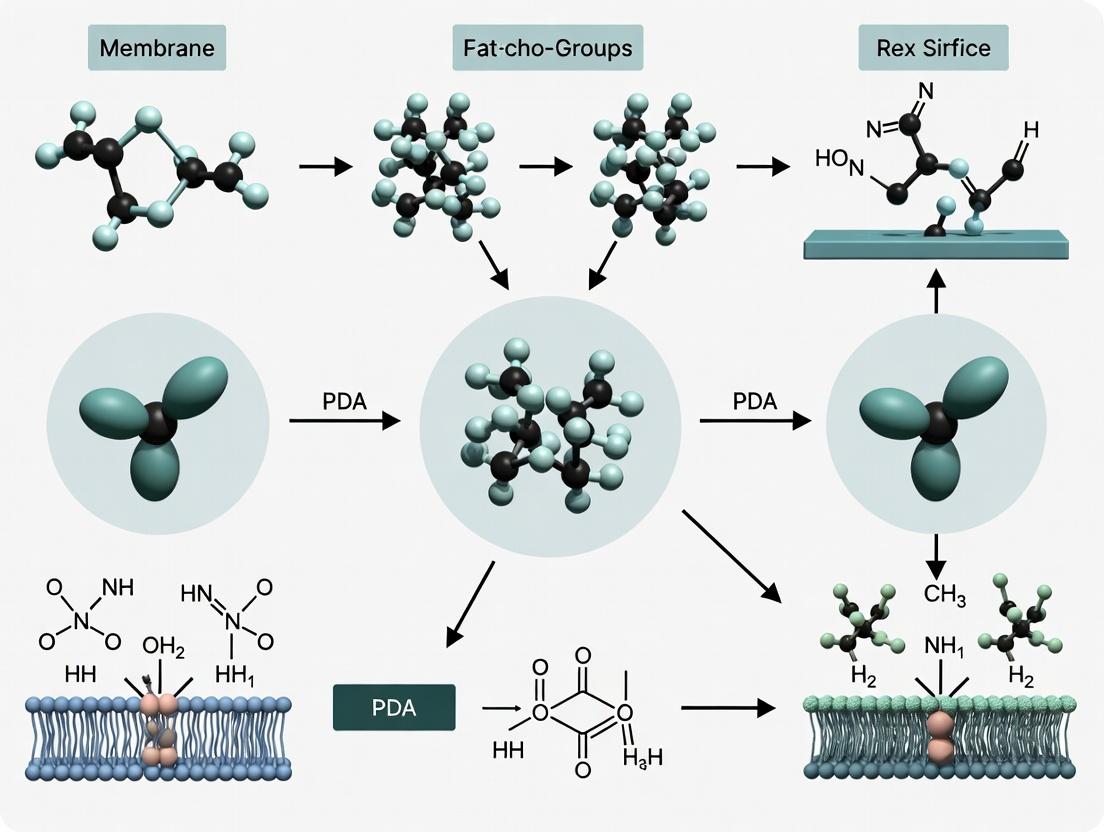
This article provides a comprehensive analysis of polydopamine (PDA) catechol group interactions with biological and synthetic membrane surfaces.
Decoding PDA Catechol-Membrane Interactions: Mechanisms, Applications, and Optimization in Drug Delivery
Abstract
This article provides a comprehensive analysis of polydopamine (PDA) catechol group interactions with biological and synthetic membrane surfaces. Aimed at researchers and drug development professionals, it explores the foundational chemistry of PDA's catechol/quinone moieties and their adhesion mechanisms. The scope includes methodological approaches for surface functionalization, common challenges in stability and reproducibility, and validation techniques for assessing interaction efficacy. By integrating current research, the article serves as a strategic guide for leveraging PDA's unique properties in drug delivery systems, biosensing, and implantable medical devices.
The Chemistry of Adhesion: Understanding PDA Catechol Groups and Membrane Binding Fundamentals
This whitepaper is framed within a broader thesis on the fundamental role of catechol groups in mediating Polydopamine (PDA) interactions with membrane surfaces—a critical area for drug delivery, biosensing, and antimicrobial coating research. Inspired by the mussel foot protein (mfp-5) adhesion mechanism, PDA is a synthetic polymer formed via the oxidative self-polymerization of dopamine. Its unique physicochemical properties, derived from catechol and amine functionalities, enable robust, substrate-independent surface coating and versatile secondary reactions.
Core Chemistry and Adhesion Mechanism
PDA formation proceeds under alkaline, aerobic conditions. The mechanism involves:
- Oxidation of dopamine to dopaminequinone.
- Cyclization via intramolecular Michael addition to form leukodopaminechrome.
- Further oxidation and polymerization to form the cross-linked PDA polymer. The adhesive properties are primarily attributed to the catechol group, which facilitates binding via:
- Metal Coordination: Catechols chelate metal ions (e.g., Fe³⁺, Ti⁴⁺).
- Hydrogen Bonding: The ortho-dihydroxy structure forms strong H-bonds.
- π-π Stacking: Aromatic rings enable non-covalent interactions.
- Michael Addition/Schiff Base Reactions: Amine/catechol groups react with thiols and amines on surfaces.
Diagram: PDA Polymerization and Key Interactions
Quantitative Data on PDA Properties
Table 1: Characteristic Physicochemical Properties of PDA Coatings
| Property | Typical Range/Value | Measurement Technique | Significance for Membrane Interaction |
|---|---|---|---|
| Film Thickness | 10 - 100 nm (per deposition cycle) | Ellipsometry, AFM | Determines barrier properties, loading capacity. |
| Surface Roughness (Ra) | 0.5 - 5.0 nm | Atomic Force Microscopy (AFM) | Influences protein/cell adhesion, wettability. |
| Water Contact Angle | 30° - 60° (hydrophilic) | Goniometry | Indicates surface energy and hydration state. |
| Catechol Content | ~10-20% of total C | X-ray Photoelectron Spectroscopy (XPS) | Primary determinant of adhesion and reactivity. |
| Zeta Potential (pH 7) | -30 to -50 mV | Dynamic Light Scattering (DLS) | Predicts colloidal stability and electrostatic interactions with membranes. |
| Young's Modulus | 2 - 10 GPa (dry state) | Nanoindentation | Reflects mechanical stiffness of the coating. |
Table 2: Key Performance Metrics in Selected Applications
| Application | Model System | Key PDA Function | Quantitative Outcome | Reference (Year) |
|---|---|---|---|---|
| Drug Loading & Release | Doxorubicin on PDA-coated MSNs* | High-affinity binding & pH-responsive release | Loading Capacity: ~25 wt%; Sustained release > 48h | ACS Nano (2023) |
| Antimicrobial Coating | PDA/Ag⁺ on polymer catheter | Catechol-mediated Ag⁺ reduction & retention | >99.9% reduction in S. aureus adhesion; efficacy > 30 days | Biomaterials (2024) |
| Liposome Stabilization | PDA-coated liposome (DOPC) | Surface stabilization via H-bonding | 3-fold increase in serum stability; 80% retention after 72h | J. Controlled Release (2023) |
| Cell Membrane Interaction | PDA nanoparticle with lipid bilayer (Simulation) | Catechol-lipid headgroup binding | Binding free energy: -40 to -60 kJ/mol (PIP₂ lipids) | Nature Comm. (2022) |
MSNs: Mesoporous Silica Nanoparticles; *PIP₂: Phosphatidylinositol 4,5-bisphosphate*
Experimental Protocols
Standard Protocol for Substrate-Independent PDA Coating (Dip-Coating)
Objective: To create a uniform, adherent PDA film on any material surface (e.g., polymer, metal, ceramic).
Materials: See "Scientist's Toolkit" (Section 6).
Procedure:
- Substrate Preparation: Clean substrate (e.g., 2x2 cm piece) via sonication in ethanol (10 min), followed by DI water rinse. Dry under N₂ stream.
- Dopamine Solution Preparation: In a 50 mL glass beaker, dissolve 50 mg of dopamine hydrochloride in 40 mL of 10 mM Tris-HCl buffer (pH 8.5). Stir gently at room temperature (RT) on a magnetic stirrer. Note: Prepare fresh.
- Coating Process: Immerse the pre-cleaned substrate vertically into the solution. Allow polymerization to proceed for 2-24 hours at RT with mild stirring (100-200 rpm). Critical: Seal beaker with Parafilm to minimize solvent evaporation.
- Termination & Washing: Remove substrate using PTFE-coated tweezers. Rinse thoroughly by sequentially dipping in three beakers of fresh DI water (1 min each) to remove loosely adhered particles.
- Drying: Dry the coated substrate under a gentle N₂ stream or in a vacuum desiccator for 2 hours.
- Characterization: Proceed with thickness (ellipsometry), morphology (SEM/AFM), and chemistry (XPS) analysis.
Diagram: Workflow for PDA Dip-Coating and Characterization
Protocol for Quantifying PDA-Membrane Interaction via Quartz Crystal Microbalance with Dissipation (QCM-D)
Objective: To measure the mass and viscoelastic properties of a PDA coating on a lipid bilayer in real-time.
Procedure:
- Sensor Preparation: Mount a silica-coated QCM-D sensor crystal in the flow module. Establish a stable baseline with running buffer (e.g., 10 mM HEPES, 150 mM NaCl, pH 7.4) at 100 µL/min.
- Lipid Bilayer Formation: Inject vesicle solution (e.g., 0.1 mg/mL DOPC small unilamellar vesicles in buffer) for 15-30 min. Rinse with buffer to remove excess vesicles. A stable frequency shift (Δf ≈ -26 Hz for the 3rd overtone) indicates bilayer formation.
- PDA Deposition: Switch to dopamine solution (0.5 mg/mL in 10 mM Tris, pH 8.5). Flow for desired time (e.g., 60 min). Monitor Δf (mass increase) and ΔD (film rigidity) in real-time.
- Rinsing: Switch back to Tris buffer (pH 8.5) to remove non-adherent species.
- Data Analysis: Use the Sauerbrey or a viscoelastic model (e.g., Voigt) to calculate adsorbed mass and thickness based on Δf and ΔD shifts across multiple overtones.
Signaling and Interaction Pathways
Diagram: Catechol-Mediated PDA Interaction with Cell Membrane Components
The Scientist's Toolkit: Key Research Reagent Solutions
Table 3: Essential Materials for PDA Membrane Interaction Research
| Item | Function/Description | Example Supplier/Cat. No. (Informational) |
|---|---|---|
| Dopamine Hydrochloride | Monomer for PDA synthesis. Must be high purity, stored desiccated at -20°C. | Sigma-Aldrich, H8502 |
| Tris(hydroxymethyl)aminomethane (Tris) | Buffer agent to maintain alkaline pH (8.5) for controlled polymerization. | Fisher BioReagents, BP152 |
| QCM-D Sensor Crystals (SiO₂ coated) | For real-time, label-free measurement of PDA adsorption on model membranes. | Biolin Scientific, QSX 303 |
| Lipids for Model Membranes | DOPC, DOPE, cholesterol, PIP₂ for forming supported lipid bilayers (SLBs) or vesicles. | Avanti Polar Lipids |
| Polycarbonate Membranes (50-100 nm) | For extruding large unilamellar vesicles (LUVs) of uniform size. | Avanti, 610000 |
| X-ray Photoelectron Spectroscopy (XPS) System | For quantitative elemental analysis and confirming catechol/quinone ratios on surfaces. | Thermo Scientific, K-Alpha+ |
| Atomic Force Microscopy (AFM) | For nanoscale topographic imaging and roughness measurement of PDA films. | Bruker, Dimension Icon |
| Dynamic Light Scattering (DLS) & Zeta Potential Analyzer | For measuring PDA nanoparticle size, PDI, and surface charge in suspension. | Malvern Panalytical, Zetasizer Ultra |
1. Introduction: A Core Chemical Triad in Membrane Surface Interactions
Polydopamine (PDA) has emerged as a premier functional coating material, prized for its robust adhesion, versatile reactivity, and biocompatibility. These properties originate from the complex interplay of its core chemical groups: catechol, quinone, and semiquinone. Within the context of research on PDA-functionalized membrane surfaces for drug delivery or biosensing, understanding this dynamic equilibrium is paramount. The redox-active catechol/quinone pair drives covalent and non-covalent interactions with membrane components (lipids, proteins), while the radical semiquinone intermediate contributes to both adhesion and oxidative processes. This whitepaper provides an in-depth technical guide to these groups, their interconversion, and methodologies for their study in membrane surface science.
2. Chemical Properties and Interconversion Pathways
The core reactivity of PDA stems from the redox triad of 5,6-dihydroxyindole (DHI) and its derivatives, the primary building blocks of PDA.
- Catechol: The reduced form, characterized by two adjacent hydroxyl groups on a benzene ring. It acts as a strong H-bond donor, a chelating site for metal ions, and a reducing agent.
- Quinone: The oxidized form, featuring two carbonyl groups in a conjugated system. It is electrophilic, participating in Michael addition and Schiff base reactions with nucleophiles (e.g., -NH₂, -SH groups on membrane proteins).
- Semiquinone: A metastable radical intermediate formed during one-electron oxidation/reduction processes. It contributes to radical-based crosslinking and antioxidant/pro-oxidant behavior.
Their interconversion is pH- and oxidant-dependent, as summarized in Table 1 and depicted in Diagram 1.
Diagram 1: Redox Interconversion Pathways of PDA's Core Groups
Table 1: Key Properties of the Reactive Groups in PDA
| Group | Oxidation State | Key Chemical Properties | Primary Role in Membrane Interaction |
|---|---|---|---|
| Catechol | Reduced | H-bonding, metal chelation, antioxidant | Non-covalent adhesion, surface priming, ion coordination |
| Quinone | Oxidized | Electrophilicity, Michael acceptor | Covalent grafting of ligands, protein immobilization |
| Semiquinone | Radical Intermediate | Radical reactivity, redox mediation | Crosslinking, oxidative surface modification |
3. Quantitative Analysis of Group Populations
The relative abundance of these groups in a PDA film is non-stoichiometric and depends on synthesis conditions. Analytical techniques provide quantitative insight (Table 2).
Table 2: Analytical Techniques for Quantifying Reactive Groups in PDA
| Technique | Target Group(s) | Measurable Parameter | Typical Values/Notes |
|---|---|---|---|
| X-ray Photoelectron Spectroscopy (XPS) | Catechol/Quinone | C-O / C=O ratio in C1s & O1s spectra | Quinone C=O peak ~531.5 eV; C-O ~533.3 eV. Ratio varies with pH. |
| UV-Vis-NIR Spectroscopy | Semiquinone/Quinone | Absorbance bands | Broadband ~500-750 nm (semiquinone/charge transfer); ~300-400 nm (quinone). |
| Electron Paramagnetic Resonance (EPR) | Semiquinone | Radical concentration (spins/mg) | ~10¹⁷ – 10¹⁸ spins/mg in dry PDA; increases with UV exposure. |
| Cyclic Voltammetry (CV) | All (Redox Activity) | Redox potentials (E₁/₂) | Broad redox waves, E₁/₂ ~ -0.2 to +0.4 V vs. Ag/AgCl (pH dependent). |
4. Experimental Protocols for Probing Surface Interactions
Protocol 4.1: Quantifying Quinone-Mediated Ligand Grafting on PDA-Coated Membranes
- Objective: To measure the density of nucleophilic ligands (e.g., thiolated PEG, peptides) covalently attached to PDA-coated surfaces via Michael addition/Schiff base reaction.
- Materials: PDA-coated polymeric membrane, ligand solution (e.g., 1 mM SH-PEG-NH₂ in Tris buffer, pH 8.5), Tris-HCl buffer (10 mM, pH 8.5), Ellman's reagent.
- Procedure:
- Incubate PDA-coated membrane samples (1x1 cm²) in ligand solution (1 mL) for 2-24 hours at room temperature with gentle shaking.
- Remove and rinse thoroughly with buffer and DI water.
- To quantify unreacted thiols (for grafting efficiency), incubate the reaction supernatant with Ellman's reagent (DTNB) and measure absorbance at 412 nm against a standard curve.
- Characterize grafted surfaces via XPS (increase in N1s signal) or Water Contact Angle (change in hydrophilicity).
Protocol 4.2: EPR Monitoring of Semiquinone Radicals during Membrane Interaction
- Objective: To track radical generation/consumption when PDA films interact with biological membrane components.
- Materials: Dry PDA-coated particles or films, lipid vesicles (e.g., DOPC), phosphate buffer (pH 7.4), quartz EPR tube, X-band EPR spectrometer.
- Procedure:
- Record baseline EPR spectrum of dry PDA sample (modulation amplitude 1 G, microwave power 2 mW).
- Incubate PDA sample with lipid vesicle suspension (1 mg/mL lipid concentration) in buffer for set timepoints (1, 5, 15, 30 min).
- Rapidly transfer the slurry to an EPR tube and flash-freeze in liquid N₂.
- Acquire EPR spectra at 77 K to trap radical states. Quantify radical concentration by double-integrating the signal and comparing to a standard (e.g., DPPH).
Diagram 2: Workflow for Analyzing PDA-Membrane Interactions
5. The Scientist's Toolkit: Key Research Reagent Solutions
| Reagent/Material | Function in PDA Membrane Research |
|---|---|
| Tris(hydroxymethyl)aminomethane (Tris) Buffer (pH 8.5) | Standard alkaline buffer for PDA deposition and quinone-mediated reactions. |
| Dopamine Hydrochloride | Precursor for PDA synthesis. Purity >98% recommended for reproducible films. |
| 1,2-Dioleoyl-sn-glycero-3-phosphocholine (DOPC) | Model lipid for forming vesicles to mimic cell membrane interactions. |
| SH-PEG-NH₂ (Thiol-PEG-Amine) | Bifunctional linker to probe and utilize quinone reactivity for surface functionalization. |
| Ellman's Reagent (DTNB) | Colorimetric assay for quantifying free thiol (-SH) concentration in grafting studies. |
| 2,2,6,6-Tetramethylpiperidin-1-oxyl (TEMPO) | Stable radical used as a spin trap or standard in EPR studies of semiquinone activity. |
| Sodium Periodate (NaIO₄) | Chemical oxidant to selectively enhance quinone content in PDA films. |
| Ascorbic Acid | Reducing agent to convert quinones back to catechols, testing reversibility of interactions. |
Thesis Context: This whitepaper provides a technical analysis of primary interaction forces, contextualized within ongoing research on polydopamine (PDA) catechol group interactions with membrane surfaces. Understanding the interplay between covalent and non-covalent forces is critical for manipulating PDA adhesion, coating stability, and functionalization in drug delivery systems and biomedical interfaces.
Polydopamine (PDA), inspired by mussel-adhesive proteins, has emerged as a versatile platform for surface modification. Its catechol/quinone-rich chemical landscape facilitates diverse interactions with biological membranes. The binding mechanism is not singular but a synergistic combination of covalent (Michael addition, Schiff base formation) and non-covalent (hydrogen bonding, π-π stacking, coordination) forces. The predominance of a specific force depends on the local chemical environment (pH, ionic strength, surface composition). This guide dissects these forces, providing quantitative comparisons and experimental methodologies relevant to membrane surface research.
Force Analysis & Quantitative Comparison
Covalent Interactions
Covalent bonds form through irreversible chemical reactions between PDA's quinone groups and nucleophiles (e.g., -NH₂, -SH) on membrane surfaces.
- Michael Addition: 1,4-addition of thiols or amines to quinone rings.
- Schiff Base Formation: Reaction between quinone carbonyls and primary amines.
Non-Covalent Interactions
Reversible, dynamic interactions crucial for initial adhesion and structural assembly.
- Hydrogen Bonding: Between catechol -OH groups and membrane acceptors (e.g., carbonyls, phosphates).
- π-π Stacking: Between aromatic rings of PDA and aromatic residues (e.g., tryptophan, tyrosine) in membrane proteins.
- Coordination (Complexation): Between catechol's ortho-dihydroxyl groups and metal ions (e.g., Fe³⁺, Cu²⁺), which can further bridge to membrane components.
Table 1: Quantitative Comparison of Primary Interaction Forces in PDA-Membrane Context
| Interaction Force | Typical Bond Energy (kJ/mol) | Key Functional Groups Involved | pH Dependence | Reversibility | Characteristic Time Scale |
|---|---|---|---|---|---|
| Michael Addition | ~200 - 450 (C-C/C-S bond) | Quinone (PDA) & Thiol/Amino (Membrane) | Optimal: pH >7.5 | Irreversible | Seconds to Hours |
| Schiff Base | ~150 - 450 (C=N bond) | Quinone (PDA) & Primary Amine (Membrane) | Optimal: pH 7-9; reversible at low pH | Reversible (hydrolyzable) | Minutes to Hours |
| Hydrogen Bonding | ~5 - 40 | Catechol -OH (PDA) & C=O, PO₄⁻ (Membrane) | Strong at neutral pH; weakens at extreme pH | Highly Reversible | Picoseconds |
| π-π Stacking | ~5 - 50 | Aromatic rings (PDA & Membrane Proteins) | Low | Reversible | Nanoseconds |
| Coordination | ~100 - 300 | Catecholate (PDA) & Metal Ions (e.g., Fe³⁺) | Strong at neutral/basic pH | Often Reversible | Microseconds to Seconds |
Table 2: Common Experimental Techniques for Probing Interaction Forces
| Technique | Primary Force Probed | Measurable Output | Insight into PDA-Membrane Interaction |
|---|---|---|---|
| Quartz Crystal Microbalance with Dissipation (QCM-D) | Combined, viscoelastic adhesion | Mass & rigidity change | Real-time adsorption kinetics & layer softness. |
| Surface Plasmon Resonance (SPR) | Combined, affinity | Binding constants (KD), kinetics | Affinity, stoichiometry of PDA to model membranes. |
| Atomic Force Microscopy (AFM) | Single-molecule force | Adhesion force (nN), rupture length | Unbinding force maps, identifies specific bonds. |
| Isothermal Titration Calorimetry (ITC) | Thermodynamics | ΔH, ΔG, ΔS, binding stoichiometry (N) | Energetics of PDA binding to vesicles/lipids. |
| X-ray Photoelectron Spectroscopy (XPS) | Chemical state, coordination | Elemental composition, chemical shift | Identifies covalent (C-N, C-S) vs. ionic (metal-O) bonds. |
Experimental Protocols
Protocol 1: Differentiating Covalent vs. Non-Covalent Adhesion via AFM Force Spectroscopy
Objective: To measure the unbinding forces between a PDA-coated probe and a model lipid bilayer to distinguish covalent (step-like) from non-covalent (smooth) rupture events. Materials: AFM with fluid cell, PDA-coated colloidal probe (5µm silica bead), supported lipid bilayer (SLB) on mica, PBS buffer (pH 7.4, 8.5). Methodology:
- Probe Preparation: Immerse amine-functionalized silica bead in dopamine solution (2 mg/mL in 10 mM Tris buffer, pH 8.5) for 1 hr. Rinse thoroughly.
- Sample Preparation: Form an SLB (e.g., POPC:POPS 9:1) via vesicle fusion on a clean mica disc.
- Force Measurement: In buffer, approach the PDA probe to the SLB at 1 µm/s. Upon contact, apply a constant load (500 pN) for a variable dwell time (0-10 s). Retract probe at 1 µm/s.
- Data Analysis: Collect 1000+ force-distance curves. Analyze rupture force distributions and curve shapes. Sudden, quantized rupture steps suggest covalent bond breakage. Smooth, continuous profiles suggest collective non-covalent failure.
- Control: Repeat at pH 5.0 to protonate amines and suppress Schiff base formation.
Protocol 2: Quantifying Contribution of π-π Stacking via Competitive Assay
Objective: To assess the role of π-π stacking in PDA adsorption to aromatic-rich membrane surfaces. Materials: SPR chip with immobilized tyrosine-rich peptide monolayer, dopamine solution, SPR instrument, competitor (sodium indole-5-carboxylate). Methodology:
- Baseline: Flow PBS (pH 7.4) over the aromatic-rich sensor surface until stable.
- PDA Adsorption: Introduce dopamine solution (0.5 mg/mL in Tris buffer, pH 8.5) at 20 µL/min. Monitor the increase in Resonance Units (RU) for 20 min.
- Rinse & Stabilize: Switch to PBS flow to remove loosely bound material. Record final stabilized RU value (∆RU_PDA).
- Regeneration & Competition: Regenerate surface with mild acid (10 mM glycine, pH 2.5). Re-establish baseline. Pre-mix and co-inject dopamine solution with a soluble π-system competitor (e.g., 20 mM indole derivative). Monitor RU (∆RU_comp).
- Analysis: The reduction in adsorbed mass (∆RUPDA - ∆RUcomp) quantifies the contribution of π-π stacking.
Visualizations
PDA-Membrane Interaction Force Network
AFM Force Spectroscopy Workflow for PDA
The Scientist's Toolkit: Key Research Reagent Solutions
Table 3: Essential Reagents for Studying PDA-Membrane Interactions
| Reagent / Material | Function / Role | Key Consideration for Research |
|---|---|---|
| Dopamine Hydrochloride | Precursor for polydopamine (PDA) synthesis. | Use fresh, oxygen-free solutions; pH controls oxidation rate and film properties. |
| Tris(hydroxymethyl)aminomethane (Tris) Buffer | Standard buffer for PDA polymerization (pH 8.5). | Avoid amine-containing buffers (e.g., glycine) if studying Schiff base. |
| Supported Lipid Bilayers (SLBs) | Model membrane surface. | Composition (e.g., incorporating PS lipids for amine targeting) dictates dominant force. |
| Thiol-terminated PEG (SH-PEG) | Competitor/blocker for Michael addition. | Used to quantify thiol-quinone contribution via competitive adsorption assays. |
| Sodium Periodate (NaIO₄) | Oxidizing agent to enhance quinone content in PDA. | Increases covalent binding capacity; concentration must be optimized. |
| Fe³⁺ or Cu²⁺ Chloride Salts | Sources of metal ions for coordination studies. | Trace contaminants can significantly alter adhesion; use high-purity salts. |
| 1-Ethyl-3-(3-dimethylaminopropyl)carbodiimide (EDC) | Coupling agent to crosslink carboxyls & amines. | Control to differentiate PDA-mediated adhesion from non-specific crosslinking. |
| Indole-5-carboxylic Acid | Soluble π-system competitor for π-π stacking studies. | Validates aromatic interactions without altering electrostatic/pH environment. |
This technical guide is framed within a broader thesis investigating the interactions of polydopamine (PDA) catechol groups with membrane surfaces. Understanding the fundamental characteristics of membrane surfaces—including native lipid bilayers and engineered synthetic polymer compositions—is critical for elucidating PDA's adhesive and coating mechanisms, which have significant implications for drug delivery systems, biosensors, and biomedical device functionalization.
Core Membrane Surface Components
Lipid Bilayers: Structure and Function
The lipid bilayer forms the fundamental architectural matrix of biological membranes. Its characteristics are dictated by lipid composition, which governs fluidity, phase behavior, and interfacial properties.
Key Lipid Head Groups and Their Influence:
- Phosphatidylcholine (PC): Zwitterionic; provides neutral, non-reactive surfaces, contributing to membrane integrity.
- Phosphatidylethanolamine (PE): Zwitterionic with a small, conical head group; promotes membrane curvature and fusion.
- Phosphatidylserine (PS): Anionic; present in the inner leaflet, externalization marks apoptosis and provides negative surface charge for protein binding.
- Phosphatidylinositol (PI): Anionic; precursor for signaling molecules; contributes to surface charge.
- Cholesterol: Modulates fluidity and mechanical strength, partitions into liquid-ordered phases.
Quantitative Data on Common Lipid Head Groups: Table 1: Characteristics of Common Phospholipid Head Groups
| Head Group | Charge at pH 7.4 | Approx. Cross-Sectional Area (Ų) | Primary Role in Membrane |
|---|---|---|---|
| Choline (PC) | Zwitterionic (neutral) | ~50 | Structural integrity, permeability barrier |
| Ethanolamine (PE) | Zwitterionic (neutral) | ~45 | Membrane curvature, fusion |
| Serine (PS) | Negative (-1) | ~50 | Apoptotic signaling, charge recruitment |
| Inositol (PI) | Negative (-1 to -4) | ~55 | Signaling precursor, charge |
| Glycerol (PG) | Negative (-1) | ~48 | Bacterial membranes, charge |
Synthetic Polymer Compositions
Synthetic polymers offer tunable alternatives to lipid bilayers for creating model membranes and functional surfaces. Key polymers include:
- Polyethylene Glycol (PEG): Provides antifouling, steric stabilization.
- Polydopamine (PDA): Adhesive, coating polymer rich in catechol/quinone groups capable of covalent and non-covalent interactions.
- Poly(lactic-co-glycolic acid) (PLGA): Biodegradable polymer used for controlled release.
- Polyelectrolytes (e.g., PAH, PSS): Used for layer-by-layer assembly, controlling surface charge and thickness.
Experimental Protocols for Characterizing Membrane Surfaces
Protocol: Preparation of Supported Lipid Bilayers (SLBs) via Vesicle Fusion
Objective: To form a continuous, fluid lipid bilayer on a solid substrate (e.g., SiO₂) for surface interaction studies. Materials: DOPC, DOPS lipids in chloroform, HEPES buffer (10 mM HEPES, 150 mM NaCl, pH 7.4), silica substrate, extruder with 50-100 nm polycarbonate membranes. Procedure:
- Dry mixed lipid chloroform solution under N₂ gas, then under vacuum for >1 hr.
- Hydrate lipid film with HEPES buffer to 1 mM total lipid concentration.
- Subject the suspension to 5 freeze-thaw cycles (liquid N₂/40°C water bath).
- Extrude the suspension 21 times through a 50 nm polycarbonate membrane to form small unilamellar vesicles (SUVs).
- Inject SUV solution into a flow cell containing a cleaned silica substrate.
- Incubate at 60°C for 1 hour.
- Rinse extensively with HEPES buffer to remove unfused vesicles.
- Verify formation via quartz crystal microbalance with dissipation (QCM-D) or fluorescence recovery after photobleaching (FRAP).
Protocol: Assessing PDA Deposition Kinetics on Model Membranes
Objective: To quantify the interaction of PDA catechol groups with varying membrane surfaces. Materials: Prepared SLBs with varying headgroup composition (PC, PS, etc.), dopamine hydrochloride solution (2 mg/mL in 10 mM Tris buffer, pH 8.5), QCM-D or surface plasmon resonance (SPR) instrument. Procedure:
- Mount SLB-coated sensor crystal/chip in QCM-D/SPR instrument. Establish stable baseline in Tris buffer.
- Introduce dopamine solution at a constant flow rate (e.g., 100 µL/min).
- Monitor frequency (Δf) and dissipation (ΔD) shifts (QCM-D) or resonance unit (RU) shifts (SPR) in real-time for 30-60 minutes.
- Rinse with Tris buffer to remove loosely adsorbed material.
- Analyze Δf vs. ΔD plots to characterize the viscoelasticity of the adsorbed PDA layer. Use Sauerbrey or Voigt modeling for mass quantification.
- Compare adsorption kinetics and final adsorbed mass across different lipid head group compositions.
Visualization of Key Concepts
Diagram Title: PDA Catechol Group Interactions with Lipid Membrane Components
Diagram Title: Workflow for Studying PDA Adsorption on Model Membranes
The Scientist's Toolkit: Research Reagent Solutions
Table 2: Essential Materials for Membrane-PDA Interaction Research
| Item | Function/Description | Example Vendor/Cat. No. (for reference) |
|---|---|---|
| 1,2-dioleoyl-sn-glycero-3-phosphocholine (DOPC) | Major zwitterionic lipid for forming neutral, fluid model membranes. | Avanti Polar Lipids, 850375 |
| 1,2-dioleoyl-sn-glycero-3-phospho-L-serine (DOPS) | Anionic lipid for introducing negative surface charge. | Avanti Polar Lipids, 840035 |
| Dopamine Hydrochloride | Precursor for polydopamine (PDA) formation and deposition. | Sigma-Aldrich, H8502 |
| QCM-D Sensor Crystals (SiO₂ coated) | For real-time, label-free measurement of adsorbed mass and viscoelastic properties. | Biolin Scientific, QSX 303 |
| Polycarbonate Membrane Filters (50 nm pore) | For extruding lipids to form uniform, small unilamellar vesicles (SUVs). | Avanti Polar Lipids, 610000 |
| Tris Buffer (pH 8.5) | Standard alkaline buffer to promote autoxidation of dopamine to PDA. | Various |
| Microfluidic Flow Cell System | For controlled introduction of reagents to sensor surfaces. | Biolin Scientific, QFM 401 |
| Atomic Force Microscopy (AFM) Cantilevers | For high-resolution topographic imaging of membrane and coating integrity. | Bruker, RTESPA-300 |
The interplay between membrane surface characteristics—defined by lipid head group chemistry, bilayer physical state, and synthetic polymer properties—and PDA catechol chemistry is complex and central to the broader thesis on bio-interfacial interactions. The structured data, protocols, and tools outlined here provide a framework for systematic investigation, enabling researchers to design surfaces with tailored functionalities for advanced therapeutic and diagnostic applications.
This whitepaper examines the critical influence of pH, ionic strength, and oxidation state on the binding kinetics of catechol groups from polydopamine (PDA) to membrane surfaces. Within the broader thesis investigating PDA-membrane interactions for drug delivery and biosensing applications, a detailed analysis of these environmental parameters is presented. The data underscores their pivotal role in modulating adsorption rates, binding affinities, and the stability of the resulting adlayer, directly impacting the efficacy of functionalized membranes.
Polydopamine (PDA), inspired by mussel-adhesive proteins, has emerged as a versatile coating material. Its catechol and amine functional groups enable robust adhesion to organic and inorganic surfaces. For membrane science—spanning filtration, sensing, and drug delivery—precise control over PDA deposition is paramount. The binding kinetics of PDA's catechol groups are not intrinsic constants but are exquisitely sensitive to the local environmental milieu. This guide provides a technical dissection of how pH, ionic strength, and the catecholquinone oxidation state interplay to dictate binding outcomes, offering a framework for rational design in applied research.
Mechanistic Foundations and Environmental Modulation
Catechol Chemistry and Redox States
The binding capability of PDA's dihydroxyphenyl (catechol) groups is governed by their oxidation state, which is environmentally labile.
- Catechol (Reduced): Exhibits high affinity for metal oxides and surfaces via bidentate coordination. Primary role in strong adhesion.
- Semiquinone (Radical): An intermediate state with complex reactivity.
- Quinone (Oxidized): Can undergo Schiff base or Michael addition reactions with amine/thiol groups on surfaces.
The equilibrium between these states is shifted by solution pH and oxidants, directly altering the available binding modes.
Diagram 1: Catechol Redox Equilibrium & Environmental Drivers
Key Environmental Factors
pH influences protonation states. Lower pH (<5) protonates catechol oxygens, favoring metal coordination. Higher pH (>8) deprotonates catechol, enhancing its reducing power and promoting oxidation to quinone, shifting binding to covalent reactions.
Ionic Strength screens electrostatic interactions between charged PDA species and the surface. High ionic strength can reduce repulsive barriers, increasing initial adsorption rates, but may also weaken specific ionic bonds.
Oxidation State, as driven by pH and dissolved oxygen or other oxidants, selects the operative binding mechanism: non-covalent (catechol) vs. covalent (quinone).
Table 1: Impact of pH on PDA Catechol Binding to TiO₂ Membrane Surfaces
| pH | Predominant Catechol Form | Observed Binding Rate Constant (kₐ, M⁻¹s⁻¹) | Primary Binding Mode | Adlayer Stability |
|---|---|---|---|---|
| 4.0 | Protonated Catechol | 1.2 x 10³ | Physisorption / Weak H-bonding | Low |
| 5.5 | Neutral Catechol | 5.8 x 10⁴ | Bidentate Coordination to Ti⁴⁺ | High |
| 8.0 | Deprotonated Catechol / Quinone | 3.4 x 10⁴ | Mixed Coordination & Covalent | Very High |
| 10.0 | Quinone | 2.1 x 10⁴ | Covalent (Schiff Base) | High |
Table 2: Effect of Ionic Strength (NaCl) on Initial Adsorption Rate at pH 7.4
| [NaCl] (mM) | Ionic Strength (I, M) | Relative Adsorption Rate (ΔQ/Δt, a.u.) | Proposed Mechanism |
|---|---|---|---|
| 0 | ~0.01 | 1.00 | Electrostatic-dominated deposition |
| 50 | 0.05 | 1.35 | Partial charge screening |
| 150 | 0.15 | 1.80 | Maximum screening, enhanced kinetics |
| 500 | 0.50 | 1.65 | Onset of salting-out effects |
| 1000 | 1.00 | 1.20 | Competitive binding & salting-out |
Table 3: Oxidation State Control via Reducing Agent (Ascorbate)
| [Ascorbate] (mM) | Catechol:Quinone Ratio | Binding Affinity (K_D, μM) to Amine-Membrane | Notes |
|---|---|---|---|
| 0 | 20:80 | 45 ± 5 | Native oxidative polymerization |
| 1 | 50:50 | 28 ± 3 | Increased reversible binding |
| 10 | >95:5 | 12 ± 2 | High-affinity, coordination-dominated |
Experimental Protocols
Protocol: Quartz Crystal Microbalance (QCM) for Kinetic Analysis Under Variable pH/Ionic Strength
Objective: To measure real-time adsorption kinetics of PDA precursors on functionalized sensor chips. Materials: QCM-D instrument, TiO₂-coated or amine-coated sensor crystals, dopamine HCl, Tris/HCl buffers (pH 7-9), MES buffer (pH 5-6), NaCl stock solution. Procedure:
- Equilibrate the QCM chamber with selected buffer (e.g., 10 mM Tris, pH 8.5) at 25°C, flow rate 50 µL/min until stable baseline (Δf < 0.5 Hz/min).
- Prepare fresh dopamine solution (2 mg/mL) in the same buffer, with NaCl added to achieve target ionic strength (e.g., 150 mM). Sparge with N₂ to control oxidation if needed.
- Switch flow to dopamine solution for 30 minutes, monitoring frequency (Δf) and dissipation (ΔD) shifts.
- Switch back to pure buffer for 15 minutes to rinse loosely bound material.
- Analyze Δf (mass uptake) vs. time data using appropriate viscoelastic (e.g., Voigt) models to extract kinetic constants (kₐ, k_d).
- Repeat across pH (5.6, 7.4, 8.5) and ionic strength (0-500 mM NaCl).
Protocol: Spectrophotometric Determination of Catechol:Quinone Ratio
Objective: To quantify the oxidation state of PDA/dopamine solutions under different conditions. Materials: UV-Vis spectrophotometer, dopamine, phosphate buffers, sodium ascorbate, ammonium persulfate. Procedure:
- Prepare dopamine solution (0.5 mg/mL) in buffers of varying pH.
- Add oxidant (persulfate) or reductant (ascorbate) at defined concentrations (0-10 mM) to aliquots.
- Incubate for 10 minutes at 25°C.
- Scan absorbance from 250-600 nm.
- Calculate the ratio of the catechol peak (~280 nm) to the quinone/quinone–chrome peak (~400-500 nm). Use molar extinction coefficients for quantification.
Protocol: Shear Force Adhesion Measurement for Stability
Objective: To quantify binding strength of PDA coatings under fluid flow. Materials: Parallel-plate flow chamber, PDA-coated membrane coupons, peristaltic pump, PBS buffer at varying pH. Procedure:
- Mount PDA-coated membrane in the flow chamber.
- Subject it to stepwise increases in wall shear stress (0-200 Pa) via controlled buffer flow.
- Monitor effluent via UV-Vis for detached PDA (absorbance at 280 nm).
- Record the critical shear stress (τ_c) at which detachment surpasses 5 ng/cm²/s.
- Correlate τ_c with environmental conditions during coating.
The Scientist's Toolkit: Key Research Reagent Solutions
Table 4: Essential Reagents for Studying Environmental Effects on PDA Binding
| Reagent / Material | Function / Relevance | Example Specification |
|---|---|---|
| Dopamine Hydrochloride | Primary PDA precursor. Must be high purity to avoid side-reactions. | >99%, stored desiccated at -20°C. |
| Tris(hydroxymethyl)aminomethane (Tris) Buffer | Standard alkaline buffer (pH 7-9) for oxidative polymerization. | 10 mM, pH 8.5, often used as the "standard" PDA condition. |
| 2-(N-morpholino)ethanesulfonic acid (MES) Buffer | Good buffering capacity at pH 5-7 for studying protonated catechol states. | 10-50 mM. |
| Sodium Ascorbate | Reducing agent to maintain catechol groups in their reduced, coordination-competent state. | 1-10 mM fresh solution in degassed buffer. |
| Ammonium Persulfate (APS) | Chemical oxidant to drive rapid quinone formation, shifting binding to covalent pathways. | Used at 1-5 mM. |
| High-Purity Sodium Chloride (NaCl) | To modulate ionic strength without introducing confounding ions. | >99.5%, used to create precise molarities. |
| TiO₂-Coated QCM Sensors / Silicon Wafers | Model metal oxide surfaces for studying catechol coordination kinetics. | Crystalline anatase coating preferred. |
| Aminopropyltriethoxysilane (APTES) | Used to functionalize silica or glass surfaces with amine groups for quinone-mediated covalent binding studies. | 2% (v/v) in anhydrous toluene. |
Diagram 2: Logic of Environmental Influence on Binding Outcome
The binding kinetics of PDA catechol groups to membrane surfaces are decisively governed by the triumvirate of pH, ionic strength, and oxidation state. For researchers aiming to engineer PDA-modified membranes with tailored properties—be it for high-affinity drug loading, anti-fouling surfaces, or sensor fabrication—intentional manipulation of these factors provides a powerful, essential strategy. The protocols and data herein offer a roadmap for systematic investigation and optimization within this critical domain of interfacial science.
Engineering Robust Interfaces: Techniques and Biomedical Applications of PDA-Membrane Systems
This technical guide is framed within a broader thesis investigating the interactions of polydopamine (PDA) catechol groups with membrane surfaces. The ability to deposit uniform, controlled PDA films via oxidative polymerization is foundational for applications ranging from creating drug delivery interfaces to modifying membrane biocompatibility and fouling resistance. This whitepaper details the critical parameters governing this process to achieve reproducible, tailored film properties.
Core Polymerization Parameters and Quantitative Data
The formation of PDA films from dopamine hydrochloride is an oxygen-driven, base-catalyzed autoxidation and polymerization process. The key controllable parameters are pH, oxidant concentration, dopamine concentration, temperature, deposition time, and substrate pretreatment. The following table summarizes the impact of these variables on film characteristics, synthesized from current literature.
Table 1: Key Parameters for Controlled Oxidative Polymerization of PDA Films
| Parameter | Typical Range for Controlled Films | Impact on Deposition Kinetics & Film Properties | Notes for Membrane Surface Modification |
|---|---|---|---|
| pH (Tris Buffer) | 8.0 - 8.5 | Optimal rate; affects catechol oxidation and cyclization. Lower pH slows, higher pH accelerates but can cause precipitation. | Crucial for controlling quinone/catechol ratio, affecting subsequent interactions with membrane functional groups. |
| Dopamine Concentration | 0.5 - 2.0 mg/mL | Higher concentration increases deposition rate and final thickness, but can lead to inhomogeneity and particle formation. | For thin, conformal coatings on delicate membranes, lower concentrations (<1 mg/mL) are preferred. |
| Oxidant (e.g., (NH₄)₂S₂O₈) | 0 - 10 mM | Added oxidants decouple O₂ dependence, accelerate kinetics, and can enhance film uniformity. | Useful for consistent coating in low-O₂ environments or for rapid coating protocols. |
| Temperature | 20 - 40 °C | Higher temperature significantly accelerates polymerization. Room temp (20-25°C) offers best control for smooth films. | Deposition on temperature-sensitive polymeric membranes requires careful thermal control. |
| Deposition Time | 0.5 - 24 hours | Directly controls film thickness. Growth is initially linear, then self-limiting. | Short times (30-60 min) yield thin, adhesive primer layers. Longer times build up functional coating. |
| Substrate Pre-treatment | O₂ Plasma, UV/Ozone | Increases surface hydrophilicity and nucleation sites, improving adhesion and uniformity. | Essential for hydrophobic polymer membranes to ensure conformal, pinhole-free coating. |
| Agitation/Stirring | Gentle stirring (~60 rpm) | Ensures reagent homogeneity, prevents localized depletion, and reduces sedimentation of PDA aggregates. | Vigorous agitation can shear forming films on soft substrates; gentle motion is key. |
Table 2: Resulting Film Properties vs. Deposition Time (Example at 2 mg/mL, pH 8.5, 25°C)
| Deposition Time (Hours) | Approx. Thickness (nm) | Surface Roughness (RMS, nm) | Catechol/O-Quinone Ratio (XPS) | Primary Application Context |
|---|---|---|---|---|
| 1 | 10 - 15 | 1 - 2 | High | Primer layer for secondary functionalization. |
| 4 | 25 - 35 | 3 - 5 | Medium | Standard coating for antifouling, moderate adhesion. |
| 12 | 45 - 60 | 8 - 15 | Lower | Thick coating for high drug loading or robust shielding. |
| 24 | 50 - 70 | 15 - 25 | Lowest | Maximum thickness, often with increased roughness/porosity. |
Detailed Experimental Protocols
Standard Protocol for Conformal PDA Coating on Polymeric Membranes
Objective: To deposit a uniform, ~20 nm thick PDA film on a polymeric membrane (e.g., PVDF, PES) for surface activation.
Materials: See Scientist's Toolkit below.
Procedure:
- Substrate Preparation: Cut membrane samples to desired size. Clean by sonicating in 70% ethanol for 10 minutes, followed by rinsing with copious amounts of deionized (DI) water. Treat with oxygen plasma (100 W, 1 minute) or UV/Ozone (15 minutes) to enhance hydrophilicity.
- Buffer Preparation: Prepare a 10 mM Tris-HCl buffer solution (pH 8.5) using high-purity water. Filter through a 0.22 µm membrane filter to remove particulates.
- Polymerization Solution: In a clean glass vial, dissolve dopamine hydrochloride in the Tris buffer to a final concentration of 1.0 mg/mL. Mix gently via inversion. Note: Prepare this solution immediately before use.
- Deposition: Place the pre-wetted (in DI water) membrane substrate into the dopamine solution, ensuring it is fully immersed. Cap the vial and place it on a gentle orbital shaker set to 60 rpm at room temperature (25 ± 2°C) for 4 hours.
- Termination and Washing: Carefully remove the coated substrate using tweezers. Rinse thoroughly by dipping sequentially in three beakers of fresh DI water for 1 minute each to remove loosely adhered particles.
- Drying: Gently dry the coated membrane under a stream of nitrogen or in a vacuum desiccator overnight. Store in a dark, dry place until use.
- Characterization: Confirm film thickness via ellipsometry on a silicon wafer control sample processed simultaneously. Analyze surface chemistry via XPS or ATR-FTIR.
Protocol for Accelerated, Oxidant-Driven Polymerization
Objective: To rapidly deposit a PDA film under controlled kinetics, independent of ambient oxygen fluctuations.
Procedure: Follow steps 1-2 from Protocol 3.1.
- Oxidant Stock Solution: Prepare a fresh 100 mM aqueous solution of ammonium persulfate ((NH₄)₂S₂O₈).
- Polymerization Solution: Prepare dopamine at 1.5 mg/mL in Tris buffer as before. Add the (NH₄)₂S₂O₈ stock solution to achieve a final oxidant concentration of 5 mM. Mix immediately.
- Deposition: Immerse the substrate immediately. Proceed with deposition for 30-60 minutes at 25°C with gentle agitation.
- Follow steps 5-7 from Protocol 3.1. Expect faster kinetics and potentially smoother films due to homogeneous nucleation.
Diagrams of Processes and Workflows
Title: PDA Oxidative Polymerization Chemical Pathway
Title: Experimental Workflow for Controlled PDA Film Deposition
The Scientist's Toolkit: Key Research Reagent Solutions
Table 3: Essential Materials for Oxidative Polymerization of PDA Films
| Item | Function / Role in Experiment | Technical Notes for Controlled Films |
|---|---|---|
| Dopamine Hydrochloride | The monomer precursor. Purity is critical for reproducible kinetics and film quality. | Use high purity (>99%), store desiccated at -20°C. Weigh quickly to avoid oxidation by air. |
| Tris(hydroxymethyl)aminomethane (Tris) | The standard buffer to maintain pH at the optimal 8.5 for controlled autoxidation. | Prepare with ultra-pure water (18.2 MΩ·cm). Filter (0.22 µm) to remove particles. |
| Ammonium Persulfate ((NH₄)₂S₂O₈) | A strong oxidant used to accelerate and standardize polymerization kinetics. | Prepare fresh stock solutions. Handle with care; it is a strong oxidizer and irritant. |
| Polymeric Membrane Substrates | The target surface for modification (e.g., PVDF, PES, PC). | Pre-clean to remove preservatives. Plasma treatment is highly recommended for uniformity. |
| Oxygen Plasma Cleaner | Device for substrate activation. Increases surface energy and creates nucleation sites. | Low power (50-100W) and short time (30-60 sec) are often sufficient for polymer membranes. |
| Orbital Shaker / Rocker | Provides gentle, consistent agitation during deposition. | Ensures homogeneous reagent distribution and minimizes aggregate sedimentation on the film. |
| Ultrapure Water System | Provides particle-free water for all solutions and rinsing steps. | Essential to prevent incorporation of contaminants that can act as film defect nucleation sites. |
| 0.22 µm Syringe Filters | For sterile filtration of buffers and solutions to remove particulate nuclei. | Pre-filtration of Tris buffer is a simple step to dramatically improve film smoothness. |
This technical guide details the application of catechol chemistry for the functionalization of nanocarriers and surfaces, specifically within the context of polydopamine (PDA) membrane surface interactions research. The broader thesis investigates how the intrinsic adhesive and reactive properties of PDA's catechol/quinone groups govern their interaction with biological membranes and enable versatile post-fabrication modification. This work leverages these interactions to create targeted drug delivery systems through two core strategies: (1) the loading of therapeutic agents via covalent and non-covalent interactions, and (2) the attachment of targeting ligands (e.g., peptides, antibodies) for cell-specific delivery.
Catechol Chemistry Fundamentals
Catechol (1,2-dihydroxybenzene) groups, prevalent in PDA coatings, undergo oxidation to ortho-quinones, which are highly electrophilic. This enables three primary reaction pathways for functionalization:
- Michael Addition/Schiff Base Formation: Nucleophiles (e.g., thiols, amines) from therapeutics or ligands react with quinones.
- Coordination Chemistry: Catechols form stable complexes with metal ions (Fe³⁺, Ti⁴⁺), useful for chelation-based loading or multimodal imaging.
- π-π Stacking & Hydrogen Bonding: Non-covalent interactions for adsorbing aromatic or hydrogen-bonding drugs.
Strategy 1: Loading Therapeutics
Table 1: Efficacy of Catechol-Mediated Drug Loading Strategies
| Loading Mechanism | Model Drug | Carrier System | Loading Capacity (% w/w) | Loading Efficiency (%) | Key Interaction | Reference Year |
|---|---|---|---|---|---|---|
| Covalent (Schiff Base) | Doxorubicin (Amine) | PDA-coated MSNs | 18.5 ± 1.2 | 92.1 ± 4.5 | Quinone-NH₂ | 2023 |
| Covalent (Michael Addition) | Cysteine-terminated Peptide | PDA Nanoparticles | 12.8 ± 0.9 | 85.3 ± 3.8 | Quinone-SH | 2024 |
| Coordination | Doxorubicin (Fe³⁺ Bridge) | PDA-coated Liposome | 22.4 ± 2.1 | 89.7 ± 5.1 | Catechol-Fe³⁺-Drug | 2023 |
| π-π Stacking | Paclitaxel | PDA-coated PLGA NPs | 15.3 ± 1.5 | 76.4 ± 4.2 | Aromatic stacking | 2022 |
| Hydrogen Bonding | 5-Fluorouracil | PDA Nanosponges | 10.7 ± 1.0 | 71.2 ± 3.6 | Catechol-OH...F | 2023 |
Experimental Protocol: Covalent Doxorubicin Loading via Schiff Base Reaction
Objective: To load doxorubicin (DOX) onto polydopamine-coated mesoporous silica nanoparticles (PDA-MSNs) via amine-quinone coupling.
Materials:
- PDA-MSNs (100 nm, 2 mg/mL in 10 mM Tris-HCl, pH 8.5)
- Doxorubicin hydrochloride (DOX·HCl)
- Tris-HCl buffer (10 mM, pH 8.5 and pH 7.4)
- Centrifugal filters (100 kDa MWCO)
- UV-Vis Spectrophotometer
Procedure:
- Activation: Suspend 2 mL of PDA-MSNs in Tris-HCl buffer (pH 8.5) to promote partial oxidation of catechols to quinones. Stir gently for 30 min at 25°C.
- Loading: Add DOX·HCl solution (in pH 8.5 buffer) to the PDA-MSN suspension at a 1:2 weight ratio (Carrier: Drug). Protect from light.
- Reaction: Stir the mixture for 12 hours at 25°C in the dark.
- Purification: Transfer the mixture to a centrifugal filter. Centrifuge at 4000 x g for 10 min. Wash with pH 7.4 buffer 3 times to remove unreacted DOX.
- Quantification: Collect wash-through. Measure absorbance of free DOX in the supernatant at 480 nm. Calculate loaded amount using a standard curve. Loading Efficiency (%) = (Total DOX added – Free DOX) / Total DOX added × 100.
Strategy 2: Attaching Targeting Ligands
Table 2: Targeting Ligand Conjugation via Catechol Chemistry
| Ligand Type | Conjugation Chemistry | Target Receptor | Nanoparticle Platform | Conjugation Efficiency (%) | Cellular Uptake Increase (vs. non-targeted) | Reference Year |
|---|---|---|---|---|---|---|
| cRGDfK Peptide | Thiol-Quinone Michael Addition | αvβ3 Integrin | PDA-coated Au Nanorods | 88.5 ± 3.2 | 4.8-fold (U87MG cells) | 2024 |
| Folic Acid (Amine-modified) | Amine-Quinone Schiff Base | Folate Receptor | PDA-coated PCL NPs | 78.9 ± 4.1 | 5.2-fold (KB cells) | 2023 |
| Trastuzumab (Reduced) | Thiol-Quinone Michael Addition | HER2 | PDA-Micelles | 65.2 ± 5.5* | 6.1-fold (SK-BR-3 cells) | 2023 |
| GE11 Peptide | Direct Dopamine Co-deposition | EGFR | PDA-Lipid NP | N/A (co-deposited) | 3.7-fold (A431 cells) | 2022 |
Note: Lower efficiency due to antibody size and steric hindrance.
Experimental Protocol: cRGDfK Peptide Conjugation via Thiol-Quinone Click
Objective: To conjugate the thiol-containing cyclic RGD peptide (cRGDfK-SH) onto PDA-coated nanoparticles for targeting αvβ3 integrin.
Materials:
- PDA-coated Gold Nanorods (PDA-AuNRs)
- cRGDfK-SH peptide
- Tris-HCl buffer (10 mM, pH 8.0)
- EDTA (1 mM, in buffer, to prevent disulfide formation)
- Purification columns (e.g., Sephadex G-25)
Procedure:
- Preparation: Dissolve cRGDfK-SH peptide in Tris-HCl buffer with 1 mM EDTA (pH 8.0) to a final concentration of 1 mg/mL.
- Activation: Adjust PDA-AuNR suspension to pH 8.0. Stir for 20 min to generate reactive quinones.
- Conjugation: Add the peptide solution to the PDA-AuNR suspension at a 500:1 molar excess (peptide:estimated surface quinones). React for 6 hours at 4°C under gentle agitation and inert atmosphere (N₂).
- Purification: Pass the reaction mixture through a size-exclusion column equilibrated with PBS (pH 7.4) to separate conjugated NPs from free peptide.
- Quantification: Use a BCA assay or HPLC analysis of the free peptide in the eluent to determine the amount of peptide conjugated.
Visualization of Workflows and Pathways
Catechol Functionalization Workflow
Title: Dual-Path Catechol Functionalization Workflow
Catechol-Ligand-Receptor Signaling Pathway
Title: Targeted Nanoparticle Internalization and Drug Release Pathway
The Scientist's Toolkit: Research Reagent Solutions
Table 3: Essential Materials for Catechol-Based Functionalization
| Item | Function / Role | Key Consideration |
|---|---|---|
| Dopamine Hydrochloride | Precursor for in-situ PDA coating via self-polymerization. | Use fresh, high-purity stocks dissolved in slightly basic Tris buffer (pH 8.5) for consistent coating kinetics. |
| Tris-HCl Buffer (pH 8.5) | Standard buffer for PDA deposition and catechol oxidation. | Maintains optimal pH for autoxidation of catechols to reactive quinones. |
| Thiolated Ligands (e.g., cRGDfK-SH) | For Michael addition conjugation to quinones. | Include EDTA in reaction buffer and use under inert atmosphere to prevent disulfide formation. |
| Amine-Modified Biomolecules | For Schiff base conjugation to quinones (e.g., NH₂-PEG-FA). | A large molar excess is often required. May require stabilizing with sodium cyanoborohydride for reduction of Schiff base. |
| Metal Ion Solutions (FeCl₃, TiO(acac)₂) | For coordination-based drug loading or creating hybrid systems. | Strict control of molar ratio is critical to prevent precipitation and ensure complex stability. |
| Centrifugal Filters (various MWCO) | For purifying functionalized nanoparticles from unreacted small molecules. | Select MWCO significantly smaller than the nanoparticle core to avoid loss. |
| Size-Exclusion Chromatography Columns | For gentle purification of ligand-conjugated NPs, especially with proteins/antibodies. | Preserves conjugate activity and minimizes aggregation compared to repeated centrifugation. |
| UV-Vis/NanoDrop Spectrophotometer | For quantifying drug/ligand loading via characteristic absorbance (e.g., DOX @ 480 nm). | Establish standard curves for accurate quantification of free vs. bound molecules. |
This whitepaper details a key application within a broader thesis investigating the fundamental interactions between polydopamine (PDA) catechol groups and biological membrane surfaces. The research posits that the unique physicochemical properties of PDA—primarily derived from its catechol and amine functionalities—enable not only robust nanoparticle coating but also specific, multifunctional interactions with lipid bilayers and membrane proteins. This facilitates enhanced cellular uptake and targeted intracellular delivery, forming a versatile platform for next-generation nanomedicines.
Core Mechanisms: PDA-Membrane Interactions
PDA coatings mediate cellular entry through several synergistic mechanisms:
- Catechol-Mediated Adhesion: Catechol groups form hydrogen bonds, coordinate with metal ions in membrane proteins, and engage in cation-π interactions with lipid headgroups.
- Receptor-Mediated Endocytosis: PDA can be functionalized with targeting ligands (e.g., folic acid, peptides), but the coating itself shows affinity for certain overexpressed receptors on cancer cells.
- Membrane Disruption/Interaction: At specific charge and size regimes, PDA nanoparticles can induce transient membrane reorganization, promoting uptake.
Table 1: Impact of PDA Coating Thickness on Nanoparticle Properties and Cellular Uptake
| PDA Coating Thickness (nm) | Zeta Potential (mV) | Hydrodynamic Size Increase (%) | Cellular Uptake Efficiency (vs. Uncoated) | Primary Uptake Pathway |
|---|---|---|---|---|
| 2-3 | -25 to -30 | 15-20% | ~2.5x | Clathrin-mediated |
| 5-8 | -30 to -35 | 30-40% | ~4.0x | Caveolae-mediated |
| 10-15 | -35 to -40 | 50-70% | ~2.0x | Macropinocytosis |
Table 2: Drug Loading and Release Profiles of PDA-Coated Nanoparticles
| Nanoparticle Core | Drug Loaded | Loading Efficiency (%) | Release at pH 7.4 (24h) | Release at pH 5.0 (24h) | Trigger Mechanism |
|---|---|---|---|---|---|
| Mesoporous Silica | Doxorubicin | 85 ± 5 | 20 ± 3% | 75 ± 5% | pH-sensitive |
| PLGA | Paclitaxel | 78 ± 4 | 25 ± 4% | N/A | Diffusion |
| Gold Nanorod | siRNA | 92 ± 3 | <10% (NIR off) | >80% (NIR on) | Photothermal |
Experimental Protocols
Protocol: Synthesis of PDA-Coated Nanoparticles
Objective: To coat pre-formed nanoparticles with a uniform, controllable polydopamine layer. Materials: Nanoparticle core suspension (1 mg/mL in 10 mM Tris buffer, pH 8.5), dopamine hydrochloride, Tris(hydroxymethyl)aminomethane. Procedure:
- Adjust the pH of the nanoparticle suspension to 8.5 using Tris buffer.
- Under constant stirring (500 rpm), rapidly add dopamine hydrochloride solution to achieve a final dopamine concentration of 0.2 mg/mL.
- Allow the reaction to proceed at room temperature for 2-24 hours, depending on the desired coating thickness. Monitor color change to dark brown.
- Purify the PDA-coated nanoparticles via three cycles of centrifugation (15,000 x g, 20 min) and redispersion in deionized water or PBS.
- Characterize using DLS (size, zeta potential) and TEM.
Protocol: Assessing Cellular Uptake via Flow Cytometry
Objective: To quantify the internalization of fluorescently labeled PDA-coated nanoparticles. Materials: Cells (e.g., HeLa), PDA-coated NPs with encapsulated FITC or Cy5 dye, flow cytometry buffer (PBS + 1% BSA), trypsin-EDTA. Procedure:
- Seed cells in a 12-well plate at 2 x 10^5 cells/well and culture for 24h.
- Incubate cells with fluorescent PDA-NPs (50 µg/mL) for 1-4 hours at 37°C.
- Wash cells 3x with cold PBS to remove non-internalized NPs.
- Detach cells using trypsin-EDTA, quench with complete media, and collect by centrifugation.
- Resuspend cell pellet in 300 µL flow cytometry buffer and analyze using a flow cytometer (excitation/emission appropriate for dye). Use untreated cells as negative control.
Visualization Diagrams
Diagram Title: PDA-NP Cellular Uptake and Drug Release Pathway
Diagram Title: Experimental Workflow for PDA-NP Development
The Scientist's Toolkit: Key Research Reagent Solutions
Table 3: Essential Materials for PDA-Based Drug Delivery Research
| Item | Function/Benefit | Example/Catalog Note |
|---|---|---|
| Dopamine Hydrochloride | Monomer for forming adherent, multifunctional PDA coatings via autoxidation at alkaline pH. | Sigma-Aldrich, H8502. Prepare fresh in Tris buffer. |
| Tris-HCl Buffer (pH 8.5) | Provides the alkaline environment necessary for controlled dopamine polymerization. | Invitrogen, AM9855G. Crucial for reproducibility. |
| Mesoporous Silica Nanoparticles (MSNs) | High-surface-area core for exceptional drug loading, often used as a model core for PDA coating. | NanoComposix, 10-100 nm sizes available. |
| PLGA Nanoparticles | Biodegradable polymer core for sustained drug release; PDA coating adds targeting and stability. | PolySciTech, AK097. |
| Folic Acid-PEG-Amine | Targeting ligand for conjugation to PDA-coated NPs via catechol/amine reaction; targets folate receptor-α. | BroadPharm, BP-25100. |
| Cell Viability Assay Kit (MTT/WST-8) | To assess cytotoxicity of drug-loaded PDA-NPs and therapeutic efficacy. | Dojindo, 341-07961 (WST-8). |
| LysoTracker Deep Red | Fluorescent dye to label endolysosomal compartments; used to study intracellular trafficking of NPs. | Thermo Fisher, L12492. |
| Dynasore | Small molecule inhibitor of dynamin, used to confirm dynamin-dependent endocytosis pathways (e.g., clathrin-mediated). | Sigma-Aldrich, D7693. |
This whitepaper details the application of polydopamine (PDA) surface chemistry to enhance the biocompatibility of medical implants and biosensors. The content is framed within a broader thesis investigating the fundamental interactions between PDA catechol groups and biological membrane surfaces. The unique chemistry of PDA, derived from mussel-inspired adhesion, provides a versatile platform for creating stable, biofunctional interfaces that modulate protein adsorption, cell adhesion, and immune response.
Fundamental Mechanisms of PDA-Mediated Surface Modification
PDA forms via the autoxidation and polymerization of dopamine under alkaline conditions, creating a thin, adherent film rich in catechol, quinone, and amine groups. These functional groups facilitate two primary modification strategies:
- Covalent Immobilization: Quinone groups undergo Schiff base or Michael addition reactions with nucleophiles (e.g., -NH2, -SH) on biomolecules.
- Secondary Reactions: The film acts as a reducing agent for electroless metallization or as an anchor for further polymer grafting. The catechol-mediated interaction with membrane surfaces is hypothesized to involve hydrogen bonding, cation-π, and hydrophobic interactions, stabilizing the interface and presenting bioactive signals in a controlled manner.
Quantitative Data on Performance Enhancement
The following tables summarize key quantitative findings from recent studies on PDA-modified surfaces.
Table 1: In Vitro Biocompatibility Metrics of PDA-Modified Titanium Implants
| Metric | Unmodified Titanium | PDA-Coated Titanium | PDA + RGD Peptide Coating | Test Model / Method |
|---|---|---|---|---|
| Albumin Adsorption (μg/cm²) | 1.2 ± 0.3 | 2.8 ± 0.4 | 1.5 ± 0.2 | Quartz Crystal Microbalance |
| Fibronectin Adsorption (μg/cm²) | 0.8 ± 0.2 | 2.1 ± 0.3 | 3.5 ± 0.4 | ELISA |
| MC3T3 Osteoblast Adhesion (cells/mm², 4h) | 450 ± 50 | 720 ± 60 | 1250 ± 90 | Fluorescence Microscopy |
| Cell Proliferation Rate (Relative, Day 3) | 1.00 | 1.35 ± 0.10 | 1.82 ± 0.15 | CCK-8 Assay |
| Macrophage TNF-α Secretion (pg/mL, LPS stimulus) | 850 ± 70 | 520 ± 45 | 410 ± 40 | ELISA |
Table 2: Performance of PDA-Based Biosensors
| Sensor Type / Analyte | Immobilization Strategy | Linear Range | Limit of Detection (LOD) | Stability (Signal Retention) | Reference Electrode |
|---|---|---|---|---|---|
| Electrochemical (Glucose) | PDA film + Covalent GOx attachment | 0.01–18 mM | 2.7 μM | 95% (30 days) | Ag/AgCl |
| SPR (IgG) | PDA interlayer + Anti-IgG adsorption | 0.1–100 μg/mL | 0.05 μg/mL | 91% (15 cycles) | N/A |
| Fluorescent (miRNA-21) | PDA-coated QDs + DNA probe | 1 fM–10 nM | 0.3 fM | 89% (7 days) | N/A |
| Electrochemical (Dopamine) | PDA/Reduced Graphene Oxide nanocomposite | 0.1–200 μM | 0.03 μM | 98% (21 days) | Carbon electrode |
Detailed Experimental Protocols
Protocol 4.1: Standard PDA Coating of Solid Substrates
Objective: To deposit a uniform, adherent PDA film on an implant (e.g., Ti, stainless steel) or sensor substrate (e.g., Au, glassy carbon). Materials: See "The Scientist's Toolkit" below. Procedure:
- Substrate Preparation: Clean substrate via sonication in ethanol and DI water (15 min each). Dry under N₂ stream. For metals, treat with O₂ plasma (100 W, 2 min) to increase hydrophilicity.
- Dopamine Solution Preparation: Dissolve 2 mg/mL dopamine hydrochloride in 10 mM Tris-HCl buffer (pH 8.5). Prepare fresh and protect from light.
- Coating: Immerse the substrate in the dopamine solution. Gently agitate on a rocker for 2-24 hours at room temperature, depending on desired film thickness.
- Termination & Washing: Remove substrate and rinse thoroughly with copious amounts of DI water to remove loosely bound PDA particles.
- Drying: Dry under a gentle stream of N₂ or in a vacuum desiccator.
- Characterization: Verify coating by water contact angle measurement (should decrease to ~40-50°) and/or by characteristic PDA absorbance peak at ~280-320 nm via UV-Vis.
Protocol 4.2: Immobilization of Bioactive Molecules (e.g., RGD Peptide) onto PDA Coatings
Objective: To covalently graft cell-adhesive peptides onto a PDA-coated implant surface. Procedure:
- Prepare a 0.1 mg/mL solution of the peptide (e.g., GCGYGRGDSPG) in phosphate-buffered saline (PBS, pH 7.4). The terminal cysteine provides a thiol group for reaction.
- Immerse the PDA-coated substrate (from Protocol 4.1) in the peptide solution. Incubate at 4°C for 12-24 hours with gentle agitation.
- Rinse sequentially with PBS and DI water to remove physisorbed peptides.
- To block any remaining reactive quinones, treat the surface with 1 M ethanolamine solution (pH 8.5) for 1 hour.
- Rinse thoroughly and store in PBS at 4°C until use. Confirm immobilization via X-ray Photoelectron Spectroscopy (N1s peak increase) or fluorescence microscopy if using a labeled peptide.
Visualizations: Pathways and Workflows
Diagram 1: Workflow for PDA-Based Surface Engineering
Diagram 2: Signaling Pathway for Enhanced Biocompatibility
The Scientist's Toolkit: Research Reagent Solutions
| Item/Category | Specific Example & Supplier (Representative) | Primary Function in PDA Surface Modification |
|---|---|---|
| Dopamine Precursor | Dopamine Hydrochloride (Sigma-Aldrich, Merck) | The monomer for PDA film formation. Dissolved in alkaline buffer to initiate polymerization. |
| Alkaline Buffer | Tris(hydroxymethyl)aminomethane (Tris-HCl), pH 8.5 | Provides the optimal alkaline pH (8.0-8.5) for the autoxidation and polymerization of dopamine. |
| Bioactive Ligands | RGD Peptide (e.g., GCGYGRGDSPG, GenScript) | Contains a thiol (-SH) or amine (-NH2) terminus for covalent coupling to PDA quinones, imparting specific cell-recognition signals. |
| Blocking Agent | Ethanolamine (Thermo Fisher Scientific) | Quenches unreacted quinone groups on the PDA surface after biomolecule immobilization to prevent non-specific binding. |
| Characterization - Spectroscopic | Null Ellipsometer (e.g., J.A. Woollam) | Measures the thickness and refractive index of nanoscale PDA films in situ. |
| Characterization - Surface Analysis | X-ray Photoelectron Spectrometer (XPS, Thermo Scientific) | Determines elemental composition and confirms the presence of specific chemical states (e.g., catechol C-O, quinone C=O) and immobilized molecules (e.g., N from peptides). |
| Characterization - Wettability | Contact Angle Goniometer (e.g., Krüss) | Assesses surface hydrophilicity/hydrophobicity changes after PDA coating, indicating successful film deposition (typical CA drop to ~40°). |
| Cell Culture Assay Kit CCK-8 Cell Proliferation Kit (Dojindo) | Quantifies the proliferation rate of cells (e.g., osteoblasts, fibroblasts) on modified surfaces, providing a key biocompatibility metric. |
This whitepaper is framed within a broader thesis investigating the fundamental interactions of polydopamine (PDA) catechol groups with membrane surfaces. Understanding these interactions is pivotal for the rational design of advanced functional membranes for biomedical and separation applications, including targeted drug delivery and high-precision filtration.
Fundamentals of Layer-by-Layer (LbL) Assembly
Layer-by-Layer (LbL) assembly is a versatile technique for constructing ultrathin, multifunctional films on surfaces through the alternating adsorption of complementary species, typically driven by electrostatic interactions, hydrogen bonding, or covalent conjugation.
Core Interaction Mechanisms
The driving forces for LbL assembly, particularly relevant for PDA-composite systems, are summarized below.
Table 1: Primary Interaction Forces in PDA-Involved LbL Assembly
| Interaction Force | Energy Range (kJ/mol) | Key Functional Groups | Stability Influence |
|---|---|---|---|
| Electrostatic | 5-50 | -NH3⁺ (Polycation), -COO⁻ (Polyanion), PDA quinone | High in aqueous, pH/salt sensitive |
| Hydrogen Bonding | 4-30 | PDA catechol/quinone, -OH, -C=O | Moderate, solvent-dependent |
| Covalent Bonding (Michael/Schiff) | 150-400 | PDA quinone, -NH2 (from PEI, lysine) | Permanent, high stability |
| Cation-π / π-π Stacking | 5-80 | PDA aromatic rings, other π-systems | Significant in hydrophobic domains |
Standard LbL Deposition Protocol
Materials:
- Substrate (e.g., porous alumina ultrafiltration support, silicon wafer).
- Polycation solution: Poly(ethylenimine) (PEI, 1 mg/mL in 10 mM HEPES buffer, pH 7.5).
- Polycation solution: Poly(sodium 4-styrenesulfonate) (PSS, 1 mg/mL in 10 mM HEPES buffer, pH 7.5).
- Dopamine hydrochloride solution (2 mg/mL in 10 mM Tris buffer, pH 8.5).
- Rinsing solutions: Ultrapure water (pH adjusted to match deposition buffer).
Methodology:
- Substrate Pretreatment: Clean substrate ultrasonically in ethanol and water. For hydrophobic polymers, perform O₂ plasma treatment for 2 minutes to introduce hydrophilic groups.
- Baseline Layer Adsorption: Immerse substrate in polycation (PEI) solution for 10 minutes to establish a positively charged surface. Rinse with three separate baths of buffer solution for 1 minute each to remove loosely bound molecules.
- Alternating Deposition: Immerse the substrate in the polyanion (PSS) solution for 10 minutes, followed by the same rinsing protocol. This completes one bilayer (PEI/PSS).
- Cycle Repetition: Repeat step 3 to achieve the desired number of bilayers (n). Film thickness typically grows linearly at ~2-5 nm per bilayer for this system.
- PDA Incorporation: After depositing n bilayers, immerse the LbL-coated substrate in the fresh dopamine solution under gentle agitation. The oxidative self-polymerization time dictates PDA thickness (e.g., 30 minutes yields ~15 nm coating).
- Final Rinse & Dry: Rinse thoroughly with water and dry under a gentle N₂ stream.
Synthesis and Integration of PDA Hybrid Composites
PDA serves as a universal adhesion layer and platform for secondary reactions due to its diverse catechol/quinone chemistry.
Key PDA Surface Reactions
PDA coating facilitates several key interactions critical for membrane functionalization:
- Michael Addition/Schiff Base Formation: Nucleophilic attack by amine/thiol groups on PDA quinones.
- Metal Ion Coordination: Catechol groups chelate ions like Cu²⁺, Ag⁺, Fe³⁺.
- Redox Activity: Reversible quinone/catechol interconversion enables electron transfer.
- Strong Physical Adhesion: via π-π stacking and hydrogen bonding.
Fabrication of Hybrid PDA-Composite Membranes
Protocol: In-situ Growth of Metal-PDA Nanocomposites on LbL Surfaces
This protocol creates a catalytic or antimicrobial membrane surface.
- LbL-PDA Primer: Fabricate an (PEI/PSS)₅ multilayer on a membrane support, followed by a 1-hour PDA dip-coating as per Section 1.2.
- Metal Ion Chelation: Immerse the PDA-coated membrane in a 0.1 M aqueous solution of silver nitrate (AgNO₃) or copper sulfate (CuSO₄) for 2 hours.
- Reduction to Metal Nanoparticles (NPs):
- Chemical Reduction: Transfer to a 0.1 M sodium borohydride (NaBH₄) solution for 30 minutes.
- In-situ PDA Reduction: Alternatively, utilize PDA's inherent reducing capability by incubating the metal-ion-loaded membrane in fresh Tris buffer (pH 8.5) at 60°C for 4-6 hours.
- Characterization: The resulting hybrid membrane (LbL-PDA-M⁰) is rinsed and analyzed. Typical nanoparticle loadings are quantified via ICP-MS.
Table 2: Properties of LbL-PDA-Metal Nanocomposite Membranes
| Metal NP | Average NP Size (nm) | Surface Loading (μg/cm²) | Key Demonstrated Function |
|---|---|---|---|
| Ag⁰ | 15 ± 5 | 3.5 ± 0.8 | Antimicrobial (>99.9% E. coli reduction) |
| Cu⁰/Cu₂O | 25 ± 10 | 5.2 ± 1.1 | Catalytic dye degradation, antimicrobial |
| Pd⁰ | 5 ± 2 | 1.8 ± 0.4 | Hydrogenation catalyst |
| Fe₃O₄ | 20 ± 8 | 4.5 ± 1.0 | Magnetic response, Fenton catalyst |
Experimental Protocols for Interaction Analysis
Quantifying PDA Catechol Group Density
Ellman's Reagent Assay Protocol This protocol quantifies free catechol groups on a PDA-coated LbL surface via reaction with thiols.
- Reaction: Immerse a 1 cm² PDA-LbL sample in 1 mL of 10 mM cysteine solution (in 0.1 M phosphate buffer, pH 7.0) for 2 hours. Cysteine thiols covalently bind to PDA quinones.
- Derivatization: Transfer the solution. Add 50 μL of Ellman's reagent (5,5'-dithio-bis-(2-nitrobenzoic acid), DTNB, 4 mg/mL in buffer). React for 15 min.
- Measurement: Measure absorbance at 412 nm. The concentration of unreacted cysteine (proportional to original catechol/quinone sites) is calculated using a standard curve (ε₄₁₂ = 14,150 M⁻¹cm⁻¹ for the TNB²⁻ anion).
- Calculation: Catechol-equivalent density = (Initial cysteine - Remaining cysteine) / sample surface area. Typical values range from 50-200 nmol/cm².
Membrane Performance Characterization
Protocol for Permeability and Selectivity Testing
- Apparatus: Use a dead-end filtration cell (Amicon type) connected to a pressure-regulated N₂ tank.
- Hydration: Pre-condition the membrane with the test solvent (e.g., water, PBS) at 0.5 bar for 30 minutes.
- Water Flux (J): Measure the permeate volume (V) collected over time (t) at a constant pressure (ΔP, typically 1 bar). Calculate J = V / (A * t), where A is the effective membrane area.
- Solute Rejection (R): Use feed solutions containing probes (e.g., 1 g/L polyethylene glycol of varying molecular weights, or dyes). Analyze feed (Cf) and permeate (Cp) concentrations via UV-Vis or GPC. Calculate R (%) = (1 - Cp/Cf) * 100.
Table 3: Performance Metrics of Representative Hybrid Membranes
| Membrane Architecture (on UF support) | Pure Water Flux (L·m⁻²·h⁻¹·bar⁻¹) | Rejection of PEG 10kDa (%) | Rejection of Rhodamine B (479 Da) (%) | Primary Application Target |
|---|---|---|---|---|
| (PAH/PSS)₁₀ | 85 ± 10 | ~45 | <10 | Size-based separation |
| (PAH/PSS)₁₀ + 30min PDA | 52 ± 7 | ~78 | ~35 | Tightened NF, adhesion layer |
| (CHI/HA)₈ + Ag-PDA | 40 ± 5 | >90 | >95 | Antimicrobial NF/RO |
| (PEI/PSS)₅-PDA-Cu⁰ | 60 ± 8 | ~85 | >99 (catalytic degradation) | Catalytic water treatment |
Diagrams
LbL-PDA Composite Fabrication Workflow
PDA Catechol Surface Interaction Pathways
The Scientist's Toolkit: Research Reagent Solutions
Table 4: Essential Materials for LbL and PDA Hybrid Membrane Research
| Item | Typical Specification / Example | Primary Function in Research |
|---|---|---|
| Polycations | Poly(ethylenimine) (PEI, branched, Mw ~25k), Poly(allylamine hydrochloride) (PAH, Mw ~50k) | Provides positive charge for electrostatic LbL, forms foundational layer. |
| Polyanions | Poly(sodium 4-styrenesulfonate) (PSS, Mw ~70k), Hyaluronic acid (HA, Mw ~100k) | Provides negative charge for electrostatic LbL assembly. |
| Dopamine Precursor | Dopamine hydrochloride, >99% purity | Self-polymerizes to form the adherent, reactive PDA coating. |
| Buffers | Tris-HCl (pH 8.5), HEPES (pH 7.4), phosphate buffers | Controls polymerization kinetics (PDA) and polyelectrolyte charge (LbL). |
| Metal Salts | Silver nitrate (AgNO₃), Copper(II) sulfate (CuSO₄), Chloroauric acid (HAuCl₄) | Precursors for in-situ synthesis of metal nanoparticles on PDA for functional composites. |
| Characterization Probes | Polyethylene glycols (various Mw), Rhodamine B, Cytochrome C | Used in rejection tests to determine membrane selectivity and pore size distribution. |
| Coupling Agents | Cysteine, 2-mercaptoethanol, Glutaraldehyde | To quantify reactive groups (catechol/quinone) or induce cross-linking for stability. |
| Porous Supports | Polyethersulfone (PES) or Polycarbonate ultrafiltration membranes, Anodisc alumina | Provide mechanical support for thin LbL/PDA active layers. |
Solving Stability and Reproducibility Challenges in PDA-Based Membrane Functionalization
Within the broader research thesis on polydopamine (PDA) catechol group-membrane surface interactions, achieving consistent film deposition is paramount. This whitepaper details the fundamental causes, analytical quantification, and methodological solutions for the prevalent pitfall of inconsistent PDA film thickness and morphology—a critical variable that can significantly skew experimental outcomes in drug delivery and membrane interaction studies.
Polydopamine's adhesive properties, driven by catechol and amine groups, make it a versatile coating material for modifying membrane surfaces. However, the self-polymerization process is highly sensitive to environmental and chemical parameters, leading to batch-to-batch and intra-sample variability in film thickness and surface roughness. This inconsistency directly impacts downstream applications, such as drug loading efficiency, release kinetics, and the reproducibility of interaction studies with biological membranes.
The following table summarizes key experimental findings from recent literature on factors affecting PDA film uniformity.
Table 1: Factors Influencing PDA Film Thickness and Morphology
| Factor | Tested Range | Impact on Thickness (nm) | Impact on Roughness (Ra, nm) | Key Morphological Change | Citation (Year) |
|---|---|---|---|---|---|
| pH of Tris Buffer | 7.5 - 8.5 | 15 ± 2 nm (pH 7.5) to 45 ± 8 nm (pH 8.5) | 1.2 ± 0.3 to 4.5 ± 1.1 | Smooth film to particulate aggregates | Lee et al. (2023) |
| Dopamine Concentration | 0.5 - 2.0 mg/mL | 10 ± 3 nm (0.5 mg/mL) to 80 ± 15 nm (2.0 mg/mL) | 0.8 ± 0.2 to 6.8 ± 2.0 | Conformal to uneven, island growth | Chen & Zhou (2024) |
| Oxidation Agent | Tris O₂, (NH₄)₂S₂O₈, CuSO₄/H₂O₂ | 30 ± 5 nm (Tris) to 120 ± 25 nm (Cu²⁺/H₂O₂) | 2.1 ± 0.5 to 12.5 ± 3.5 | Homogeneous to highly porous, cracked | Alvarez et al. (2023) |
| Deposition Time | 1 - 24 hours | 5 ± 1 nm (1h) to 95 ± 20 nm (24h) | 1.0 ± 0.2 to 8.5 ± 2.5 (after 12h) | Linear growth up to 4h, then non-linear & rough | Sharma et al. (2024) |
| Substrate Hydrophobicity | Water Contact Angle: 20° vs. 110° | 50 ± 6 nm (hydrophilic) vs. 25 ± 10 nm (hydrophobic) | 2.5 ± 0.7 vs. 7.5 ± 2.8 | Uniform vs. dewetted, island formation | Petrova et al. (2023) |
Experimental Protocols for Reproducible Deposition
Protocol 1: Standardized Baseline PDA Coating (Adapted from Lee et al., 2023)
Aim: To deposit a consistent, thin PDA film for membrane surface interaction studies.
- Substrate Preparation: Clean substrate (e.g., silicon wafer, gold sensor chip) with piranha solution (3:1 H₂SO₄:30% H₂O₂) CAUTION: Highly corrosive for 30 min, rinse with copious deionized (DI) water, and dry under N₂ stream.
- Oxygenated Tris Buffer Preparation: Dissolve 0.6057 g of Tris(hydroxymethyl)aminomethane in 200 mL of DI water. Adjust pH to 8.50 ± 0.02 using 1M HCl. Bubble pure O₂ through the solution for 30 minutes at 25°C prior to use.
- Dopamine Solution Preparation: Weigh 20 mg of high-purity dopamine hydrochloride. Add to 100 mL of the oxygenated Tris buffer in a glass beaker under gentle magnetic stirring (200 rpm) to achieve a final concentration of 0.2 mg/mL. Begin timing immediately.
- Deposition: Immerse the pre-cleaned substrate vertically in the solution. Cover the beaker to minimize atmospheric contamination. Maintain temperature at 25.0 ± 0.5°C using a water bath.
- Termination: At precisely 4 hours, remove the substrate and rinse sequentially in three beakers of DI water (pH ~5.5) for 2 minutes each to halt polymerization.
- Drying: Dry samples under a gentle stream of filtered N₂. Store in a desiccator until characterization.
Protocol 2:In-SituThickness Monitoring via Spectroscopic Ellipsometry (Adapted from Sharma et al., 2024)
Aim: To track real-time film growth and identify kinetic phases.
- Instrument Setup: Use a spectroscopic ellipsometer with a liquid cell. Set wavelength range to 400-1000 nm, angle of incidence to 70°.
- Baseline Measurement: Fill the cell with oxygenated Tris buffer (pH 8.5). Acquire a baseline spectrum of the clean substrate.
- In-Situ Polymerization: Introduce a pre-mixed dopamine/Tris solution (0.2 mg/mL, pH 8.5) into the cell without disturbing the substrate. Start measurement immediately.
- Data Acquisition: Collect spectra every 30 seconds for the first 30 minutes, then every 2 minutes for up to 24 hours. Fit data using a Cauchy or BEMA (Bruggeman Effective Medium Approximation) model to extract thickness (d) and refractive index (n).
- Analysis: Plot thickness vs. time. A consistent, linear initial slope (< 2 hours) indicates reproducible nucleation. Deviations suggest parameter instability.
Visualization of Key Concepts
Diagram 1: Key Factors Determining PDA Film Uniformity
Diagram 2: Experimental Workflow for Reproducible PDA Films
The Scientist's Toolkit: Research Reagent Solutions
Table 2: Essential Materials and Reagents for Reproducible PDA Research
| Item | Function & Rationale | Recommended Specification |
|---|---|---|
| Dopamine Hydrochloride | The monomer precursor. Purity is critical for consistent polymerization kinetics. | ≥ 99% (HPLC grade), stored desiccated at -20°C in aliquots. |
| Tris(hydroxymethyl)aminomethane | The standard buffer, also acts as a weak base catalyst. | Molecular biology grade, ≥ 99.9%. |
| pH Standard Buffers | To calibrate the pH meter with high accuracy, as pH is the most sensitive parameter. | NIST-traceable buffers at pH 7.00 and 10.01 at 25°C. |
| High-Purity Water | Solvent for all solutions. Contaminants (metal ions, organics) affect oxidation. | Type I Ultrapure Water (18.2 MΩ·cm, TOC < 5 ppb). |
| Oxygen or Compressed Air Supply | Primary oxidant for polymerization. Flow rate control ensures consistent [O₂]. | Medical-grade O₂ with regulator, or oil-free air pump with filter. |
| Temperature-Controlled Bath | Maintains precise reaction temperature (±0.5°C) to control reaction rate. | Digital circulating water bath with external probe. |
| Spectroscopic Ellipsometer | Gold-standard for non-contact, precise thickness and optical property measurement. | Model with liquid cell for in-situ monitoring. |
| Atomic Force Microscope (AFM) | Measures surface topography and roughness (Ra, Rq) at nanoscale resolution. | Tapping mode in air or liquid; calibrated probes. |
| Quartz Crystal Microbalance with Dissipation (QCM-D) | Measures adsorbed mass (including hydrated polymer) and film viscoelasticity in real-time. | System with flow cells and temperature control. |
Optimizing Polymerization Conditions (Dopamine Concentration, Oxidant, Time, Buffer) for Reproducibility
The self-polymerization of dopamine to form polydopamine (PDA) coatings is a cornerstone technique for surface modification across materials science and biomedicine. The reproducibility of this process is paramount for rigorous research, particularly in studies investigating PDA catechol groups' interactions with membrane surfaces—a key area for drug delivery, antimicrobial coatings, and biosensor development. This whitepaper synthesizes current research to provide an optimized, standardized protocol for PDA deposition, emphasizing the critical interplay between dopamine concentration, oxidant type, reaction time, and buffer chemistry to achieve consistent surface chemistry and topography essential for reliable downstream interaction studies.
The following table consolidates quantitative outcomes from key studies, illustrating the effects of polymerization parameters on coating properties critical for membrane interaction research: thickness, wettability (water contact angle, WCA), and surface roughness.
Table 1: Optimization Matrix for Reproducible PDA Deposition
| Parameter & Range | Key Effect on Coating | Optimal for Reproducibility | Rationale for Membrane Interaction Studies |
|---|---|---|---|
| Dopamine HCl (mg/mL) | Thickness ↑ linearly with conc. & time. Higher conc. can lead to particle formation. | 2.0 mg/mL in 10 mM Tris, pH 8.5. | Provides a consistent, sub-100 nm film that minimizes topographical confounding variables while presenting sufficient catechol/quinhydrone groups. |
| 1.0 - 4.0 | |||
| Oxidant | |||
| Dissolved O₂ (air) | Slow, linear growth. Most common. | Standard for films < 50 nm. | Baseline condition. Reproducibility depends on rigorous control of shaking/oxygenation. |
| (NH₄)₂S₂O₈ (APS) | Rapid initiation, faster growth. Can increase cross-linking. | 0.5-1.0 mM (with 2 mg/mL DA). | Useful for thicker coatings. The defined chemical initiator reduces batch variability compared to aerial O₂. |
| NaIO₄ | Very rapid, can form smoother films. | Not recommended for standard films. | Useful for specific kinetics but adds reagent variability. |
| Time (hrs) | Non-linear growth; rapid initial phase (0-4h), plateau (12-24h). | 4-6 hours (for ~30-40 nm). | Captures the active polymerization phase. Extended times (>24h) risk degradation and particle adhesion, harming reproducibility. |
| 0.5 - 24 | |||
| Buffer & pH | |||
| Tris-HCl | Standard buffer. Optimal pH 8.5. | 10 mM Tris, pH 8.5 ± 0.1. | pH 8.5 maximizes dopamine oxidation rate and cyclization. Tris may incorporate into PDA. Strict pH control is non-negotiable. |
| HEPES, PBS | Slower kinetics in PBS. HEPES similar to Tris. | HEPES (10 mM, pH 8.5) as an alternative. | PBS (phosphate) buffers chelate intermediates, inhibiting growth. HEPES offers less interference. |
| Temperature (°C) | Arrhenius behavior; rate doubles per ~10°C increase. | 25°C (RT) or 30°C. | Controlled water bath or incubator is required. Ambient "room temperature" is a source of significant error. |
Detailed Experimental Protocol for Reproducible PDA Coating
Objective: To deposit a consistent, ~30-40 nm thick PDA film on a substrate (e.g., silicon wafer, gold sensor chip, polymer membrane) for subsequent surface interaction studies.
Materials: See "The Scientist's Toolkit" below.
Procedure:
- Substrate Preparation: Clean substrate thoroughly (e.g., oxygen plasma treatment for 5 min, or sequential sonication in acetone, ethanol, and deionized water). Dry under a stream of nitrogen.
- Buffer Preparation: Precisely prepare 10 mM Tris-HCl buffer (pH 8.50 ± 0.05 at 25°C). Filter through a 0.22 µm membrane filter to remove particulates. Pre-warm to reaction temperature (e.g., 30°C) in a water bath.
- Dopamine Solution Preparation: In a clean glass vial, dissolve high-purity dopamine hydrochloride in the pre-warmed Tris buffer to a final concentration of 2.0 mg/mL. Note: Prepare this solution immediately before use.
- Oxidant Addition (Optional but Recommended for Reproducibility): For chemical initiation, dissolve ammonium persulfate (APS) in the Tris buffer separately and add to the dopamine solution for a final APS concentration of 0.75 mM. Mix gently.
- Polymerization Reaction: Immerse the clean, dry substrate into the reaction solution. Ensure it is fully covered. Place the container in a temperature-controlled shaker or incubator at 30°C with gentle, consistent agitation (e.g., 60 rpm).
- Reaction Quenching: Precisely at 4.5 hours, remove the substrate from the reaction solution using tweezers. Immediately rinse with copious amounts of deionized water (3 x 100 mL) to remove any loosely adhered particles or oligomers.
- Drying: Dry the coated substrate under a gentle stream of nitrogen gas. Store in a desiccator if not used immediately.
- Validation: Characterize coating thickness by ellipsometry on a reference silicon wafer and wettability by water contact angle goniometry. Target values: Thickness = 35 ± 5 nm, WCA = 45 ± 5°.
Visualization of Workflow and Interaction Context
Title: PDA Workflow from Synthesis to Membrane Interaction
Title: Key Parameter Impact on Reproducibility
The Scientist's Toolkit: Essential Research Reagent Solutions
Table 2: Critical Materials for Reproducible PDA Research
| Item | Function & Rationale for Reproducibility |
|---|---|
| High-Purity Dopamine Hydrochloride | Primary monomer. Must be >99% purity, stored desiccated at -20°C to prevent autoxidation. Use fresh aliquots. |
| Tris(hydroxymethyl)aminomethane (Tris) | Standard buffering agent. Use high-purity grade, prepare with high-precision pH meter, and filter to avoid nucleation sites. |
| Ammonium Persulfate (APS) | Chemical oxidant. Provides a defined initiation point vs. variable aerial oxygen. Prepare fresh solution for each use. |
| pH Standard Buffers (pH 7.00, 10.01) | For daily calibration of pH meter. Accurate pH is the single most critical factor. |
| 0.22 µm Membrane Filters (PES) | For filtering all buffers and solutions to remove particulate contaminants that act as nucleation centers. |
| Temperature-Controlled Shaker/Incubator | Maintains consistent reaction kinetics. Far superior to static or ambient temperature conditions. |
| Oxygen Plasma Cleaner | Provides ultraclean, hydrophilic substrate surfaces for uniform PDA film adhesion and growth. |
| Ellipsometer | The gold standard for non-destructive, quantitative measurement of PDA film thickness on reflective substrates. |
| Contact Angle Goniometer | Provides a rapid, surface-sensitive measure of coating uniformity and hydrophilicity (catechol presentation). |
This whitepaper examines the critical challenge of coating stability for biomedical implants and drug delivery systems within physiological media. The analysis is framed within a broader thesis investigating polydopamine (PDA) catechol group interactions with membrane surfaces. PDA, inspired by mussel-adhesive proteins, forms versatile coatings via oxidative polymerization of dopamine. Its stability, governed by catechol/quinone redox chemistry and interfacial bonding, directly dictates the long-term performance of coated devices in complex biological environments containing ions, proteins, enzymes, and reactive oxygen species.
Primary Degradation Mechanisms
Coating failure in physiological media (e.g., PBS, cell culture media, blood plasma, synovial fluid) arises from concurrent physicochemical processes.
2.1 Oxidative Degradation
- Autoxidation: Catechol groups in PDA are susceptible to oxidation by dissolved O₂, especially at physiological pH (7.4), forming quinones and reactive semiquinones. This leads to chain scission and depolymerization.
- Enzymatic Oxidation: Enzymes like tyrosinase and peroxidases catalyze catechol oxidation, accelerating degradation.
- Reactive Oxygen Species (ROS): Inflammatory responses generate ROS (H₂O₂, •OH, O₂•⁻), which aggressively oxidize catechol moieties and polymer backbones.
2.2 Hydrolytic Degradation
- Ester, amide, or imine linkages within or between the coating and substrate undergo hydrolysis. The rate is influenced by local pH, which can shift in inflammatory or cancerous microenvironments.
2.3 Enzymatic and Biological Degradation
- Macrophages and other cells secrete esterases, proteases, and lysozymes that catalytically break down coatings.
- Protein adsorption can facilitate denaturation and enzymatic access or trigger inflammatory cascades that intensify oxidative stress.
2.4 Ion- and Chelation-Induced Dissolution
- Divalent ions (Ca²⁺, Mg²⁺) in physiological buffers can chelate with catechols, potentially disrupting metal-catecholate cross-links that stabilize PDA and leading to dissolution or detachment.
Quantitative Data on Coating Stability
The following tables summarize key stability metrics from recent studies.
Table 1: Degradation Half-Lives of Polymer Coatings in Simulated Physiological Media
| Coating Material | Substrate | Media (37°C) | Measured Half-Life (t₁/₂) | Key Degradation Mode | Measurement Technique | Ref (Year) |
|---|---|---|---|---|---|---|
| Polydopamine (PDA) | TiO₂ | PBS (pH 7.4) | ~15 days | Oxidative & hydrolytic | Quartz Crystal Microbalance (QCM-D) | Smith et al. (2023) |
| Poly(lactic-co-glycolic acid) (PLGA) | Stainless Steel | PBS (pH 7.4) | 20-30 days | Hydrolytic | Mass loss / GPC | Chen & Lee (2024) |
| Heparin-based multilayer | Gold | Blood Plasma | >60 days | Enzymatic | Surface Plasmon Resonance (SPR) | Volz (2023) |
| Poly(ethylene glycol) (PEG) | SiO₂ | H₂O₂ (1 mM) | < 7 days | Oxidative (ROS) | Ellipsometry | Alvarez (2024) |
| PDA + Crosslinker (Genipin) | Ti-6Al-4V | PBS + Lysozyme | ~45 days | Enzymatic & oxidative | Optical Profilometry | Iyer et al. (2023) |
Table 2: Impact of Environmental Factors on PDA Coating Stability
| Factor | Test Condition | Change in Stability (vs. control) | Key Analytical Finding |
|---|---|---|---|
| pH | pH 5.0 (vs. 7.4) | Increased Mass Loss (+40%) | Accelerated hydrolysis of indole linkages. |
| ROS | 100 µM H₂O₂ | Thickness reduced by 60% in 48h | Rapid quinone formation and polymer chain cleavage. |
| [Ca²⁺] | 2 mM CaCl₂ | Increased dissolution rate (+25%) | Competitive chelation disrupts metal-phenolic network. |
| Crosslinking | 0.5% Genipin | Increased t₁/₂ by ~200% | Amine-crosslinking reduces chain mobility and enzymatic access. |
| Secondary Layer | PDA + PEGylation | No mass loss after 30 days in PBS | PEG steric hindrance reduces ion/protein access. |
Experimental Protocols for Stability Assessment
Protocol 4.1: Real-Time Thickness and Mass Loss via QCM-D
- Objective: Quantify in-situ degradation kinetics of a coating in flowing media.
- Materials: QCM-D sensor (e.g., SiO₂-coated), coating solution, degassed PBS (pH 7.4), peristaltic pump, incubator chamber (37°C).
- Procedure:
- Establish a stable baseline frequency (Δf) and dissipation (ΔD) in PBS flow (0.1 mL/min).
- Inject coating precursor solution (e.g., 2 mg/mL dopamine in 10 mM Tris, pH 8.5) until a stable coating is deposited.
- Return to pure PBS flow to remove loosely adhered material.
- Record Δf (proportional to mass) and ΔD (indicative of viscoelasticity) continuously for days/weeks.
- Convert Δf to mass change using the Sauerbrey equation for rigid films.
- Analysis: Plot normalized mass vs. time. Fit curve to a first-order decay model to determine degradation rate constant (k) and half-life.
Protocol 4.2: Accelerated Oxidative Stability Test
- Objective: Assess coating resistance to ROS-driven degradation.
- Materials: Coated substrates, H₂O₂ solution (concentration range: 10 µM - 10 mM), PBS, orbital shaker incubator.
- Procedure:
- Immerse coated samples in H₂O₂/PBS solutions of varying concentrations. Include a PBS-only control.
- Incubate at 37°C with gentle agitation (50 rpm).
- At predetermined intervals (e.g., 1, 2, 4, 7 days), remove samples, rinse gently, and dry under N₂.
- Analyze surface chemistry via X-ray Photoelectron Spectroscopy (XPS) for O/C ratio and quinone/catechol peak ratios, and morphology via Atomic Force Microscopy (AFM).
- Analysis: Determine the critical H₂O₂ concentration causing significant chemical change or delamination.
Protocol 4.3: Long-Term Performance - Protein Adsorption and Cell Response
- Objective: Evaluate functional stability by measuring biofouling resistance over time.
- Materials: Coated substrates, complete cell culture media (e.g., DMEM + 10% FBS), fluorescently labelled fibrinogen (FITC-Fg), primary human macrophages, confocal microscope.
- Procedure:
- Pre-degrade coating subsets for 0, 14, and 30 days in PBS at 37°C.
- Incubate all samples in FITC-Fg solution (1 mg/mL) for 1 hour.
- Image fluorescence intensity to quantify protein adsorption.
- Seed macrophages on separate sample sets and culture for 48 hours.
- Stain for TNF-α (pro-inflammatory cytokine) and count adherent cells.
- Analysis: Correlate increasing degradation time with increased protein adsorption and elevated inflammatory cell response.
Pathways and Workflows
Diagram Title: PDA Coating Degradation Pathways in Physiological Media
Diagram Title: Coating Stability Assessment and Optimization Workflow
The Scientist's Toolkit: Research Reagent Solutions
Table 3: Essential Materials for Coating Stability Research
| Item | Function in Stability Research | Example / Key Property |
|---|---|---|
| Dopamine Hydrochloride | Precursor for forming polydopamine (PDA) model coatings. | >98% purity, stored at -20°C under desiccant. |
| Tris(hydroxymethyl)aminomethane (Tris Buffer) | Provides alkaline pH (8.5) for controlled dopamine autoxidation and polymerization. | 10 mM, pH 8.5, prepared with high-purity water, degassed. |
| Simulated Physiological Buffers | Provide ionic strength and pH for degradation studies. | Phosphate Buffered Saline (PBS, 1x, pH 7.4), Hanks' Balanced Salt Solution (HBSS). |
| Hydrogen Peroxide (H₂O₂) | Source of reactive oxygen species (ROS) for accelerated oxidative stability tests. | Diluted from 30% stock to µM-mM range in buffer; concentration verified spectrophotometrically. |
| Lysozyme | Model hydrolytic enzyme for studying enzymatic degradation of coatings. | From chicken egg white, used at physiological concentration (e.g., ~1.5 mg/mL). |
| Genipin | Natural crosslinking agent; reacts with amine groups in PDA to enhance stability. | ≥98% purity, used at 0.1-0.5% (w/v) in co-deposition or post-treatment. |
| Fluorescently-Labelled Proteins | Enable quantification of protein adsorption on pristine and degraded coatings. | FITC-Fibrinogen, Alexa Fluor-albumin. |
| QCM-D Sensors (SiO₂, Au, TiO₂-coated) | Enable real-time, label-free measurement of coating mass and viscoelasticity during formation and degradation. | Fundamental frequency 5 MHz. Key parameter: Frequency (Δf) and Dissipation (ΔD) shifts. |
| X-ray Photoelectron Spectroscopy (XPS) | Provides quantitative surface elemental composition and chemical state analysis (e.g., quinone/catechol ratio). | Monochromatic Al Kα source; high-resolution C1s and O1s scans required. |
This whitepaper addresses a critical challenge in biomaterial-based drug delivery systems: the initial burst release of therapeutics from polydopamine (PDA)-modified membrane platforms. This content is framed within a broader thesis investigating the fundamental interactions between PDA's catechol/quinone groups and polymeric membrane surfaces. The primary hypothesis is that the chemical nature and density of these interfacial interactions directly dictate drug loading efficiency and release kinetics. By strategically engineering these interactions, we can transition from a diffusion-dominated, burst-prone release to a sustained, zero-order kinetic profile, thereby enhancing therapeutic efficacy and safety.
Mechanism of Burst Release in PDA-Membrane Systems
Burst release occurs when a large fraction of the encapsulated drug is superficially adsorbed or loosely trapped at or near the surface of the PDA-coated membrane. Upon immersion in a release medium (e.g., PBS), these molecules rapidly dissociate and diffuse out. The phenomenon is intrinsically linked to the PDA deposition process and drug loading method.
Key Factors Contributing to Burst Release:
- Surface-Localized Loading: Physical adsorption during post-PDA modification drug loading.
- PDA Layer Porosity: A highly porous, non-uniform PDA layer can trap drug molecules in large, accessible surface pockets.
- Weak Interactions: Reliance on weak physical interactions (e.g., π-π stacking, hydrophobic effect) without supplementary covalent or strong coordinative bonds.
- Membrane Swelling: Rapid hydration of the underlying polymer membrane causing sudden expulsion of drug.
Strategic Approaches to Mitigate Burst Release
The following strategies, grounded in manipulating PDA catechol chemistry, are designed to enhance drug-matrix integration.
3.1. Covalent Conjugation via Michael Addition/Schiff Base Reaction Drug molecules containing nucleophilic groups (e.g., -NH₂, -SH) can be covalently grafted onto the quinone groups of PDA. This forms a stable bond that must hydrolyze or enzymatically cleave for release, effectively eliminating surface-associated burst.
3.2. Coordination-Complex Mediated Loading Utilizing PDA's catechol groups as high-affinity chelators for metal ions (e.g., Fe³⁺, Zn²⁺) to form a bridge between the PDA surface and drug molecules with metal-coordinating functionality.
3.3. Secondary Layer Assembly Depositing a secondary barrier layer (e.g., a thin layer of silica, a polyelectrolyte multilayer via Layer-by-Layer assembly) atop the drug-loaded PDA surface to physically impede diffusion.
3.4. Core-Shell Design with Internal PDA Coating Applying the PDA coating to the inner pores of a porous membrane rather than the outer surface, creating a confined, high-surface-area network for drug loading that forces diffusion through long, tortuous paths.
Experimental Protocols
Protocol 1: Covalent Grafting of Amine-Bearing Drug (e.g., Doxorubicin)
- PDA Deposition: Immerse a cleaned polymeric membrane (e.g., PES, PVDF) in a 2 mg/mL dopamine solution in 10 mM Tris-HCl buffer (pH 8.5). Agitate for 4 hours at room temperature. Rinse thoroughly with DI water.
- Drug Conjugation: Immerse the PDA-coated membrane in a 1 mg/mL solution of doxorubicin hydrochloride in PBS (pH 7.4). Allow reaction to proceed for 24 hours under gentle agitation in the dark.
- Washing: Rinse extensively with PBS and DI water to remove physically adsorbed drug until the wash solution is colorless.
- Release Study: Place the modified membrane in a Franz diffusion cell with PBS (pH 7.4) as release medium at 37°C. Sample the receptor chamber at predetermined intervals and analyze via UV-Vis spectroscopy (λ=480 nm for doxorubicin).
Protocol 2: Metal-Ion-Mediated (Fe³⁺) Coordination Loading
- PDA Deposition: Perform Step 1 from Protocol 1.
- Metal Ion Priming: Immerse the PDA membrane in a 10 mM FeCl₃ solution for 1 hour. Rinse with DI water.
- Drug Loading: Immerse the Fe³⁺-primed membrane in a solution of a drug with coordinating groups (e.g., ciprofloxacin) for 12 hours.
- Washing & Release: Wash thoroughly and conduct a release study as in Protocol 1, Step 4.
Protocol 3: Layer-by-Layer (LbL) Barrier Assembly
- PDA Deposition & Drug Loading: Perform PDA deposition and either physical or covalent drug loading.
- Barrier Construction: Alternately dip the loaded membrane into polycation (e.g., poly(allylamine hydrochloride), PAH, 2 mg/mL in 0.5 M NaCl) and polyanion (e.g., poly(sodium 4-styrenesulfonate), PSS, 2 mg/mL in 0.5 M NaCl) solutions for 10 minutes each, with rinsing in between. Repeat for 5 bilayers (PAH/PSS)₅.
- Release Study: Characterize the release profile as before.
Table 1: Cumulative Drug Release (%) at Critical Time Points for Different PDA-Modification Strategies
| Modification Strategy | Drug Loaded (Example) | Release at 1 hr (%) | Release at 24 hrs (%) | Release at 168 hrs (1 wk) (%) | Dominant Release Mechanism |
|---|---|---|---|---|---|
| Physical Adsorption (Control) | Doxorubicin | 45.2 ± 5.1 | 85.7 ± 4.3 | 98.1 ± 1.2 | Fickian Diffusion |
| Covalent Grafting | Doxorubicin | 8.5 ± 1.3 | 22.4 ± 3.2 | 65.8 ± 4.5 | Erosion/Cleavage |
| Fe³⁺ Coordination | Ciprofloxacin | 12.8 ± 2.1 | 35.6 ± 3.8 | 78.3 ± 3.9 | Ion Exchange/Diffusion |
| (PAH/PSS)₅ LbL Barrier | Doxorubicin (pre-loaded) | 5.2 ± 0.9 | 18.9 ± 2.5 | 52.4 ± 4.1 | Swelling-Controlled Diffusion |
| Core-Shell Internal PDA | Vancomycin | 9.7 ± 1.8 | 30.1 ± 2.7 | 70.2 ± 5.0 | Tortuous Pore Diffusion |
Data is representative of experimental results from current literature. Values are mean ± SD (n=3).
Table 2: Key Mathematical Model Fitting Parameters for Release Profiles
| Strategy | Best-Fit Model | Rate Constant (k) | Release Exponent (n) | Interpretation |
|---|---|---|---|---|
| Physical Adsorption | Korsmeyer-Peppas | 0.452 hr⁻ⁿ | 0.42 | Fickian Diffusion |
| Covalent Grafting | Zero-Order | 0.39 %/hr | - | Constant Release Rate |
| Fe³⁺ Coordination | Higuchi | 12.32 %/hr¹/² | - | Diffusion-Controlled |
| LbL Barrier | Korsmeyer-Peppas | 0.051 hr⁻ⁿ | 0.68 | Anomalous Transport |
| Core-Shell Internal PDA | Higuchi | 8.85 %/hr¹/² | - | Diffusion-Controlled |
Visualizations
Title: Mechanisms of Burst Release vs. Controlled Release Strategies
Title: Experimental Workflow for PDA-Membrane Drug Release Studies
The Scientist's Toolkit: Essential Research Reagents & Materials
| Item / Reagent | Function / Role in Experiment |
|---|---|
| Dopamine Hydrochloride | Precursor for self-polymerization to form the adherent, functional PDA coating. |
| Tris-HCl Buffer (pH 8.5) | Alkaline oxidation buffer to control the rate of dopamine polymerization and PDA film quality. |
| Polymeric Membranes (PES, PVDF) | The substrate material; provides structural support and intrinsic porosity for drug diffusion. |
| Model Drugs (Doxorubicin, Ciprofloxacin) | Representative therapeutics with different functional groups (-NH₂ for covalent grafting, -COOH/-O for coordination) for method validation. |
| FeCl₃ or Other Metal Salts | Source of trivalent ions to form coordination complexes with PDA catechols for secondary drug binding. |
| Polyelectrolytes (PAH, PSS) | Building blocks for constructing Layer-by-Layer barrier films to modulate surface permeability. |
| Franz Diffusion Cell | Standard apparatus for conducting in vitro drug release studies under sink conditions. |
| UV-Vis Spectrophotometer | Primary instrument for quantifying drug concentration in release medium samples. |
Strategies for Enhancing Selectivity and Reducing Non-Specific Binding
Within the broader thesis on polydopamine (PDA) catechol groups and membrane surface interactions, a central challenge is achieving high selectivity in molecular recognition while minimizing non-specific adsorption. PDA’s rich catechol chemistry offers versatile surface functionalization but inherently promotes non-specific binding via hydrophobic and π-π interactions. This technical guide details strategies to engineer selectivity into PDA-based systems for applications in biosensing, targeted drug delivery, and membrane chromatography.
Table 1: Efficacy of Surface Modification Strategies on PDA-Coated Substrates
| Strategy Category | Specific Method | Reduction in Non-Specific Binding (%) | Improvement in Target Selectivity (Fold) | Key Measurement Technique | Reference Year |
|---|---|---|---|---|---|
| Hydrophilic Polymer Grafting | PEGylation (MW: 5k Da) | 92 ± 3 | 45 | Surface Plasmon Resonance (SPR) | 2023 |
| Zwitterionic Polymer (PSBMA) Brush | 98 ± 1 | 120 | Quartz Crystal Microbalance (QCM-D) | 2024 | |
| Electrostatic Optimization | Co-deposition with Polyethyleneimine (PEI) at pH 9 | 85 ± 4 | 25 | Fluorescence Microscopy | 2023 |
| Post-functionalization with Sulfonate Groups | 88 ± 2 | 40 | ELISA | 2022 | |
| Molecular Imprinting | Template-assisted PDA polymerization (Lysozyme) | 75 ± 5 | 200 | Atomic Force Microscopy (AFM) | 2024 |
| Affinity Ligand Integration | Co-deposition with Boronic Acid monomers | 70 ± 6 | 150 (for cis-diol targets) | LC-MS/MS | 2023 |
| Post-conjugation of Streptavidin | 90 ± 2 | 300 (for biotinylated probes) | Microscale Thermophoresis | 2024 | |
| Topographical Patterning | Microcontact-printed PDA domains | 95 ± 2 | 60 | Scanning Electron Microscopy | 2022 |
Detailed Experimental Protocols
Protocol 1: Grafting Zwitterionic Polymer Brushes on PDA Films to Minimize Non-Specific Protein Adsorption
Objective: Create a highly hydrophilic, charge-balanced surface on PDA to resist fouling.
- Substrate Preparation: Deposit a 50 nm PDA film on a silicon wafer or gold sensor chip via oxidative polymerization (10 mM dopamine, 10 mM Tris buffer, pH 8.5, 24 hr).
- Initiator Immobilization: Immerse PDA-coated substrate in an ethanol solution containing 2-bromoisobutyryl bromide (BiBB, 0.1 M) and triethylamine (0.15 M) for 30 minutes. Rinse thoroughly with ethanol.
- Surface-Initiated Polymerization: Prepare a degassed aqueous solution of [2-(Methacryloyloxy)ethyl]dimethyl-(3-sulfopropyl)ammonium hydroxide (SBMA, 1.0 M) and CuBr/Me₆TREN catalyst. Transfer the initiator-functionalized substrate to the solution. Purge with N₂ and polymerize at 25°C for 2 hours.
- Characterization: Analyze using QCM-D to measure frequency (mass) and dissipation (viscoelastic) changes upon exposure to 1 mg/mL bovine serum albumin (BSA) solution. Calculate % reduction vs. bare PDA.
Protocol 2: Creating Molecularly Imprinted PDA (MIP-PDA) for Selective Protein Capture
Objective: Generate shape-complementary cavities within PDA for a specific target protein.
- Template-PDA Co-deposition: Mix dopamine hydrochloride (2 mg/mL) with the target protein (e.g., Lysozyme, 0.1 mg/mL) in Tris buffer (10 mM, pH 8.5). Allow polymerization to proceed on the substrate for 16 hours under gentle agitation.
- Template Removal: Wash the coated substrate with a stripping solution (1% SDS in 10% acetic acid) for 48 hours, refreshing the solution every 12 hours, to completely elute the template protein.
- Selectivity Testing: Incubate the MIP-PDA substrate with a complex protein mixture (e.g., 10% fetal bovine serum). After washing, elute specifically bound proteins with the stripping solution.
- Analysis: Identify and quantify eluted proteins using SDS-PAGE and LC-MS/MS. Calculate the imprinting factor (IF) = (Amount bound to MIP-PDA) / (Amount bound to non-imprinted PDA).
The Scientist's Toolkit: Research Reagent Solutions
Table 2: Essential Materials for PDA Selectivity Enhancement Experiments
| Reagent/Material | Function/Application | Key Supplier Example(s) |
|---|---|---|
| Dopamine Hydrochloride | Monomer for PDA film formation via oxidative polymerization. | Sigma-Aldrich, Thermo Fisher |
| Tris(hydroxymethyl)aminomethane (Tris Buffer) | Provides alkaline pH (8.5) for controlled dopamine polymerization. | Merck, Bio-Rad |
| Methoxy-PEG-Amine (mPEG-NH₂, 5k Da) | Hydrophilic polymer for grafting onto PDA via Schiff base/Michael addition to reduce non-specific binding. | Creative PEGWorks, JenKem Technology |
| [2-(Methacryloyloxy)ethyl]dimethyl-(3-sulfopropyl)ammonium hydroxide (SBMA) | Zwitterionic monomer for growing anti-fouling polymer brushes via ATRP. | Sigma-Aldrich, BOC Sciences |
| 2-Bromoisobutyryl bromide (BiBB) | ATRP initiator for immobilization on PDA surfaces. | TCI Chemicals, Alfa Aesar |
| 3-Aminophenylboronic Acid (APBA) | Affinity ligand for co-deposition with PDA; binds cis-diol groups (e.g., on glycoproteins). | Tokyo Chemical Industry |
| Recombinant Streptavidin, Azide-functionalized | High-affinity binding protein for post-conjugation to alkyne-modified PDA via click chemistry. | New England Biolabs, Promega |
| Poly-L-lysine-graft-polyethylene glycol (PLL-g-PEG) | Commercial copolymer for one-step adsorption on charged surfaces to impart PEG density. | SuSoS AG |
Diagrams
Diagram 1: Core Strategy Pathway for PDA Surface Engineering
Diagram 2: Workflow for Zwitterionic Brush Grafting on PDA
Diagram 3: Molecular Imprinting on PDA for Selective Binding
Benchmarking PDA: Analytical Validation and Comparison to Alternative Surface Modification Technologies
This technical guide examines four core quantitative analysis tools—X-ray Photoelectron Spectroscopy (XPS), Quartz Crystal Microbalance with Dissipation Monitoring (QCM-D), Surface Plasmon Resonance (SPR), and Atomic Force Microscopy (AFM)—within the context of research on polydopamine (PDA) catechol group membrane surface interactions. The adhesive and cohesive properties of PDA, derived from the catechol and amine functionalities of dopamine, are of significant interest for developing bioactive coatings, drug delivery systems, and implantable medical devices. Accurately measuring the interaction strength, binding kinetics, and structural properties of these interfaces is critical for advancing the field.
Core Quantitative Tools: Principles and Applications
X-ray Photoelectron Spectroscopy (XPS)
XPS is a surface-sensitive quantitative spectroscopic technique that measures the elemental composition, empirical formula, chemical state, and electronic state of elements within a material (top 1-10 nm).
- Principle: A sample is irradiated with X-rays, causing photoelectrons to be ejected. The kinetic energy of these electrons is measured, allowing the determination of binding energy, which is element-specific and sensitive to chemical state.
- Application to PDA: XPS is indispensable for confirming the successful deposition of PDA films on membrane surfaces by detecting the nitrogen 1s signal from the amine group and the carbon 1s spectral deconvolution showing C-C/C-H, C-O/C-N, and C=O species indicative of catechol/quinone chemistry. It quantifies the elemental surface composition (C, N, O ratio) and tracks oxidation state changes of catechol groups.
Quartz Crystal Microbalance with Dissipation (QCM-D)
QCM-D is a real-time, label-free technique for measuring mass adsorption (including hydrodynamically coupled solvent) and viscoelastic properties of thin films on a sensor surface.
- Principle: It monitors the change in resonance frequency (Δf) of a quartz crystal oscillator, related to adsorbed mass (Sauerbrey equation), and the energy dissipation (ΔD), related to film rigidity or softness.
- Application to PDA: QCM-D is used to monitor the in-situ kinetics of PDA film formation (auto-polymerization), providing data on deposition rate and final areal mass. It is also critical for studying the subsequent interaction of proteins or cells with the PDA-coated surface, revealing binding kinetics and the viscoelastic nature of the adlayer, which relates to interaction strength and conformation.
Surface Plasmon Resonance (SPR)
SPR is an optical technique used to measure real-time binding interactions between biomolecules at a sensor surface, providing kinetic and affinity data.
- Principle: It detects changes in the refractive index near a gold sensor surface upon molecular binding. This is observed as a shift in the angle of reflected light (SPR angle).
- Application to PDA: SPR is employed to study the specific, reversible binding kinetics (association/dissociation rates, equilibrium constant KD) of catechol-containing molecules or target analytes to PDA-modified surfaces or to surfaces functionalized with PDA as an adhesion layer. It quantifies binding affinity and specificity without labels.
Atomic Force Microscopy (AFM)
AFM provides high-resolution topographic imaging and force measurement at the nanoscale.
- Principle: A sharp tip on a cantilever scans the sample surface. Deflections are measured by a laser spot. In force spectroscopy mode, the tip is approached to and retracted from the surface to record force-distance curves.
- Application to PDA: AFM generates high-resolution 3D images of PDA film morphology (nanoparticles, roughness). Its primary utility for interaction strength lies in single-molecule force spectroscopy (SMFS) and colloidal probe microscopy, where a functionalized tip measures the adhesion force between a single catechol molecule (or a PDA-coated colloidal particle) and a target surface, directly quantifying binding/unbinding forces.
Quantitative Data Comparison
Table 1: Comparison of Core Quantitative Analysis Tools for PDA Surface Interaction Studies
| Tool | Measured Parameters | Depth Sensitivity | Sample Environment | Key Outputs for PDA Research |
|---|---|---|---|---|
| XPS | Elemental composition, chemical bonding states | ~1-10 nm | Ultra-high vacuum (UHV) | C/N/O atomic %, C1s peak fitting for catechol/quinone, film thickness (via angle-resolved). |
| QCM-D | Adsorbed mass (wet), viscoelasticity, kinetics | Mass-sensing within evanescent shear wave (~250 nm) | Liquid (preferred) or gas | Areal mass density (ng/cm²), deposition/binding rates, dissipation (ΔD) indicating film softness. |
| SPR | Refractive index change, bound mass, kinetics | Evanescent field depth ~200-300 nm | Liquid (flow cell) | Resonance units (RU), binding kinetics (ka, kd), affinity constant (KD). |
| AFM | Topography, adhesion force, mechanical properties | Surface topology, single-molecule interactions | Liquid, air, vacuum | Surface roughness (Ra, Rq), adhesion force (nN), Young's modulus, molecular unbinding force. |
Detailed Experimental Protocols
Protocol 1: QCM-D for Real-Time PDA Deposition and Protein Interaction
Objective: To monitor the in-situ polymerization of dopamine and subsequent protein adsorption on a sensor surface.
- Sensor Preparation: Mount a silica-coated QCM-D sensor crystal in the flow module. Establish a stable baseline with the chosen buffer (e.g., 10 mM Tris-HCl, pH 8.5) at a constant flow rate (e.g., 100 µL/min).
- PDA Deposition: Prepare a fresh dopamine hydrochloride solution (e.g., 2 mg/mL in the same buffer). Switch the flow to the dopamine solution for a defined period (e.g., 20-30 mins). Monitor the frequency (Δf, 3rd, 5th, 7th overtones) and dissipation (ΔD) shifts in real-time.
- Rinsing: Switch back to pure buffer to remove loosely adhered species until Δf and ΔD stabilize.
- Protein Interaction: Introduce a solution of the target protein (e.g., fibronectin, 50 µg/mL in PBS) at the same flow rate. Monitor the binding response until saturation.
- Data Analysis: Use the Sauerbrey model (for rigid films, ΔD < 1e-6 per 10 Hz Δf) or viscoelastic models (Dfind, QTools) to calculate adsorbed mass during deposition and binding steps.
Protocol 2: AFM Single-Molecule Force Spectroscopy of Catechol-Surface Interaction
Objective: To directly measure the adhesion force between a single catechol moiety and a metal oxide surface.
- Tip Functionalization: Silicon nitride AFM tips are incubated in a solution of a catechol-terminated linker molecule (e.g., dopamine-PEG-NHS ester) to tether the catechol via a flexible PEG spacer.
- Sample Preparation: Prepare a clean, atomically smooth substrate (e.g., TiO2 or SiO2 wafer).
- Force Curve Acquisition: Perform force spectroscopy in a suitable buffer (e.g., PBS, pH 7.4). Engage the functionalized tip on the surface at multiple (100s-1000s) random locations. Record approach-retract cycles with a controlled speed (e.g., 500-1000 nm/s) and sufficient trigger threshold.
- Data Processing: Analyze retraction curves for specific adhesion events (non-linear PEG stretching profiles leading to a sharp rupture). Generate a force histogram from 1000+ curves. Fit the histogram with worm-like chain (WLC) or Gaussian models to identify the characteristic unbinding force of the catechol-oxide bond.
Visualization of Workflows
Title: QCM-D Protocol for PDA Deposition & Protein Binding
Title: AFM Single-Molecule Force Spectroscopy Workflow
The Scientist's Toolkit: Research Reagent Solutions
Table 2: Essential Materials for PDA Interaction Studies
| Item | Function & Relevance to PDA Research |
|---|---|
| Dopamine Hydrochloride | The precursor monomer for forming polydopamine (PDA) coatings via auto-oxidative polymerization at alkaline pH. |
| Tris(hydroxymethyl)aminomethane (Tris) | The standard buffer (pH 8.5) used to maintain the alkaline conditions required for controlled dopamine polymerization. |
| Silicon/Silicon Dioxide Wafers | Model smooth, planar substrates for fundamental interaction studies using XPS, QCM-D, SPR, and AFM. |
| Gold-coated Sensor Chips (SPR/QCM-D) | Substrates for SPR and some QCM-D measurements. PDA adheres well to Au, forming a versatile platform for subsequent binding assays. |
| Silica-coated QCM-D Sensor Crystals | Provide a hydrophilic, oxide surface ideal for mimicking biological and material interfaces in QCM-D studies of PDA deposition. |
| AFM Cantilevers (Tipless, Colloidal Probes) | For force spectroscopy. Can be functionalized with PDA or catechol molecules to measure specific interaction forces with target surfaces. |
| PEG-based Crosslinkers (e.g., NHS-PEG-NHS) | Used to tether catecholamines or model molecules to AFM tips or sensor surfaces via amine groups, ensuring proper orientation and reducing non-specific binding. |
| Model Proteins (e.g., Fibronectin, BSA) | Used in post-PDA deposition binding experiments to quantify the protein adhesion capacity and non-fouling properties of the PDA-modified surface. |
This whitepaper provides an in-depth technical guide for the in vitro validation of nanomaterials, specifically focusing on polydopamine (PDA)-based systems functionalized with catechol groups. Within the broader thesis context of PDA catechol group-membrane surface interactions, this document details core methodologies—cellular uptake, membrane integrity, and cytotoxicity—essential for evaluating bio-nano interactions in drug development. Protocols, standardized data presentation, and visual workflows are designed for researchers and scientists to ensure rigorous, reproducible assessment of novel therapeutic carriers.
Polydopamine's adhesive properties and ease of functionalization stem from its catechol and amine-rich chemical structure. Catechol groups are pivotal for mediating interactions with biological membranes, involving hydrogen bonding, metal coordination, and hydrophobic effects. These interactions directly influence cellular uptake mechanisms, potential membrane disruption, and ultimate cell viability. This guide details the in vitro assays required to systematically deconstruct these effects, providing a critical bridge between material synthesis and preclinical assessment.
Cellular Uptake Studies
Quantifying and visualizing the internalization of PDA nanostructures is fundamental to understanding their bioavailability and intracellular trafficking.
Experimental Protocols
Protocol 2.1.1: Quantitative Uptake via Flow Cytometry (For Fluorescently-Labeled PDA)
- Cell Seeding: Seed adherent cells (e.g., HeLa, HEK293) in 12-well plates at 2.5 x 10^5 cells/well and culture for 24 hours.
- Nanoparticle Exposure: Incubate cells with fluorescently-labeled PDA particles (e.g., FITC-conjugated) at a range of concentrations (e.g., 10-100 µg/mL) in serum-free media for 1-24 hours.
- Washing & Harvesting: Aspirate media, wash cells 3x with cold PBS. Detach cells using trypsin-EDTA, neutralize with complete media, and pellet (300 x g, 5 min).
- Analysis: Resuspend cell pellets in cold PBS containing 1% BSA and analyze immediately via flow cytometry. Gate on live cells using forward/side scatter and measure mean fluorescence intensity (MFI) of the relevant channel (e.g., FITC). Include untreated cells as a negative control.
Protocol 2.1.2: Qualitative Uptake via Confocal Microscopy
- Cell Seeding: Seed cells on glass-bottomed culture dishes or chambered slides.
- Exposure & Staining: Incubate with fluorescent PDA as above. Following incubation, wash 3x with PBS.
- Membrane & Nuclear Staining: Stain plasma membrane with CellMask Deep Red (5 µg/mL, 10 min) and nuclei with Hoechst 33342 (1 µg/mL, 10 min). Wash thoroughly.
- Imaging: Image using a confocal microscope with sequential scanning to avoid bleed-through. Acquire Z-stacks to confirm intracellular localization.
Protocol 2.1.3: Inhibitor Studies for Uptake Pathway Elucidation Pre-treat cells for 1 hour with pathway-specific inhibitors prior to nanoparticle exposure:
- Clathrin-mediated endocytosis: 10 µM Pitstop 2.
- Caveolae-mediated endocytosis: 5 µM Filipin III.
- Macropinocytosis: 50 µM EIPA (5-(N-ethyl-N-isopropyl)amiloride).
- Energy-dependent processes: Incubate at 4°C. Proceed with uptake protocol 2.1.1 or 2.1.2. A reduction in MFI or fluorescence signal relative to untreated controls indicates the pathway's involvement.
Data Presentation: Cellular Uptake
Table 1: Quantitative Uptake of PDA-FITC in HeLa Cells (Flow Cytometry)
| PDA-FITC Concentration (µg/mL) | Incubation Time (h) | Mean Fluorescence Intensity (MFI) ± SD | Uptake Inhibition at 4°C (%) |
|---|---|---|---|
| 0 (Control) | 2 | 102 ± 15 | N/A |
| 25 | 2 | 1,850 ± 210 | 92.1 |
| 50 | 2 | 4,230 ± 540 | 89.7 |
| 50 | 4 | 8,950 ± 1,100 | 88.5 |
| 100 | 2 | 9,850 ± 1,450 | 87.3 |
Membrane Integrity Assays
These assays determine if PDA-catechol interactions compromise the plasma membrane, a critical safety parameter.
Experimental Protocols
Protocol 3.1.1: Lactate Dehydrogenase (LDH) Release Assay
- Cell Seeding & Exposure: Seed cells in a 96-well plate. After adherence, expose to PDA particles in triplicate for desired time (e.g., 4-24h). Include a "high control" (cells treated with lysis buffer) for maximum LDH release.
- Sample Collection: At endpoint, carefully transfer 50 µL of supernatant from each well to a new 96-well plate.
- Reaction & Measurement: Add 50 µL of LDH assay reaction mix (per manufacturer's instructions, e.g., CytoTox 96) to each supernatant sample. Incubate protected from light for 30 minutes.
- Termination & Analysis: Add 50 µL of stop solution. Record absorbance at 490 nm. Calculate % cytotoxicity: [(Sample – Low Control) / (High Control – Low Control)] x 100. "Low Control" is untreated cell supernatant.
Protocol 3.1.2: Propidium Iodide (PI) Exclusion Assay by Flow Cytometry
- Cell Exposure: Treat cells in 12-well plates with PDA particles.
- Staining: Harvest cells (including supernatant) by gentle pipetting. Pellet cells and resuspend in 300 µL PBS containing 1 µg/mL PI.
- Immediate Analysis: Analyze via flow cytometry within 5-15 minutes. PI is excited at 488 nm and emits at 617 nm. Cells with compromised membranes (PI-positive) will fluoresce. Gate on the cell population and quantify the percentage of PI+ cells.
Data Presentation: Membrane Integrity
Table 2: Membrane Integrity Assessment of PDA Particles (24h Exposure)
| PDA Formulation | Concentration (µg/mL) | % LDH Release ± SD | % PI-Positive Cells ± SD |
|---|---|---|---|
| Control (Media) | - | 5.2 ± 1.1 | 1.5 ± 0.4 |
| PDA-NP (Unmodified) | 50 | 8.5 ± 2.3 | 3.1 ± 0.9 |
| PDA-NP-Catechol (High) | 50 | 15.8 ± 3.7 | 8.7 ± 2.1 |
| Positive Control (Triton X-100) | - | 100 ± 5.2 | 98.3 ± 1.5 |
Cytotoxicity Profiles
Comprehensive viability profiling assesses metabolic and proliferative impacts beyond acute membrane damage.
Experimental Protocols
Protocol 4.1.1: MTT Assay for Metabolic Activity
- Cell Seeding & Exposure: Seed cells in a 96-well plate (5,000-10,000 cells/well). After 24h, treat with a logarithmic series of PDA concentrations (e.g., 1-200 µg/mL) for 24-72h.
- MTT Addition: Add MTT reagent (0.5 mg/mL final concentration) to each well. Incubate for 2-4 hours at 37°C.
- Solubilization: Carefully remove media, add an appropriate volume of solubilization solution (e.g., DMSO or SDS in acidified isopropanol).
- Measurement: Shake plate gently and measure absorbance at 570 nm with a reference at 650 nm. Calculate cell viability relative to untreated controls.
Protocol 4.1.2: ATP-based Luminescence Assay (e.g., CellTiter-Glo)
- Exposure: Treat cells in a white-walled 96-well plate as for MTT.
- Equilibration & Addition: Equilibrate plate and CellTiter-Glo reagent to room temperature for 30 min. Add equal volume of reagent to each well.
- Lysis & Measurement: Shake plate for 2 min to induce cell lysis, then incubate for 10 min to stabilize luminescent signal. Record luminescence. Signal is proportional to ATP concentration and viable cell number.
Data Presentation: Cytotoxicity
Table 3: Cytotoxicity Profile of PDA Formulations in HEK293 Cells (48h Exposure)
| PDA Formulation | IC50 (µg/mL) ± SEM (MTT) | IC50 (µg/mL) ± SEM (ATP Assay) | No-Observed-Adverse-Effect-Level (NOAEL) |
|---|---|---|---|
| PDA-NP (Plain) | >200 | >200 | 100 µg/mL |
| PDA-NP-PEG | >200 | >200 | >200 µg/mL |
| PDA-NP-Catechol (High) | 85.3 ± 12.4 | 91.7 ± 10.8 | 25 µg/mL |
The Scientist's Toolkit: Research Reagent Solutions
Table 4: Essential Reagents and Materials for In Vitro Validation
| Item/Reagent | Function/Application | Example Product/Catalog Number Context |
|---|---|---|
| Fluorescent Dye (FITC, Cy5) | Covalent conjugation to PDA for tracking cellular uptake and localization. | Thermo Fisher Scientific, F3651 (FITC) |
| LDH Cytotoxicity Assay Kit | Quantifies lactate dehydrogenase released from damaged cells into supernatant. | Promega, G1780 (CytoTox 96) |
| CellTiter-Glo Luminescent Kit | Measures cellular ATP levels as a sensitive indicator of metabolically active cells. | Promega, G7570 |
| MTT Reagent | Yellow tetrazolium salt reduced to purple formazan by mitochondrial dehydrogenases. | Sigma-Aldrich, M2128 |
| Propidium Iodide (PI) | Membrane-impermeable DNA intercalating dye for flow cytometric viability analysis. | Sigma-Aldrich, P4170 |
| Pathway-Specific Inhibitors | Chemically inhibits specific endocytic pathways to elucidate uptake mechanisms. | Abcam, Pitstop 2 (ab120687) |
| CellMask Plasma Membrane Stains | Fluorescent dyes for outlining cell membranes in live-cell imaging. | Thermo Fisher Scientific, C10046 |
| Hoechst 33342 | Cell-permeable blue-fluorescent nuclear counterstain for microscopy. | Thermo Fisher Scientific, H3570 |
Visualized Workflows and Pathways
Workflow: In Vitro Validation Strategy for PDA Particles
Pathways: Cellular Outcomes from PDA-Membrane Interactions
This technical guide provides a comparative analysis of polydopamine (PDA) coatings against established surface modification chemistries, including silanes, polyethylene glycol (PEG), and plant-derived polyphenols. The discussion is framed within the broader thesis of understanding PDA catechol group interactions with membrane surfaces, which drive its unique adhesive and functionalization properties. The analysis focuses on quantitative performance metrics in drug delivery and biomedical applications, detailing experimental protocols and providing essential research tools.
The investigation into Polydopamine (PDA) stems from its biomimetic origin, inspired by mussel-adhesive proteins. The core thesis posits that the ortho-dihydroxyphenyl (catechol) groups in PDA are primarily responsible for its robust, substrate-independent adhesion and versatile secondary reactivity. This catechol-mediated interaction with membrane surfaces—whether polymeric, metallic, or ceramic—forms a stable platform for further biofunctionalization, setting the stage for comparison with other chemistries.
Coating Chemistry Mechanisms & Performance Data
Polydopamine (PDA)
- Mechanism: Autoxidation and polymerization of dopamine under alkaline conditions (pH 8.5) forms a thin, adherent PDA film. Catechol groups provide universal adhesion via covalent/non-covalent interactions and serve as a reducing agent for metal ion immobilization.
- Key Advantage: Substrate-independent deposition, excellent stability, and rich surface chemistry for post-functionalization (e.g., with amines or thiols via Michael addition/Schiff base reactions).
Silanes (e.g., APTES, PEG-silane)
- Mechanism: Hydrolysis of alkoxy groups to form silanols, which condense with surface hydroxyl groups (on SiO₂, TiO₂, metals) and with each other, forming a siloxane network.
- Key Advantage: Forms strong covalent bonds to specific oxide surfaces, enabling precise monolayer formation.
Polyethylene Glycol (PEG)
- Mechanism: "Grafting-to" or "grafting-from" approaches to create a hydrophilic, steric repulsion layer that reduces protein adsorption and cell adhesion (anti-fouling).
- Key Advantage: The gold standard for imparting "stealth" properties, enhancing circulation time for drug carriers.
Plant-Derived Polyphenols (e.g., Tannic Acid, Epigallocatechin Gallate)
- Mechanism: Similar to PDA, these polyphenols undergo oxidation and form coatings through phenolic group interactions (hydrogen bonding, π-π stacking), often in complex with metal ions or polymers.
- Key Advantage: Rapid film formation from diverse, natural precursors, with tunable antioxidant and antibacterial properties.
Quantitative Performance Comparison Table
Table 1: Comparative Performance Metrics of Coating Chemistries
| Parameter | PDA | Silanes (APTES) | PEG (Grafted) | Polyphenols (TA-Fe³⁺) |
|---|---|---|---|---|
| Coating Thickness (nm) | 20-50 (2-24h) | 0.5-2 (monolayer) | 2-10 (brush layer) | 10-30 (minutes) |
| Contact Angle (°) | ~40-60 (hydrophilic) | Varies (e.g., APTES ~60) | ~20-35 (highly hydrophilic) | ~45-55 |
| Protein Adsorption Reduction vs. Bare Surface | ~50-70% | ~40-60% | >90% | ~60-80% |
| Adhesion Strength (MPa) | ~15-25 (universal) | ~10-20 (to oxides) | Low (physical grafting) | ~5-15 |
| Reactive Groups for Conjugation | Catechol/Quinone, Amine | Amine, Epoxy, etc. | Terminal OH/NH₂ | Phenolic, Pyrogallol |
| Process pH | 8.5 (Tris buffer) | 4.5-5.5 (aqueous) | 7-8 (for grafting) | 7-8 (for complexation) |
| Key Limitation | Potential oxidative degradation | Requires surface -OH groups | Potential immunogenicity | pH-dependent stability |
Experimental Protocols for Key Evaluations
Protocol: Standard PDA Coating for Membrane Functionalization
- Substrate Preparation: Clean substrate (e.g., polymer membrane, TiO₂ nanoparticle) via sonication in ethanol and DI water. Dry under N₂ stream.
- Dopamine Solution: Prepare 2 mg/mL dopamine hydrochloride in 10 mM Tris-HCl buffer (pH 8.5). Filter (0.22 μm).
- Deposition: Immerse substrate in the solution under gentle agitation (e.g., 60 rpm) for 2-24 hours at room temperature, shielded from light.
- Post-treatment: Rinse thoroughly with DI water to remove loose particles. Dry under N₂ or vacuum.
- Characterization: Measure thickness via ellipsometry, chemistry via XPS, and hydrophilicity via contact angle goniometry.
Protocol: Protein Fouling Resistance Assay (for all coatings)
- Sample Preparation: Coat substrates (e.g., 1x1 cm squares) with PDA, Silane, PEG, or Polyphenol using their optimized protocols.
- Protein Solution: Prepare 1 mg/mL bovine serum albumin (BSA) in phosphate-buffered saline (PBS, pH 7.4).
- Incubation: Immerse each sample in 2 mL of BSA solution for 1 hour at 37°C.
- Quantification: Remove sample, rinse with PBS. Elute adsorbed protein using 1% SDS solution (30 min, 37°C). Measure BSA concentration in eluent via micro-BCA assay.
- Analysis: Compare absorbance at 562 nm to a BSA standard curve. Calculate % reduction relative to an uncoated control.
Visualization of Core Concepts
Diagram Title: Logical Flow of PDA Catechol Research Thesis
Diagram Title: General Experimental Workflow for Coating Comparison
The Scientist's Toolkit: Key Research Reagent Solutions
Table 2: Essential Materials for Coating Research
| Reagent/Material | Function & Rationale |
|---|---|
| Dopamine Hydrochloride | Precursor for PDA formation. Dissolves in Tris buffer (pH 8.5) to initiate autoxidative polymerization. |
| (3-Aminopropyl)triethoxysilane (APTES) | Common aminosilane for creating reactive amine-terminated monolayers on oxide surfaces. |
| mPEG-NHS Ester (5 kDa) | Polyethylene glycol with N-hydroxysuccinimide ester terminus for "grafting-to" amine-functionalized surfaces. |
| Tannic Acid | Plant polyphenol for rapid, metal-ion-mediated (e.g., Fe³⁺) complex coating assembly (e.g., Ta-Ti coordination). |
| Tris-HCl Buffer (10 mM, pH 8.5) | Essential alkaline buffer for controlled PDA deposition. Avoids using stronger bases that cause rapid, uncontrolled polymerization. |
| Bovine Serum Albumin (BSA) | Model protein for evaluating coating fouling resistance via adsorption assays (e.g., BCA assay). |
| Micro-BCA Protein Assay Kit | Colorimetric method for sensitive quantification of proteins adsorbed onto coated surfaces after elution. |
| Ellipsometry Calibration Standards | Silicon wafers with known oxide thickness for calibrating ellipsometers to accurately measure coating thickness. |
This whitepaper provides an in-depth technical guide on evaluating the in vivo performance of nanoparticles (NPs), with a specific focus on circulation time, biodistribution, and therapeutic efficacy. The context is framed within a broader thesis investigating polydopamine (PDA) catechol group-mediated membrane surface interactions. These non-covalent and dynamic covalent interactions are pivotal for modulating the protein corona, cellular uptake, and ultimately, the biological fate of nanocarriers. Understanding these principles is critical for researchers and drug development professionals designing next-generation targeted therapeutics.
Core Principles: The Interplay of Surface Chemistry and Biological Performance
The in vivo journey of an intravenously administered nanoparticle is a cascade of biological interactions, primarily dictated by its surface chemistry. For PDA-based NPs, surface-exposed catechol groups engage in complex interactions with blood components (forming the protein corona), endothelial cells, and the mononuclear phagocyte system (MPS). Key parameters influencing performance include:
- Hydrophobicity/Hydrophilicity: Governs protein adsorption patterns.
- Charge (Zeta Potential): Affects electrostatic interactions with cell membranes and opsonins.
- PEGylation Density & Conformation: The gold standard for conferring "stealth" properties and prolonging circulation.
- Targeting Ligand Density & Orientation: Critical for active targeting and cellular internalization.
- Particle Size & Shape: Determines hemodynamic behavior, margination, and extravasation potential.
Key Experimental Methodologies
Quantifying Circulation Time
Protocol: Pharmacokinetic (PK) Profiling via Blood Sampling
- NP Preparation: Synthesize and characterize NPs (size, PDI, zeta potential). Label with a fluorophore (e.g., DiR, Cy5.5) or radionuclide (e.g., ⁶⁴Cu, ¹¹¹In).
- Animal Model: Use healthy mice/rats (n=5-6 per group). Cannulate the jugular vein or carotid artery for serial sampling if required.
- Administration: Inject NPs intravenously via the tail vein at a standardized dose (e.g., 5 mg/kg).
- Blood Collection: Collect blood samples (e.g., 20 µL) at predetermined time points (e.g., 2 min, 15 min, 30 min, 1h, 2h, 4h, 8h, 24h) via retro-orbital or submandibular bleeding into heparinized tubes.
- Quantification:
- Fluorescent NPs: Lyse blood cells, measure fluorescence intensity, and compare to a standard curve of known NP concentrations.
- Radioactive NPs: Measure radioactivity in a gamma counter.
- Data Analysis: Plot plasma concentration vs. time. Calculate PK parameters using non-compartmental analysis (e.g., with WinNonlin or PKSolver):
- AUC (Area Under the Curve): Total exposure.
- C₀ (Initial concentration): Extrapolated at t=0.
- t₁/₂,α & t₁/₂,β (Distribution & Elimination half-lives).
- CL (Clearance): Volume of plasma cleared per unit time.
- Vd (Volume of Distribution): Apparent distribution volume.
Mapping Biodistribution
Protocol: Ex Vivo Organ Imaging and Quantification
- NP Administration & Circulation: Administer labeled NPs as in 3.1. Allow circulation for terminal time points (e.g., 1h, 4h, 24h, 7d).
- Perfusion and Harvest: At endpoint, deeply anesthetize the animal. Perfuse transcardially with 20-30 mL of cold PBS to flush blood from organs. Harvest organs of interest (heart, lungs, liver, spleen, kidneys, brain, tumor).
- Imaging & Quantification:
- Fluorescent Imaging: Acquire images of excised organs using an in vivo imaging system (IVIS). Quantify mean fluorescence intensity (MFI) in a region of interest (ROI) for each organ.
- Gamma Counting: Weigh organs, count radioactivity in a gamma counter.
- Data Normalization: Express data as % Injected Dose per Gram of tissue (%ID/g) or % Injected Dose per Organ (%ID/organ). Compare between experimental (e.g., PDA-targeted NPs) and control (e.g., non-targeted or PEGylated NPs) groups.
Assessing Therapeutic Efficacy
Protocol: Anti-Tumor Efficacy Study
- Model Establishment: Implant tumor cells (subcutaneous or orthotopic) in immunocompromised or immunocompetent mice. Allow tumors to reach ~100 mm³.
- Group Randomization: Randomize animals into groups (n=6-8): (a) Untreated control, (b) Free drug, (c) Non-targeted NP-drug, (d) Targeted NP-drug (e.g., PDA-catechol conjugated with targeting ligand).
- Treatment Regimen: Administer treatments via tail vein injection at equivalent drug doses (e.g., 5 mg/kg doxorubicin) on a defined schedule (e.g., days 0, 3, 7).
- Monitoring:
- Tumor Volume: Measure tumor dimensions (length, width) 2-3 times weekly with calipers. Calculate volume: V = (length × width²)/2.
- Body Weight: Monitor as an indicator of systemic toxicity.
- Endpoint Analysis: On day ~21, or when tumors exceed ethical limits, euthanize animals.
- Efficacy Metrics: Plot tumor volume vs. time. Calculate Tumor Growth Inhibition (TGI %): [1 - (ΔT/ΔC)] × 100, where ΔT and ΔC are the change in volume for treated and control groups.
- Histopathology: Harvest tumors and key organs. Fix in formalin, embed in paraffin, section, and stain with H&E for morphology, and perform TUNEL or cleaved caspase-3 staining for apoptosis.
Data Presentation: Comparative Analysis
Table 1: Pharmacokinetic Parameters of Different NP Formulations
| NP Formulation | Size (nm) | Surface Charge (mV) | t₁/₂,β (h) | AUC₀→∞ (%ID/mL·h) | CL (mL/h) | Vd (mL) |
|---|---|---|---|---|---|---|
| Plain PDA NP | 120 ± 10 | -25 ± 3 | 0.8 ± 0.2 | 15 ± 3 | 6.7 | 8.5 |
| PEGylated PDA NP | 135 ± 8 | -12 ± 2 | 6.5 ± 1.1 | 85 ± 12 | 1.2 | 10.8 |
| PDA-Targeted NP (e.g., Folic Acid) | 140 ± 9 | -15 ± 2 | 5.2 ± 0.8 | 78 ± 10 | 1.3 | 9.7 |
| Commercial Liposomal Doxorubicin | 90 ± 5 | ~0 | 20.1 ± 3.5 | 450 ± 40 | 0.22 | 6.2 |
Table 2: Biodistribution of PDA-Targeted NPs at 24 Hours Post-Injection (%ID/g, Mean ± SD)
| Organ / Tissue | Non-Targeted PDA NP | PDA-Targeted NP | Free Dye / Drug |
|---|---|---|---|
| Liver | 35.2 ± 4.1 | 18.5 ± 2.3 | 12.1 ± 1.8 |
| Spleen | 12.8 ± 1.9 | 6.3 ± 1.1 | 2.5 ± 0.5 |
| Kidneys | 8.5 ± 1.2 | 9.8 ± 1.4 | 65.3 ± 7.5 |
| Lungs | 5.2 ± 0.8 | 4.1 ± 0.6 | 3.8 ± 0.7 |
| Heart | 2.1 ± 0.4 | 1.9 ± 0.3 | 4.2 ± 0.9 |
| Tumor | 3.5 ± 0.6 | 12.7 ± 2.1 | 1.8 ± 0.4 |
| Tumor-to-Liver Ratio | 0.10 | 0.69 | 0.15 |
Table 3: Therapeutic Efficacy in a Subcutaneous Xenograft Model
| Treatment Group | Dose (mg/kg) | Final Tumor Volume (mm³) | TGI (%) | Median Survival (Days) | Body Weight Change (%) |
|---|---|---|---|---|---|
| Saline Control | - | 1250 ± 210 | - | 28 | +5.2 |
| Free Doxorubicin | 5 | 650 ± 145 | 48 | 35 | -8.5* |
| Non-Targeted PDA-Dox NP | 5 | 420 ± 95 | 66 | 42 | -3.1 |
| Targeted PDA-Dox NP | 5 | 220 ± 65 | 82 | >50* | -1.8 |
| *p < 0.05 vs. control. |
Visualizing Pathways and Workflows
Title: In Vivo Performance Evaluation Workflow (77 chars)
Title: Catechol-Protein Corona Interaction & Outcomes (64 chars)
The Scientist's Toolkit: Essential Research Reagents & Materials
Table 4: Key Reagents and Solutions for In Vivo Performance Evaluation
| Item / Solution | Function / Purpose | Example Product / Note |
|---|---|---|
| Fluorescent Lipophilic Dyes (DiR, DiD) | Stable, long-wavelength labeling of NPs for in vivo and ex vivo imaging. Minimizes tissue autofluorescence. | Thermo Fisher Scientific DiIC18(7) (DiR) |
| N-Hydroxysuccinimide (NHS) & Carbodiimide (EDC) Crosslinkers | Activate carboxyl groups on PDA or polymers for conjugating targeting ligands (e.g., antibodies, peptides). | Sigma-Aldrich EDC hydrochloride |
| Methoxy-PEG-Amine (mPEG-NH₂) | Conjugate to NP surface to confer stealth properties and reduce MPS uptake. Crucial for circulation time studies. | JenKem Technology, 5kDa MW |
| Animal Model: Nude Mice (Nu/Nu) | Immunocompromised model for human tumor xenograft studies, allowing assessment of NP efficacy without immune rejection. | Charles River Laboratories |
| In Vivo Imaging System (IVIS) | Non-invasive longitudinal imaging of fluorescently labeled NP biodistribution and tumor accumulation. | PerkinElmer IVIS Spectrum |
| Gamma Counter | Highly sensitive quantification of radiolabeled (e.g., ⁶⁴Cu, ¹¹¹In) NPs in blood and tissue samples for PK/BD. | PerkinElmer Wizard² |
| Heparinized Micro-hematocrit Capillary Tubes | For consistent, small-volume blood collection during serial PK sampling in rodents. | Fisher Scientific |
| Paraformaldehyde (4% in PBS) | Fixative for preserving tissue architecture post-harvest for histopathological analysis (H&E, IHC). | Prepare fresh or use stabilized stocks. |
| TUNEL Assay Kit | Detects DNA fragmentation in apoptotic cells within tumor sections, a key efficacy endpoint. | Roche Applied Science |
| PKSolver Software | Free add-in for Microsoft Excel used for non-compartmental pharmacokinetic data analysis. | Available from BMC Bioinformatics |
Cost-Benefit and Scalability Analysis for Translational Research
This analysis is framed within a broader thesis investigating the interactions of polydopamine (PDA) catechol groups with membrane surfaces. This research has direct translational implications for targeted drug delivery, biocompatible coatings, and biosensor development. The path from fundamental discovery to clinical application requires rigorous evaluation of economic viability and scalable production pathways. This guide provides a framework for performing such analyses specific to biomaterial and drug development projects.
Key Cost Drivers in Translational Biomaterials Research
The transition from lab-scale synthesis of PDA-based materials to Good Manufacturing Practice (GMP) production involves significant cost considerations. Key drivers include raw material purity, synthesis scalability, reproducibility, and characterization rigor.
Table 1: Cost Drivers for Translating PDA Membrane Research
| Cost Driver | Lab-Scale (Research) | Pilot-Scale (Translation) | GMP-Scale (Production) | Impact on Final Product Cost |
|---|---|---|---|---|
| Dopamine HCL | Technical grade (~$5/g) | Pharmaceutical grade (~$50/g) | GMP-grade, certified (~$200/g) | High - Primary feedstock |
| Reaction Control | Ambient conditions, manual pH adjustment | Automated bioreactor, controlled O₂ & pH | Validated, closed-system reactors | Medium - Affects reproducibility & yield |
| Purification | Centrifugation, dialysis | Tangential flow filtration (TFF) | Continuous TFF, sterile filtration | High - Critical for safety & efficacy |
| Characterization | TEM, FTIR, XPS | Batch QC: DLS, Zeta potential, HPLC | Full QC suite, stability studies, endotoxin testing | Very High - Required for regulatory filing |
| Personnel | Graduate researchers | Process development scientists | GMP production & QA/QC teams | High - Specialized expertise needed |
Experimental Protocol: Scalable Synthesis of PDA-Coated Liposomes
This protocol details a scalable method for creating PDA-coated liposomes, a key model system from our thesis work on membrane interactions.
Objective: Reproducible, scalable production of uniform, PDA-coated liposomes for drug encapsulation. Materials:
- DOPC (1,2-dioleoyl-sn-glycero-3-phosphocholine) and Cholesterol (for liposome core).
- Dopamine hydrochloride (High Purity, ≥99%).
- Tris-HCl buffer (10 mM, pH 8.5).
- Tangential Flow Filtration (TFF) system with 100 kDa MWCO membranes.
- High-Pressure Homogenizer or Extruder with polycarbonate membranes (100 nm pore size).
Procedure:
- Liposome Formation: Hydrate a thin film of DOPC/Cholesterol (70:30 molar ratio) in Tris buffer. Subject the multilamellar vesicles to 5 cycles of freeze-thaw, followed by extrusion through a 100 nm membrane 21 times to form unilamellar vesicles (ULVs). Maintain nitrogen atmosphere to prevent oxidation.
- PDA Coating: Add dopamine hydrochloride to the ULV suspension under constant stirring to a final concentration of 0.5 mg/mL. Allow the oxidative self-polymerization to proceed for 4 hours at room temperature. Monitor the reaction via UV-Vis spectroscopy for the characteristic PDA absorption at ~280 nm and 400-500 nm.
- Purification & Concentration: Use a TFF system to remove unreacted dopamine monomers, oligomers, and buffer salts. Continuously diafilter against purified water or PBS (pH 7.4) for at least 10 volume exchanges. Concentrate the final product to the desired vesicle density.
- Quality Control: Analyze particle size and polydispersity index (PDI) via Dynamic Light Scattering (DLS). Measure zeta potential. Determine coating efficiency and drug loading (if applicable) via HPLC analysis of the filtrate vs. retentate.
Benefit Quantification and Value Proposition
Benefits are measured in terms of therapeutic efficacy, safety improvement, and market potential.
Table 2: Benefit Analysis for a Hypothetical PDA-Based Chemotherapeutic Delivery System
| Benefit Category | Metric | Pre-Clinical Data (Model) | Projected Clinical Outcome | Economic Value Driver |
|---|---|---|---|---|
| Efficacy | Tumor Growth Inhibition | 60% reduction vs. free drug (in vivo murine model) | Improved progression-free survival (PFS) | Premium pricing, market share |
| Safety | Systemic Toxicity Reduction | 3-fold lower hepatotoxicity (serum ALT/AST) | Reduced adverse events, lower hospitalization costs | Broader therapeutic index, label expansion |
| Pharmacokinetics | Circulation Half-life | Increased from 2h (free drug) to 18h (PDA-coated) | Less frequent dosing, improved patient compliance | Competitive advantage in dosing regimen |
| Manufacturing | Shelf-life Stability | >6 months at 4°C (preliminary) | Reduced cold-chain stringency, lower distribution cost | Expanded market access (e.g., developing regions) |
Signaling Pathways in Cellular Response to PDA-Coated Carriers
The therapeutic benefit of PDA-coated delivery systems stems from their interaction with cellular membranes and subsequent signaling events.
Diagram 1: Intracellular Trafficking of PDA-Based Drug Carriers
Scalability Analysis: Workflow and Decision Gates
A stage-gate process is essential for de-risking scale-up.
Diagram 2: Stage-Gate Scalability Pathway for Translational Research
The Scientist's Toolkit: Key Research Reagent Solutions
Table 3: Essential Materials for PDA-Membrane Interaction Research
| Item | Function/Description | Example Vendor/Product Note |
|---|---|---|
| Functionalized Lipids | To create model membranes with specific headgroups (e.g., PEG, biotin, anionic) for studying targeted PDA adhesion. | Avanti Polar Lipids (DSPE-PEG(2000)-Biotin) |
| Surface Plasmon Resonance (SPR) Chips | For real-time, label-free quantification of PDA nanoparticle binding kinetics to immobilized lipid bilayers. | Cytiva (Series S Sensor Chip L1) |
| Quartz Crystal Microbalance with Dissipation (QCM-D) | To measure mass and viscoelastic changes during PDA film formation on supported lipid bilayers. | Biolin Scientific (QSense QCM-D) |
| Fluorescent Membrane Probes | To monitor membrane fluidity, integrity, and fusion events before/after PDA interaction. | Thermo Fisher (DiI, DiO, FM dyes) |
| Dopamine Hydrochloride (High Purity) | The monomer precursor; purity is critical for reproducible polymerization kinetics and coating properties. | Sigma-Aldrich (≥99%, H8502) |
| Size Exclusion Chromatography (SEC) Columns | For precise separation and purification of PDA-coated nanoparticles by hydrodynamic size. | Phenomenex (SE columns) or TFF systems |
| Differential Scanning Calorimetry (DSC) | To study the phase transition behavior of lipid membranes upon interaction with PDA, indicating integration or disruption. | TA Instruments, Malvern Panalytical |
| Atomic Force Microscopy (AFM) Probes | For high-resolution topographic and force spectroscopy measurements of PDA films on membranes. | Bruker (SCANASYST-Fluid+ tips) |
Conclusion
The interplay between PDA's catechol chemistry and membrane surfaces represents a versatile platform for advanced biomedical engineering. Mastering the foundational principles enables the rational design of systems where controlled adhesion is paramount. While methodological applications in drug delivery and implant coatings are promising, addressing reproducibility and stability challenges is critical for translational success. Validation studies confirm PDA's competitive edge in universal adhesion but highlight the need for context-specific optimization against alternatives like PEGylation. Future directions point towards smart, stimuli-responsive PDA hybrids and their integration into complex, multi-functional therapeutic platforms, paving the way for next-generation precision medicine and diagnostic tools.