Organic vs Inorganic Nanomaterials: Core Principles, Applications, and Selection Strategies for Biomedical Research
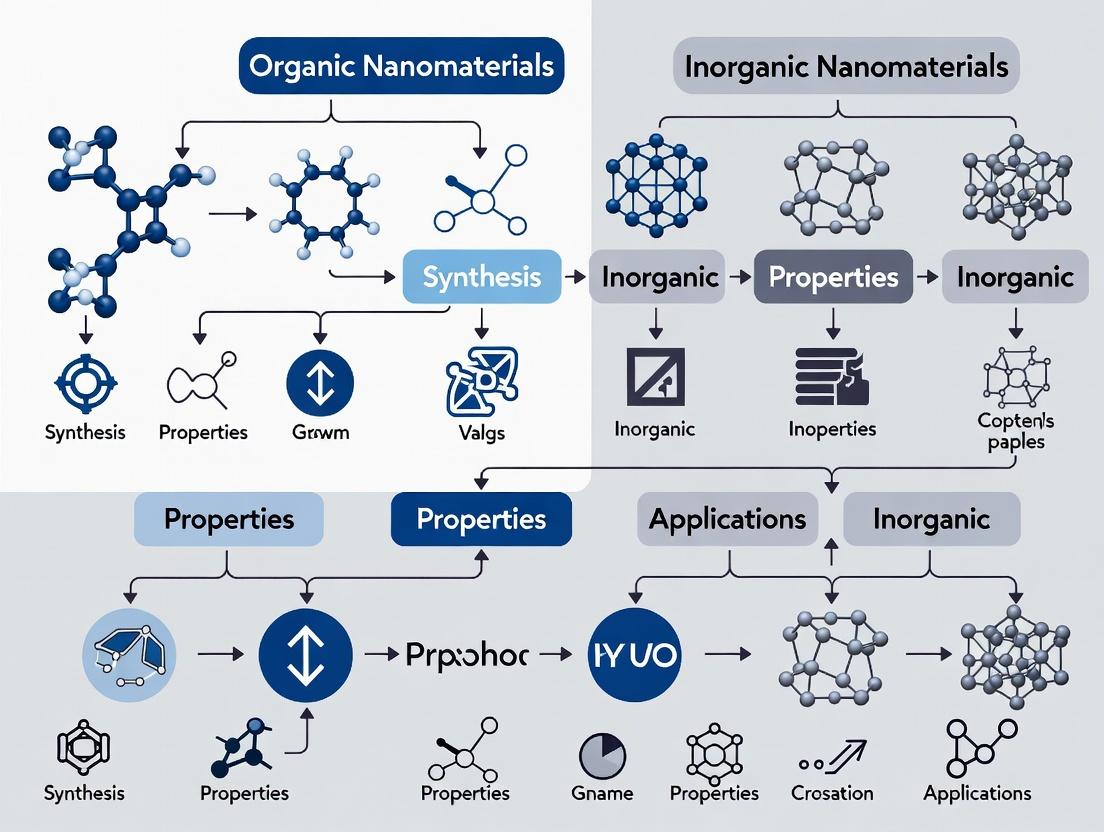
This comprehensive article elucidates the fundamental principles distinguishing organic and inorganic nanomaterials, crucial for researchers and drug development professionals.
Organic vs Inorganic Nanomaterials: Core Principles, Applications, and Selection Strategies for Biomedical Research
Abstract
This comprehensive article elucidates the fundamental principles distinguishing organic and inorganic nanomaterials, crucial for researchers and drug development professionals. It explores the foundational chemistry and properties of each class, details synthesis methodologies and key biomedical applications, addresses common challenges and optimization strategies, and provides a comparative framework for validation and material selection. The scope covers nanoparticles, dendrimers, liposomes, quantum dots, metallic and silica nanoparticles, with a focus on drug delivery, imaging, and theranostics, equipping the audience with a decision-making framework for their research.
Defining the Divide: Core Chemistry and Intrinsic Properties of Organic and Inorganic Nanomaterials
The systematic design of functional nanomaterials is predicated on a fundamental understanding of their atomic and molecular construction. The core distinction lies in the nature of the bonding forces that assemble the primary structural units. Covalent organic nanomaterials are built from light, non-metallic elements (C, H, O, N, B, etc.) linked by strong, directional covalent bonds, forming discrete molecules or extended frameworks with precise architectures. In contrast, metallic and ionic inorganic nanomaterials are primarily composed of metal atoms or ions held together by delocalized metallic bonds or non-directional ionic electrostatic forces, leading to extended lattices with properties dominated by band structure and plasmonics. This whitepaper delineates these foundational principles, providing a technical guide for researchers in nanotechnology and drug development.
Atomic-Level Bonding & Structural Motifs
2.1 Covalent Organics: Directionality and Molecular Precision Covalent bonds involve the sharing of electron pairs between atoms with high electronegativity differences < ~1.7 (Pauling scale). The geometry is dictated by hybrid orbital theory (sp³, sp², sp), leading to characteristic angles (e.g., 109.5°, 120°, 180°). This directionality enables the predictable construction of complex topologies.
- Key Motifs: Aromatic rings (benzene), aliphatic chains, hydrogen-bonding sites, and functional groups (carboxyl, amine).
- Nanoscale Manifestations: Dendrimers, covalent organic frameworks (COFs), organic nanoparticles (liposomes, polymeric NPs), carbon nanotubes (graphene derivatives).
2.2 Metallic/Ionic Inorganics: Non-Directionality and Collective Properties
- Metallic Bonding: Involves a lattice of positive metal ions immersed in a "sea" of delocalized valence electrons. This grants high electrical/thermal conductivity, malleability, and surface plasmon resonance (SPR).
- Ionic Bonding: Results from the electrostatic attraction between cations (often metals: Na⁺, Ca²⁺, Fe³⁺) and anions (often non-metals: Cl⁻, O²⁻). Bonds are strong but non-directional, forming dense, crystalline lattices.
- Nanoscale Manifestations: Metal nanoparticles (Au, Ag, Fe), quantum dots (CdSe, PbS), metal oxides (TiO₂, Fe₃O₄), and upconversion nanoparticles (NaYF₄:Yb,Er).
Table 1: Comparative Analysis of Core Properties
| Property | Covalent Organic Nanomaterials | Metallic/Ionic Inorganic Nanomaterials |
|---|---|---|
| Primary Bonding | Directional Covalent | Metallic (delocalized) / Ionic (electrostatic) |
| Typical Elements | C, H, O, N, B, S, P | Metals (Au, Ag, Fe, Cd, Pb) & Anions (O, S, Se, Cl) |
| Structural Control | High (molecular design) | Moderate (crystal facet control) |
| Electronic Structure | Discrete HOMO-LUMO gaps (tunable) | Continuous band structure; Plasmonic bands (metals) |
| Optical Properties | Absorption/Emission via molecular orbitals | SPR (metals); Band-gap photoluminescence (QDs) |
| Mechanical Behavior | Often flexible, lower stiffness | Hard, brittle (ionic); Ductile (metallic bulk, not always NP) |
| Solubility/Processing | Often soluble in organic solvents; can be functionalized | Require surface ligands for colloidal stability |
| Biocompatibility | Often inherently higher; biodegradation possible | Can be inert (Au) or pose ion release toxicity (Cd²⁺) |
| Representative NPs | Dendrimers, Liposomes, Polymer NPs, COFs | Au/Ag NPs, Fe₃O₄ NPs, CdSe/ZnS QDs, Mesoporous SiO₂ |
Experimental Protocols for Synthesis & Characterization
3.1 Protocol: Synthesis of Covalent Organic Framework (COF) Nanoparticles Objective: To synthesize crystalline, porous COF nanoparticles via solvothermal condensation.
- Reagents: 1,3,5-Triformylphloroglucinol (Tp) (monomer A), Benzidine (BD) (monomer B), mesitylene, 1,4-dioxane, acetic acid (6M aq.).
- Procedure: In a Pyrex tube, dissolve Tp (0.15 mmol) and BD (0.225 mmol) in a mixture of mesitylene/dioxane (1:2 v/v, 3 mL total). Add 0.3 mL of 6M acetic acid as catalyst. Sonicate for 10 min.
- Reaction: Seal the tube under N₂ atmosphere and heat at 120°C for 72 hours without disturbance.
- Work-up: Cool to room temperature. Collect the precipitate by centrifugation (12,000 rpm, 10 min). Wash sequentially with anhydrous THF and acetone (3x each).
- Activation: Supercritical CO₂ drying or vacuum drying at 120°C overnight to yield activated COF nanoparticles.
3.2 Protocol: Synthesis of Gold Nanospheres (Turkevich Method) Objective: To synthesize ~15 nm spherical citrate-capped Au NPs.
- Reagents: Hydrogen tetrachloroaurate(III) trihydrate (HAuCl₄·3H₂O), trisodium citrate dihydrate.
- Procedure: Bring 100 mL of 1.0 mM HAuCl₄ aqueous solution to a rolling boil under vigorous stirring in a round-bottom flask.
- Reduction: Rapidly add 10 mL of 38.8 mM trisodium citrate solution to the boiling gold solution. The solution will change from pale yellow to deep red over ~2 minutes.
- Reaction: Continue boiling and stirring for an additional 10 minutes. Remove from heat and stir until cooled to room temperature.
- Characterization: Determine size and monodispersity via UV-Vis spectroscopy (SPR peak ~520 nm) and dynamic light scattering (DLS).
Visualization of Key Concepts & Workflows
Diagram 1: Synthesis pathways for organic COFs and inorganic Au NPs
Diagram 2: Generalized NP-cell interaction and therapeutic pathway
The Scientist's Toolkit: Essential Research Reagents & Materials
Table 2: Key Reagent Solutions for Featured Experiments
| Reagent / Material | Function & Relevance | Example in Protocol |
|---|---|---|
| 1,3,5-Triformylphloroglucinol (Tp) | Aromatic aldehyde monomer for Schiff-base COF synthesis; provides structural rigidity and binding sites. | COF Synthesis (Monomer A) |
| Benzidine (BD) | Aromatic amine comonomer; reacts with aldehydes to form β-ketoenamine-linked COFs, enhancing stability. | COF Synthesis (Monomer B) |
| HAuCl₄·3H₂O | Gold(III) chloride precursor; water-soluble source of Au³⁺ ions for reduction to metallic Au⁰ nanoparticles. | Au NP Synthesis |
| Trisodium Citrate | Dual-function agent: reduces Au³⁺ to Au⁰ and acts as a capping ligand via carboxylate groups, stabilizing NPs. | Au NP Synthesis (Reductant/Capping Agent) |
| Mesitylene & 1,4-Dioxane | Solvent mixture for COF synthesis; moderates reaction kinetics and promotes crystallinity via slow condensation. | COF Synthesis (Solvent System) |
| Acetic Acid (6M aq.) | Catalyzes the reversible Schiff-base reaction in COF formation, enabling error correction and crystallinity. | COF Synthesis (Catalyst) |
| Polyethylene Glycol (PEG)-Thiol | Common surface functionalization reagent; forms self-assembled monolayers on Au NPs for enhanced biocompatibility. | Post-synthesis NP Functionalization |
| Dialysis Membranes (MWCO) | Purifies nanoparticles by removing small-molecule impurities, unreacted monomers, and excess ligands. | NP Purification |
| THF & Acetone | Low-surface-tension solvents for washing porous COFs; prevent pore collapse during solvent removal. | COF Work-up |
Within the broader thesis contrasting organic and inorganic nanomaterials, organic platforms are defined by carbon-based covalent frameworks offering inherent biocompatibility, synthetic versatility, and functional adaptability. This guide details the core classes—polymers, lipids, and dendrimers—that underpin advancements in drug delivery, diagnostics, and tissue engineering, distinguishing them from inorganic counterparts by their dynamic interaction with biological systems.
Core Classes, Building Blocks, and Quantitative Properties
Table 1: Core Organic Nanomaterial Classes and Characteristics
| Class | Primary Building Blocks | Key Nanostructures | Typical Size Range (nm) | Key Advantages | Primary Applications |
|---|---|---|---|---|---|
| Polymers | Vinyl monomers, lactic/glycolic acids, ε-caprolactone, amino acids. | Micelles, nanoparticles, nanocapsules, nanogels. | 10-500 | High drug loading, tunable degradation, functionalizable backbone. | Controlled drug release, gene delivery, tissue scaffolds. |
| Lipids | Phospholipids, sphingolipids, cholesterol, fatty acids. | Liposomes, solid lipid nanoparticles (SLNs), nanostructured lipid carriers (NLCs). | 50-200 | Innate biocompatibility, ability to fuse with cell membranes. | IV drug delivery, mRNA vaccines, topical formulations. |
| Dendrimers | Di-amines, acrylates, polyamidoamine (PAMAM) cores. | Monodisperse dendritic structures. | 2-10 | Multivalent surface, precise molecular weight, controlled architecture. | Molecular carriers, contrast agents, antiviral therapeutics. |
Table 2: Comparative Physicochemical Properties
| Property | Polymeric NPs (PLGA) | Liposomes (DOPC/Chol) | PAMAM Dendrimers (G4) |
|---|---|---|---|
| Zeta Potential (mV) | -25 to -40 | -10 to +10 (chg. dependent) | +35 to +45 (amine-terminated) |
| Drug Encapsulation Efficiency (%) | 30-70 | 50-90 | 20-60 (covalent conj.) |
| Degradation Time | Weeks to months | Hours to days (fusion/rupture) | Stable, non-degrading |
| Scalability | High | Moderate | Low (complex synthesis) |
Synthesis and Experimental Protocols
Protocol: Nanoprecipitation for Polymeric Nanoparticles (PLGA)
Objective: Prepare drug-loaded PLGA nanoparticles. Reagents: PLGA (50:50, MW 10kDa), acetone (organic phase), poloxamer 407 (surfactant), deionized water (aqueous phase), active pharmaceutical ingredient (API). Procedure:
- Dissolve 100 mg PLGA and 10 mg API in 10 mL acetone (organic phase).
- Prepare 50 mL of 0.5% w/v poloxamer 407 aqueous solution, stir at 600 rpm.
- Using a syringe pump, add the organic phase to the aqueous phase at a rate of 1 mL/min under constant stirring.
- Stir for 4 hours to evaporate acetone.
- Centrifuge at 20,000 x g for 30 min, resuspend pellet in PBS, and filter through a 0.45 µm membrane.
- Characterize by DLS (size, PDI) and HPLC (encapsulation efficiency).
Protocol: Thin-Film Hydration for Liposomes
Objective: Prepare blank or drug-loaded liposomes. Reagents: DOPC, cholesterol, DSPE-PEG2000, chloroform, PBS buffer (pH 7.4). Procedure:
- Dissolve lipid mixture (e.g., DOPC:Chol:DSPE-PEG = 55:40:5 molar ratio) in chloroform in a round-bottom flask.
- Evaporate chloroform using a rotary evaporator (40°C, 30 min) to form a thin lipid film.
- Dry film under vacuum overnight to remove residual solvent.
- Hydrate film with PBS (pre-warmed to 60°C) to a final lipid concentration of 10 mM, vortexing vigorously for 1 hour.
- Extrude the suspension through polycarbonate membranes (0.1 µm pore size) 21 times using a mini-extruder.
- Characterize by DLS and measure phospholipid content via Bartlett assay.
Diagram: Organic Nanomaterial Synthesis Workflow
Diagram Title: Organic Nanomaterial Synthesis Steps
The Scientist's Toolkit: Key Research Reagent Solutions
Table 3: Essential Reagents and Their Functions
| Reagent/Material | Function in Research | Example Use Case |
|---|---|---|
| PLGA (50:50 lactide:glycolide) | Biodegradable polymer backbone for nanoparticle formation. | Core matrix for sustained-release drug delivery systems. |
| DOPC (1,2-dioleoyl-sn-glycero-3-phosphocholine) | Primary phospholipid for forming fluid lipid bilayers. | Creating model membrane liposomes for fusion studies. |
| PAMAM Dendrimer (Generation 4, NH2 termini) | Precise, multivalent nanocarrier for covalent conjugation. | Attaching siRNA or targeting ligands for cell-specific delivery. |
| DSPE-PEG2000 | PEGylated lipid for imparting stealth properties to nanoparticles. | Coating liposomes or polymeric NPs to reduce phagocytic clearance. |
| Poloxamer 407 | Non-ionic surfactant for stabilizing emulsions and nanoparticles. | Stabilizer in nanoprecipitation to prevent aggregation. |
| Cholesterol | Lipid modulator to increase membrane stability and rigidity. | Incorporated into liposomal formulations to reduce leakage. |
| Cyanine5 NHS ester | Near-infrared fluorescent dye for labeling and tracking. | Covalently conjugated to amine groups on NPs for in vivo imaging. |
| Methoxy PEG-thiol | Thiol-reactive PEG for surface functionalization of gold or quantum dots. | Creating stealth coatings on inorganic-organic hybrid NPs. |
Diagram: Cellular Uptake Pathways for Organic Nanomaterials
Diagram Title: Cellular Uptake and Intracellular Trafficking
Critical Analysis: Organic vs. Inorganic Building Principles
The fundamental thesis distinguishing organic from inorganic nanomaterials lies in their building block identity and bonding. Organic nanomaterials derive functionality from directed covalent synthesis (e.g., dendrimer growth) or supra-molecular self-assembly (e.g., lipid bilayers) of carbon-based units, enabling "soft," dynamic structures that often mimic biological components. In contrast, inorganic nanomaterials (quantum dots, gold nanoparticles, mesoporous silica) are built from metal or metalloid precursors via crystal growth or deposition, resulting in "hard" structures defined by rigid lattices and plasmonic or semiconductor properties. The organic classes detailed here excel in biodegradability and pharmacokinetic modulation but may lack the innate optical, magnetic, or electronic properties of inorganic systems, driving the current frontier in precisely engineered organic-inorganic hybrids.
This guide details prominent inorganic nanomaterial (INM) classes, framed within the broader thesis of basic principles distinguishing organic and inorganic nanomaterials research. The fundamental divergence lies in composition and bonding: organic nanomaterials are carbon-based, utilizing covalent carbon-carbon/hydrogen bonds, enabling flexible structures like polymers and liposomes. In contrast, INMs are characterized by ionic/metallic bonding, crystalline lattices, and compositions of metals, metal oxides, silica, or semiconductors, yielding distinct optical, electronic, magnetic, and catalytic properties. This inherent difference dictates divergent synthesis routes, surface functionalization strategies, biocompatibility profiles, and ultimate applications in fields like drug delivery, imaging, and diagnostics.
Core Inorganic Nanomaterial Types: Synthesis, Properties, and Applications
Metallic Nanoparticles (e.g., Au, Ag, Fe)
Primary Synthesis: The Turkevich method (citrate reduction of HAuCl4) is a standard for spherical gold nanoparticles. Key Properties: Surface Plasmon Resonance (SPR), strong optical absorption/scattering, facile surface chemistry, superparamagnetism (Fe). Applications: Biosensing, photothermal therapy, MRI contrast agents (iron oxide), catalytic converters.
Metal Oxide Nanoparticles (e.g., Fe3O4, TiO2, ZnO)
Primary Synthesis: Co-precipitation of Fe²⁺ and Fe³⁺ salts in basic aqueous solution for magnetite (Fe3O4). Key Properties: Magnetic responsiveness, photocatalytic activity (TiO2, ZnO), wide bandgap semiconductors. Applications: Targeted drug delivery (magnetic guidance), antimicrobial coatings, sunscreens, photovoltaic cells.
Silica Nanoparticles (Mesoporous Silica NPs - MSNs)
Primary Synthesis: Sol-gel process using tetraethyl orthosilicate (TEOS) as a precursor, often with a surfactant template (e.g., CTAB) for mesoporosity. Key Properties: High surface area, tunable pore size, excellent chemical/thermal stability, ease of surface modification. Applications: High-capacity drug delivery vectors, controlled release systems, biosensing platforms.
Quantum Dots (QDs) (e.g., CdSe, InP)
Primary Synthesis: Hot-injection method: rapid injection of precursors into hot coordinating solvent (e.g., trioctylphosphine oxide). Key Properties: Size-tunable photoluminescence, broad absorption/narrow emission, high quantum yield, photostability. Applications: Multiplexed cellular imaging, in vivo tracking, LED displays, photovoltaic devices.
Quantitative Comparison of Key Properties
Table 1: Comparative Properties of Prominent Inorganic Nanomaterials
| Nanomaterial Type | Typical Size Range | Key Optical Property | Key Electronic/Magnetic Property | Common Surface Coating | Primary Biomedical Application |
|---|---|---|---|---|---|
| Gold Nanoparticles | 2-100 nm | Surface Plasmon Resonance (SPR) Peak: 520-850 nm | Conductive, Non-magnetic (except alloyed) | PEG, Thiolated Polymers, Antibodies | Photothermal Therapy, Lateral Flow Assays |
| Iron Oxide (Fe3O4) | 5-50 nm | N/A (Optically Absorptive) | Superparamagnetic (Ms: ~60-90 emu/g) | Dextran, PEG, Silica, Dimercaptosuccinic acid | MRI Contrast (T₂), Magnetic Hyperthermia |
| Mesoporous Silica | 50-300 nm | N/A (Can be doped with fluorophores) | Insulator | Amine, Carboxyl, PEG, Phosphonate | Drug Delivery (Loading: up to 30% wt/wt) |
| CdSe/ZnS QDs | 2-10 nm (core) | Emission λ: 450-650 nm (size-dependent); QY: 50-90% | Semiconductor (Bandgap: 1.7-2.8 eV) | PEG, Amphiphilic Polymers, Mercaptoalkanoic Acids | Multiplexed Bioimaging |
Table 2: Synthesis Methods and Critical Parameters
| Nanomaterial | Standard Synthesis Method | Key Reaction Parameters | Yield (Typical) | Size Control Agent |
|---|---|---|---|---|
| Gold NPs (Spherical) | Turkevich (Citrate Reduction) | [HAuCl4]: ~0.25-1 mM; Citrate:Au molar ratio: 3:1 to 10:1; Temp: 100°C | >95% | Sodium Citrate (Reductant & Stabilizer) |
| Magnetite (Fe3O4) NPs | Co-precipitation | Fe³⁺:Fe²⁺ molar ratio: 2:1; pH: 9-11; Temp: 70-80°C; Inert Atmosphere (N₂) | 70-85% | Coating added in situ (e.g., citrate, oleate) |
| Mesoporous Silica NPs | Modified Stöber (Sol-Gel) | TEOS precursor; [CTAB template]; NaOH catalyst; Temp: 80°C; Stirring: 2h | 60-80% | Surfactant Template (CTAB) defines pore size |
| CdSe QDs | Hot-Injection | CdO + OA -> Cd(OA)₂ at 300°C; Rapid Se/TOP injection; Growth: 250-300°C | ~90% (for precursors) | Oleic Acid/Trioctylphosphine Oxide (TOPO) |
Detailed Experimental Protocols
Protocol 1: Synthesis of 15 nm Citrate-Capped Gold Nanoparticles (Turkevich Method)
- Reagents: Hydrogen tetrachloroaurate(III) trihydrate (HAuCl4·3H2O), Trisodium citrate dihydrate (Na3C6H5O7·2H2O), deionized water (18.2 MΩ·cm).
- Procedure: a. Prepare a 1.0 mM HAuCl4 solution (100 mL in a 250 mL round-bottom flask). b. Heat the solution to boiling with vigorous stirring on a hot plate. c. Rapidly add 3.0 mL of a 1% (w/v) trisodium citrate solution. d. Observe a color change from pale yellow to deep red within minutes. e. Continue heating and stirring for 15 minutes, then remove from heat and allow to cool while stirring. f. Characterize by UV-Vis spectroscopy (SPR peak ~520 nm) and Dynamic Light Scattering (DLS).
- Critical Notes: All glassware must be thoroughly cleaned with aqua regia and rinsed with copious DI water. Reaction kinetics and final size are sensitive to the citrate-to-gold ratio, temperature, and stirring rate.
Protocol 2: Synthesis of Magnetite (Fe3O4) Nanoparticles via Co-precipitation
- Reagents: Ferric chloride hexahydrate (FeCl3·6H2O), Ferrous chloride tetrahydrate (FeCl2·4H2O), Ammonium hydroxide (NH4OH, 28-30%), Deoxygenated DI water, Sodium citrate (optional for coating).
- Procedure (under N2 atmosphere): a. Dissolve FeCl3·6H2O (1.62 g, 6 mmol) and FeCl2·4H2O (0.60 g, 3 mmol) in 80 mL of deoxygenated DI water (Fe³⁺:Fe²⁺ = 2:1). b. Heat the solution to 70°C with mechanical stirring under a constant N2 flow. c. Rapidly add 10 mL of NH4OH solution. A black precipitate forms immediately. d. Stir for 45 minutes at 70°C. For citrate coating, add 1.0 g of sodium citrate and stir for an additional 30 minutes. e. Cool to room temperature. Separate particles using a magnet and wash 3x with DI water/ethanol.
- Critical Notes: Oxygen exclusion is crucial to prevent oxidation to maghemite (γ-Fe2O3). pH must be >9 for complete precipitation.
Visualizations: Synthesis and Functionalization Pathways
Title: Turkevich Synthesis of Gold Nanoparticles
Title: General INM Biofunctionalization Workflow
The Scientist's Toolkit: Essential Research Reagents & Materials
Table 3: Key Reagent Solutions for INM Synthesis and Functionalization
| Reagent/Material | Primary Function | Example Use Case | Critical Notes |
|---|---|---|---|
| Tetraethyl Orthosilicate (TEOS) | Silicon alkoxide precursor for silica nanoparticles. Hydrolyzes and condenses to form SiO2 networks. | Synthesis of Stöber silica or mesoporous silica nanoparticles (MSNs). | Must be stored anhydrous. Reaction rate controlled by water, catalyst (NH4OH), and solvent (ethanol). |
| Cetyltrimethylammonium Bromide (CTAB) | Cationic surfactant template for mesostructure formation. Forms micelles around which silica condenses. | Creating ordered mesopores in MSNs. | Toxic. Requires careful removal via calcination or solvent extraction post-synthesis. |
| Poly(ethylene glycol) Thiol (HS-PEG-COOH) | Thiol-terminated PEG for creating stealth coatings on noble metal (Au, Ag) surfaces. Provides colloidal stability, reduces opsonization. | PEGylation of gold nanoparticles for in vivo applications. | Thiol group provides strong Au-S bond. PEG chain length (MW) impacts pharmacokinetics. |
| (3-Aminopropyl)triethoxysilane (APTES) | Amine-functional silane coupling agent. Silanol groups bind to oxide surfaces (SiO2, Fe3O4, TiO2), exposing primary amines. | Introducing amine groups on nanoparticle surfaces for subsequent bioconjugation. | Requires careful control of water content to prevent excessive polymerization/aggregation. |
| Sulfo-N-hydroxysuccinimide (Sulfo-NHS) & 1-Ethyl-3-(3-dimethylaminopropyl)carbodiimide (EDC) | Zero-length crosslinkers for coupling carboxylates to primary amines. EDC activates -COOH, Sulfo-NHS forms stable amine-reactive ester. | Conjugating antibodies (amines) to carboxylated nanoparticle surfaces (e.g., PEG-coated QDs). | Reactions are pH-sensitive (optimum pH 7-8). Sulfo-NHS ester is water-soluble but hydrolyzes quickly. |
| Oleic Acid & Trioctylphosphine Oxide (TOPO) | High-temperature coordinating solvents and surfactants. Stabilize growing nanocrystals, control growth kinetics and morphology. | Synthesis of high-quality, monodisperse quantum dots (CdSe, CdS) and metal oxide nanoparticles. | TOPO must be dried and degassed. Oleic acid acts as both ligand and reaction medium. |
Within the paradigm of organic versus inorganic nanomaterials research, the selection of a material class for biomedical and technological applications hinges on a critical understanding of four inherent properties: biocompatibility, degradation profile, mechanical strength, and optical traits. This whitepaper provides an in-depth technical comparison of these fundamental properties, serving as a guide for rational nanomaterial design. The core thesis posits that organic nanomaterials (e.g., polymeric nanoparticles, liposomes, dendrimers) derive their properties from molecular structure and supramolecular assembly, whereas inorganic nanomaterials (e.g., quantum dots, gold nanoparticles, mesoporous silica) are governed by crystal structure, surface chemistry, and quantum confinement effects.
Quantitative Property Comparison
Table 1: Inherent Properties of Representative Organic Nanomaterials
| Material Class | Biocompatibility (Cytotoxicity) | Degradation Time (Typical) | Mechanical Strength (Young's Modulus) | Optical Traits (Key Feature) |
|---|---|---|---|---|
| PLGA Nanoparticles | High ( >80% cell viability at 100 µg/mL) | 2-6 months (hydrolytic) | ~2-4 GPa | Opaque, often fluorescently tagged |
| Liposomes | Very High (Mimic cell membranes) | Hours to days (fusogenic) | Bending modulus: ~10-200 kBT | Low intrinsic contrast, require labeling |
| Chitosan NPs | High (pH-dependent) | Days to weeks (enzymatic) | ~1-3 GPa | Low autofluorescence |
| PEG-Polymer Micelles | Excellent (stealth effect) | Stable; disassembles | Variable, soft (0.1-1 GPa) | Encapsulation of dyes |
Table 2: Inherent Properties of Representative Inorganic Nanomaterials
| Material Class | Biocompatibility (Cytotoxicity) | Degradation/Stability | Mechanical Strength (Young's Modulus) | Optical Traits (Key Feature) |
|---|---|---|---|---|
| Gold Nanoparticles | Moderate-High (Surface-dependent) | Non-degradable, stable | ~80 GPa (bulk) | Surface Plasmon Resonance (Tunable LSPR) |
| Cadmium Selenide QDs | Low (Heavy metal leakage) | Photobleaching resistant | ~70-90 GPa | Narrow, tunable emission; high QY |
| Mesoporous Silica | Moderate (Surface silanol groups) | Slow dissolution (weeks-months) | ~70-90 GPa | Low absorption, translucence |
| Iron Oxide NPs | High (with coating) | Slow oxidation/iron metabolism | High hardness | Superparamagnetic (not optical) |
Experimental Protocols for Property Assessment
Protocol:In VitroBiocompatibility/Cytotoxicity Assay (MTT Assay)
Objective: Quantify cell viability after nanomaterial exposure. Materials: Nanomaterial suspension, cell line (e.g., HEK293), Dulbecco’s Modified Eagle Medium (DMEM), fetal bovine serum (FBS), MTT reagent (3-(4,5-dimethylthiazol-2-yl)-2,5-diphenyltetrazolium bromide), DMSO, 96-well plate, CO2 incubator, microplate reader. Procedure:
- Seed cells in a 96-well plate at 10,000 cells/well and incubate for 24h.
- Prepare serial dilutions of the nanomaterial in complete media.
- Aspirate media from wells and add 100 µL of nanomaterial suspension per well. Include untreated control wells.
- Incubate for 24-48h.
- Add 10 µL of MTT solution (5 mg/mL in PBS) to each well. Incubate for 4h.
- Carefully aspirate media and add 100 µL of DMSO to solubilize formazan crystals.
- Shake plate gently for 10 minutes.
- Measure absorbance at 570 nm with a reference at 630 nm using a microplate reader.
- Calculate viability: % Viability = (Abssample / Abscontrol) * 100.
Protocol: Hydrolytic Degradation Profiling of Polymeric NPs
Objective: Measure mass loss and molecular weight change over time. Materials: Lyophilized nanoparticles, phosphate-buffered saline (PBS, pH 7.4), shaking water bath, centrifugal filters (MWCO 10 kDa), gel permeation chromatography (GPC) system. Procedure:
- Weigh accurately 20 mg of nanoparticles (W0) into microcentrifuge tubes.
- Add 2 mL of PBS (with 0.02% sodium azide) to each tube.
- Place tubes in a shaking water bath at 37°C, 100 rpm.
- At predetermined time points (e.g., 1, 7, 14, 28 days), remove tubes in triplicate.
- Centrifuge at 15,000 rpm for 15 min. Carefully collect supernatant for degradation product analysis.
- Wash the pellet with DI water, lyophilize, and weigh (Wt).
- Calculate mass loss: % Mass Loss = [(W0 - Wt) / W0] * 100.
- Redissolve a portion of the lyophilized pellet in GPC solvent for molecular weight analysis.
Protocol: Nanoindentation for Mechanical Strength
Objective: Determine Young's modulus of a nanoparticle film. Materials: Nanoparticle film on rigid substrate, nanoindenter with Berkovich tip, atomic force microscope (AFM) for validation. Procedure:
- Prepare a dense, smooth film of nanoparticles via spin-coating or drop-casting.
- Mount sample in the nanoindenter. Set environmental parameters (temperature, humidity).
- Perform a grid of indents (e.g., 5x5) with controlled force/displacement. Use a standard Oliver-Pharr method.
- For each indent, record the load-displacement curve.
- Calculate the reduced modulus (Er) from the unloading curve's slope. Convert to sample Young's modulus (Es) using Poisson's ratio (νs) and the tip's modulus (Ei) and Poisson's ratio (νi): 1/Er = (1-νs²)/Es + (1-νi²)/Ei.
- Perform statistical analysis on the grid data.
Protocol: Characterization of Optical Properties (Absorption/Emission)
Objective: Measure UV-Vis absorption and photoluminescence spectra. Materials: Nanomaterial colloid in solvent, quartz cuvette (1 cm path length), UV-Vis-NIR spectrophotometer, fluorometer. Procedure:
- Dilute the nanomaterial suspension to an appropriate optical density (OD < 0.1 at the excitation wavelength for fluorescence).
- For absorption: Blank the spectrophotometer with the pure solvent. Place sample in cuvette and acquire spectrum from 200-1100 nm.
- For photoluminescence: Set the excitation monochromator to the desired wavelength (often at the absorption maximum). Acquire the emission spectrum across a relevant range. Adjust slit widths for signal intensity.
- For quantum yield (QY) measurement: Use a known standard (e.g., Rhodamine 6G for visible) with matched absorbance at the excitation wavelength. Compare integrated emission intensities of sample and standard, correcting for solvent refractive index.
Visualizations
Diagram 1: Property Assessment Workflow
Diagram 2: Organic vs Inorganic Property Determinants
The Scientist's Toolkit: Research Reagent Solutions
Table 3: Essential Materials for Nanomaterial Property Evaluation
| Item/Category | Example Product/Technique | Function in Experiments |
|---|---|---|
| Cell Viability Assay Kit | MTT, CCK-8, AlamarBlue | Quantifies metabolic activity as a proxy for cytotoxicity. |
| Standard Polymer | PLGA (50:50, Resomer RG 503H) | Positive control for degradation studies; well-characterized benchmark. |
| Phosphate Buffered Saline | PBS, pH 7.4 (without calcium) | Standard medium for hydrolytic degradation and biocompatibility dilutions. |
| Gel Permeation Chromatography | Agilent PL-GPC 50 with refractive index detector | Measures molecular weight distribution changes during polymer degradation. |
| Nanoindentation System | Keysight G200 or Hysitron TI 950 | Applies precise force to measure hardness and elastic modulus of thin films/particles. |
| UV-Vis Spectrophotometer | Agilent Cary 6000i | Measures absorption spectra for concentration determination and optical property analysis. |
| Fluorometer | Horiba Fluorolog or PTI QuantaMaster | Measures photoluminescence spectra, quantum yield, and lifetime. |
| Dynamic Light Scattering | Malvern Zetasizer Nano ZS | Measures nanoparticle hydrodynamic size and zeta potential in suspension. |
| Reference Quantum Yield Standard | Rhodamine 6G (in ethanol) | Calibrated standard for determining the photoluminescence quantum yield of new materials. |
The synthetic divide between organic and inorganic nanomaterials often obscures a fundamental unity: their ultimate utility in advanced applications, from targeted drug delivery to quantum sensing, is overwhelmingly determined by their surface chemistry. Regardless of core composition—be it a polymeric nanoparticle, a liposome, a quantum dot, or a mesoporous silica particle—the interface with the biological or material environment is governed by similar physico-chemical principles. This guide posits that functionalization strategies, the deliberate engineering of surface properties, form a common conceptual and methodological realm. The core thesis is that mastering these surface engineering techniques, which transcend the organic/inorganic dichotomy, is more critical for applied outcomes than the intrinsic properties of the nanomaterial core itself.
Foundational Chemistry: The Common Toolkit
Surface functionalization relies on a set of well-established chemical reactions that are agnostic to the substrate's organic or inorganic nature, provided suitable anchoring points exist.
2.1 Covalent Grafting Strategies
- Amino-Coupling: Reaction of primary amines with activated esters (e.g., NHS-esters) or carboxylic acids (via EDC/NHS chemistry) to form stable amide bonds. Universal for surfaces bearing -COOH or -NH₂ groups.
- Click Chemistry: Copper-catalyzed Azide-Alkyne Cycloaddition (CuAAC) or strain-promoted (SPAAC) variants provide high specificity and yield under mild conditions, ideal for complex biomolecule conjugation.
- Thiol-Metal & Thiol-Disulfide Exchange: Thiol groups (-SH) bind strongly to gold, silver, and other metals (forming Au-S bonds) and also undergo reversible disulfide exchange, useful for dynamic surfaces.
- Silane Coupling: The workhorse for oxide surfaces (SiO₂, TiO₂, Fe₃O₄). Organosilanes (e.g., (3-Aminopropyl)triethoxysilane, APTES) form stable Si-O-Si bonds, presenting organic functional groups (amine, epoxy, thiol) for further reaction.
2.2 Non-Covalent Strategies
- Electrostatic Layer-by-Layer (LbL): Alternating deposition of polycations and polyanions on charged surfaces. Applicable to colloidal particles of all types for building multi-functional shells.
- Hydrophobic Insertion/Adsorption: Amphiphilic molecules (e.g., phospholipids, polymers) embed into hydrophobic domains of polymeric nanoparticles or lipid bilayers.
- Biotin-Avidin/Streptavidin Binding: Exploits the ultra-high affinity (Kd ~10⁻¹⁵ M) between biotin and (strept)avidin. A universal "molecular glue" for attaching biotinylated ligands to (strept)avidin-coated nanocarriers.
Quantitative Comparison of Functionalization Methods
Table 1: Key Metrics for Common Functionalization Strategies
| Strategy | Bond Type | Typical Density (groups/nm²) | Stability | Orthogonality | Primary Nanomaterial Suitability |
|---|---|---|---|---|---|
| Silanization (e.g., APTES) | Covalent (Si-O-Si) | 2 - 6 | High (Hydrolyzes at extreme pH) | Moderate | Inorganic Oxides (SiO₂, Fe₃O₄) |
| Thiol-Gold | Covalent (Au-S) | ~4.6 (on Au(111)) | High (Oxidizes under strong oxidizers) | High | Metallic NPs (Au, Ag) |
| EDC/NHS Coupling | Covalent (Amide) | Limited by surface -COOH/-NH₂ | High | Low | Polymers, Lipids, Oxides |
| CuAAC Click | Covalent (Triazole) | Varies, often high | High | Very High | Any (with azide/alkyne handle) |
| Streptavidin-Biotin | Non-Covalent | ~1.5 (streptavidin/nm²) | Very High | Very High | Universal (via pre-coating) |
| Electrostatic LbL | Non-Covalent | N/A (multilayer) | Moderate (pH, ionic strength dependent) | Low | Charged Surfaces (Universal) |
Table 2: Characterization Techniques for Functionalized Surfaces
| Technique | Information Gained | Detection Limit/Sensitivity | Sample Requirement |
|---|---|---|---|
| X-ray Photoelectron Spectroscopy (XPS) | Elemental composition, chemical state | ~0.1-1 at% | Solid, ultra-high vacuum |
| Fourier-Transform IR Spectroscopy (FTIR) | Functional group identification | ~1% monolayer | Solid or liquid |
| Thermogravimetric Analysis (TGA) | Organic content, grafting density | ~1 µg | Powder |
| Dynamic Light Scattering (DLS) | Hydrodynamic size, surface charge (Zeta potential) | ~0.3 nm (size change) | Colloidal suspension |
| Fluorescence Assay | Quantification of tagged ligands (e.g., FITC) | pM-nM | Solution or solid |
Detailed Experimental Protocols
Protocol 1: Standard Aminosilane Functionalization of Mesoporous Silica Nanoparticles (MSNs) This protocol is directly applicable to other oxide surfaces (TiO₂, Fe₃O₄).
- Activation: Disperse 50 mg of purified MSNs in 50 mL of anhydrous toluene under nitrogen atmosphere.
- Silanization: Add 200 µL of (3-Aminopropyl)triethoxysilane (APTES) dropwise with vigorous stirring.
- Reaction: Reflux the mixture at 110°C under N₂ for 18-24 hours.
- Purification: Centrifuge (15,000 rpm, 15 min) and wash sequentially with toluene, ethanol, and deionized water (3x each) to remove unreacted silane.
- Curing: Dry the pellet under vacuum at 80°C for 4 hours to complete condensation. Store under inert atmosphere.
- Validation: Confirm amine grafting via (a) positive ninhydrin test (color change to purple), (b) shift in zeta potential to positive values in neutral pH, and (c) characteristic N1s peak in XPS (~399.5 eV).
Protocol 2: EDC/NHS-Mediated Antibody Conjugation to PEGylated PLGA Nanoparticles A universal protocol for coupling carboxyl-terminated surfaces to amine-containing biomolecules.
- Surface Activation: In 2 mL of MES buffer (0.1 M, pH 6.0), disperse 5 mg of COOH-PEG-PLGA NPs. Add 10 µL of freshly prepared EDC (400 mM) and 25 µL of NHS (100 mM) solutions.
- Incubation: React for 15 minutes at room temperature with gentle agitation.
- Purification: Isolate activated NPs using a size-exclusion column (e.g., Sephadex G-25) pre-equilibrated with coupling buffer (PBS, pH 7.4).
- Conjugation: Immediately mix the eluted NPs with 100 µg of the target antibody (in PBS, pH 7.4). React for 2 hours at 4°C.
- Quenching & Final Purification: Add 50 µL of 1M glycine (or ethanolamine) to quench unreacted esters for 30 minutes. Purify via ultracentrifugation (100,000 g, 45 min) and resuspend in storage buffer.
- Validation: Use BCA assay on supernatant to determine coupling efficiency. Confirm by SDS-PAGE of stripped surface proteins or a shift in DLS size.
Visualization of Core Concepts
Universal Functionalization Workflow for Nanomaterials
EDC/NHS Bioconjugation Mechanism
The Scientist's Toolkit: Essential Research Reagents
Table 3: Key Reagents for Surface Functionalization
| Reagent / Material | Category | Primary Function | Critical Consideration |
|---|---|---|---|
| (3-Aminopropyl)triethoxysilane (APTES) | Organosilane | Introduces primary amine (-NH₂) groups onto oxide surfaces for covalent coupling. | Must be anhydrous. Use with dry solvents under inert gas to prevent polymerization. |
| 1-Ethyl-3-(3-dimethylaminopropyl)carbodiimide (EDC) | Carbodiimide Crosslinker | Activates carboxyl groups for direct coupling to amines. Often used with NHS. | Short aqueous half-life (~15 min). Requires immediate use after preparation. |
| N-Hydroxysuccinimide (NHS) / Sulfo-NHS | NHS Ester Stabilizer | Converts unstable O-acylisourea intermediate (from EDC) to stable amine-reactive NHS ester. | Sulfo-NHS is water-soluble for purely aqueous reactions. |
| Dibenzocyclooctyne (DBCO) | Strain-Promoted Alkyne | Click chemistry handle for SPAAC with azides. No cytotoxic copper catalyst needed. | High specificity. Ideal for sensitive biomolecules and live-cell labeling. |
| Methoxy-PEG-Thiol (mPEG-SH) | PEGylation Reagent | Forms self-assembled monolayer on gold surfaces or inserts into membranes, conferring "stealth" properties. | Thiol purity and molecular weight (e.g., 2kDa, 5kDa) determine layer density and performance. |
| Streptavidin, Agarose-Bound | Affinity Purification Tool | Immobilized on resin for rapid purification of biotinylated nanoparticles from excess ligand. | High binding capacity (≥2 mg biotinylated ligand/mL resin) ensures efficient removal. |
| Ninhydrin Reagent | Qualitative Assay | Detects primary amines on surfaces via Ruhemann's purple formation (colorimetric). | Simple spot-test for confirming aminosilane functionalization success. |
From Synthesis to Therapy: Fabrication Methods and Dominant Biomedical Applications
Within the broader thesis on the fundamental principles governing organic versus inorganic nanomaterials, the synthesis philosophy stands as a primary differentiator. This guide explores the core methodologies of bottom-up and top-down approaches, contextualizing their predominant application in the fabrication of polymeric nanoparticles (organic) and metal nanoparticles (inorganic), respectively. The choice of philosophy is dictated by the intrinsic chemical nature, bonding, and target applications of the nanomaterial, profoundly impacting properties like size distribution, crystallinity, surface chemistry, and scalability.
Core Philosophies and Their Material Alignment
Bottom-Up Synthesis: The Domain of Polymer NPs
The bottom-up approach constructs nanomaterials from atomic or molecular precursors via controlled chemical reactions and self-assembly. This is the predominant and most effective philosophy for polymer NPs.
Thesis Context: Organic materials, like polymers, are characterized by covalent bonding and long-chain architectures. Their synthesis inherently involves molecular assembly (polymerization) followed by nanoscale structuring. Bottom-up methods leverage this by controlling polymerization kinetics and supramolecular interactions to form well-defined nanostructures.
Primary Techniques:
- Emulsification-Solvent Evaporation/Diffusion: A polymer dissolved in an organic solvent is emulsified in an aqueous phase. Removal of the solvent leads to polymer precipitation as NPs.
- Nanoprecipitation (Solvent Displacement): A polymer solution is added to a non-solvent, causing instantaneous polymer aggregation into NPs.
- Controlled/Living Polymerizations (e.g., RAFT, ATRP): These allow precise synthesis of block copolymers that self-assemble into micelles, vesicles, or other morphologies in selective solvents.
Top-Down Synthesis: The Domain of Metal NPs
The top-down approach begins with a bulk material and uses physical or chemical energy to fragment it into nanoscale particles. This is commonly applied to inorganic metal NPs, though bottom-up methods are also extensively used.
Thesis Context: Inorganic metals possess metallic bonding and a sea of delocalized electrons. Their bulk form is often crystalline. Top-down methods physically break down this bulk lattice. While chemical reduction (a bottom-up method) is extremely common for metal NPs, top-down approaches are crucial for producing certain shapes, alloys, or when precursor-free synthesis is desired.
Primary Techniques:
- Laser Ablation: A high-energy laser pulse vaporizes material from a bulk metal target in a liquid or gas, leading to nucleation and NP formation.
- Mechanical Milling/Ball Milling: Bulk material is ground using kinetic energy from colliding balls to reduce particle size to the nanoscale.
- Lithography (e.g., E-beam, NIL): Patterns and etches a substrate to create nanostructures, more common for fixed arrays than colloidal NPs.
Table 1: Synthesis Philosophy Comparison for Polymer vs. Metal NPs
| Parameter | Polymer NPs (Organic) - Dominant: Bottom-Up | Metal NPs (Inorganic) - Common: Top-Down (e.g., Laser Ablation) |
|---|---|---|
| Typical Size Range | 20 – 500 nm | 5 – 100 nm |
| Size Dispersity (PDI) | Moderate to High (0.05 – 0.3) | Low to Moderate (0.01 – 0.2) |
| Shape Control | Good (Spheres, capsules, vesicles) | Excellent (Spheres, rods, cubes, triangles) |
| Crystallinity | Amorphous or Semicrystalline | Highly Crystalline (FCC, etc.) |
| Surface Chemistry | Highly tunable via monomer/ polymer choice | Often requires post-synthesis functionalization |
| Scalability | High (Batch reactors) | Moderate (Energy-intensive, slower throughput) |
| Key Driving Force | Chemical potential, Supramolecular interactions | Physical energy input (laser, mechanical) |
| Common Precursors | Monomers, polymers, solvents | Bulk metal target, milling media |
Table 2: Quantitative Comparison of Key Synthesis Protocols (2023-2024 Literature)
| Method | Yield (mg/h) | Avg. Size (nm) | PDI | Zeta Potential (mV) | Key Application Cited |
|---|---|---|---|---|---|
| Polymer: Nanoprecipitation | 150 | 85 | 0.12 | -25 ± 3 | Drug Delivery (Paclitaxel) |
| Polymer: Emulsion (Double) | 80 | 120 | 0.18 | -30 ± 5 | mRNA Vaccine Delivery |
| Metal: Laser Ablation (Au) | 20 | 40 | 0.09 | +35 ± 8 (in water) | Photothermal Therapy |
| Metal: Ball Milling (Fe3O4) | 500 | 25 | 0.25 | Variable | Magnetic Hyperthermia |
Detailed Experimental Protocols
Protocol: Bottom-Up Synthesis of PLGA NPs via Nanoprecipitation
Objective: To synthesize drug-loaded poly(lactic-co-glycolic acid) nanoparticles for controlled release.
Materials: See "The Scientist's Toolkit" below.
Procedure:
- Organic Phase Preparation: Dissolve 50 mg PLGA (50:50) and 5 mg of the hydrophobic drug (e.g., curcumin) in 10 mL of acetone. Vortex until clear.
- Aqueous Phase Preparation: Prepare 20 mL of a 1% (w/v) polyvinyl alcohol (PVA) solution in deionized water.
- Nanoprecipitation: Using a syringe pump set at a flow rate of 1 mL/min, inject the organic phase into the aqueous phase under magnetic stirring (600 rpm) at room temperature.
- Solvent Removal: Stir the resulting milky suspension for 3 hours at room temperature to allow complete evaporation of acetone.
- Purification: Centrifuge the suspension at 20,000 rpm for 30 minutes at 4°C. Discard the supernatant and resuspend the NP pellet in deionized water. Repeat centrifugation twice.
- Characterization: Analyze size and PDI by DLS, surface charge by Zeta Potential, and morphology by TEM.
Protocol: Top-Down Synthesis of Gold NPs via Pulsed Laser Ablation in Liquid (PLAL)
Objective: To synthesize surfactant-free gold nanoparticles in aqueous media.
Materials: High-purity gold target (99.99%), deionized water, glass vial, pulsed Nd:YAG laser (λ=1064 nm, 10 ns pulse width).
Procedure:
- Target Preparation: Clean a gold metal disc (2 mm thick) successively with acetone, ethanol, and water in an ultrasonic bath. Dry under nitrogen.
- Liquid Cell Setup: Place the gold target at the bottom of a glass vial filled with 5 mL of deionized water. The target surface should be perpendicular to the laser beam.
- Laser Ablation: Immerse the target and focus the laser beam onto its surface. Perform ablation for 10 minutes at a pulse repetition rate of 10 Hz and a fluence of 5 J/cm². Use a magnetic stirrer to circulate the liquid.
- Collection: The colorless water will turn to a characteristic pink/red color, indicating Au NP formation.
- Purification: Centrifuge the colloid at 10,000 rpm for 15 minutes to remove any large aggregates. Collect the supernatant containing the Au NPs.
- Characterization: Analyze UV-Vis spectrum (SPR peak ~520 nm), size by DLS/TEM, and composition by EDX.
Visualizations
Synthesis Philosophy Decision Flowchart
Title: Decision Flow for NP Synthesis Philosophy
Nanoprecipitation vs. Laser Ablation Workflow
Title: Side-by-Side NP Synthesis Workflows
The Scientist's Toolkit
Table 3: Essential Research Reagent Solutions & Materials
| Item | Function in Synthesis | Typical Example (Polymer NP) | Typical Example (Metal NP - Top-Down) |
|---|---|---|---|
| Biodegradable Polymer | Matrix material forming the NP core; determines degradation rate and drug release kinetics. | PLGA, PLA, Chitosan, PEG-PCL | N/A |
| Stabilizing Agent/Surfactant | Prevents NP aggregation during and after synthesis by providing steric or electrostatic stabilization. | Polyvinyl Alcohol (PVA), Poloxamers | Not always required in PLAL. |
| Organic Solvent (Water-miscible) | Dissolves polymer/drug; rapid diffusion into water drives NP formation. | Acetone, Ethyl Acetate, DMSO | N/A |
| High-Purity Metal Target | Source material for ablation; purity defines NP composition and minimizes impurities. | N/A | Gold, Silver, Titanium disc |
| Ablation Liquid Medium | Confines the plasma plume, influences NP surface chemistry, and acts as the colloidal medium. | N/A | Deionized Water, Acetone, SDS Solution |
| Centrifugal Filters | Purifies NP suspension by removing unreacted precursors, stabilizers, or solvent. | 100 kDa MWCO filters | 10-50 kDa MWCO filters |
| Lyoprotectant | Prevents aggregation during freeze-drying for long-term NP storage. | Trehalose, Sucrose, Mannitol | Trehalose, PVP |
| Chemical Crosslinker | Stabilizes polymer NP structure (e.g., for capsules) by forming covalent interchain bonds. | Glutaraldehyde, Genipin, EDC/NHS | N/A |
Within the broader thesis on the basic principles of organic versus inorganic nanomaterials research, this guide focuses on two dominant classes of organic, soft-matter nanocarriers. Inorganic nanomaterials (e.g., gold, silica, quantum dots) are prized for their structural rigidity, precise tunability, and unique optical/electronic properties. In contrast, the "organic workhorses"—liposomal and polymeric nanoparticles—leverage biocompatibility, biodegradability, and dynamic interaction with biological systems. Their organic composition, primarily carbon-based and often mimicking biological structures, allows for sophisticated drug and gene delivery by navigating complex biological barriers through stealth, targeting, and responsive release mechanisms. This document provides a technical deep-dive into their design, characterization, and application.
Liposomal Nanoparticles: Design & Formulation
Liposomes are spherical vesicles comprising one or more phospholipid bilayers enclosing an aqueous core. Their structure enables encapsulation of hydrophilic (in core) and hydrophobic (in bilayer) cargos.
Key Experimental Protocol: Thin-Film Hydration for Liposome Preparation
- Dissolution: Dissolve phospholipids (e.g., DPPC, DSPC), cholesterol, and PEGylated lipid (e.g., DSPE-mPEG2000) in an organic solvent (e.g., chloroform) in a round-bottom flask.
- Film Formation: Rotate flask under reduced pressure (using a rotary evaporator) at elevated temperature (above lipid transition temperature, Tm) to form a thin, dry lipid film.
- Hydration: Hydrate the dry film with an aqueous buffer (e.g., PBS, HEPES) containing the hydrophilic drug/gene cargo (e.g., doxorubicin, siRNA) at a temperature above the Tm of the lipid mixture. This yields multilamellar vesicles (MLVs).
- Size Reduction: Sequentially process the MLV suspension through extrusion (using polycarbonate membranes of defined pore sizes, e.g., 100 nm, 50 nm) or sonication to form small, unilamellar vesicles (SUVs).
- Purification: Remove unencapsulated cargo via dialysis, gel filtration chromatography, or tangential flow filtration.
- Sterilization: Filter through a 0.22 μm sterile membrane.
Active Loading (for weak base drugs like doxorubicin): After forming empty liposomes with a transmembrane pH gradient (internal acidic pH), incubate with the drug. The neutral form of the drug diffuses across the bilayer and becomes protonated and trapped in the acidic interior, achieving high encapsulation efficiency (>90%).
Research Reagent Solutions for Liposomal Formulation
| Reagent/Material | Function & Brief Explanation |
|---|---|
| DPPC (1,2-dipalmitoyl-sn-glycero-3-phosphocholine) | Primary phospholipid providing bilayer structure; high phase transition temperature (~41°C) confers rigidity. |
| Cholesterol | Modulates membrane fluidity and stability; reduces permeability and improves in vivo stability. |
| DSPE-PEG2000 | Polyethylene glycol-conjugated lipid; creates a hydrophilic corona that reduces opsonization and prolongs circulation half-life ("stealth" effect). |
| Ammonium Sulfate Solution | Used to create an active loading pH gradient; interior ammonium sulfate dissociates to create acidic interior upon formation of liposomes. |
| Polycarbonate Extrusion Membranes | Filters with defined pore sizes (e.g., 50, 100, 200 nm) for liposome size reduction and homogenization via extrusion. |
| Sephadex G-50/G-75 | Gel filtration medium for purifying liposomes from unencapsulated small molecule drugs or free nucleic acids. |
| Calcein | Fluorescent dye used as a model hydrophilic cargo or for membrane integrity/leakage studies. |
Liposome Preparation via Thin-Film Hydration & Extrusion
Polymeric Nanoparticles: Design & Synthesis
Polymeric nanoparticles (PNPs) are solid colloidal particles typically made from biodegradable polymers like poly(lactic-co-glycolic acid) (PLGA), chitosan, or poly(ε-caprolactone) (PCL).
Key Experimental Protocol: Nanoprecipitation for PNP Formation
- Dissolution: Dissolve the polymer (e.g., PLGA, 50 mg) and a hydrophobic drug (if any) in a water-miscible organic solvent (e.g., acetone, acetonitrile, typically 5-10 mL).
- Injection: Under moderate magnetic stirring, rapidly inject the organic solution into an aqueous phase (typically 10-20 mL) containing a stabilizer (e.g., polyvinyl alcohol, PVA; poloxamer 188).
- Formation: Spontaneous diffusion of the organic solvent into the water causes precipitation of the polymer into nanoparticles, entrapping the drug.
- Solvent Removal: Stir the suspension open to air or under reduced pressure to evaporate the organic solvent.
- Purification: Centrifuge (high-speed, e.g., 20,000 rpm for 30 min) and wash pellets to remove excess stabilizer and free drug. Resuspend in isotonic buffer.
- Sterilization: Filter through a 0.22 μm sterile membrane.
Ionotropic Gelation for Chitosan NPs (for gene delivery): Dropwise addition of anionic tripolyphosphate (TPP) solution into a chitosan solution under stirring induces ionic crosslinking, forming nanoparticles suitable for encapsulating DNA or siRNA.
Research Reagent Solutions for Polymeric Nanoparticle Formulation
| Reagent/Material | Function & Brief Explanation |
|---|---|
| PLGA (50:50, acid-terminated) | Biodegradable, FDA-approved copolymer; degrades into lactic/glycolic acids; backbone for sustained release formulations. |
| Polyvinyl Alcohol (PVA) | Surfactant/stabilizer; adsorbs to nanoparticle surface during emulsification/nanoprecipitation to prevent aggregation. |
| Dichloromethane (DCM) | Water-immiscible organic solvent used in single/double emulsion methods for encapsulating hydrophilic drugs. |
| Acetone | Water-miscible organic solvent used in nanoprecipitation method; rapid diffusion into water drives nanoparticle formation. |
| Chitosan (low MW) | Cationic polysaccharide; enables mucoadhesion and ionic complexation with nucleic acids (polyplexes) or TPP crosslinker. |
| Sodium Tripolyphosphate (TPP) | Crosslinking agent for chitosan; ionic interaction forms stable gel nanoparticles under mild conditions. |
| Poloxamer 188 (Pluronic F-68) | Non-ionic triblock copolymer surfactant; stabilizes nanoparticles and may inhibit P-glycoprotein efflux. |
Polymeric Nanoparticle Formation via Nanoprecipitation
Critical Characterization Parameters: Quantitative Comparison
Table 1: Core Characterization Metrics for Liposomal and Polymeric Nanoparticles
| Parameter | Liposomal Nanoparticles | Polymeric Nanoparticles | Standard Measurement Technique |
|---|---|---|---|
| Size (Diameter) | 80 - 150 nm (sterically stabilized) | 100 - 250 nm (PLGA NPs) | Dynamic Light Scattering (DLS) |
| Polydispersity Index (PDI) | <0.1 (ideal, monodisperse) | <0.2 (acceptable) | DLS cumulants analysis |
| Zeta Potential | Near neutral or slightly negative for PEGylated; Cationic liposomes: +20 to +60 mV | Variable: PLGA/PVA: -5 to -25 mV; Chitosan: +20 to +40 mV | Laser Doppler Velocimetry |
| Encapsulation Efficiency (EE%) | Small Molecules: >90% (active load); siRNA: 70-90% | Small Molecules: 50-80%; Proteins: 20-60% | Indirect (free drug assay) or direct (dissolution) methods |
| Drug Loading (DL%) | Typically 5-15% (w/w) | Typically 1-10% (w/w) | Calculated: (Mass of drug in NPs / Mass of NPs) x 100 |
| In Vitro Release (PBS, 37°C) | Biphasic: burst release (0-24h), then sustained (days to weeks) | Triphasic: burst, diffusion-controlled, erosion-controlled (weeks) | Dialysis bag / Franz cell; HPLC sampling |
| Sterilization Method | 0.22 μm filtration (aseptic process critical) | 0.22 μm filtration; some tolerate gamma irradiation | N/A |
Table 2: Key In Vivo Pharmacokinetic Parameters (Representative Data)
| Parameter | Conventional Liposome (no PEG) | Stealth Liposome (PEGylated) | PLGA Nanoparticle (PEGylated) | Chitosan Nanoparticle |
|---|---|---|---|---|
| Circulation Half-life (t½) | Minutes to 1-2 hours | 10 - 48 hours | 5 - 30 hours | Minutes to few hours |
| Primary Clearance Route | RES (Liver, Spleen) | Reduced RES uptake; prolonged circulation | RES uptake; liver/spleen accumulation | RES; rapid renal/biliary? |
| Tumor Accumulation (EPR Effect) | Low (rapid clearance) | Enhanced (2-5% ID/g tumor) | Moderate (1-3% ID/g tumor) | Low (limited data) |
| Key Advantage | Simplicity, high EE | Long circulation, passive targeting | Sustained release, tunable degradation | Mucoadhesion, cationic for nucleic acids |
Intracellular Delivery & Signaling Pathways
For gene delivery, both systems must facilitate endosomal escape to avoid lysosomal degradation and enable cytosolic release.
Liposomal (Cationic Liposome/siRNA Complex) Pathway:
- Complexation: Cationic lipids (e.g., DOTAP) electrostatically condense nucleic acids into lipoplexes.
- Cellular Uptake: Primarily via endocytosis (clathrin-mediated, caveolae, or macropinocytosis).
- Endosomal Escape: The "proton sponge" effect (for ionizable cationic lipids, pKa ~6.5) or membrane fusion/disruption leads to cargo release into cytosol.
- siRNA RISC Loading: Released siRNA loads into the RNA-induced silencing complex (RISC).
- Target mRNA Cleavage: RISC-mediated cleavage of complementary mRNA.
Liposomal siRNA Delivery & Intracellular Pathway
Polymeric (Chitosan/DNA Polyplex) Pathway:
- Polyplex Formation: Cationic chitosan condenses DNA via electrostatic interaction.
- Cellular Uptake: Endocytosis, often enhanced by mucoadhesion.
- Endosomal Escape: Proposed buffering capacity of chitosan's amine groups causes proton influx, chloride entry, osmotic swelling, and endosome rupture.
- Nuclear Entry: For DNA, the polyplex must traffic to and enter the nucleus, a major barrier (often relies on cell division or nuclear localization signals).
- Gene Expression: DNA transcription and translation.
Advanced Targeting & Stimuli-Responsive Designs
Ligand Targeting (Active Targeting): Conjugation of antibodies, peptides (e.g., RGD, transferrin), or small molecules (folate) to the nanoparticle surface (via PEG terminus) for receptor-mediated uptake.
Stimuli-Responsive Release:
- pH-Sensitive: Use of lipids (e.g., DOPE) or polymers (e.g., poly(β-amino ester)) that become fusogenic or degrade in acidic endosomal/tumor environments.
- Enzyme-Sensitive: Incorporation of peptide linkers cleavable by tumor-associated enzymes (e.g., matrix metalloproteinases).
- Redox-Sensitive: Use of disulfide linkages in polymers or lipid conjugates that cleave in the reducing cytosolic environment.
Liposomal and polymeric nanoparticles represent the foundational pillars of organic nanomedicine. Their design principles—rooted in the chemistry of lipids and polymers—allow for engineering around the core thesis tenets of organic nanomaterials: dynamic bio-interaction, compositional complexity, and metabolic integration. While inorganic counterparts offer distinct advantages in imaging and hyperthermia, these organic workhorses remain frontline carriers for translating therapeutic and genetic cargo to the clinic, continually evolving through advanced targeting and stimuli-responsive designs.
The exploration of nanomaterials for biomedical applications is fundamentally bifurcated along the lines of organic (e.g., liposomes, polymeric micelles, dendrimers) and inorganic compositions. While organic nanomaterials excel in biocompatibility and drug encapsulation, inorganic nanomaterials offer unparalleled and often tunable physical properties—such as plasmonic resonance, superparamagnetism, and exceptional photostability—that are intrinsic to their crystalline or metallic core. This whitepaper details two paradigmatic inorganic tools: gold nanoparticles (AuNPs) for photothermal therapy (PTT) and iron oxide nanoparticles (IONPs) for magnetic resonance imaging (MRI) contrast. Their utility underscores the thesis that inorganic nanomaterials provide unique mechanisms of action based on their physical responses to external energy (light, magnetic fields), a stark contrast to the primarily biochemical interactions of their organic counterparts.
Gold Nanoparticles for Photothermal Therapy
Mechanism and Key Parameters
AuNPs, particularly gold nanorods (GNRs) and nanoshells, exhibit a strong localized surface plasmon resonance (LSPR) in the near-infrared (NIR) region (650-900 nm), where biological tissue shows minimal absorption and scattering. Upon NIR laser irradiation, the LSPR effect leads to efficient photon-to-heat conversion, inducing localized hyperthermia (>42°C) that ablates cancerous cells.
Table 1: Key Properties and Performance Metrics of Common Photothermal AuNPs
| Nanoparticle Type | Typical Size (nm) | LSPR Peak (nm) | Photothermal Conversion Efficiency (%) | Laser Parameters (Typical) | Reported Cell Killing Efficiency in vitro |
|---|---|---|---|---|---|
| Gold Nanospheres | 10-100 | 520-580 | 20-35 | 808 nm, 1-4 W/cm², 5-10 min | >70% at 50 µg/mL, 10 min irradiation |
| Gold Nanorods (GNRs) | 10 x 40 | 650-900 (tunable) | 70-95 | 808 nm, 1-2 W/cm², 5-10 min | >90% at 25 µg/mL, 5 min irradiation |
| Gold Nanoshells | 100-150 (core+shell) | 700-900 (tunable) | 70-85 | 808 nm, 2-4 W/cm², 5-10 min | >85% at 20 µg/mL, 10 min irradiation |
| Gold Nanocages | 30-50 | 700-900 (tunable) | 65-80 | 808 nm, 0.5-1.5 W/cm², 5 min | >80% at 40 µg/mL, 5 min irradiation |
Detailed Experimental Protocol: Synthesis andIn VitroPTT of PEGylated GNRs
A. Seed-Mediated Synthesis of CTAB-Capped GNRs (Adapted from Nikoobakht & El-Sayed, 2003)
- Seed Solution: Combine 5 mL of 0.0005 M HAuCl₄ with 5 mL of 0.2 M cetyltrimethylammonium bromide (CTAB) in a 15 mL tube. Gently stir (700 rpm).
- Under vigorous stirring, rapidly inject 600 µL of ice-cold 0.01 M NaBH₄. Solution turns pale brown-yellow. Continue stirring for 2 minutes. Age seeds at 27°C for 30 minutes before use.
- Growth Solution: In a 50 mL flask, mix 5 mL of 0.001 M HAuCl₄, 5 mL of 0.2 M CTAB, 250 µL of 0.004 M AgNO₃, and 70 µL of 0.0788 M ascorbic acid. Gently mix until solution becomes colorless.
- Add 12 µL of the aged seed solution to the growth solution. Invert gently 5 times and let sit undisturbed overnight at 27°C.
- Purification: Centrifuge at 12,000 rpm for 15 minutes. Carefully discard supernatant and redisperse the GNR pellet in deionized water. Repeat twice.
B. Surface Functionalization with mPEG-Thiol (PEGylation)
- Prepare a 1 mM solution of methoxy-poly(ethylene glycol)-thiol (mPEG-SH, MW 5000) in deionized water.
- Add the PEG solution to the purified CTAB-GNRs at a 5000:1 molar ratio (PEG:Gold). Stir gently for 12-18 hours at room temperature.
- Purify via centrifugation (12,000 rpm, 15 min) to remove excess PEG. Resuspend in 1x PBS or cell culture medium.
C. In Vitro Photothermal Cell Killing Assay
- Seed cancer cells (e.g., HeLa, MCF-7) in a 96-well plate at 10,000 cells/well and incubate for 24 hours.
- Replace medium with fresh medium containing serial dilutions of PEG-GNRs (0, 10, 25, 50 µg/mL). Incubate for 4-6 hours.
- Wash wells twice with PBS to remove uninternalized nanoparticles.
- Add 100 µL of fresh PBS per well. Irradiate wells with an 808 nm NIR laser at a calibrated power density (e.g., 1.5 W/cm²) for 5 minutes. Include control wells (no NPs, no laser; NPs, no laser; no NPs, laser).
- Replace with full culture medium and incubate for an additional 12-24 hours.
- Assess cell viability using an MTT or Alamar Blue assay per manufacturer's protocol.
Iron Oxide Nanoparticles for MRI Contrast
Mechanism and Key Parameters
Superparamagnetic iron oxide nanoparticles (SPIONs), primarily magnetite (Fe₃O₄) or maghemite (γ-Fe₂O₃), act as T₂/T₂* contrast agents in MRI. Their large magnetic moment causes dephasing of proton spins in surrounding water molecules, leading to a decrease in signal (darkening) on T₂-weighted images.
Table 2: Key Properties and Performance Metrics of IONPs for MRI
| IONP Type / Coating | Core Size (nm) | Hydrodynamic Size (nm) | R₂ Relaxivity (mM⁻¹s⁻¹) | Field Strength (T) | Primary Application |
|---|---|---|---|---|---|
| Ferumoxides (Feridex) | 4.8-5.6 | 80-150 | ~100 | 1.5 | Liver lesion detection |
| Ferucarbotran (Resovist) | 4.2 | 60 | 151-190 | 1.5 | Liver imaging |
| USPIO (Ferumoxtran-10) | 4-6 | 25-30 | 20-25 | 1.5 | Lymph node imaging |
| Monocrystalline (MION) | ~3 | 10-20 | 20-30 | 3.0 | Molecular/cellular MRI |
| PEG-coated SPIONs | 8-10 | 25-35 | 150-200 | 3.0 | Targeted imaging |
Detailed Experimental Protocol: Synthesis and Relaxometry of Citrate-coated SPIONs
A. Co-precipitation Synthesis (Adapted from Massart, 1981)
- Solution Preparation: In a three-neck flask under N₂ purge and mechanical stirring (800 rpm), dissolve 2.35 g of FeCl₃·6H₂O (8.7 mmol) and 0.86 g of FeCl₂·4H₂O (4.3 mmol) in 40 mL of deoxygenated 0.1 M HCl (molar ratio Fe³⁺:Fe²⁺ = 2:1).
- Heat the mixture to 70°C under a continuous N₂ blanket.
- Rapidly add 5 mL of 30% NH₄OH solution. An immediate black precipitate will form.
- Continue stirring at 70°C for 30 minutes.
- Citrate Coating: Add 2 mL of a 1 M aqueous solution of sodium citrate. Continue stirring at 70°C for 60 minutes.
- Purification: Cool to room temperature. Separate particles using a strong neodymium magnet. Decant supernatant. Redisperse particles in deionized water. Repeat washing 3 times. Filter through a 0.22 µm membrane. Store at 4°C.
B. Characterization of Magnetic Relaxivity (R₂)
- Prepare a series of Fe concentrations (e.g., 0, 0.05, 0.1, 0.2, 0.4 mM) of the SPION suspension in 1% agarose phantoms in PCR tubes.
- Acquire T₂-weighted images using a clinical or preclinical MRI scanner. A multi-echo spin-echo sequence is standard (e.g., TR = 3000 ms, multiple TEs from 20 to 300 ms).
- Measure the mean signal intensity (SI) within a region of interest (ROI) for each sample at each TE.
- Fit the SI decay to the equation: SI(TE) = SI₀ * exp(-TE / T₂), where SI₀ is the signal at TE=0, to calculate the T₂ value for each concentration.
- Calculate the transverse relaxivity R₂ (where R₂ = 1/T₂). Plot 1/T₂ (s⁻¹) vs. Fe concentration (mM). The slope of the linear fit is the R₂ relaxivity.
The Scientist's Toolkit: Research Reagent Solutions
Table 3: Essential Materials for Featured Inorganic Nanomaterial Experiments
| Item | Function/Application | Example Vendor/Catalog |
|---|---|---|
| Chloroauric Acid (HAuCl₄) | Gold precursor for AuNP synthesis. | Sigma-Aldrich, 254169 |
| Cetyltrimethylammonium Bromide (CTAB) | Surfactant and shape-directing agent for GNR synthesis. | Sigma-Aldrich, H9151 |
| Silver Nitrate (AgNO₃) | Shape-directing agent for tuning GNR aspect ratio. | Sigma-Aldrich, 209139 |
| mPEG-Thiol (MW 5000) | Provides stealth properties, colloidal stability, and reduces cytotoxicity for AuNPs. | Creative PEGWorks, PSB-001 |
| Iron (II) Chloride Tetrahydrate | Fe²⁺ precursor for SPION co-precipitation. | Sigma-Aldrich, 44939 |
| Iron (III) Chloride Hexahydrate | Fe³⁺ precursor for SPION co-precipitation. | Sigma-Aldrich, 236489 |
| Ammonium Hydroxide (28-30% NH₃) | Precipitating agent for SPION synthesis. | Sigma-Aldrich, 221228 |
| Sodium Citrate Tribasic Dihydrate | Coating agent for SPIONs, provides carboxyl groups for further functionalization. | Sigma-Aldrich, W302600 |
| NIR Laser Diode (808 nm) | Light source for photothermal excitation. | Thorlabs, L808P1W |
| 7-Tesla Preclinical MRI Scanner | High-field system for relaxivity measurement and in vivo imaging studies. | Bruker BioSpin, PharmaScan |
| Dynamic Light Scattering (DLS) / Zetasizer | Measures hydrodynamic size and zeta potential of nanoparticles. | Malvern Panalytical, Zetasizer Ultra |
| UV-Vis-NIR Spectrophotometer | Characterizes LSPR absorption of AuNPs. | Agilent, Cary 5000 |
Visualization of Principles and Workflows
Mechanism of AuNP Photothermal Therapy
Mechanism of SPION-Induced T₂ MRI Contrast
Workflow for PEGylated Gold Nanorod Synthesis
Within the foundational thesis of organic versus inorganic nanomaterials research, a fundamental dichotomy exists. Organic systems (e.g., polymers, liposomes, dendrimers) offer biocompatibility, facile functionalization, and tunable degradation. Inorganic systems (e.g., mesoporous silica, gold nanoparticles, quantum dots, iron oxide) provide structural robustness, distinct optical/magnetic properties, and high surface area. This whitepaper posits that hybrid and composite systems represent the logical synthesis of this thesis, engineered to transcend the limitations of each constituent by integrating their advantages synergistically. The core principle is the creation of a single entity where the organic and inorganic components interface at the molecular or nanoscale level to perform functions impossible for either alone.
Core Design Strategies and Quantitative Comparison
The synthesis of hybrid systems follows strategic design paradigms, each with distinct advantages and applications, as quantified below.
Table 1: Core Hybrid/Composite Design Strategies and Performance Metrics
| Design Strategy | Typical Components | Key Advantage Merged | Primary Application | Reported Size Range | Loading Capacity (Drug/Agent) | Key Performance Metric |
|---|---|---|---|---|---|---|
| Inorganic Core-Organic Shell | Gold NP core, PEG-Thiol shell | Optical property + Stealth/Biofunc. | Photothermal Therapy, Imaging | 20-100 nm | Low (Surface conjug.) | Photothermal Conv. Eff. >80% |
| Organic Core-Inorganic Shell | Liposome core, Silica shell | Encapsulation + Stability/Control | Controlled Drug Release | 80-150 nm | High (>10% wt/wt) | Release Half-life Increase: 2-5x |
| Matrix Hybrid | Mesoporous Silica + Polymer Matrix | High Surface Area + Stimuli-Response | Targeted Drug Delivery | 50-200 nm | Very High (>20% wt/wt) | pH/GSH-triggered Release >70% |
| Decorated Surface | Iron Oxide NP, Antibody-Polymer | Magnetic + Active Targeting | MRI, Magnetic Targeting | 15-50 nm | Moderate | Targeting Specificity >4x vs. passive |
Detailed Experimental Protocols
Protocol 1: Synthesis of a pH-Responsive Polymer-Gated Mesoporous Silica Nanoparticle (MSN) Hybrid System
- Objective: To create a drug carrier with high inorganic loading capacity and organic polymer-triggered release.
- Materials: Tetraethyl orthosilicate (TEOS), Cetyltrimethylammonium bromide (CTAB), 3-Aminopropyltriethoxysilane (APTES), model drug (e.g., Doxorubicin), pH-sensitive polymer (e.g., poly(acrylic acid)-chitosan copolymer), anhydrous ethanol, ammonium nitrate.
- Method:
- MSN Synthesis: Add CTAB (1.0 g) to a solution of NaOH (3.5 mL, 2M) in H₂O (480 mL) at 80°C. Under stirring, add TEOS (5 mL) dropwise. Stir for 2h. Recover by centrifugation, wash with EtOH.
- Template Removal & Amine Functionalization: Redisperse MSNs in a solution of ammonium nitrate (10 mg/mL in EtOH, 100 mL). Stir at 60°C for 2h. Centrifuge, wash. Redisperse in anhydrous toluene (100 mL) with APTES (1 mL). Reflux under N₂ for 24h. Wash with toluene and EtOH. (Yields amine-MSN).
- Drug Loading: Stir amine-MSN (50 mg) with doxorubicin (10 mg) in PBS (10 mL, pH 7.4) for 24h in the dark. Centrifuge, collect drug-loaded MSNs (MSN-Dox). Measure supernatant absorbance (λ=480 nm) to calculate loading efficiency.
- Polymer Gating: Incubate MSN-Dox with the pH-sensitive polymer (25 mg in 10 mL PBS, pH 7.4) for 12h. The polymer electrostatically gates the pores. Centrifuge to obtain the final hybrid (Polymer-gated-MSN-Dox).
- Release Test: Disperse hybrid NPs in buffers at pH 7.4 and 5.0. At intervals, centrifuge samples and measure doxorubicin fluorescence (Ex/Em: 480/590 nm) in the supernatant.
Protocol 2: Synthesis of Lipid-Coated Magnetic Nanoparticles (Lipid-MNP) for Targeting
- Objective: To coat inorganic magnetic nanoparticles with an organic lipid bilayer for biocompatibility and functionalization.
- Materials: Oleic acid-coated Fe₃O₄ nanoparticles (10 nm), 1,2-distearoyl-sn-glycero-3-phosphoethanolamine-N-[amino(polyethylene glycol)-2000] (DSPE-PEG(2000)-Amine), cholesterol, phospholipid (e.g., DOPC), chloroform.
- Method:
- Lipid Film Formation: Dissolve DSPE-PEG-Amine (5 mg), cholesterol (10 mg), and DOPC (35 mg) in chloroform (5 mL) in a round-bottom flask. Remove solvent via rotary evaporation to form a thin, dry lipid film.
- Hydration & Nanoparticle Incorporation: Hydrate the film with 5 mL of citrate buffer (10 mM, pH 6.0) by vortexing and sonication to form multilamellar vesicles. Add oleic acid-Fe₃O₄ NPs (2 mg in 100 µL chloroform) to the suspension. Sonicate in a bath sonicator for 1-2h above the lipid phase transition temperature.
- Extrusion & Purification: Pass the mixture through a polycarbonate membrane filter (e.g., 100 nm pore) using a mini-extruder for 21 cycles. Purify the Lipid-MNP hybrid via size-exclusion chromatography or magnetic separation.
- Functionalization: To conjugate targeting ligands (e.g., RGD peptide), incubate purified Lipid-MNP with the ligand's NHS-ester in PBS (pH 8.0) for 4h.
Visualized Signaling Pathways and Workflows
The Scientist's Toolkit: Key Research Reagent Solutions
Table 2: Essential Materials for Hybrid Nanomaterial Synthesis
| Reagent/Material | Function in Hybrid Systems | Example Specification / Note |
|---|---|---|
| Tetraethyl Orthosilicate (TEOS) | Precursor for silica-based inorganic components (MSNs, shells). | Purity ≥99%, store under inert atmosphere. |
| Cetyltrimethylammonium Bromide (CTAB) | Porogen/template for creating mesoporous structures in silica. | Critical for tuning pore size (typically 2-4 nm). |
| (3-Aminopropyl)triethoxysilane (APTES) | Common silane for amine-functionalizing silica surfaces. | Enables covalent conjugation of organic molecules. |
| DSPE-PEG(2000)-Amine | Amphiphilic polymer for creating stealth coatings & providing functional -NH₂ groups. | PEG MW varies (2k, 5k). "Acid" or "Maleimide" versions also common. |
| Oleic Acid-Coated Nanoparticles | Standardized starting point for inorganic cores (Fe₃O₄, Au, QDs). | Dispersible in organic solvents; enables phase transfer. |
| pH-Sensitive Polymers | Organic gatekeepers for controlled release (e.g., poly(acrylic acid), chitosan). | Trigger point (pH 5.5-6.5) must match biological target. |
| Mini-Extruder with Membranes | Essential for producing uniform lipid-based hybrids (liposomes, lipid coatings). | Polycarbonate membranes, various pore sizes (50-400 nm). |
| Size Exclusion Columns | For purifying hybrid systems from unreacted small molecules or aggregates. | Sephadex G-50 or G-100, PD-10 desalting columns. |
Within the broader thesis on the basic principles of organic versus inorganic nanomaterials research, a fundamental paradigm is the application-specific selection of materials. The divergent physicochemical properties of organic (e.g., liposomes, polymeric nanoparticles, dendrimers) and inorganic (e.g., gold nanoparticles, quantum dots, mesoporous silica, iron oxides) nanomaterials dictate their suitability for diagnostic versus therapeutic goals. This guide provides a technical framework for matching core material properties—such as composition, size, surface charge, modularity, and stimuli-responsiveness—to the specific functional requirements of diagnostics (e.g., signaling, contrast, quantification) and therapy (e.g., drug loading, targeting, controlled release).
Core Property Analysis: Organic vs. Inorganic Nanomaterials
The selection process begins with a fundamental understanding of property matrices inherent to each class.
Table 1: Intrinsic Property Comparison of Nanomaterial Classes
| Property | Typical Organic Nanomaterials (e.g., PLGA, Liposomes) | Typical Inorganic Nanomaterials (e.g., AuNPs, SPIONs, QDs) | Primary Implications for Application |
|---|---|---|---|
| Composition & Biocompatibility | Biodegradable polymers, lipids. Often inherently biocompatible with predictable metabolic pathways. | Metals, metal oxides, semiconductors. Long-term biocompatibility varies; potential for metal ion leaching. | Therapy (Org): Preferred for systemic drug delivery. Diag (Inorg): Superior for long-term imaging probes with stable signals. |
| Structural Rigidity & Drug Loading | Soft, flexible structures. Hydrophobic/hydrophilic cores for encapsulation. Loading capacity can be limited. | Rigid, crystalline structures. High surface-area-to-volume for conjugation; mesoporous structures for high payloads. | Therapy (Inorg): High payload capacity in mesoporous silica. Therapy (Org): Excellent for hydrophobic drug solubilization. |
| Surface Engineering & Modularity | High. Functional groups (COOH, NH2) are easily introduced for ligand conjugation. | Requires ligand exchange or coating (e.g., with silica, PEG) for bio-conjugation. Can be more complex. | Both: Organic materials offer simpler ligand grafting. Inorganic surfaces provide precise geometric patterning. |
| Optical/Electronic Properties | Generally poor intrinsic optical signals; require loading of dyes. | Excellent intrinsic properties (SPR for AuNPs, fluorescence for QDs, magnetism for SPIONs). | Diag (Inorg): Dominant class for contrast (MRI, CT, fluorescence imaging). |
| Stimuli-Responsiveness | Sensitive to biological stimuli (pH, enzymes). Can be engineered for thermal/pH-triggered release. | Responsive to external stimuli (NIR light, magnetic fields, ultrasound). High photothermal conversion. | Therapy (Inorg): For externally triggered therapy (photothermal, magnetic hyperthermia). Therapy (Org): For biologically triggered release in tumor microenvironments. |
| Scalability & Reproducibility | Batch-to-batch variability can be an issue. Scalable synthesis. | Highly reproducible synthesis with precise control over size/shape. Scalability can be costly. | Diag (Inorg): Reproducibility critical for quantitative assays. |
Diagnostic Applications: Property Mapping
Diagnostics demand materials that provide a strong, quantifiable signal, stability in biological matrices, and low non-specific background.
Key Property Requirements for Diagnostics:
- High Signal-to-Noise Ratio: Inherently strong optical (QDs, gold nanorods for photoacoustics), magnetic (SPIONs for MRI), or radioactive signals.
- Stability: Signal must not quench in physiological environments.
- Targeting Specificity: Efficient surface functionalization for attaching targeting moieties (antibodies, peptides).
- Low Toxicity (for in vivo): Especially for imaging, though inorganic materials often face longer-term clearance challenges.
Table 2: Material Selection for Diagnostic Modalities
| Diagnostic Modality | Optimal Nanomaterial Class | Specific Material Examples | Critical Material Properties | Quantifiable Benefit (Example Data) |
|---|---|---|---|---|
| Fluorescence Imaging | Inorganic > Organic | Quantum Dots (QDs), Dye-loaded Polymers | QDs: High quantum yield (>0.7), narrow emission, broad absorption, photostability. | QDs: 10-100x brighter, 100-1000x more stable than organic dyes. |
| Magnetic Resonance Imaging (MRI) | Inorganic | Superparamagnetic Iron Oxide Nanoparticles (SPIONs), Gd-chelate carriers | High saturation magnetization (>60 emu/g Fe for SPIONs), r2/r1 relaxivity. | SPIONs: r2 relaxivity ~150-300 mM⁻¹s⁻¹ (vs. ~5 for Gd chelates). |
| Computed Tomography (CT) | Inorganic | Gold Nanoparticles (AuNPs), Bismuth Sulfide | High X-ray attenuation coefficient (Au: 5.16 cm²/kg at 100 keV). | AuNPs: Provide 2-3x greater contrast per unit mass than iodine. |
| Photoacoustic Imaging | Inorganic > Organic | Gold Nanorods/Shells, Carbon nanotubes | Strong NIR absorption, high photothermal conversion efficiency. | Au Nanorods: Absorption cross-section ~10⁻¹⁴ m², ~10⁶x larger than organic dyes. |
| Nuclear Imaging (PET/SPECT) | Either (as carriers) | Organic liposomes/polymers radiolabeled, or inorganic particles as scaffolds. | Rapid chelation of radionuclides (⁶⁴Cu, ⁹⁹ᵐTc), stable conjugation, minimal non-specific binding. | Radiolabeled liposomes: >15% ID/g tumor uptake at 24h post-injection in murine models. |
Therapeutic Applications: Property Mapping
Therapeutics prioritize high biocompatible payload, controlled and targeted release, and mechanisms to overcome biological barriers.
Key Property Requirements for Therapy:
- High Payload Capacity: Maximizing drug per particle.
- Controlled Release Kinetics: Triggered by internal (pH, redox) or external (light, magnetic) stimuli.
- Targeting & Cellular Uptake: Surface charge and ligand density affect endocytosis.
- Biosafety & Clearance: Biodegradation into non-toxic byproducts is ideal.
Table 3: Material Selection for Therapeutic Strategies
| Therapeutic Strategy | Optimal Nanomaterial Class | Specific Material Examples | Critical Material Properties | Quantitative Performance Metrics |
|---|---|---|---|---|
| Systemic Chemotherapy | Organic | Poly(lactic-co-glycolic acid) (PLGA) NPs, Liposomes | Drug loading capacity (>10% w/w), encapsulation efficiency (>80%), sustained release profile (days-weeks). | PLGA NPs: Provide sustained release over 14-28 days, reducing dosing frequency. |
| Nucleic Acid Delivery | Organic > Inorganic | Cationic lipid nanoparticles (LNPs), Polyethylenimine (PEI) polymers | Positive surface charge (Zeta potential +20 to +40 mV) for complexation, endosomal escape capability. | LNPs: >90% siRNA encapsulation efficiency, >80% target gene knockdown in vivo. |
| Photothermal Therapy (PTT) | Inorganic | Gold Nanoshells/Rods, Palladium nanosheets | High photothermal conversion efficiency (>70%), strong NIR absorption (650-900 nm). | Au Nanorods: Can heat tumor to >50°C within 5 min of NIR laser exposure (1 W/cm²). |
| Combined Therapy & Theranostics | Hybrid | PLGA-coated QDs, Mesoporous Silica-coated AuNPs, SPION-Polymer composites | Multifunctionality: combines imaging property (e.g., fluorescence) with drug loading. | Theranostic NPs: Achieve >15% drug loading while maintaining quantum yield >0.4. |
Experimental Protocols for Key Evaluations
Protocol 1: Evaluating Drug Loading & Encapsulation Efficiency
- Objective: Quantify drug association with nanoparticles.
- Materials: Nanoparticle suspension, free drug standard, centrifugation filters (MWCO 10 kDa), UV-Vis spectrophotometer/HPLC.
- Method:
- Prepare nanoparticle suspension (1 mg/mL in PBS).
- Separate free drug from nanoparticle-associated drug via centrifugal filtration (14,000 x g, 20 min).
- Analyze the filtrate (free drug) and a lysed/dissolved sample of the retentate (total drug) using a calibrated standard curve.
- Calculate: Drug Loading (DL)% = (Mass of drug in NPs / Mass of NPs) x 100. Encapsulation Efficiency (EE)% = (Mass of drug in NPs / Total mass of drug fed) x 100.
Protocol 2: Assessing Photothermal Conversion Efficiency
- Objective: Measure the ability of inorganic nanoparticles to convert light to heat.
- Materials: NIR laser (e.g., 808 nm), thermocouple/IR thermal camera, nanoparticle suspension in quartz cuvette, power meter.
- Method:
- Irradiate a known concentration of nanoparticles (e.g., 100 µg/mL, 1 mL) with a fixed laser power density (e.g., 1 W/cm²).
- Record temperature rise over time (ΔT) until a steady state is reached.
- Calculate photothermal conversion efficiency (η) using the energy balance equation: η = (hAΔTₘₐₓ - Qₛ)/I(1 - 10⁻⁴⁸⁰⁸), where h is heat transfer coefficient, A is surface area, ΔTₘₐₓ is max temp change, Qₛ is heat from solvent, I is laser power, A₈₀₈ is absorbance at 808 nm.
Protocol 3: In Vitro Targeted Cellular Uptake Validation
- Objective: Confirm specific binding and internalization of targeted nanoparticles.
- Materials: Target-positive and target-negative cell lines, fluorescently-labeled nanoparticles (targeted and non-targeted), flow cytometer/confocal microscope, culture media.
- Method:
- Seed cells in 24-well plates (1x10⁵ cells/well) and incubate overnight.
- Treat cells with nanoparticles (e.g., 50 µg/mL) in serum-containing media for 2-4 hours at 37°C.
- Wash cells 3x with PBS, trypsinize, and resuspend in PBS for flow cytometry.
- Quantify mean fluorescence intensity (MFI). Specific uptake = MFI(targeted NPs in positive cells) - MFI(non-targeted NPs in positive cells or targeted NPs in negative cells).
Signaling Pathways in Nanomaterial-Cell Interactions
Title: Cellular Uptake and Intracellular Trafficking Pathway for Nanomedicines
Experimental Workflow for Application-Specific Selection
Title: Decision Workflow for Nanomaterial Selection Based on Application
The Scientist's Toolkit: Key Research Reagent Solutions
| Item | Function in Application-Specific Research |
|---|---|
| DSPE-PEG(2000)-Maleninde | A lipid-PEG conjugate used to functionalize liposomes and polymeric nanoparticles with thiol-containing targeting ligands (e.g., peptides, Fab' fragments) for enhanced specificity. |
| Sulfo-Cy5 NHS Ester | A water-soluble, amine-reactive fluorescent dye for labeling nanoparticles to track cellular uptake, biodistribution, and pharmacokinetics in diagnostic and theranostic studies. |
| MES Buffer (pH 6.0) | Used in conjugation chemistry (EDC/NHS coupling) for attaching ligands to carboxylated nanoparticle surfaces, mimicking the slightly acidic tumor microenvironment for release studies. |
| CellROX Green Reagent | A fluorogenic probe for measuring reactive oxygen species (ROS) in cells, used to evaluate the therapeutic efficacy of photodynamic or chemodynamic therapy nanoparticles. |
| Cytotoxicity Assay Kit (e.g., MTS) | A colorimetric assay to quantify cell viability and proliferation, essential for evaluating the therapeutic efficacy and safety window of drug-loaded nanoparticles. |
| PD-10 Desalting Columns | Used for rapid buffer exchange and purification of functionalized nanoparticles from excess dyes, ligands, or unreacted chemicals post-synthesis. |
| Chlorin e6 (Ce6) | A common photosensitizer molecule loaded into nanoparticles for photodynamic therapy (PDT) applications, generating ROS upon light irradiation. |
| DOTA-NHS Ester | A macrocyclic chelator used to radiolabel nanoparticles with positron-emitting isotopes (e.g., ⁶⁴Cu) for Positron Emission Tomography (PET) imaging and pharmacokinetic studies. |
| LysoTracker Deep Red | A fluorescent dye that stains acidic organelles (lysosomes), used in confocal microscopy to co-localize with nanoparticles and study intracellular trafficking pathways. |
| Poly(vinyl alcohol) (PVA) | A common stabilizer and surfactant used in the emulsion/solvent evaporation synthesis of polymeric nanoparticles (e.g., PLGA) to control size and prevent aggregation. |
Navigating Challenges: Stability, Toxicity, and Performance Optimization in Nanomaterial Design
This whitepaper addresses the fundamental stability challenges defining the shelf-life of nanomaterials, a core topic within the thesis "Basic Principles of Organic vs Inorganic Nanomaterials Research". For organic nanoparticles (e.g., liposomes, polymeric NPs), instability is predominantly governed by molecular degradation pathways. In contrast, inorganic nanoparticles (e.g., Au, Ag, silica NPs) face colloidal instability primarily driven by aggregation. This guide details the mechanistic underpinnings, quantitative analysis, and standardized experimental protocols for assessing these distinct failure modes.
Degradation Pathways in Organic Nanoparticles
Organic NPs undergo chemical and physical degradation, compromising efficacy and safety.
Primary Degradation Mechanisms
- Hydrolysis: Cleavage of ester, amide, or anhydride bonds in polymers (e.g., PLGA, polyesters) by water. Rate is pH- and temperature-dependent.
- Oxidation: Reaction of reactive oxygen species (ROS) with unsaturated lipids (in liposomes) or polymer chains, leading to chain scission or cross-linking.
- Photodegradation: UV/visible light-induced radical formation and bond cleavage.
- Physical Instability: Drug leakage, fusion/coalescence of particles, and phase separation in lipid matrices.
Quantitative Data on Degradation Kinetics
Degradation is often modeled using first-order or pseudo-first-order kinetics: ( C = C_0 e^{-kt} ), where ( k ) is the degradation rate constant.
Table 1: Degradation Rate Constants for Representative Organic NPs
| Nanoparticle Type | Core Material | Degradation Condition (pH, Temp) | Mechanism | Observed Rate Constant (k, day⁻¹) | Half-Life (t₁/₂) | Reference Key |
|---|---|---|---|---|---|---|
| PLGA Nanoparticle | PLGA (50:50) | pH 7.4, 37°C | Hydrolysis | 0.023 | ~30 days | Siepmann et al., 2005 |
| Solid Lipid NP | Glyceryl Tristearate | pH 6.8, 40°C | Hydrolysis & Polymorphism | 0.011 | ~63 days | zur Mühlen et al., 1998 |
| Liposome (DPPC) | Phospholipid Bilayer | pH 7.4, 50°C (Oxidative) | Lipid Peroxidation | 0.069 | ~10 days | Grit et al., 1993 |
| Chitosan NP | Chitosan-TPP | pH 6.0, 25°C | Hydrolysis & Swelling | 0.005 | ~139 days | Calvo et al., 1997 |
Experimental Protocol: Assessing Chemical Degradation via HPLC
Objective: Quantify intact drug/polymer remaining in organic NP formulations over time under accelerated stability conditions.
Protocol:
- Sample Storage: Place NP suspensions in sealed vials under controlled conditions (e.g., 25°C/60% RH, 40°C/75% RH). Include time points (0, 1, 2, 4, 8, 12 weeks).
- Sample Preparation: At each time point, dissolve a measured aliquot of NPs in an appropriate solvent (e.g., acetonitrile for PLGA) to disrupt the matrix. Vortex and sonicate to ensure complete dissolution/drug extraction. Centrifuge (14,000 rpm, 10 min) to pellet insoluble excipients.
- HPLC Analysis: Inject supernatant onto a reversed-phase C18 column. Use an isocratic or gradient mobile phase (e.g., Water:Acetonitrile + 0.1% TFA). Detect using UV-Vis or MS.
- Data Analysis: Calculate the percentage of intact compound remaining relative to t=0. Plot Ln(% Remaining) vs. time; the slope gives the degradation rate constant ( k ).
Aggregation in Inorganic Nanoparticles
The stability of inorganic NPs is dictated by colloidal science, where the balance between attractive van der Waals forces and repulsive forces (electrostatic, steric) prevents aggregation.
The DLVO Theory Framework
Aggregation kinetics are described by the Derjaguin-Landau-Verwey-Overbeek (DLVO) theory. The total interaction energy (VT) is: ( VT = VA + V_R ), where VA is attractive van der Waals energy and VR is repulsive electrostatic energy.
Quantitative Data on Aggregation Kinetics
The initial rate of diffusion-limited aggregation (DLA) is given by the Smoluchowski equation. Reaction-Limited Aggregation (RLA) is slower and depends on the energy barrier.
Table 2: Critical Aggregation Parameters for Representative Inorganic NPs
| Nanoparticle Type | Core | Coating / Stabilizer | Medium (Ionic Strength) | Zeta Potential (mV) | Hydrodynamic Diameter Increase (after 30 days, nm) | Aggregation Regime | Reference Key |
|---|---|---|---|---|---|---|---|
| Gold Nanospheres | Au (20 nm) | Citrate | DI Water (Low) | -38 ± 5 | +2 | Stable (DLA prevented) | Hu et al., 2007 |
| Gold Nanospheres | Au (20 nm) | Citrate | 100 mM NaCl (High) | -12 ± 3 | +85 | RLA/DLA | Hu et al., 2007 |
| Silica NPs | SiO₂ (50 nm) | PEG-Silane | PBS (High) | -5 ± 2 | +15 | Stable (Steric) | Napierska et al., 2010 |
| Silver NPs | Ag (40 nm) | PVP | DI Water (Low) | -25 ± 4 | +5 | Stable | El Badawy et al., 2010 |
| Iron Oxide (SPIONs) | Fe₃O₄ (10 nm) | DMSA | Water, pH 7 (Low) | -42 ± 3 | +8 | Stable | Petri-Fink et al., 2005 |
Experimental Protocol: Monitoring Aggregation via DLS & Zeta Potential
Objective: Measure changes in hydrodynamic size and surface charge to quantify colloidal instability.
Protocol:
- Sample Preparation: Dilute inorganic NP stock suspension in the relevant biological buffer (e.g., PBS, cell culture medium) to a suitable scattering intensity. Perform triplicate measurements.
- Dynamic Light Scattering (DLS): Place sample in disposable cuvette. Measure hydrodynamic diameter (Z-average) and polydispersity index (PdI) at 25°C. Allow 2 min equilibration. Perform minimum 12 sub-runs per measurement.
- Zeta Potential Measurement: Transfer sample to folded capillary cell. Measure electrophoretic mobility and calculate zeta potential via the Smoluchowski model. Conduct at least 3 runs of >12 cycles each.
- Stability Study: Repeat measurements on samples stored at 4°C and 25°C over time (0, 1, 7, 30 days). A significant increase in Z-average or PdI, or a decrease in the absolute value of zeta potential (typically > |20| mV is stable), indicates aggregation.
- Data Analysis: Plot size and zeta potential vs. time. Use time-resolved DLS to calculate the aggregation rate constant.
Comparative Stability Workflow
Stability Assessment Workflow for NPs
Key Degradation and Aggregation Pathways
Degradation vs Aggregation Pathways
The Scientist's Toolkit: Essential Research Reagents & Materials
Table 3: Key Reagents for Stability Studies of Organic and Inorganic NPs
| Item | Function & Relevance | Example Use-Case |
|---|---|---|
| Size-Exclusion Chromatography (SEC) Columns | Separates NPs from free molecular species (drug, degraded polymers). Critical for assessing drug encapsulation efficiency (EE%) over time. | Measuring paclitaxel leakage from PLGA NPs during storage. |
| HPLC-MS System | Gold standard for quantifying chemical degradation. Identifies and quantifies both the parent compound and its degradation products. | Tracking hydrolysis of polyester nanoparticles; identifying oxidative byproducts in liposomes. |
| Dynamic Light Scattering (DLS) / Zeta Potential Analyzer | Measures hydrodynamic diameter, PdI, and zeta potential. Primary tool for detecting aggregation onset and colloidal stability. | Monitoring citrate-stabilized Au NP stability in saline. |
| Quartz Cuvettes (for UV-Vis) | Essential for measuring surface plasmon resonance (SPR) shifts in noble metal NPs, a sensitive indicator of aggregation. | Detecting early aggregation of silver NPs by SPR band broadening. |
| Controlled Atmosphere Chambers | Enables stability studies under specific O₂, CO₂, or humidity levels without opening containers. | Studying oxidation-sensitive lipid NPs under inert N₂ atmosphere. |
| Dialysis Membranes (MWCO) | Allows controlled exchange of buffer to study stability in different media or to remove unbound stabilizers. | Exchanging NP suspension from water to physiological buffer for stability testing. |
| Cryo-Transmission Electron Microscopy (Cryo-TEM) | Provides direct, high-resolution visualization of NP morphology, core-shell structure, and aggregation state in vitrified solution. | Confirming fusion of liposomes or aggregation of iron oxide NPs. |
| Stabilizers: PEG-Thiols, Polyvinylpyrrolidone (PVP) | Provides steric stabilization for inorganic NPs, preventing aggregation by creating a hydration layer and physical barrier. | PEGylating gold nanorods for improved stability in serum. |
| Antioxidants (e.g., α-Tocopherol, BHT) | Added to organic NP formulations (especially lipid-based) to inhibit radical chain reactions and slow oxidation. | Incorporating BHT into solid lipid nanoparticles to extend shelf-life. |
| Lyoprotectants (e.g., Trehalose, Sucrose) | Protects NPs during freeze-drying (lyophilization) by forming a glassy matrix, preventing fusion and aggregation upon reconstitution. | Lyophilizing mRNA-loaded lipid nanoparticles with sucrose for long-term storage. |
1. Introduction and Context
Within the fundamental principles of organic and inorganic nanomaterials research, a critical dichotomy emerges: the challenge of managing the inherent, often non-biodegradable persistence of inorganic nanomaterials against the potential toxicity of organic by-products from degradable organic nanocarriers. This guide delves into the comparative toxicology profiles, measurement techniques, and mitigation strategies essential for researchers and drug development professionals.
2. Quantitative Data Summary: Persistence and By-Product Profiles
Table 1: Comparative Characteristics of Inorganic vs. Organic Nanomaterials
| Property | Inorganic Nanomaterials (e.g., Au NPs, Quantum Dots, Mesoporous Silica) | Organic Nanomaterials (e.g., PLGA, Liposomes, Dendrimers) |
|---|---|---|
| Primary Persistence Concern | Long-term biological/environmental persistence due to non-biodegradability. | Typically biodegradable; concern shifts to degradation by-products. |
| Key Toxicity Drivers | Size, shape, surface charge, dissolution ions (e.g., Cd²⁺, Ag⁺), oxidative stress. | Monomer/polymer toxicity, inflammatory response to by-products, burst drug release. |
| Clearance Pathways | Reticuloendothelial System (RES) sequestration, potential for long-term tissue accumulation (e.g., liver, spleen). | Renal clearance of small fragments, metabolic processing. |
| Degradation Timeline | Years to decades (minimal biodegradation). | Hours to weeks (controllable via polymer chemistry). |
| By-Product Nature | Persistent core, potentially toxic ions. | Organic acids (e.g., lactic, glycolic), monomers, lipids. |
Table 2: Measured Toxicity Endpoints for Inorganic Persistence & Organic By-Products
| Endpoint | Typical Assay | Inorganic Nanomaterial (Example: Silver NP) | Organic Nanomaterial (Example: PLGA NP) |
|---|---|---|---|
| Reactive Oxygen Species (ROS) | DCFH-DA assay | High (ion-mediated & surface catalytic). | Moderate (transient, during degradation phase). |
| Genotoxicity | Comet assay | Positive (persistent ROS, direct DNA interaction). | Typically negative; dependent on monomer purity. |
| Inflammation (in vitro) | IL-6/IL-1β ELISA | Sustained elevation due to persistence. | Acute, transient spike during degradation. |
| Organ Accumulation (in vivo) | ICP-MS (Inorganic) / Radiolabeling (Organic) | Liver: >50% ID/g at 28 days (non-degrading). | Liver: <10% ID/g at 28 days (cleared). |
| Degradation By-Product Concentration | HPLC-MS | Not applicable. | Serum lactate: ~5-15 μM peak during degradation. |
3. Experimental Protocols for Key Assessments
Protocol 1: Assessing Inorganic Nanomaterial Dissolution and Ion-Specific Toxicity
- Objective: Decouple particle-specific effects from ionic by-product effects.
- Materials: Nanoparticle suspension, dialysis membrane (MWCO 3.5 kDa), appropriate buffer, Inductively Coupled Plasma Mass Spectrometry (ICP-MS).
- Method:
- Place a known concentration of nanomaterials (e.g., ZnO NPs) in a dialysis cassette.
- Dialyze against a large volume of simulated biological fluid (e.g., PBS at pH 7.4 and 4.5) at 37°C with stirring.
- Sample the external buffer at defined time points (1h, 6h, 24h, 72h).
- Analyze samples via ICP-MS to quantify ion release (Zn²⁺).
- Perform parallel in vitro cytotoxicity assays (e.g., MTT) on cells exposed to: a) pristine NPs, b) the dialyzed NP suspension (particles only), c) the ionic fraction collected from dialysis, d) ionic standards at equivalent concentrations.
- Analysis: Correlate cell viability with particle concentration vs. ion concentration to identify the primary toxicity driver.
Protocol 2: Profiling Organic Nanomaterial Degradation By-Products In Vitro
- Objective: Identify and quantify degradation by-products from polymeric nanoparticles.
- Materials: PLGA nanoparticles, complete cell culture medium, sterile centrifuge filters (100 kDa MWCO), Liquid Chromatography-Mass Spectrometry (LC-MS).
- Method:
- Incubate a known mass of nanoparticles in complete cell medium at 37°C under gentle agitation.
- At defined intervals (Day 1, 3, 7, 14), centrifuge aliquots using a 100 kDa filter to separate intact nanoparticles from soluble degradation products.
- Acidify the filtrate and extract analytes using solid-phase extraction.
- Analyze extracts via LC-MS (reverse-phase column, negative ion mode). Use standards (lactic acid, glycolic acid, PLGA oligomers) for quantification.
- Perform metabolomic profiling on exposed cells to assess by-product assimilation and metabolic stress.
4. Visualization of Key Concepts and Workflows
Title: Comparative Nanomaterial Toxicity Pathways Diagram
Title: Experimental Workflow for Ion Release Toxicity
5. The Scientist's Toolkit: Essential Research Reagents & Materials
Table 3: Key Reagents for Nanomaterial Toxicity and Fate Studies
| Item | Function/Benefit | Example Use Case |
|---|---|---|
| Dialysis Cassettes (3.5 kDa MWCO) | Physical separation of nanoparticles from released ions/small molecules. | Quantifying ion dissolution from inorganic NPs (Protocol 1). |
| Inductively Coupled Plasma Mass Spectrometry (ICP-MS) | Ultra-sensitive quantification of elemental composition and ion concentration. | Measuring gold (Au) NP accumulation in tissue or silver (Ag⁺) ion release. |
| LC-MS/MS Systems | Identification and quantification of organic degradation by-products. | Profiling lactic/glycolic acid release from PLGA nanoparticles (Protocol 2). |
| DCFH-DA Probe | Cell-permeable fluorogenic dye for detecting intracellular Reactive Oxygen Species (ROS). | Comparing oxidative stress induced by persistent inorganic vs. degrading organic NPs. |
| Cytokine ELISA Kits (e.g., IL-6, TNF-α) | Quantify protein markers of inflammatory response. | Assessing acute (organic) vs. chronic (inorganic) inflammation profiles. |
| Ultrafiltration Centrifugal Devices (e.g., 100 kDa MWCO) | Rapid separation of intact nanoparticles from soluble biological components or degradation products. | Isolating protein corona or collecting degradation by-products from in vitro assays. |
| Stable Isotope-Labeled Monomers (e.g., ¹³C-Lacticle) | Enables precise tracking of organic nanomaterial degradation fate in vivo via isotopic tracing. | Metabolic fate studies of polymer by-products using ¹³C-NMR or isotope-ratio MS. |
| Chelating Agents (e.g., DMSA for Cd/As) | Binds toxic metal ions, used as a positive control for ion-mediated toxicity. | Confirming ion-specific toxicity mechanisms in inorganic NP studies. |
The rational design of drug delivery systems (DDS) hinges on the strategic selection and engineering of nanomaterial carriers. The foundational dichotomy between organic and inorganic nanomaterials presents distinct avenues for controlling release kinetics. Organic nanomaterials (e.g., liposomes, polymeric micelles, dendrimers) offer advantages in biocompatibility, biodegradability, and ease of functionalization for active targeting. Their release mechanisms are often governed by polymer degradation or diffusion through hydrophobic/hydrophilic domains. Inorganic nanomaterials (e.g., mesoporous silica nanoparticles, gold nanoparticles, quantum dots) provide superior mechanical stability, defined porosity, and unique stimuli-responsiveness to external triggers like magnetic fields, light, or ultrasound. The synthesis of hybrid organic-inorganic systems aims to synergize these properties, enabling sophisticated spatiotemporal control over drug release. This whitepaper delves into the core strategies for achieving both sustained and triggered release, grounded in the material-centric principles of nanoscience.
Strategies for Sustained Release: Material-Based Mechanisms
Sustained release aims for prolonged, controlled drug delivery over days to weeks, minimizing dosing frequency and maintaining therapeutic concentrations within the therapeutic window. The mechanism is intrinsically linked to the nanocarrier's composition and structure.
2.1. Organic Nanocarrier Strategies
- Polymer Degradation: Poly(lactic-co-glycolic acid) (PLGA) is a benchmark biodegradable polymer. Drug release occurs via a triphasic profile: initial burst (surface-associated drug), followed by diffusion-controlled release, and finally degradation-controlled release as polymer chains cleave via hydrolysis.
- Matrix Diffusion: In non-degradable systems (e.g., ethylene vinyl acetate), drug release is governed by Fickian diffusion through the polymer matrix. The release rate is tuned by polymer crystallinity, drug solubility, and matrix porosity.
2.2. Inorganic Nanocarrier Strategies
- Mesoporous Silica Nanoparticles (MSNs): Sustained release is achieved by loading drugs into the mesoporous channels (2-10 nm). Release kinetics are controlled by pore size, surface functionalization (e.g., with alkyl chains to increase diffusion barrier), and sealing of pore openings with molecular "gatekeepers."
Table 1: Quantitative Comparison of Sustained Release Systems
| Nanomaterial Class | Example System | Typical Size Range (nm) | Drug Loading Capacity (% w/w) | Sustained Release Duration | Key Release Mechanism |
|---|---|---|---|---|---|
| Organic | PLGA Nanoparticles | 100-300 | 5-20 | 1-4 weeks | Bulk Erosion, Diffusion |
| Organic | PEG-PLGA Micelles | 20-100 | 1-10 | 24-72 hours | Polymer Disassembly, Diffusion |
| Inorganic | Mesoporous Silica (MCM-41) | 50-200 | 10-30 | 24 hrs - 1 week | Pore Diffusion |
| Hybrid | Lipid-Coated MSNs | 80-150 | 15-25 | 1-2 weeks | Lipid Bilayer Fusion/Diffusion |
Strategies for Triggered Release: Responsive Nanosystems
Triggered release enables precise, on-demand drug burst at target sites in response to specific internal or external stimuli, enhancing efficacy and reducing off-target effects.
3.1. Internally Triggered Systems
- pH-Responsive: Tumors and inflammatory sites exhibit a slightly acidic extracellular pH (6.5-7.0), while endosomes/lysosomes are more acidic (pH 4.5-6.0). Systems utilize polymers with ionizable groups (e.g., polyacrylic acid) or acid-labile linkers (e.g., hydrazone, acetal) that undergo cleavage at low pH.
- Redox-Responsive: The intracellular environment has a high glutathione (GSH) concentration (2-10 mM) versus the extracellular milieu (2-20 μM). Disulfide bonds (-S-S-) are stable in circulation but rapidly cleaved inside cells, triggering carrier disassembly.
- Enzyme-Responsive: Overexpressed enzymes (e.g., matrix metalloproteinases, phospholipases) at disease sites can cleave specific peptide or lipid substrates conjugated to the nanocarrier.
3.2. Externally Triggered Systems
- Thermoresponsive: Polymers like poly(N-isopropylacrylamide) (pNIPAM) undergo a hydrophilic-to-hydrophobic phase transition above a lower critical solution temperature (LCST ~32°C), causing collapse and drug release.
- Photo-Responsive: Inorganic nanoparticles like gold nanorods absorb near-infrared (NIR) light, generating localized heat for photothermal release or inducing cleavage of light-sensitive groups (e.g., o-nitrobenzyl).
- Magnetic-Responsive: Superparamagnetic iron oxide nanoparticles (SPIONs) in an alternating magnetic field generate heat, melting a temperature-sensitive coating (e.g., lipid bilayer) to release cargo.
Table 2: Key Parameters for Triggered Release Systems
| Trigger Type | Stimulus | Responsive Material/Mechanism | Characteristic Response Time/Threshold | Primary Application Focus |
|---|---|---|---|---|
| Internal | pH (5.0-6.8) | Hydrazone bond cleavage | Cleavage t½: 2-12 hrs at pH 5.0 | Tumor targeting, Intracellular delivery |
| Internal | Redox (10mM GSH) | Disulfide bond reduction | Reduction t½: <10 min at 10mM GSH | Cytoplasmic delivery |
| External | NIR Light (808 nm) | Au Nanorod Photothermal Heating | ΔT > 40°C in seconds | Localized tumor therapy |
| External | Alternating Magnetic Field (100-500 kHz) | SPION Néel Relaxation | ΔT > LCST in minutes | Deep-tissue targeted release |
Detailed Experimental Protocols
4.1. Protocol: Fabrication and Characterization of pH-Responsive Polymeric Nanoparticles
- Objective: Synthesize PLGA-PEG nanoparticles with pH-sensitive hydrazone-linked doxorubicin (DOX).
- Materials: PLGA-COOH, PEG-NH₂, DOX.HCl, EDC/NHS coupling agents, DMSO, dialysis tubing (MWCO 3.5 kDa).
- Method:
- Drug Conjugation: Activate PLGA-COOH with EDC/NHS in DMSO. React with adipic dihydrazide to form PLGA-hydrazide. Conjugate DOX to the hydrazide terminal via its ketone group to form a pH-sensitive hydrazone bond.
- Nanoprecipitation: Dissolve the PLGA-hydrazone-DOX conjugate and PLGA-PEG block copolymer in acetone. Add dropwise to stirring aqueous phase (pH 7.4). Stir for 4 hours to evaporate acetone.
- Purification: Centrifuge at 15,000 rpm for 30 min or dialyze against PBS (pH 7.4) for 24 hours.
- Characterization: Determine size and PDI by DLS, morphology by TEM, drug loading by UV-Vis spectroscopy after nanoparticle dissolution in DMSO/acidic buffer.
4.2. Protocol: Evaluating Triggered Release In Vitro
- Objective: Quantify DOX release from the above nanoparticles under simulated physiological (pH 7.4) and acidic (pH 5.0) conditions.
- Materials: Release media (PBS at pH 7.4 and 5.0), dialysis cassettes (MWCO 10 kDa), fluorometer/plate reader.
- Method:
- Load 1 mL of nanoparticle suspension (1 mg/mL DOX equivalent) into a dialysis cassette.
- Immerse the cassette in 50 mL of pre-warmed release medium (37°C) with gentle agitation.
- At predetermined intervals, withdraw 1 mL of external medium and replace with fresh pre-warmed medium.
- Quantify DOX concentration fluorometrically (Ex/Em: 480/590 nm) using a standard curve.
- Plot cumulative release (%) vs. time. Compare release profiles at pH 7.4 vs. 5.0 to demonstrate pH-triggered release.
Visualization of Core Concepts
Diagram 1: Triggered Release Logic
Diagram 2: DDS Development Workflow
The Scientist's Toolkit: Key Research Reagent Solutions
| Item Name / Category | Function & Relevance |
|---|---|
| PLGA (Poly(lactic-co-glycolic acid)) | Biodegradable polyester copolymer; backbone of sustained-release systems; erosion rate tuned by LA:GA ratio. |
| DSPE-PEG(2000)-Amine | Phospholipid-PEG conjugate; used for nanoparticle stealth coating (anti-opsonization) and for conjugating targeting ligands. |
| Mesoporous Silica (SBA-15, MCM-41) | Inorganic scaffold with high surface area & tunable pore size; ideal for high drug loading and gated release strategies. |
| N-Hydroxysuccinimide (NHS) / EDC | Carbodiimide crosslinker system; standard for conjugating carboxylic acids to amines to form stable amide bonds. |
| Traut's Reagent (2-Iminothiolane) | Thiolation reagent; introduces sulfhydryl (-SH) groups onto amines for subsequent conjugation via disulfide or thioether bonds. |
| LCST Polymer (e.g., pNIPAM) | Thermoresponsive polymer; undergoes phase transition at ~32°C, used for heat-triggered drug release. |
| Cyanine5.5 NHS Ester | Near-infrared (NIR) fluorescent dye; used for in vitro and in vivo imaging and biodistribution studies of nanocarriers. |
| Dialysis Tubing/Cassettes (various MWCO) | Essential for purifying nanoparticles and conducting in vitro release studies via the dialysis method. |
This technical guide explores the fundamental principles governing the in vivo biodistribution and targeting efficacy of nanomaterials, framed within the broader thesis of organic versus inorganic nanomaterial research. While organic nanomaterials (e.g., liposomes, polymeric nanoparticles, dendrimers) and inorganic nanomaterials (e.g., gold nanoparticles, quantum dots, silica nanoparticles, iron oxide nanoparticles) differ in composition and synthesis, their biological fate is universally dictated by a core set of physicochemical properties. Understanding and optimizing size, surface charge (zeta potential), and surface coating/functionalization is paramount for designing nanocarriers that can overcome biological barriers, evade immune clearance, and accumulate at target sites for therapeutic or diagnostic applications.
Quantitative Impact of Physicochemical Parameters on Biodistribution
Recent search data corroborates established principles while providing updated quantitative benchmarks. The following tables synthesize key findings.
Table 1: Impact of Nanoparticle Size on Primary Biodistribution Pathways
| Size Range (nm) | Primary Fate / Target Organ | Mechanistic Reason | Key Application Implication |
|---|---|---|---|
| < 5-10 nm | Rapid renal clearance via glomerular filtration. | Size below renal filtration cutoff (~8-10 nm). | Suitable for diagnostic imaging agents requiring short half-life; poor tumor accumulation. |
| 10 - 100 nm | Optimal for tumor accumulation via EPR effect; prolonged circulation. | Can extravasate through leaky tumor vasculature; avoids rapid renal/hepatic clearance. | Mainstream size for passive tumor targeting (chemotherapy, siRNA delivery). |
| 100 - 200 nm | Prolonged circulation; significant splenic and hepatic filtration. | Large enough to avoid rapid kidney clearance; susceptible to mechanical filtration in spleen sinusoids. | Vaccine delivery (targeting lymph nodes via dendritic cells); liver macrophage targeting. |
| > 200 nm | Rapid clearance by the Mononuclear Phagocyte System (MPS), primarily liver and spleen. | Efficiently opsonized and phagocytosed by Kupffer cells and splenic macrophages. | Intended for macrophage-specific therapies (e.g., leishmaniasis); poor tumor targeting. |
Table 2: Impact of Surface Charge (Zeta Potential) on Biological Interactions
| Charge Range | Typical Zeta Potential (mV) | Key Interactions & Fate | Experimental Outcome (Common Model) |
|---|---|---|---|
| Cationic (+) Strong | > +30 mV | High non-specific cellular uptake (electrostatic binding to anionic cell membranes); significant cytotoxicity; rapid MPS clearance. | High in vitro transfection efficiency but high in vivo toxicity and short circulation half-life. |
| Cationic (+) Moderate | +10 to +30 mV | Enhanced endocytosis; some protein adsorption; moderate circulation time. | Good for gene/drug delivery to endothelial cells or in localized administration. |
| Neutral / Slightly Negative | -10 to +10 mV | Minimal non-specific interactions; low protein opsonization; longest circulation times. | Optimal for in vivo applications requiring stealth (e.g., PEGylated liposomes like Doxil). |
| Anionic (-) Moderate | -30 to -10 mV | Repulsion from negatively charged cell membranes; lower non-specific uptake; can activate complement system. | Good circulation, but may have limited cellular internalization without active targeting. |
| Anionic (-) Strong | < -30 mV | Can induce strong complement activation and rapid blood clearance. | Generally avoided for systemic delivery due to rapid clearance and potential immunogenicity. |
Table 3: Common Surface Coatings and Their Functional Roles
| Coating Material | Type (Organic/Inorganic) | Primary Function | Effect on Physicochemical Properties |
|---|---|---|---|
| Polyethylene Glycol (PEG) | Organic (Polymer) | Steric stabilization; reduces protein opsonization and MPS uptake ("Stealth" effect). | Increases hydrodynamic size; shifts zeta potential towards neutral. |
| Poly(sarcosine) | Organic (Polymer) | Alternative stealth polymer; potentially lower immunogenicity than PEG. | Similar to PEG; provides hydrophilicity and steric barrier. |
| Chitosan | Organic (Polysaccharide) | Mucoadhesive; promotes penetration through epithelial tight junctions. | Imparts positive charge; increases size. |
| Hyaluronic Acid | Organic (Polysaccharide) | CD44 receptor targeting (cancer, macrophages); biodegradable. | Imparts negative charge; increases size. |
| Polyethyleneimine (PEI) | Organic (Polymer) | High cationic charge density for nucleic acid condensation and proton-sponge endosomal escape. | Imparts strong positive charge; can be cytotoxic. |
| DSPE-PEG | Organic (Lipid-Polymer) | Anchoring moiety for liposomal and micellar systems; provides PEG stealth layer. | Stabilizes structure; confers stealth properties. |
| Silica Shell | Inorganic | Provides a biocompatible, tunable matrix for encapsulation; surface easily functionalized. | Significantly increases size; charge depends on terminal silanol/surface groups. |
| Citrate | Inorganic (Ionic) | Common stabilizer for gold nanoparticles; provides negative charge. | Confers moderate negative charge (~ -30 to -40 mV for AuNPs). |
Experimental Protocols for Key Characterization andIn VivoStudies
Protocol 3.1: Dynamic Light Scattering (DLS) and Zeta Potential Measurement
Objective: To determine the hydrodynamic diameter, polydispersity index (PDI), and surface charge (zeta potential) of nanoparticles in suspension. Materials: Nanoparticle suspension, appropriate buffer (e.g., 1x PBS, 10 mM NaCl), DLS/Zeta Potential analyzer (e.g., Malvern Zetasizer Nano ZS), disposable cuvettes, zeta potential cells. Procedure:
- Sample Preparation: Dilute nanoparticle sample in a clear, low-conductivity buffer to an appropriate concentration (typically 0.1-1 mg/mL) to avoid multiple scattering. Filter buffer through a 0.22 µm filter.
- Hydrodynamic Size Measurement:
- Rinse a disposable sizing cuvette with filtered buffer.
- Load 1 mL of the diluted sample into the cuvette.
- Place in the instrument and set temperature to 25°C with an equilibration time of 120 seconds.
- Run measurement with appropriate refractive index and viscosity settings for the solvent. Perform a minimum of 3 runs per sample.
- Record the Z-average diameter (intensity-weighted mean) and the PDI.
- Zeta Potential Measurement:
- Rinse the zeta potential cell (folded capillary cell) thoroughly with filtered buffer.
- Load 750 µL of the diluted sample into the cell, ensuring no air bubbles.
- Insert the cell into the instrument.
- Set parameters: temperature 25°C, dielectric constant of dispersant, Smoluchowski model.
- Perform a minimum of 3 runs, each consisting of >10 sub-runs.
- Record the mean zeta potential and standard deviation.
Protocol 3.2:In VivoBiodistribution Study Using Fluorescent or Radiolabeled Nanoparticles
Objective: To quantify the temporal accumulation of nanoparticles in major organs and tumors. Materials: Fluorescently labeled (e.g., DiR, Cy5.5) or radiolabeled (e.g., ¹¹¹In, ⁶⁴Cu) nanoparticles, animal model (e.g., tumor-bearing mouse), in vivo imaging system (IVIS, PET/CT) or gamma counter, dissection tools. Procedure:
- Labeling & Administration: Prepare a sterile solution of labeled nanoparticles at the desired dose (e.g., 5 mg/kg, 100 µCi). Inject via tail vein into mice (n=5 per time point).
- Time-Course Imaging/Measurement:
- For Fluorescent Probes: Anesthetize mice at predetermined time points (e.g., 1, 4, 24, 48 h). Acquire whole-body fluorescence images using IVIS with appropriate excitation/emission filters. Quantify fluorescence intensity in regions of interest (ROIs) for organs/tumors.
- For Radiolabeled Probes: At each time point, euthanize mice and collect organs of interest (blood, heart, liver, spleen, lungs, kidneys, tumor). Weigh each tissue. Measure radioactivity in each sample using a gamma counter.
- Data Analysis: Calculate percentage of injected dose per gram of tissue (%ID/g).
- For radioactivity:
%ID/g = (counts in tissue / counts of injected dose standard) / tissue weight (g) * 100. - For fluorescence: Convert ROI radiance to %ID/g using a standard curve of known nanoparticle concentrations.
- For radioactivity:
Protocol 3.3: Protein Corona Analysis via SDS-PAGE and LC-MS/MS
Objective: To identify serum proteins adsorbed onto nanoparticles, forming the "protein corona." Materials: Nanoparticles, fetal bovine serum (FBS) or human plasma, ultracentrifuge, SDS-PAGE gel, mass spectrometry facility. Procedure:
- Corona Formation: Incubate nanoparticles (1 mg/mL) with 50% FBS in PBS at 37°C for 1 hour under gentle rotation.
- Hard Corona Isolation: Pellet the nanoparticles via ultracentrifugation (e.g., 100,000 g, 1 hour, 4°C). Carefully remove the supernatant.
- Washing: Resuspend the pellet in cold PBS and repeat ultracentrifugation twice to remove loosely associated proteins (soft corona).
- Protein Elution & Digestion: Resuspend the final hard corona-nanoparticle pellet in SDS-PAGE loading buffer. Heat at 95°C for 10 min to elute proteins. Alternatively, for LC-MS/MS, digest proteins on-bead using trypsin after reduction and alkylation.
- Analysis:
- SDS-PAGE: Load eluted proteins onto a polyacrylamide gel. Run electrophoresis and stain with Coomassie or silver stain to visualize protein bands.
- LC-MS/MS: Analyze the tryptic peptides via liquid chromatography-tandem mass spectrometry. Identify proteins by searching against a relevant proteome database.
Visualizations: Pathways and Workflows
Title: Nanoparticle Biodistribution Decision Pathway
Title: Experimental Workflow for Nanocarrier Optimization
Title: Organic vs Inorganic NPs: Unified Design Principles
The Scientist's Toolkit: Key Research Reagent Solutions
Table 4: Essential Materials for Nanoparticle Biodistribution Research
| Reagent / Material | Supplier Examples | Primary Function in Experiments |
|---|---|---|
| 1,2-distearoyl-sn-glycero-3-phosphoethanolamine-N-[methoxy(polyethylene glycol)-2000] (DSPE-PEG2000) | Avanti Polar Lipids, Sigma-Aldrich | The gold-standard PEGylated lipid for creating stealth layers on liposomes and micelles. Provides steric stabilization. |
| Maleimide-PEG-NHS Ester Heterobifunctional Linker | Creative PEGWorks, Thermo Fisher | Enables covalent conjugation of thiol-containing ligands (e.g., antibodies, peptides) to amine-functionalized nanoparticles for active targeting. |
| Cy5.5 NHS Ester (or similar NIR dye) | Lumiprobe, Sigma-Aldrich | Fluorescent probe for labeling nanoparticles. Near-infrared emission allows for deep-tissue imaging in in vivo biodistribution studies. |
| ¹¹¹In Chloride (Indium-111) | Curium, PerkinElmer | A gamma-emitting radionuclide. Can be chelated to nanoparticles (e.g., via DOTA) for highly quantitative biodistribution studies using gamma counting or SPECT imaging. |
| Poly(lactic-co-glycolic acid) (PLGA) 50:50, Carboxyl-terminated | Evonik (RESOMER), Sigma-Aldrich | A biodegradable, FDA-approved polymer for forming organic nanoparticles. Carboxyl termination allows for easy surface conjugation. |
| Citrate-capped Gold Nanoparticles (e.g., 20 nm) | nanoComposix, Sigma-Aldrich | Ready-to-use, well-characterized inorganic nanoparticles. Serve as a model system for studying surface coating/functionalization and size-dependent phenomena. |
| Mouse-on-Mouse Blocking Reagent | Vector Laboratories | Critical for in vivo studies using mouse-derived antibodies (e.g., for targeting) to prevent anti-mouse antibody responses and false positives. |
| Recombinant Human Serum Albumin (rHSA) | Sigma-Aldrich, Novozymes | Used in in vitro protein corona studies as a major component of plasma, or as a "passivating" agent to block non-specific binding on surfaces. |
| Dynasore | Tocris Bioscience, Sigma-Aldrich | A cell-permeable inhibitor of dynamin. Used in in vitro uptake experiments to confirm clathrin-mediated endocytosis as an internalization pathway. |
| IVISbrite D-Luciferin (for bioluminescence) | PerkinElmer | Substrate for firefly luciferase. Used in co-injection or co-localization studies with luciferase-expressing tumor models to normalize nanoparticle signal to tumor burden. |
Within the broader thesis on the basic principles of organic (e.g., liposomes, polymeric nanoparticles) versus inorganic (e.g., gold nanoparticles, quantum dots, silica) nanomaterials research, the translation from discovery to clinical application presents distinct and formidable challenges. While the core thesis explores fundamental differences in synthesis, functionalization, stability, and biocompatibility, this whitepaper addresses the critical next phase: scaling these nanoscale innovations into reproducible, safe, and efficacious medicines. The inherent physicochemical properties that differentiate organic and inorganic platforms directly dictate their unique scale-up trajectories and manufacturing hurdles.
Key Scale-Up Challenges by Nanomaterial Class
The transition from milligram-scale synthesis in a research laboratory to kilogram-scale Good Manufacturing Practice (GMP) production exposes critical vulnerabilities. The table below contrasts primary hurdles for the two major classes.
Table 1: Core Scale-Up Challenges for Organic vs. Inorganic Nanomaterials
| Challenge Parameter | Organic Nanomaterials (e.g., Liposomes, LNPs, Polymeric NPs) | Inorganic Nanomaterials (e.g., Gold NPs, Mesoporous Silica, Iron Oxide NPs) |
|---|---|---|
| Synthesis Reproducibility | Batch-to-batch variability in lipid/polymer composition, molecular weight distribution, and self-assembly kinetics. Sensitive to process parameters (mixing rate, temperature, solvent removal). | Precise control of crystal nucleation/growth, size, and shape. Reproducibility of surface chemistry and coating uniformity at large scale. |
| Critical Quality Attributes (CQAs) | Particle size (PDI), encapsulation efficiency, drug release profile, lamellarity, surface charge (zeta potential). | Core size & shape, crystallinity, coating thickness & density, surface charge, elemental purity (metal contaminants). |
| Purification & Concentration | Tangential flow filtration (TFF) for buffer exchange and concentration. Risk of shear-induced deformation or aggregation. | Often requires complex centrifugation, cross-flow filtration, or chromatography. Ligand stripping can occur. |
| Sterilization & Terminal Processing | Limited autoclave tolerance (heat-sensitive). Aseptic processing or sterile filtration (size-dependent) is standard. | Many are heat-stable, allowing autoclaving. Sterile filtration may not be feasible for larger or anisotropic particles. |
| Long-Term Stability | Chemical degradation (lipid hydrolysis, polymer degradation), physical instability (aggregation, drug leakage), and fusion. | Ostwald ripening, agglomeration, oxidation of surface coatings, or dissolution in biological media. |
| CMC & Regulatory Path | Complex chemistry, manufacturing, and controls (CMC) documentation due to multi-component, often non-covalent systems. | Defined chemical structure but complexities in characterization of nano-specific properties (surface area, reactivity). |
Detailed Experimental Protocols for Critical Process Steps
Protocol 1: Microfluidic Mixing for Lipid Nanoparticle (LNP) Formulation (Lab to Pilot Scale)
Objective: Reproducibly formulate siRNA or mRNA-loaded LNPs with controlled size and high encapsulation efficiency. Materials: Ethanol phase (ionizable lipid, phospholipid, cholesterol, PEG-lipid), Aqueous phase (mRNA/siRNA in citrate buffer, pH 4.0), Precision microfluidic mixer (e.g., NanoAssemblr), TFF system, pH meter. Procedure:
- Preparation: Dissolve lipid components in ethanol to a final concentration of 12.5 mM total lipid. Dilute nucleic acid in aqueous citrate buffer (10 mM, pH 4.0) to 0.2 mg/mL.
- Mixing: Set total flow rate (TFR) to 12 mL/min and flow rate ratio (FRR, aqueous:ethanol) to 3:1. Initiate simultaneous pumping of both phases into the microfluidic mixer.
- Collection: Collect the formed LNPs in a vessel containing 4x volume of 1x PBS (pH 7.4) to allow for immediate buffer exchange and neutralization.
- Dialysis/TFF: Transfer the entire suspension to a TFF system equipped with a 100 kDa MWCO membrane. Diafilter against 10 volumes of 1x PBS (pH 7.4) to remove ethanol and unencapsulated nucleic acid.
- Concentration & Sterilization: Concentrate the LNP dispersion to the target concentration (e.g., 1 mg/mL RNA). Pass through a sterile 0.22 µm pore-size filter (if size permits).
- Analysis: Measure particle size and PDI by DLS, zeta potential by ELS, and encapsulation efficiency using a dye-binding assay (e.g., RiboGreen).
Protocol 2: Seeded-Growth Synthesis of Gold Nanorods (AuNRs) with Scale Considerations
Objective: Synthesize anisotropic AuNRs with consistent aspect ratio and surface chemistry. Materials: Gold(III) chloride trihydrate (HAuCl₄), Cetyltrimethylammonium bromide (CTAB), Sodium borohydride (NaBH₄), Silver nitrate (AgNO₃), Ascorbic acid, Seeded growth apparatus with temperature-controlled stirring. Procedure:
- Seed Solution: Mix CTAB (5 mL, 0.20 M) with HAuCl₄ (5 mL, 0.50 mM). Add ice-cold NaBH₄ (0.60 mL, 10 mM) under vigorous stirring for 2 min. Solution turns brownish-yellow. Seed solution ages at 25-28°C for 30 min before use.
- Growth Solution: Combine CTAB (40 mL, 0.20 M) with HAuCl₄ (2.0 mL, 10 mM). Add AgNO₃ (0.4 mL, 10 mM) and mild stirring. Add ascorbic acid (0.32 mL, 0.10 M), which changes the solution from yellow to colorless.
- Seeded Growth: Add seed solution (96 µL) to the growth solution. Stir gently for 30 seconds, then let the reaction proceed undisturbed at 30°C for a minimum of 3 hours. The solution color evolves to deep blue/purple.
- Purification (Scale-Up Hurdle): Centrifuge at 12,000 rpm for 30 min to pellet AuNRs. Critical: Carefully remove the supernatant containing excess CTAB. Resuspend the pellet in ultrapure water. This step must be repeated 2-3 times, representing a significant bottleneck for large-volume processing.
- Surface Functionalization: For biomedical use, replace CTAB with a biocompatible ligand (e.g., mPEG-thiol) via ligand exchange. This requires iterative centrifugation and resuspension, introducing further variability.
Visualization of Key Processes
Title: Scale-Up Workflow from Lab to Clinic
Title: Link Between CPPs and CQAs in Nanomedicine Manufacturing
The Scientist's Toolkit: Key Research Reagent Solutions
Table 2: Essential Materials for Nanomaterial Scale-Up Research
| Item | Function & Relevance to Scale-Up |
|---|---|
| Precision Microfluidic Mixers (e.g., NanoAssemblr, staggered herringbone micromixer chips) | Enables controlled, reproducible nanoprecipitation and self-assembly by precisely managing fluid dynamics at the nanoliter scale. Critical for translating bench lipid nanoparticle formulations. |
| Tangential Flow Filtration (TFF) Systems with cassettes (100-500 kDa MWCO) | Scalable method for buffer exchange, concentration, and purification of nanoparticle suspensions, replacing dialysis. Key for removing organic solvents and unencapsulated drugs. |
| Dynamic Light Scattering (DLS) / Nanoparticle Tracking Analysis (NTA) | For real-time monitoring of particle size, polydispersity index (PDI), and concentration. Essential for tracking batch-to-batch consistency during process optimization. |
| Asymmetric Flow Field-Flow Fractionation (AF4) coupled to MALS/DLS/UV | High-resolution separation technique to characterize complex nanoparticle mixtures, detect aggregates, and precisely determine size distributions—critical for rigorous CQA assessment. |
| GMP-Grade Lipids & Polymers (e.g., ionizable lipids, PEG-lipids, PLGA) | Raw materials with certified purity, traceability, and documentation. The foundation of reproducible organic nanoparticle synthesis; research-grade materials are unsuitable for clinical lots. |
| Functionalized PEG Ligands (e.g., mPEG-thiol, DSPE-PEG-COOH) | For imparting stealth properties and enabling targeted conjugation. Scalable and consistent conjugation chemistry is a major hurdle in surface modification. |
| Stability Testing Chambers (controlled temperature/humidity) | To conduct ICH-compliant stability studies (accelerated and long-term) assessing physical and chemical stability of nanoparticle drug products over time. |
| Endotoxin Testing Kits (LAL-based) & Sterility Test Systems | Non-negotiable safety tests for parenteral nanomedicines. Endotoxin can bind to nanoparticle surfaces, complicating detection and clearance. |
Achieving reproducibility from lab bench to clinic demands a fundamental shift from empirical formulation to a science-driven, process-aware development strategy. The path diverges significantly for organic and inorganic nanomaterials, as dictated by their core principles. Success hinges on the early identification of CQAs and CPPs, rigorous implementation of scalable unit operations (like microfluidics and TFF), and relentless analytical monitoring. Ultimately, integrating these manufacturing considerations into the earliest stages of nanomaterial research—a central tenet of the broader thesis—is paramount to delivering on the clinical promise of nanotechnology.
Head-to-Head Analysis: Validating Performance and Selecting the Right Nanomaterial for Your Research
Within the fundamental thesis of organic versus inorganic nanomaterials research, three comparative metrics stand as critical determinants of therapeutic efficacy and translational potential: Loading Capacity (LC), Encapsulation Efficiency (EE), and Circulating Half-Life (t½). These metrics are not merely performance indicators; they are deeply rooted in the intrinsic physicochemical properties that distinguish organic systems (e.g., liposomes, polymeric nanoparticles, dendrimers) from inorganic systems (e.g., mesoporous silica nanoparticles, gold nanoparticles, quantum dots). This guide provides a technical deep-dive into the measurement, interpretation, and optimization of these pivotal metrics, underpinned by current experimental data and methodologies.
Table 1: Comparative Metrics of Representative Nanomaterial Platforms
| Nanomaterial Platform (Type) | Avg. Loading Capacity (% w/w) | Avg. Encapsulation Efficiency (%) | Avg. Circulating Half-Life (in vivo, mice) | Key Determinant Factors |
|---|---|---|---|---|
| PEGylated Liposomes (Organic) | 5-15% | 60-95% | 10-24 hours | Lipid composition, PEG density & MW, surface charge. |
| PLGA Nanoparticles (Organic) | 1-10% | 30-80% | 1-12 hours | Polymer MW, lactide:glycolide ratio, drug hydrophobicity. |
| Dendrimers (e.g., PAMAM) (Organic) | 5-25% | 50-90% (conjugation) | 0.5-6 hours | Generation number, surface functional groups. |
| Mesoporous Silica NPs (Inorganic) | 10-40% | 70-99% | 0.5-4 hours | Pore size/volume, surface chemistry, particle morphology. |
| Gold Nanoparticles (Inorganic) | 1-20% (surface) | Varies by conjugation | 5-20 hours (PEGylated) | Core size, surface coating, ligand conjugation chemistry. |
| Quantum Dots (Inorganic) | 1-5% (shell) | N/A (integral) | 1-8 hours | Hydrodynamic diameter, surface PEGylation. |
Data compiled from recent literature (2022-2024). Ranges reflect variability due to specific formulations, cargo types (small molecule vs. nucleic acid), and experimental conditions.
Table 2: Impact of Surface Modification on Circulating Half-Life
| Surface Coating/Modification | Primary Mechanism | Typical Half-Life Extension (vs. uncoated) | Applicable to Nanomaterial Class |
|---|---|---|---|
| Polyethylene Glycol (PEG) | Steric hindrance, reduces opsonization | 5x to 20x | Universal (Organic & Inorganic) |
| "Stealth" Polymers (e.g., PDMAEMA) | Reduced protein adsorption, "brush" effect | 3x to 15x | Primarily Organic |
| Biomimetic Membranes (e.g., RBC membrane) | CD47 "self" marker, reduced phagocytosis | 10x to 30x | Primarily Inorganic Cores |
| Hybrid Organic-Inorganic Coating | Combined steric & biological camouflage | 8x to 25x | Inorganic Cores |
Experimental Protocols & Methodologies
Protocol for Determining Loading Capacity (LC) and Encapsulation Efficiency (EE)
Principle: Separation of free/unencapsulated cargo from nanoparticle-associated cargo, followed by quantitative analysis.
Materials:
- Purified nanoparticle sample
- Appropriate buffer (e.g., PBS, HEPES)
- Centrifugal filtration units (MWCO appropriate for nanoparticle retention, e.g., 100 kDa)
- or Size Exclusion Chromatography (SEC) columns (e.g., Sephadex G-50)
- Lysis buffer (specific to nanoparticle: e.g., 1% Triton X-100 for liposomes, 0.1 M NaOH for silica)
- Analytical instrument (HPLC, UV-Vis spectrophotometer, fluorescence plate reader)
Procedure:
- Separation: Purify 1.0 mL of the crude nanoparticle suspension using a centrifugal filter (centrifuge at recommended g-force) or SEC. Elute with appropriate buffer. Collect the purified nanoparticle fraction.
- Quantification of Encapsulated Drug:
- Direct Lysis: Dilute an aliquot of the purified nanoparticles (e.g., 100 µL) with lysis buffer (900 µL). Vortex thoroughly to ensure complete disruption.
- Indirect Method (for EE): Analyze the flow-through from step 1 for free drug content.
- Use a calibrated standard curve to quantify the drug amount in the lysate (encapsulated) and/or flow-through (free).
- Quantification of Nanoparticle Mass:
- Determine the total mass of the nanoparticle formulation (lipids, polymers, or inorganic material) in the sample aliquot using a validated method (e.g., colorimetric phosphate assay for liposomes, gravimetric analysis for polymers, ICP-MS for inorganic elements).
- Calculation:
- Encapsulation Efficiency (%) = (Mass of drug in nanoparticles / Total mass of drug used in formulation) x 100
- Loading Capacity (% w/w) = (Mass of drug in nanoparticles / Total mass of nanoparticles (drug + matrix)) x 100
Protocol for Determining Circulating Half-Life (t½)In Vivo
Principle: Intravenous administration of nanoparticles, followed by serial blood sampling and pharmacokinetic analysis.
Materials:
- Animal model (e.g., BALB/c mice, Sprague-Dawley rats)
- Labeled nanoparticles (fluorophore, radiolabel [e.g., ³H, ¹¹¹In], or intrinsically trackable)
- Heparinized capillary tubes or microtainers
- Microcentrifuge
- Imaging/Detection system (e.g., IVIS for fluorescence, gamma counter for radiolabel, ICP-MS for elements)
Procedure:
- Administration: Inject a known dose of labeled nanoparticles via the tail vein (mouse) or other appropriate venous access.
- Serial Blood Sampling: Collect blood samples (e.g., 10-20 µL) at predetermined time points (e.g., 2 min, 15 min, 1h, 4h, 8h, 24h, 48h) post-injection via submandibular or retro-orbital puncture.
- Sample Processing: Centrifuge blood samples to separate plasma. Lyse an aliquot of plasma if necessary for signal detection.
- Quantification: Measure the signal (fluorescence counts, radioactivity, elemental concentration) in each plasma sample. Express as percentage of injected dose per gram of plasma (%ID/g) or per mL (%ID/mL).
- Pharmacokinetic Analysis: Fit the plasma concentration-time data to a two-compartment or non-compartmental model using software (e.g., PK Solver, Phoenix WinNonlin). The terminal elimination half-life (t½β) is reported as the circulating half-life.
Visualization of Core Concepts
Title: Determinants and Impact of Core Nanocarrier Metrics
Title: Experimental Workflow for Determining Circulating Half-Life
The Scientist's Toolkit: Essential Research Reagents & Materials
Table 3: Key Reagent Solutions for Nanoparticle Characterization
| Item / Reagent | Primary Function | Application in Metrics |
|---|---|---|
| Dialysis Tubing / Centrifugal Filters | Separation of free cargo from nanoparticles based on size. | Critical for accurate determination of LC & EE. |
| Size Exclusion Chromatography (SEC) Media (e.g., Sephadex, Sepharose) | High-resolution purification of nanoparticles from unencapsulated materials. | Essential for preparing samples for in vivo PK studies and precise EE/LC. |
| Polyethylene Glycol (PEG) Derivatives (DSPE-PEG, Silane-PEG) | Conjugation to nanoparticle surface to impart "stealth" properties. | Primary tool for modulating and extending Circulating Half-Life. |
| Fluorescent Probes (DiD, DiR, Cy dyes) | Hydrophobic or reactive dyes for labeling nanoparticle structure or cargo. | Enables tracking for in vivo biodistribution and half-life studies. |
| Opsonin-Rich Media (e.g., 50% FBS) | In vitro simulation of the protein corona formation. | Predictive screening for nanoparticle stability and half-life potential. |
| Dynamic Light Scattering (DLS) / Zeta Potential Instrument | Measurement of hydrodynamic diameter, PDI, and surface charge (ζ-potential). | Fundamental characterization correlating size/charge with in vivo behavior (t½). |
| Asymmetric Flow Field-Flow Fractionation (AF4) | High-resolution size-based separation and purification of complex nanocarriers. | Advanced analysis of carrier integrity and drug loading distribution. |
This whitepaper provides a technical guide on two dominant nanomaterial classes for biomedical imaging and tracking: inorganic quantum dots (QDs) and organic fluorescent dyes. The discussion is framed within the broader thesis on the basic principles of organic versus inorganic nanomaterials research. The core dichotomy lies in the inherent trade-off between the superior, stable photophysical properties of engineered inorganic systems and the biocompatible, metabolizable nature of designed organic molecules. This document details their characteristics, experimental protocols, and applications for researchers and drug development professionals.
Core Properties & Quantitative Comparison
Table 1: Quantitative Comparison of Core Properties
| Property | Quantum Dots (CdSe/ZnS Core/Shell) | Organic Dyes (e.g., Cyanine, Alexa Fluor) |
|---|---|---|
| Molar Extinction Coefficient (ε) | 0.5 - 5 x 10⁶ M⁻¹cm⁻¹ | 70,000 - 250,000 M⁻¹cm⁻¹ |
| Quantum Yield (QY) | 0.5 - 0.9 (High) | 0.05 - 0.9 (Variable) |
| Stokes Shift | 15 - 150 nm (Tunable, Large) | 10 - 30 nm (Typically Small) |
| Fluorescence Lifetime | 10 - 100 ns | 1 - 5 ns |
| Photostability (t½ under irradiation) | Minutes to Hours | Seconds to Minutes |
| Size (Hydrodynamic Diameter) | 10 - 20 nm (Core/Shell + coating) | 1 - 2 nm |
| Biodegradability | Non-biodegradable (Potential heavy metal toxicity) | Biodegradable/Excretable |
| Surface Functionalization | Requires ligand exchange/encapsulation | Direct covalent modification |
| Multiplexing Capacity | Excellent (Single excitation source) | Limited (Multiple excitation sources needed) |
Table 2: In Vivo Tracking Performance Metrics
| Metric | Quantum Dots | Organic Dyes |
|---|---|---|
| Circulation Half-life (PEGylated) | 15 - 30 hours | Minutes to a few hours |
| Primary Clearance Pathway | Reticuloendothelial System (RES) accumulation | Renal/Hepatic clearance |
| Long-term (>1 month) Fate | Persistent in liver/spleen | Metabolized and excreted |
| Tumor Targeting Signal-to-Background | High (due to EPR effect & stability) | Moderate (signal decays, clears faster) |
| Potential for Long-term Toxicity | Higher (persistence, metal ion leakage) | Lower |
Experimental Protocols
Protocol 1: Conjugation of Quantum Dots to Targeting Antibodies (Carbodiimide Coupling)
Objective: To covalently link carboxylic acid-functionalized QDs to a primary amine on an antibody.
- Activation: Dilute 1 nmol of COOH-QD (e.g., CdSe/ZnS) in 100 µL of MES buffer (50 mM, pH 6.0). Add 5 µL of fresh EDC (400 mM) and 5 µL of NHS (100 mM). Vortex and incubate for 15 minutes at room temperature (RT).
- Purification: Pass the reaction mixture through a size-exclusion chromatography column (e.g., NAP-5, Sephadex G-25) pre-equilibrated with PBS (pH 7.4) to remove excess crosslinkers. Collect the activated QD fraction.
- Conjugation: Immediately add 50 µg of purified antibody (in PBS, pH 7.4) to the activated QDs. Incubate with gentle shaking for 2 hours at RT.
- Quenching & Final Purification: Add 10 µL of 1M glycine to quench the reaction. Incubate for 15 minutes. Purify the QD-Ab conjugate via size-exclusion HPLC or agarose gel electrophoresis to remove unreacted antibody.
- Characterization: Use UV-Vis spectroscopy to determine the QD:Ab ratio based on absorbance at 280 nm (protein) and the first excitonic peak (QD). Validate functionality with a dot-blot assay against the target antigen.
Protocol 2: Labeling Live Cells with a Biodegradable Organic Dye (Succinimidyl Ester Reaction)
Objective: To covalently label cell surface proteins with a fluorescent, enzymatically degradable dye.
- Preparation: Harvest and wash adherent cells (e.g., HeLa) with sterile, cold PBS (pH 7.4). Count and resuspend at 1-5 x 10⁷ cells/mL in labeling buffer (PBS + 1% BSA, cold).
- Dye Solution: Prepare a 1-10 mM stock of the NHS-ester dye (e.g., Cy5) in anhydrous DMSO. Dilute in cold labeling buffer to a final working concentration of 5-10 µM immediately before use.
- Labeling: Add the dye solution to the cell suspension. Mix gently and incubate for 20-30 minutes on ice (to minimize internalization).
- Quenching & Washing: Add a 10x volume of complete growth medium (containing serum, which quenches the reaction) to the cells. Pellet cells at 300 x g for 5 minutes. Wash cells 3x with cold PBS + 1% BSA.
- Imaging & Degradation Assay: Resuspend cells in culture medium and image immediately using a fluorescence microscope (appropriate Cy5 filter set). To track degradation, re-image cells at 24, 48, and 72-hour time points. Fluorescence loss indicates dye degradation and clearance.
Visualization Diagrams
Title: Quantum Dot Antibody Conjugation Workflow
Title: In Vivo Tracking & Fate Pathways
The Scientist's Toolkit
Table 3: Key Research Reagent Solutions
| Item | Function & Application | Example Product/Brand |
|---|---|---|
| Carboxylated Quantum Dots | Inorganic nanocrystals with carboxylic acid surface groups for biomolecule conjugation. Used as bright, photostable imaging probes. | Thermo Fisher Qdot, Cytodiagnostics CdSe/ZnS |
| NHS-Ester Organic Dyes | Reactive dyes forming stable amide bonds with primary amines. Enable labeling of antibodies, proteins, and peptides. | Cyanine (Cy3, Cy5), Alexa Fluor, DyLight |
| EDC (1-Ethyl-3-(3-dimethylaminopropyl)carbodiimide) | Zero-length crosslinker activating carboxyl groups for conjugation to amines. Critical for QD functionalization. | Sigma-Aldrich, Pierce |
| Sulfo-NHS (N-Hydroxysulfosuccinimide) | Water-soluble crosslinker additive used with EDC to improve conjugation efficiency and stability. | Pierce, Thermo Fisher |
| Size-Exclusion Chromatography Columns | For rapid purification of conjugated nanostructures from excess reagents based on hydrodynamic size. | GE Healthcare NAP, Bio-Rad Micro Bio-Spin |
| PEGylated Phospholipids | Amphiphilic polymers used to encapsulate and solubilize QDs in aqueous buffer, improving biocompatibility and circulation time. | Avanti Polar Lipids, Laysan Bio MPEG-DSPE |
| Fluorescence Quenchers | Molecules that absorb emission energy. Used to study dye degradation or create activatable "smart" probes. | Black Hole Quencher (BHQ), Iowa Black |
| Protease-Sensitive Linkers | Peptide sequences cleaved by specific enzymes (e.g., cathepsins). Used to design biodegradable, activatable probes. | GFLG, DEVD, MMP-substrate peptides |
The development of nanomaterial-based therapeutics and diagnostics sits at the intersection of material science, biology, and regulatory science. Within the broader thesis on the basic principles of organic versus inorganic nanomaterials research, a critical divergence emerges not only in their physicochemical properties and biological interactions but also in their pathways to clinical translation. This guide contrasts the regulatory and clinical landscapes for these two material classes, providing a technical framework for researchers and developers.
Material Classification and Regulatory Definitions
Regulatory bodies classify nanomaterials based on composition, structure, and intended function. This initial classification dictates the regulatory pathway.
Key Definitions:
- Organic Nanomaterials: Primarily carbon-based, including lipid nanoparticles (LNPs), polymeric nanoparticles (e.g., PLGA), dendrimers, and exosomes. They are often biodegradable.
- Inorganic Nanomaterials: Composed of non-carbon elements, including metallic (e.g., gold, silver, iron oxide), silica, and quantum dots (e.g., CdSe). They are often non-biodegradable.
Contrasting Regulatory Pathways (FDA/EMA)
The regulatory journey from lab to clinic is fundamentally shaped by material class, influencing the type of application (e.g., drug, device, combination product) and the evidence required.
Table 1: Comparative Regulatory Pathways for Organic vs. Inorganic Nanomaterials
| Regulatory Aspect | Organic Nanomaterials (e.g., Polymeric NP, LNP) | Inorganic Nanomaterials (e.g., Gold NP, Iron Oxide NP) |
|---|---|---|
| Primary Regulatory Center | Typically reviewed as drugs/biologics (CDER/CBER at FDA). LNPs for mRNA are regulated as biologics. | Often reviewed as devices (CDRH at FDA) or combination products. Iron oxide NPs for imaging are contrast agents (drugs/devices). |
| Key Guidance Documents | FDA: Liposome Drug Products (2018); Chemistry, Manufacturing, and Controls (CMC) for drug substances. EMA: Guideline on quality requirements for drug-device combinations. | FDA: Technical Considerations for Medical Devices with Nanotechnologies (2022). ISO 10993 series for biological evaluation of medical devices. |
| Critical CMC Concerns | Batch-to-batch variability, polymer molecular weight/dispersion, lipid purity/oxidation, drug loading/release kinetics, biological sourcing (exosomes). | Elemental impurity (ICH Q3D), particle size/crystal structure distribution, surface coating stability, metal ion leaching, particulate matter. |
| Non-Clinical Safety Focus | Immunogenicity, complement activation, organ toxicity from degradation products, pharmacokinetics/ADME. | Long-term biodistribution & persistence, degradation products & ion release, novel toxicity mechanisms (e.g., ferroptosis), radio-sensitization. |
| Clinical Trial Design | Standard Phase I-III for therapeutic efficacy. Pharmacokinetics heavily influenced by corona formation and RES uptake. | Often for diagnostic imaging (Phase II/III trials for efficacy). Therapeutic applications (e.g., hyperthermia) require novel endpoints. |
| Major Hurdle | Demonstrating consistent, scalable manufacturing and complex bioanalytical characterization. | Providing comprehensive long-term biodistribution and persistence data to justify chronic exposure safety. |
Core Experimental Protocols for Regulatory Characterization
Detailed, standardized protocols are essential for generating regulatory-grade data.
Protocol 1: In Vitro Hemocompatibility Assessment (ASTM E2524-08)
Purpose: To evaluate nanoparticle effects on red blood cells, coagulation, and complement activation—critical for intravenous administration. Methodology:
- Sample Preparation: Dilute nanomaterials in isotonic buffer (pH 7.4) across a concentration series (e.g., 0-1000 µg/mL).
- Hemolysis Assay: Incubate with fresh human whole blood or washed RBCs at 37°C for 3 hours. Centrifuge; measure hemoglobin release in supernatant at 540 nm. Calculate % hemolysis vs. water (100%) and saline (0%) controls.
- Coagulation Assay: Use platelet-poor plasma. Incubate NPs with plasma and measure prothrombin time (PT) and activated partial thromboplastin time (aPTT) using a coagulometer vs. plasma controls.
- Complement Activation (C3a, SC5b-9): Incubate NPs with human serum. Use ELISA kits to quantify generation of complement activation products.
Protocol 2: Quantitative Biodistribution Study Using ICP-MS
Purpose: To trace inorganic nanoparticle or released ion accumulation in tissues over time, a key requirement for inorganic nanomaterials. Methodology:
- Animal Dosing: Administer a single dose of NPs (e.g., Au, SiO2) to rodents (n=5/group) via the intended clinical route (e.g., IV).
- Tissue Collection: Euthanize at predetermined time points (e.g., 24h, 7d, 30d, 90d). Harvest major organs (liver, spleen, kidneys, heart, lungs, brain), blood, and excreta.
- Sample Digestion: Digest weighed tissue samples in high-purity concentrated nitric acid (and optionally hydrochloric acid for some metals) using a microwave-assisted digestion system.
- ICP-MS Analysis: Dilute digests appropriately. Use Inductively Coupled Plasma Mass Spectrometry (ICP-MS) with relevant elemental isotopes (e.g., ^197^Au, ^28^Si, ^56^Fe). Employ standard addition or external calibration with matrix-matched standards.
- Data Analysis: Calculate % of injected dose per gram of tissue (%ID/g) and total organ burden. Statistical comparison to controls.
Title: Inorganic NP Biodistribution Workflow
Critical Signaling Pathways in Nanomaterial-Biology Interactions
Understanding these pathways is vital for safety and mechanism-of-action dossiers.
Title: Common Nano-Immune Signaling Pathway
The Scientist's Toolkit: Key Research Reagent Solutions
Table 2: Essential Materials for Regulatory Nanoscience
| Item/Category | Function & Relevance to Regulatory Science | Example (Research-Use) |
|---|---|---|
| Standard Reference Materials (SRMs) | Provide benchmark for size, surface charge, and composition to calibrate instruments and validate protocols. Critical for CMC. | NIST RM 8012 (30 nm Au NPs), NIST RM 8017 (PVP-coated Ag NPs). |
| Endotoxin Detection Kits | Quantify bacterial endotoxin levels per regulatory limits (<5 EU/kg/hr for IV). Essential for all parenteral nanomedicines. | Limulus Amebocyte Lysate (LAL) chromogenic or gel-clot assays. |
| In Vitro Toxicology Assay Kits | Standardized, reproducible kits to assess cytotoxicity (LDH, MTT), oxidative stress (ROS), and genotoxicity (Comet, γ-H2AX). | Commercial ELISA or fluorometric kits for IL-1β, Caspase-1 (Inflammasome). |
| Stable Isotope-Labeled Materials | Enable precise tracing of nanomaterials and their degradation products in complex biological matrices for ADME studies. | ^68^Ga- or ^89^Zr-labeled NPs for PET tracking; ^13^C-labeled polymers. |
| Size Exclusion Chromatography (SEC) Columns | Separate nanoparticles from free molecular components (drugs, ligands, ions) for accurate characterization of drug loading and serum stability. | High-resolution SEC columns with appropriate pore sizes for NPs (e.g., Sepharose, Superose). |
| Protein Corona Isolation Kits | Isolate the hard/soft corona from NPs after plasma exposure for proteomic analysis, informing fate and immune recognition. | Magnetic separation kits or differential centrifugation protocols. |
The choice between organic (e.g., liposomes, polymeric nanoparticles, dendrimers) and inorganic (e.g., gold nanoparticles, mesoporous silica, quantum dots) nanomaterials is foundational to modern drug development and research. This decision is not arbitrary but must be anchored in a project's specific physiological, pharmacological, and engineering parameters. A systematic decision matrix provides a critical framework to navigate this selection, ensuring alignment with the core thesis that organic materials often prioritize biocompatibility and controlled release, while inorganic materials offer superior structural control and unique optical/magnetic properties. This guide details a step-by-step methodology for researchers.
Core Decision Matrix Framework
The following matrix integrates key project parameters to guide the initial high-level selection between organic and inorganic nanomaterial platforms.
Table 1: Decision Matrix for Primary Nanomaterial Platform Selection
| Project Parameter | Favors Organic Nanomaterials | Favors Inorganic Nanomaterials | Weighting Factor (Example) |
|---|---|---|---|
| Primary Goal | Drug encapsulation & controlled release; Biocompatibility | Imaging contrast (MRI, CT); Photothermal therapy; Catalysis | Critical |
| Payload Type | Small molecule drugs, nucleic acids (siRNA, pDNA), proteins | Metal ions, radiosensitizers, photosensitizers | High |
| Desired Release Kinetics | Sustained, diffusion/degradation-controlled release | On-demand release (e.g., pH, ROS, light, magnetic triggered) | High |
| Required Degradability | Must degrade in vivo to clear (e.g., PLGA, lipids) | Long-term stability required; or specific biodegradability (e.g., silica) | Medium |
| Imaging Modality | Fluorescence (organic dyes); Generally low inherent contrast | MRI (SPIONs); CT (gold, bismuth); Photoacoustic (gold, copper) | Critical if needed |
| Surface Functionalization Complexity | Moderate; covalent conjugation or lipid insertion | High; versatile silane or thiol chemistry for dense grafting | Medium |
| Scalability & Cost | Often established, scalable (e.g., lipid nanoprecipitation) | Can be cost-prohibitive (e.g., gold); synthesis may involve high temps/toxics | Low-Medium |
| Regulatory Pathway Clarity | Higher (several FDA-approved lipid/polymer systems) | Evolving; fewer clinically approved inorganic agents | High |
Application of the Matrix:
- List your project's specific requirements for each parameter.
- Assign a qualitative (High/Med/Low) or quantitative (1-5) score for how well each platform meets each requirement.
- Apply a weighting factor based on project priorities.
- Sum the weighted scores to determine the leading platform candidate.
Quantitative Data Comparison: Key Material Properties
Table 2: Representative Quantitative Properties of Common Organic vs. Inorganic Nanomaterials
| Material Class | Specific Example | Typical Size Range (nm) | Surface Charge (Zeta Potential, mV) | Drug Loading Capacity (% w/w) | Key Functional Property |
|---|---|---|---|---|---|
| Organic | Poly(lactic-co-glycolic acid) (PLGA) NPs | 80-200 | -30 to -20 | 5-20% | Degradation time tunable from weeks to months. |
| Organic | PEGylated Liposome | 50-150 | -10 to +5 (varies) | 1-10% | High biocompatibility; passive tumor targeting (EPR). |
| Organic | Chitosan Nanoparticle | 50-300 | +20 to +60 | 10-30% | Mucoadhesive; permeation enhancing. |
| Inorganic | Gold Nanoparticle (spherical) | 5-100 | -40 to +40 (based on coating) | <5% (surface conjugation) | Surface Plasmon Resonance (tunable optical absorption). |
| Inorganic | Superparamagnetic Iron Oxide Nanoparticle (SPION) | 10-50 | Varies with coating | <10% (surface/porous coating) | Superparamagnetism (MRI T2 contrast, hyperthermia). |
| Inorganic | Mesoporous Silica Nanoparticle (MSN) | 50-200 | -20 to -30 | 10-35% (pore loading) | High surface area (>900 m²/g); tunable pore size. |
Experimental Protocol: Evaluating Cytocompatibility & Cellular Uptake
A fundamental experiment following material synthesis is the assessment of biocompatibility and cellular engagement, a key step validating the matrix-based selection.
Protocol: MTT Assay & Confocal Microscopy for Nanomaterial Screening
A. MTT Viability Assay
- Cell Seeding: Seed relevant cell lines (e.g., HEK293, HepG2, or primary cells) in a 96-well plate at a density of 5,000-10,000 cells/well in complete medium. Incubate for 24h (37°C, 5% CO₂).
- Nanomaterial Treatment: Prepare serial dilutions of the nanomaterials (organic and inorganic candidates) in serum-free or complete medium. Typical concentration range: 0.1-200 µg/mL. Replace cell medium with 100 µL of treatment per well. Include wells with medium only (blank) and untreated cells (control).
- Incubation: Incubate for desired exposure time (e.g., 24h, 48h).
- MTT Addition: Add 10 µL of MTT reagent (5 mg/mL in PBS) to each well. Incubate for 2-4 hours.
- Solubilization: Carefully remove the medium and add 100 µL of DMSO to each well to dissolve the formed formazan crystals.
- Absorbance Measurement: Shake the plate gently and measure absorbance at 570 nm (reference 650 nm) using a microplate reader.
- Analysis: Calculate cell viability:
% Viability = (Abs_sample - Abs_blank) / (Abs_control - Abs_blank) * 100. Determine IC₅₀ values if applicable.
B. Confocal Microscopy for Uptake
- Fluorescent Labeling: Label nanomaterials with appropriate fluorophores (e.g., FITC for organic, Cy5 for surface conjugation, or use inherently fluorescent inorganic QDs).
- Cell Preparation: Seed cells on glass-bottom confocal dishes. Incubate overnight.
- Treatment & Incubation: Treat cells with labeled NPs (at a sub-toxic concentration from MTT assay) for 2-6 hours.
- Staining: Wash cells 3x with PBS. Fix with 4% paraformaldehyde (15 min). Permeabilize with 0.1% Triton X-100 (10 min). Stain actin filaments with Phalloidin (e.g., TRITC, 30 min). Stain nuclei with DAPI (5 min). Wash thoroughly.
- Imaging: Image using a confocal microscope with appropriate laser lines and filters. Perform Z-stack imaging to confirm internalization vs. surface adhesion.
Visualization of Pathways and Workflows
Title: Material Selection Decision Workflow
Title: Cellular Uptake & Intracellular Fate Pathways
The Scientist's Toolkit: Research Reagent Solutions
Table 3: Essential Reagents for Nanomaterial Synthesis & Characterization
| Reagent / Material | Function / Application | Example Vendor(s) |
|---|---|---|
| DSPE-PEG(2000)-amine | Lipid conjugate for liposome/PEGylation; provides stealth & functional group for targeting ligand conjugation. | Avanti Polar Lipids, Sigma-Aldrich |
| PLGA (50:50) | Biodegradable copolymer for nanoparticle formation via nanoprecipitation/emulsion; tunable drug release. | Lactel Absorbable Polymers, Sigma-Aldrich |
| Chitosan (low MW) | Natural cationic polymer for nanoparticle self-assembly with anionic drugs (siRNA, pDNA); mucoadhesive. | Sigma-Aldrich, NovaMatrix |
| Chloroauric Acid (HAuCl₄) | Gold precursor for synthesis of gold nanoparticles (spheres, rods, shells) via citrate reduction or seed-mediated growth. | Sigma-Aldrich, Strem Chemicals |
| Tetraethyl Orthosilicate (TEOS) | Silicon alkoxide precursor for the sol-gel synthesis of silica nanoparticles, including mesoporous (MSN). | Sigma-Aldrich, Gelest |
| (3-Aminopropyl)triethoxysilane (APTES) | Silane coupling agent for introducing primary amine groups onto silica/oxide surfaces for bioconjugation. | Sigma-Aldrich, Gelest |
| MTT Reagent | Tetrazolium salt used in colorimetric assays to measure cellular metabolic activity and cytotoxicity. | Thermo Fisher, Sigma-Aldrich |
| Dynasore | Cell-permeable inhibitor of dynamin, used experimentally to confirm clathrin-mediated endocytosis uptake pathways. | Tocris, Sigma-Aldrich |
| LysoTracker Deep Red | Fluorescent dye that accumulates in acidic organelles (endosomes, lysosomes) for co-localization studies in confocal microscopy. | Thermo Fisher |
The fundamental schism in nanomaterials research lies between organic (e.g., polymeric nanoparticles, liposomes, dendrimers) and inorganic (e.g., mesoporous silica, quantum dots, gold nanoparticles) classes. Each is governed by distinct principles: organic materials excel in biocompatibility, biodegradation, and functionalization via covalent chemistry, while inorganic materials offer superior structural rigidity, tunable optoelectronic properties, and high surface area. Emerging hybrid and advanced material classes, such as Metal-Organic Frameworks (MOFs) and carbon-based nanomaterials (e.g., graphene, carbon nanotubes, nanodiamonds), challenge this dichotomy. They embody a convergence of principles, offering unprecedented combinations of porosity, conductivity, and chemical versatility. This whitepaper provides a technical assessment of these emerging materials against established benchmarks, providing a framework for future-proofing research investment and direction.
Quantitative Performance Benchmarking
Table 1: Core Physicochemical & Performance Metrics
| Material Class | Specific Surface Area (m²/g) | Typical Pore Size (nm) | Drug Loading Capacity (wt%) | In Vitro Degradation Time | Key Functionalization Method |
|---|---|---|---|---|---|
| Established Organic | 10 - 500 | 5 - 100 (vesicle) | 1 - 10 | 1 hr - 2 weeks | Carbodiimide, NHS-Ester |
| Established Inorganic | 200 - 1000 | 2 - 10 | 5 - 30 | Non-degradable to months | Silane Coupling, Physisorption |
| MOFs | 1000 - 7000 | 0.5 - 3.0 | 10 - 50 | Minutes - Days | Coordinative, PSM* |
| Carbon Nanotubes | 130 - 1500 | 1 - 5 (internal) | 10 - 40 | Non-degradable | π-π Stacking, Covalent Defect |
| Graphene Oxide | 260 - 1500 | N/A (2D sheets) | 20 - 200 | Slow / Variable | π-π Stacking, EDC/NHS |
*PSM: Post-Synthetic Modification
Table 2: Biological Interaction & Translational Profile
| Material Class | Cellular Uptake Efficiency | Primary Clearance Route | In Vivo Toxicity Concern | Clinical Stage (Example) |
|---|---|---|---|---|
| Liposomes | Moderate | RES/MPS | Low (PEGylated) | Marketed (Doxil) |
| Mesoporous Silica | High | Renal / Hepatic | Inflammatory Response | Phase II |
| MOFs | High | Degradation & Renal | Metal Ion Leaching | Preclinical / Phase I |
| Carbon Nanotubes | Very High | RES / Biliary | Fibrogenic, Persistence | Preclinical |
| Polymeric NPs | Moderate-High | Enzymatic Degradation & Renal | Polymer-specific | Marketed (Genexol-PM) |
Experimental Protocols for Critical Evaluations
Protocol 1: Assessing Porosity and Drug Loading (e.g., Doxorubicin)
- Objective: Quantify BET surface area and pore volume, then determine loading efficiency and capacity.
- Materials: Activated material (MOF-5, MSN, Graphene Oxide), Doxorubicin HCl (DOX), PBS (pH 7.4), dialysis tubing (MWCO 3.5 kDa).
- Method:
- Degas & Analyze: Degas 50 mg of sample under vacuum at 120°C for 12 hrs. Perform N₂ physisorption at 77 K. Calculate surface area via BET theory and pore volume via t-plot or NLDFT.
- Loading: Incubate 10 mg of material with 5 mL of DOX solution (1 mg/mL in PBS) for 24h in the dark at 25°C under agitation.
- Separation: Centrifuge at 15,000 rpm for 20 min. Collect supernatant.
- Quantification: Measure supernatant absorbance at 480 nm. Calculate loading efficiency (LE%) and capacity (LC%):
- LE% = [(Cᵢ - Cբ) / Cᵢ] x 100
- LC% = [(Mass of loaded drug) / (Mass of loaded material)] x 100
- Validation: Lyophilize loaded nanoparticles. Confirm loading via TGA (mass loss step) and FTIR (characteristic peaks).
Protocol 2: In Vitro Degradation and Ion Leaching (for MOFs vs. Silica)
- Objective: Monitor material breakdown and metal ion release in simulated physiological conditions.
- Materials: ZIF-8 (Zn-MOF), MCM-41 (SiO₂), PBS (pH 7.4 & 5.0), ICP-MS standards.
- Method:
- Incubation: Disperse 5 mg of each material in 10 mL of PBS at pH 7.4 and 5.0 (n=3). Place in a shaker incubator at 37°C.
- Sampling: At t = 1h, 6h, 24h, 72h, centrifuge aliquots. Collect supernatant.
- Particle Analysis: Analyze pellet via DLS for size change and PXRD for crystallinity loss.
- Ion Quantification: Acidify supernatants with 2% HNO₃. Measure Zn²⁺ or Si⁴⁺ concentration via ICP-MS against a standard curve. Express as µg ion/mg material.
Visualization of Concepts and Workflows
The Scientist's Toolkit: Essential Research Reagents
Table 3: Key Reagent Solutions for Cross-Class Nanomaterial Research
| Reagent / Material | Function & Application | Example Use Case |
|---|---|---|
| 1-Ethyl-3-(3-dimethylaminopropyl)carbodiimide (EDC) | Zero-length crosslinker for carboxyl-to-amine coupling. | Conjugating targeting peptides to GO or polymeric NPs. |
| N-Hydroxysuccinimide (NHS) | Stabilizes EDC-formed O-acylisourea intermediate, improving coupling efficiency. | Used with EDC for stable amide bond formation. |
| (3-Aminopropyl)triethoxysilane (APTES) | Silane coupling agent introducing amine groups onto oxide surfaces (SiO₂, GO). | Functionalizing MSNs for subsequent bioconjugation. |
| Polyethylene Glycol (PEG) Thiols (-SH) | Provides stealth properties and prevents aggregation via steric hindrance. | PEGylating gold NPs or MOFs for improved stability. |
| Dialysis Tubing (MWCO 3.5-14 kDa) | Purifies nanoparticles from unreacted precursors/drugs via size-based diffusion. | Cleaning synthesized NPs after loading or reaction. |
| Fetal Bovine Serum (FBS) | Used in in vitro media to create a protein corona for realistic stability & uptake studies. | Pre-incubating NPs to model physiological behavior. |
| MTT or CCK-8 Assay Kit | Measures cell metabolic activity as a proxy for cytotoxicity. | Screening nanomaterial toxicity across cell lines. |
| ICP-MS Standard Solutions | Calibration standards for quantifying metal ion release (e.g., Zn²⁺ from ZIF-8). | Assessing biodegradation and safety of inorganic NPs. |
Conclusion
The choice between organic and inorganic nanomaterials is not a matter of superiority but of strategic alignment with specific biomedical objectives. Organic nanomaterials excel in biocompatibility, biodegradability, and high drug-loading for therapeutic delivery, while inorganic counterparts offer unparalleled stability, unique optical/magnetic properties, and potency in imaging and hyperthermia. The future lies in intelligent hybrid systems that synthesize the best of both worlds, and in leveraging advanced characterization and computational design to predict performance. For researchers, a rigorous understanding of these core principles, coupled with the comparative and troubleshooting frameworks provided, is essential for innovating the next generation of nanomedicines and navigating their path toward clinical validation and impact.